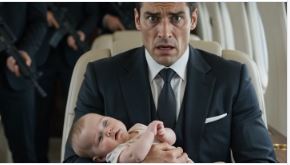
Sokolov’s hand disappeared beneath his coat just as Matteo finished reading the toxicologist’s warning.
I did not think about courage.
I thought about the baby breathing against my chest.
I turned my body sideways, shielding her head with my hand.
Matteo moved with terrifying speed.
He caught Sokolov’s wrist before the weapon cleared his jacket and drove him into the cabin wall.
The jet shuddered as the other two guards surged from their seats.
One restrained Sokolov.
The other shut the divider between the front cabin and the terrified flight attendant.
No shot was fired.
That somehow made the silence afterward worse.
Sokolov’s face was pressed against the polished wood panel.
His voice remained calm.
“The woman poisoned the child.”
Matteo looked at me.
I had seen suspicion enter the eyes of frightened parents before.
Fear needed somewhere to go.
Sometimes it became accusation because blame felt easier than helplessness.
Sokolov continued.
“She approached without being asked.
She knew exactly what to do.
Now she claims the bottle is contaminated.
Search her bag.”
The baby stirred, and I felt Matteo’s attention split between his daughter and the man he had trusted to protect her.
“Open it,” he told me.
I set my medical bag on the seat and unzipped it with one hand.
The bottle was gone.
Matteo’s expression hardened.
Sokolov smiled against the wall.
“There.
She destroyed the evidence.”
I looked directly at him.
“No.
You tried to steal it when you grabbed my bag.”
“You have no proof.”
“I have the bottle.”
I reached into the diaper case beside Matteo’s seat and lifted it out.
Sokolov’s smile vanished.
I had moved it after noticing his fingers linger near the zipper.
The medical bag had become a decoy the moment he touched it.
Matteo took the bottle from me carefully, as though it contained something explosive.
“It needs to remain sealed,” I said.
“The cap, nipple, formula, and container all need to be tested.
No one wipes it.
No one pours it out.
No one touches it without gloves.”
One of the guards produced a clean evidence pouch from an emergency kit.
Matteo placed the bottle inside.
Sokolov laughed once.
“You are taking laboratory orders from a grieving stranger?”
The insult struck exactly where he intended.
My husband and sons had been dead for ninety-two days.
I still counted because grief turned time into numbers when feelings became too large to hold.
But grief had not erased my training.
“I spent eight years keeping newborns alive,” I said.
“You spent the last six hours watching one starve.”
The flight attendant made a sound that was almost a gasp.
Sokolov stopped laughing.
Matteo’s phone rang.
The toxicologist had called through the jet’s secure connection after receiving my upload.
I put the call on speaker.
Dr.
Miriam Hale did not waste time with greetings.
She explained that the residue visible around the bottle cap was inconsistent with ordinary formula preparation.
The baby’s mouth irritation, refusal to drink, weakening cry, and unusual exhaustion suggested exposure to a bitter toxic compound.
She could not identify it from a photograph, but she was certain of one thing.
The baby needed emergency evaluation as soon as we landed.
“She may appear calmer because she has finally eaten,” Miriam warned.
“That does not mean she is
Monitor her breathing.
If she becomes difficult to wake, tell the pilot to declare a medical emergency.”
Matteo knelt beside me.
His daughter looked impossibly small against my body.
“What do you need?” he asked.
It was the first question he had asked instead of issuing an order.
“A hospital waiting on the runway.
A pediatric team.
Police or an independent security officer to receive the bottle.”
At the word police, both loyal guards looked toward Matteo.
His world did not invite uniforms into its problems.
I saw the refusal forming in his face.
“If you hide this,” I said, “the person who did it gets another chance.
Evidence disappears.
Witnesses change their stories.
Your daughter becomes a rumor instead of a patient.”
Sokolov twisted against the guard restraining him.
“She is manipulating you.”
Matteo never looked away from me.
Then he called the pilot.
“Declare the emergency,” he said.
“Have an ambulance and airport police meet us.”
Sokolov’s confidence cracked.
Only slightly, but I saw it.
The flight attendant saw it too.
Her name was Alina.
Her hands were shaking so badly that she had to grip the galley counter.
“There’s a camera,” she whispered.
Matteo turned.
She pointed to a small security monitor installed above the beverage cabinet.
The camera covered the galley preparation area and had been added after supplies disappeared on a previous flight.
Sokolov’s voice sharpened.
“The system was disabled.”
Alina stared at him.
That sentence betrayed more than he realized.
“You told me it was disabled,” she said.
“You made me turn off the cabin display, but the recorder runs separately.”
Matteo’s second guard retrieved the storage unit.
The footage showed Alina preparing the bottle before takeoff from a sealed container Sokolov had delivered.
She stepped away to answer a call from the cockpit.
Sokolov entered the galley alone.
For twenty-three seconds, his back blocked the counter.
Then he slipped something into his pocket and replaced the cap on the formula container.
The video did not show what he added.
It did show him wiping the rim.
Sokolov watched himself on the monitor without speaking.
Matteo’s face became still in a way that frightened everyone in the cabin.
“Why?” he asked.
Sokolov lifted his chin.
“That proves nothing.”
“It proves you lied about the camera.”
“It proves I checked a container.”
“It proves you touched my daughter’s food and concealed it.”
The jet began descending.
The change in pressure made the baby fuss.
I shifted her upright and watched her chest.
Her breaths remained steady but shallow.
Matteo hovered close enough to catch her if my arms failed.
I could feel his need to take control of the situation by force.
That was how men like him survived.
But force could not identify a chemical.
It could not preserve a chain of custody.
It could not make a frightened witness speak truthfully.
“Do not threaten him,” I said quietly.
Matteo’s gaze snapped toward me.
“Not yet.
Let him keep talking.”
Sokolov smiled.
“You see? She gives you orders now.”
“No,” Matteo said.
“She is keeping my daughter alive.”
The words silenced the cabin.
When the landing gear lowered, Sokolov changed tactics.
He claimed the formula container had arrived unsealed.
He accused Alina of contaminating it.
Then he suggested the baby’s regular physician had
altered her feeding schedule to make Matteo vulnerable during travel.
Each accusation contradicted the last.
Alina began crying.
“He threatened my brother,” she said.
Sokolov went rigid.
Matteo crouched near her, though he kept several feet between them.
“Tell me exactly what happened.”
Alina explained that Sokolov had ordered her to serve only the formula he supplied.
When she asked why the baby’s usual refrigerated milk had been removed from the jet, he showed her a photograph of her younger brother leaving work.
“He said following instructions would keep everyone safe.”
“Why didn’t you tell me?” Matteo asked.
Her laugh was broken and frightened.
“Because people who tell you bad news disappear.”
No one defended him.
Matteo absorbed the sentence without anger.
That was the first moment I understood that Sokolov’s betrayal had grown inside a larger system Matteo himself had created.
Fear had made obedience look like loyalty.
It had also made honest warnings impossible.
The jet touched down hard.
Through the window, I saw an ambulance, two airport police vehicles, and a black medical transport waiting near the hangar.
Sokolov suddenly threw his weight backward.
The guard holding him stumbled.
Sokolov broke free and lunged toward the diaper case.
He was not reaching for a weapon.
He was reaching for the bottle.
I kicked the case beneath the seat and turned away with the baby.
Matteo caught Sokolov around the shoulders.
The two loyal guards pinned him to the carpet before he reached the evidence pouch.
This time, Sokolov’s control disappeared.
“You have no idea what happens if that bottle reaches a laboratory!” he shouted.
Matteo looked down at him.
“Then tell me.”
Sokolov said nothing.
The cabin door opened.
Paramedics entered first.
I gave them the baby’s feeding history, symptoms, approximate intake, and the toxicologist’s warning.
They transferred her into a warmed pediatric carrier while allowing me to remain beside her because she became distressed whenever I stepped away.
Matteo followed us down the stairs.
An airport investigator received the sealed bottle, recorded each transfer, and placed it in a locked transport container.
Alina handed over the camera storage unit.
The guards surrendered Sokolov’s weapon and stepped back.
For the first time since the crying began, Matteo was not the most powerful person in the room.
He hated it.
He accepted it anyway.
At the hospital, the baby was taken into a pediatric emergency suite.
Her name, I finally learned, was Sofia.
The doctors found early signs of exposure but no respiratory collapse.
Her refusal to drink the contaminated formula had limited the amount she swallowed.
Hunger had weakened her, but it had also kept her alive.
My milk had stabilized her blood sugar and bought the medical team time.
I sat outside the treatment room in a borrowed scrub top while Matteo paced the corridor.
He had made three calls.
On the first, he ordered every container of Sofia’s formula secured.
On the second, he placed Alina’s brother under protection.
On the third, he told one of his attorneys to cooperate with the airport investigators without destroying or withholding anything.
That last instruction seemed to cost him the most.
He stopped in front of me.
“You knew the bottle might be evidence before anyone else did.”
“I knew a hungry baby was refusing it.”
“You hid
it from Sokolov.”
“I watched him touch my bag.”
“You sent the photograph without permission.”
“I did not need your permission.”
His jaw tightened.
Then he surprised me.
“No,” he said.
“You didn’t.”
The laboratory results arrived two hours later.
The formula contained a fast-acting sedative compound not approved for infants.
In a concentrated dose, it could suppress breathing and produce a death that might initially resemble an unexplained medical crisis.
Investigators found traces of the same compound inside a vial hidden in Sokolov’s jacket lining.
His fingerprints were on the vial.
The batch number on the formula container matched supplies purchased by one of his shell companies three days earlier.
The evidence did not reveal his full motive immediately.
His phone did.
Encrypted messages showed that Sokolov had been communicating with Matteo’s uncle, Konstantin Volkov, who controlled several businesses that would pass to Sofia’s trust if Matteo died or became legally incapacitated.
Sofia’s death would have triggered a private succession fight and weakened Matteo’s position.
Sokolov had expected the baby to become sleepy during the flight, stop breathing in the air, and leave no independent witness who understood neonatal distress.
He had not expected Sofia to reject the bitter formula.
He had not expected me.
When confronted with the messages, Sokolov tried to bargain.
He offered names, accounts, and recordings in exchange for protection.
Matteo stood behind the observation window while investigators led his former security chief away.
Sokolov turned once and said, “You trusted me for twelve years.”
Matteo’s answer was quiet.
“I trusted your fear of me.
I mistook it for loyalty.”
Sokolov was charged with attempted murder, poisoning, witness intimidation, and conspiracy.
Alina entered protective custody with her brother and agreed to testify.
Konstantin was arrested several weeks later after financial records and recovered messages connected him to the plan.
Matteo could have handled the betrayal privately.
Instead, he allowed the evidence to remain in public hands.
Not because he had suddenly become innocent.
Because I had forced him to understand that secrecy had nearly killed his daughter.
Sofia stayed in the hospital for three days.
During the first night, she refused every bottle offered by the nurses.
The pediatrician suggested donor milk through a different feeding system, but Sofia became frantic whenever unfamiliar hands held her.
Matteo found me near the elevator with my coat folded over my arm.
“She needs you,” he said.
“I saved her.
That does not mean you own me.”
His eyes lowered briefly.
“I know.”
“You locked the door.”
“I believed anyone outside my control was a threat.”
“You threatened the person helping your child.”
“Yes.”
There was no excuse in his voice.
Only admission.
“I should not have said you were not going home,” he continued.
“I should have told you that the bottle might make you a target.
I should have asked you to stay.”
I looked through the glass at Sofia sleeping beneath a pale blanket.
My body ached with milk meant for sons I would never hold again.
Helping Sofia did not replace them.
Nothing could.
But grief did not make what I had left worthless.
“I will stay tonight,” I said.
“After that, the hospital creates a feeding plan.
A licensed nurse is present.
No armed men in the room.
No locked doors.
No orders.”
