My father noticed my face before he noticed the cake.
That was the first thing I remembered afterward.
Not the music.
Not the champagne.
Not the gold balloons floating beneath the chandeliers.
Not the enormous white cake that had taken a pastry chef two days to decorate.
He saw the bruise.
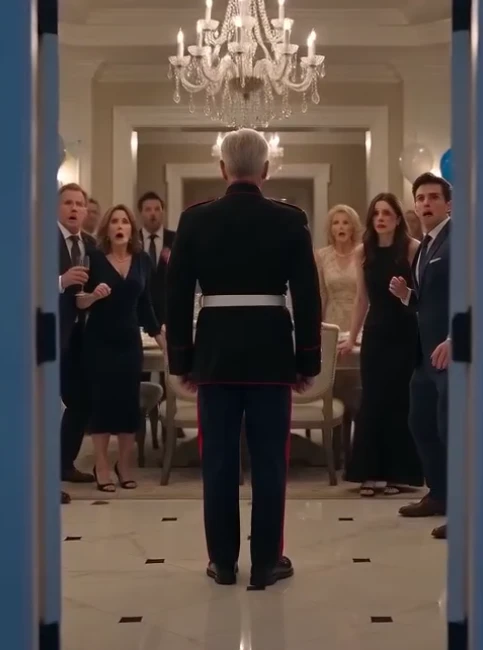
The ballroom in the Bennett mansion was full of people pretending to enjoy themselves when my father walked through the doors.
There were thirty-two guests, most of them people my husband’s family knew through business, charity boards, country clubs, or the private school where our children were expected to go one day.
A jazz trio played beside the marble staircase.
Waiters moved quietly between tables with trays of champagne.
My mother-in-law, Celeste Bennett, had chosen the flowers, the music, the menu, and even the dress she thought I should wear.
It was supposed to be my thirty-sixth birthday party.
But in the Bennett family, even my birthday belonged to someone else.
I wore a black sleeveless dress because Celeste had said red looked desperate on women over thirty-five.
There was concealer beneath my left eye.
Foundation along my jaw.
A little powder over my cheek.
I had stood in the bathroom for nearly forty minutes trying to hide what Lucas had done the previous night.
I managed to cover most of it.
Not all.
The swelling remained.
So did the thin purple shadow near my eye.
Most people had politely ignored it.
My father did not.
Colonel Thomas Reid had been retired from the Marines for six years, but people still called him Colonel even when he asked them not to.
He was sixty-five.
His hair, once almost black, had become silver.
His shoulders were still straight.
That night, he wore his Marine dress uniform because Celeste had specifically asked him to.
She liked photographs.
She liked having interesting people standing in her house.
A retired colonel with medals looked impressive beside the grand staircase.
My father hated being used as decoration.
But he wore the uniform for me.
He had driven almost four hours to attend.
He entered alone.
For years, that had been normal.
My mother had been dead since I was twenty-two.
At least, that was what I believed.
My father saw me from across the ballroom.
He smiled.
Then the smile vanished.
His eyes stopped on my left cheek.
He came toward me.
I immediately wanted to turn away.
That reaction embarrassed me more than the bruise itself.
I was thirty-six years old.
And suddenly I felt fourteen again, caught doing something I knew my father would notice.
“Mia.”
He stopped in front of me.
“Hi, Dad.”
He did not hug me.
Not yet.
His attention remained on my face.
“What happened?”
“Nothing.”
His jaw tightened.
He had taught me years earlier that “nothing” was one of the most suspicious words in the English language.
“Mia.”
“I bumped into the bathroom cabinet.”
I hated how easily the lie came out.
For almost four years, I had become very good at lying about injuries.
A door.
A cupboard.
A fall.
A clumsy step.
A headache.
A bad night of sleep.
My father looked directly into my eyes.
Then his gaze moved toward Lucas.
My husband was sitting at the main table with his mother and several business associates.
Lucas Bennett was thirty-nine.
Tall.
Fit.
Always perfectly dressed.
He wore a navy suit and a pale gray tie.
His dark hair was brushed neatly back.
He looked like the sort of man strangers trusted quickly.
That had been one of the reasons I fell in love with him.
Lucas lifted his champagne glass when he noticed my father looking at him.
He smiled.
My father looked back at me.
“Did he do that?”
I opened my mouth.
No words came.
Lucas answered for me.
He laughed softly from across the table.
“I did.”
Several nearby conversations stopped.
My father turned.
Lucas leaned back in his chair.
His mother glanced at him, but she did not look alarmed.
She looked entertained.
Lucas lifted the glass slightly higher.
“Consider it an early birthday gift.”
Someone near the piano gave an awkward laugh and immediately stopped.
My father stood very still.
“What did you say?”
Lucas smiled.
“I slapped her.”
My throat closed.
“Lucas.”
He ignored me.
“She was being difficult last night.”
Celeste gave a little sigh.
“Thomas, please don’t make this dramatic.”
My father looked at her.
Celeste took a sip of champagne.
“She probably pushed him too far.”
The sentence was spoken casually.
As if they were discussing a parking ticket.
My father looked around the ballroom.
People avoided his eyes.
Some stared at their glasses.
One woman suddenly became interested in the flowers.
A man beside the fireplace checked his phone.
That was the moment I understood something I should have understood years earlier.
Witnesses did not always protect you.
Sometimes they simply made your humiliation public.
A room could be full of people and still feel like a locked room if everyone agreed that what happened to you was none of their business.
My father took two steps toward Lucas.
“Dad.”
He did not stop.
Lucas laughed again.
“What are you going to do?”
My father still said nothing.
He walked past me toward the birthday table.
For one strange second, I thought he was leaving.
Then he put both hands beneath the cake.
The cake was enormous.
Three layers.
White icing.
Gold decoration.
Thirty-six small candles around the top.
My father lifted the entire thing.
Everyone stared.
Lucas finally stopped smiling.
“What the hell are you doing?”
Dad turned and drove the cake straight into Lucas’s face.
The sound was soft and ridiculous.
A wet thump.
White frosting exploded across his hair, his tie, his shoulders, and the front of his suit.
Candles bounced across the marble floor.
Someone screamed.
A waiter dropped a tray.
Champagne glasses shattered.
Lucas stumbled backward.
For half a second, there was complete silence.
Then Lucas roared.
“You son of a—”
He lunged.
His right fist came up.
My father shifted half a step.
That was all.
Lucas never finished the punch.
Dad drove one fist into his stomach.
Not his face.
Not his throat.
His stomach.
Lucas folded forward.
Air left him in a choking grunt.
His knees hit the floor.
Then he rolled onto one side, gasping.
The jazz trio stopped in the middle of a song.
My father looked down at him.
He did not look angry.
That was what frightened everyone.
He looked calm.
Then he removed his watch.
A simple old stainless-steel watch he had worn since I was a teenager.
He placed it carefully on the dining table.
“Mia.”
I stared at him.
“Outside.”
“What?”
“Patio. Now.”
“Dad—”
“Please.”
Something in his voice made me obey.
I walked toward the patio doors.
Behind me, Celeste began shouting.
“You attacked my son!”
My father did not answer.
“You are finished, Thomas! Do you hear me?”
I pushed open the glass doors.
Cool October air hit my face.
For the first time all evening, I could breathe.
The patio overlooked the formal garden.
Beyond it were trees, a stone fountain, and the long driveway leading toward the front gates.
I wrapped my arms around myself.
Then something moved behind the kitchen window.
Celeste.
Her face had changed.
She was no longer furious.
She was frightened.
She looked toward the front hall.
Then toward my father.
Then toward the kitchen.
She started walking backward.
Lucas struggled onto one elbow.
“What’s happening?” he demanded.
Celeste ignored him.
She reached the rear doorway.
My father said something I could not hear through the glass.
Celeste stopped.
Then she did something I had never seen her do in the ten years I had known her.
She dropped to her knees.
Not because she was hurt.
Because she was terrified.
She crawled toward the kitchen door.
“No.”
I could barely hear her through the glass.
“No, please.”
Guests began turning toward the front entrance.
Lucas wiped frosting from his eyes.
“Mom?”
The mansion’s front doors were secured by three heavy locks.
I heard them opening.
One.
Then another.
Then the final bolt.
The doors swung inward.
Three men in dark suits entered first.
I did not recognize them.
Behind them came Detective Rachel Sloan.
I knew Rachel.
I had met her eight days earlier.
But Lucas did not know that.
Neither did Celeste.
Rachel carried a folder beneath one arm.
Behind her walked a woman wearing blue medical scrubs and carrying a clear evidence case.
Then another figure stepped through the doorway.
My heart stopped.
I knew her before my mind accepted it.
The shape of her face.
The way she held her shoulders.
The pale blue eyes.
The slight tilt of her head.
She was older.
Her hair was silver instead of dark brown.
She walked with a cane.
A thick scar ran from below her left ear to the base of her throat.
But I knew her.
My mother.
Elena Reid.
The woman whose funeral I had attended fourteen years earlier.
The woman whose photograph still sat on my bedside table.
The woman whose ashes I had believed were buried beside my grandmother.
She stood inside my husband’s house.
Alive.
Lucas stopped moving.
The remaining frosting slowly slid from his cheek.
Celeste made a sound that did not resemble a word.
My mother looked at her.
Celeste whispered, “You were supposed to be dead.”
My knees nearly gave way.
My mother’s eyes moved past her.
Through the kitchen window.
Toward me.
She saw the bruise.
Her mouth opened.
For several seconds, she simply stared.
Then she whispered my name.
“Mia.”
I stepped backward.
“No.”
She began walking toward the patio.
I shook my head.
“No.”
She stopped.
My father came outside.
I turned on him.
“You knew.”
He said nothing.
“You knew she was alive.”
“Mia—”
“How long?”
My voice broke.
“How long have you known?”
He took a slow breath.
“Three weeks.”
My chest hurt.
“Three weeks?”
“I was going to tell you.”
“When?”
“Tonight.”
I laughed.
It sounded almost hysterical.
“At my birthday party?”
“No.”
My mother remained inside the kitchen.
She looked like she wanted to come toward me and was forcing herself not to.
I pointed at her.
“I buried her.”
Dad’s face tightened.
“I know.”
“I stood next to you at the funeral.”
“I know.”
“I cried for months.”
“I know.”
“You let me believe she was dead.”
“I believed it too.”
That stopped me.
“What?”
My father looked toward her.
“Until three weeks ago.”
Inside, Detective Sloan ordered everyone to remain where they were.
One of the men in suits moved toward Lucas.
I saw him try to stand.
“What is this?” Lucas demanded.
Rachel held up the folder.
“Search warrant.”
“For what?”
“Financial records, medical records, electronic devices, and evidence connected to multiple offenses currently under investigation.”
Celeste suddenly stood.
“You cannot search my home.”
Rachel looked at her.
“The warrant says otherwise.”
“This is private property.”
“Then you can discuss it with your attorney.”
My mother remained still.
Lucas looked at her.
His face had lost all color.
“Who is she?”
Nobody answered.
He looked at Celeste.
“Mom.”
Celeste closed her eyes.
My father turned back to me.
“We need to leave them to work.”
“No.”
“Mia.”
“No.”
I pointed at my mother.
“I want to know why my dead mother is standing in my kitchen.”
Elena finally spoke.
“Because fourteen years ago, somebody tried very hard to make sure I never came home.”
I stared at her.
Celeste shouted from inside.
“She’s lying!”
Detective Sloan turned.
“Mrs. Bennett, I strongly suggest you stop speaking.”
Lucas looked between them.
“What does she mean?”
My mother looked at him.
“Ask your mother.”
That was where the evening truly began.
Everything before that—the decorations, the cake, Lucas admitting he hit me—felt almost small compared with what came next.
Detective Sloan asked me to sit in the library while investigators searched the house.
My father came with me.
My mother remained outside the room.
I refused to let her enter.
At first.
I sat on the leather sofa shaking so badly that I had to hold my hands between my knees.
Dad stood near the fireplace.
Neither of us spoke.
Then I looked at him.
“Start.”
“Mia—”
“No.”
He nodded.
Fourteen years earlier, my mother worked as a forensic accountant.
I knew that.
She audited hospitals, insurance companies, medical suppliers, and charitable organizations.
When I was a teenager, I thought her job involved spreadsheets and boring meetings.
I never understood that some of the people she investigated were dangerous.
Six months before she disappeared, she had been working on the finances of a regional medical equipment network.
Several companies were billing insurers for equipment that was never delivered.
Wheelchairs.
Oxygen machines.
Home-care devices.
The fraud involved millions of dollars.
One of the companies supplying those devices was partly owned by my future father-in-law.
Gordon Bennett.
Lucas’s father.
Gordon died nine years before my birthday.
I had met him only twice.
By the time Lucas and I started dating seriously, Gordon was already very ill.
According to my father, my mother discovered that the billing fraud was only one part of the problem.
Money was being moved through shell companies.
Several people were being paid to falsify patient records.
A local health administrator had been bribed.
And someone inside the investigation was leaking information.
My mother became frightened.
She told my father she thought someone had entered her office.
Then her car was followed twice.
Dad wanted her to stop working.
She refused.
“What happened the night she died?” I asked.
Dad looked exhausted.
“She left work late.”
I remembered that night.
I had been twenty-two and living in another city after college.
My father called at three in the morning.
My mother’s car had gone through a guardrail near an old quarry road.
The vehicle burned.
A body was found inside.
Dental identification was used.
The funeral happened six days later.
I had never seen the body.
Dad had told me the damage was too severe.
“What was in the car?”
“A woman.”
I stared at him.
“What woman?”
“We still don’t know.”
My stomach turned.
“You buried someone else.”
“Yes.”
“Whose family thinks she disappeared?”
“Possibly.”
I covered my mouth.
Dad continued carefully.
My mother had not been inside the car when it went over the guardrail.
Someone had attacked her in a parking garage before she left work.
Her throat was cut.
Not deeply enough to kill her immediately.
She was placed in another vehicle.
What happened next remained unclear.
She escaped or was left somewhere outside the city.
A delivery driver found her unconscious near an industrial access road nearly twenty miles away.
She had no identification.
Her face was swollen.
She could not speak because of the injury to her throat.
She had suffered a head injury.
At the hospital, she gave a false name.
“Why?” I asked.
Dad looked toward the closed library door.
“She remembered enough to know she was in danger.”
“And not enough to remember us?”
“She remembered us.”
That hurt worse.
I stood.
“She remembered me?”
“Yes.”
“And she stayed away?”
“Mia.”
“No. Don’t protect her. Did she remember me?”
“Yes.”
I turned toward the door.
“Get her.”
My father hesitated.
“Get her.”
He opened the door.
My mother was sitting in the hallway.
She stood slowly when she saw me.
I had imagined that if I ever saw my mother again after death, I would run to her.
Instead, I stepped backward.
She entered.
Dad closed the door.
My mother looked smaller than I remembered.
She had always been slim, but now she seemed fragile.
Her cane tapped softly against the floor.
I stared at the scar on her throat.
“Why?”
She lowered herself into a chair.
Her voice was rough and slightly breathless.
The injury had permanently changed it.
“I thought I was protecting you.”
“Fourteen years?”
Her eyes filled.
“The first months were different.”
“What does that mean?”
She explained.
At the hospital, she told police she believed someone was trying to kill her.
An investigator contacted the federal task force handling the fraud case.
They quickly realized her supposed death had already been reported.
That changed everything.
Whoever attacked her believed she was dead.
Investigators wanted to keep it that way.
At first, the plan was temporary.
Several weeks.
Maybe months.
They moved her under protection.
She testified secretly before a grand jury.
Several arrests followed.
But the leak inside the investigation was never identified.
One witness disappeared.
Another recanted.
The larger case collapsed.
My mother was told that returning publicly could put both her and our family at risk.
“So you chose them,” I said.
She looked confused.
“The investigators.”
“No. You chose their fear over us.”
Her face crumpled.
“Mia, I was terrified.”
“So was I.”
“I know.”
“No, you don’t.”
I stood.
“You know what Dad told me at your funeral?”
She closed her eyes.
“He said you loved yellow roses.”
“I did.”
“I put one on your coffin.”
My voice broke.
“I talked to you.”
My father looked away.
“I told a coffin that I was sorry I hadn’t answered your last phone call.”
My mother began crying.
“I know.”
“How would you know?”
“Thomas told me recently.”
I laughed bitterly.
“Recently.”
She reached toward me.
I stepped back.
She dropped her hand.
“For years, I told myself I would come back when it was safe.”
“But it never became safe.”
“No.”
“And then?”
She looked down.
“Then time became another kind of fear.”
I understood what she meant even though I hated it.
After a year, coming home would require explaining a year.
After five years, it required explaining five.
After ten, how could she knock on the door and say she had been alive the entire time?
Still, understanding was not forgiveness.
“What changed three weeks ago?”
My mother looked at my father.
Dad answered.
“A photograph.”
One of my birthday photographs.
It had been posted online by Celeste after a charity event.
My mother had maintained occasional secret contact with a retired federal agent from the old case.
He still followed the Bennett family because he believed some of Gordon Bennett’s money had never been accounted for.
He saw the photograph.
Me standing beside Lucas.
My mother recognized me instantly.
She also recognized Celeste.
“She knew Celeste?” I asked.
Mother nodded.
“Celeste worked for Gordon.”
“His wife worked for him?”
“Before they married.”
My mother took a breath.
“She controlled several of the accounts I was investigating.”
I stared toward the ballroom.
The woman who had spent ten years telling me how to dress, how to speak, how to host dinner, and how grateful I should be to marry her son had known my mother before I ever met Lucas.
“Did she know who I was when Lucas brought me home?”
My mother nodded slowly.
I felt sick.
“That’s impossible.”
Dad said, “We think she did.”
“She never said anything.”
“Why would she?”
I turned toward him.
“Because my mother supposedly died investigating her husband.”
“That may be exactly why she said nothing.”
I sank onto the sofa.
Images from the past ten years moved through my mind.
The first dinner with Celeste.
The way she had stared at me for several seconds before smiling.
Her questions about my parents.
Her surprise when I said my mother died young.
The way she immediately changed the subject.
I had thought she was being polite.
Now every memory felt contaminated.
“Did Lucas know?”
My mother answered carefully.
“We don’t know.”
I laughed without humor.
“Everyone keeps saying that.”
“Mia—”
“Did you know he hit me?”
Dad looked at me sharply.
My mother’s face changed.
I regretted the question immediately.
Not because I wanted to protect Lucas.
Because I saw what it did to her.
“No,” she whispered.
My father looked at my arms.
Then my shoulders.
As if suddenly searching for more injuries.
“How long?” he asked.
I looked away.
“Mia.”
“Four years.”
My mother made a small sound.
Dad closed his eyes.
I continued before either could speak.
“It wasn’t always.”
I hated myself for saying that.
It sounded like the beginning of an excuse.
“The first time he shoved me. Then nothing happened for months.”
Dad sat opposite me.
“Why didn’t you tell me?”
“Because you hated him.”
“I didn’t hate him.”
“You didn’t trust him.”
“That is different.”
“Not to me.”
My father had never liked Lucas.
He thought Lucas was too controlling.
Too interested in appearances.
Too quick to answer questions for me.
I had accused Dad of judging him unfairly because of wealth.
After a few years, my pride became another wall keeping me silent.
Telling Dad meant admitting he had been right.
“So you stayed,” my mother said softly.
I looked at her.
Something about that sentence made me angry.
“You don’t get to judge that.”
“I’m not.”
“You disappeared for fourteen years.”
“I know.”
“You don’t get to ask why I stayed with someone I was afraid to leave.”
Her eyes filled again.
“No,” she said. “I suppose I don’t.”
A knock came at the door.
Detective Sloan entered.
“Mia, I need to ask you some questions about your husband.”
My father stood.
“Is he under arrest?”
“Not yet.”
“What did you find?”
Rachel looked at me.
“May I?”
I nodded.
She closed the door.
“The warrant concerns financial fraud connected to the original medical equipment investigation and several newer shell companies.”
“Lucas is involved?”
“We have reason to believe accounts controlled by him received money.”
“How much?”
“We don’t know the total yet.”
I almost laughed.
Lucas had spent three years questioning every purchase I made.
A new handbag.
A weekend with friends.
A donation to an animal shelter.
Once, he argued with me for twenty minutes because I spent two hundred dollars repainting my home office.
Apparently, he had been moving millions.
Rachel continued.
“There’s something else.”
I waited.
“Your medical records.”
My stomach tightened.
“What about them?”
“We obtained records from two clinics connected to a physician employed by Bennett Health Services.”
“That was Gordon’s company.”
“Yes.”
“Why do you need my records?”
“Because your husband contacted one of those clinics six times in the past year.”
I stared at her.
“I’ve never been there.”
“We know.”
Rachel opened the folder.
“There are records under your name.”
My hands became cold.
“What records?”
“Psychiatric treatment.”
I laughed.
“I’ve never had psychiatric treatment.”
“I know.”
“Then why—”
My mother looked at Rachel.
She understood first.
Rachel nodded.
“The records describe paranoia, alcohol abuse, impulsive behavior, and episodes of self-harm.”
My father stood so quickly his chair moved backward.
“What?”
I could not breathe.
Rachel remained calm.
“They appear to be fabricated.”
“Why would Lucas do that?”
The answer came from my mother.
“If you died.”
Everyone looked at her.
She swallowed.
“If Mia died under suspicious circumstances, a medical history could make suicide or accidental overdose easier to believe.”
The room seemed to tilt.
“No.”
I shook my head.
“No.”
Lucas hit me.
Lucas controlled money.
Lucas humiliated me.
But murder?
“No.”
I stood.
“You’re wrong.”
Rachel did not argue.
“I may be.”
“He loses his temper.”
“I understand.”
“He’s cruel sometimes.”
“Mia—”
“He is not trying to kill me.”
My mother looked at my bruise.
I immediately hated the contradiction written across my own face.
“I need air.”
I walked outside again.
This time, Dad followed but stayed several feet away.
Through the windows, investigators moved through the mansion.
Guests had been asked to leave.
Several were giving statements first.
Lucas sat near the dining table with a lawyer who had apparently arrived while we were in the library.
Celeste was nowhere visible.
“She knew,” I said.
Dad did not ask what I meant.
“Celeste knew who I was.”
“Yes.”
“She let me marry her son.”
“Yes.”
“Why?”
“We don’t know.”
I turned.
“What do you think?”
Dad hesitated.
“I think your last name scared her.”
“Reid?”
“Your mother’s name was Reid when she investigated them.”
“So?”
“Imagine spending years believing a woman who nearly exposed your family was dead. Then her daughter walks into your house dating your son.”
I stared through the glass.
“She wanted to watch me.”
“Possibly.”
“Or control me.”
“Possibly.”
I remembered Celeste insisting we live near her.
Insisting Lucas manage our finances.
Encouraging me to stop working after our wedding.
She had failed at that one.
I kept my interior design business, though Lucas constantly complained that it took too much time.
Then I remembered something.
“My storage unit.”
Dad frowned.
“What?”
“I have Mom’s old files.”
My mother came outside.
“What files?”
I stared at her.
“Your things.”
After her supposed death, Dad could not bear to sort through her office.
Years later, he gave several boxes to me.
I stored them in a climate-controlled unit with family photographs and old furniture.
“Do you still have them?” Mother asked.
“Yes.”
Her face changed.
“What?”
“There was a blue ledger.”
“A notebook?”
“Leather.”
“I remember something like that.”
My mother gripped her cane.
“I thought it was lost.”
“What was in it?”
“Handwritten account numbers. Names. Transactions. I kept it outside the official files because I believed someone was accessing my computer.”
Dad immediately called Detective Sloan.
Within an hour, officers were heading to the storage unit.
Lucas’s lawyer objected to nearly everything.
By midnight, the mansion was still full of investigators.
I did not stay.
Dad drove me to a hotel.
My mother came separately.
I asked for my own room.
Nobody argued.
I sat on the edge of the hotel bed wearing the same black birthday dress.
I had no pajamas.
No toothbrush.
No makeup remover.
My cheek still hurt.
At one in the morning, there was a soft knock.
Dad stood outside holding a pharmacy bag.
“Toothbrush.”
I almost smiled.
“You went shopping?”
“Don’t make a big deal out of it.”
“What else?”
“Toothpaste. Face wash. Some thing the woman said removes makeup.”
He handed me the bag.
“Thank you.”
He remained in the hall.
I knew what he wanted to ask.
“Dad.”
“Yes?”
“I’m sorry.”
His face tightened.
“For what?”
“For not telling you about Lucas.”
“You don’t apologize for that.”
“I lied to you.”
“You were surviving something.”
“I should have called.”
“Yes.”
The answer surprised me.
He continued.
“I wish you had called. I wish you told me the first time. I wish I noticed sooner.”
His eyes filled.
“But I am not going to make your shame heavier because I wanted a different decision from you.”
That was my father.
Direct even when kindness would have been easier if softened.
“Is Mom staying here?”
“Yes.”
“Have you talked to her?”
“Some.”
“Are you angry?”
He looked down the hallway.
“I lost fourteen years too.”
That was the first moment I remembered he had been a husband before he became a widower.
I had been so consumed by losing my mother that I forgot he lost his wife.
Except she had not been dead.
In some ways, that was worse.
“Did she apologize?”
“Yes.”
“Do you believe her?”
“I believe she was afraid.”
“That isn’t the same as forgiving.”
“No.”
“Will you?”
“I don’t know.”
His honesty helped.
The next morning, Detective Sloan called at seven fifteen.
They had found the blue ledger.
It was exactly where I said it would be.
Inside were names, transaction references, and handwritten notes linking Gordon Bennett’s medical company to three shell corporations.
One of those corporations still existed.
Its current director was Lucas.
My husband.
The ledger did not prove Lucas had participated in the fraud fourteen years earlier.
He had been only twenty-five then.
But recent transactions showed he had inherited more than his father’s company.
He inherited the system.
For the next four days, my life became a series of interviews.
Police.
Federal investigators.
Attorneys.
Doctors.
My bank.
My business accountant.
Rachel helped me obtain an emergency protective order.
My father helped me collect clothes from the mansion.
My mother stayed mostly away unless I asked for her.
I did not know what to do with her.
Sometimes I wanted to stare at her for hours.
Sometimes I could not stand being in the same room.
On the third day, she asked if we could have coffee.
We sat in the hotel restaurant.
She put both hands around the cup.
“You look like my mother.”
The sentence irritated me.
“You don’t get to arrive after fourteen years and start telling me who I look like.”
“I know.”
“No, you keep saying that.”
She lowered her eyes.
“I don’t know what else to say.”
“Try the truth.”
She looked up.
“Which part?”
“Did you ever come back?”
Her face changed.
That was enough.
I leaned forward.
“You did.”
“Once.”
“When?”
“You were twenty-seven.”
I would have been married to Lucas for a year.
“Where?”
“Outside your house.”
My throat tightened.
“You saw me?”
“Yes.”
“Did I see you?”
“No.”
“Why didn’t you knock?”
“I saw Lucas.”
The answer surprised me.
“What does that mean?”
“I recognized him.”
“You knew Lucas?”
“I knew his face from Gordon’s family photographs.”
I stared.
“You saw that I married Gordon Bennett’s son and still left?”
She looked ashamed.
“I panicked.”
“You could have warned me.”
“Yes.”
“You could have called Dad.”
“Yes.”
“You could have called the police.”
“Yes.”
“But you left.”
“Yes.”
I stood.
“Mia—”
“I need to go.”
She did not follow.
That afternoon, I met with a divorce attorney.
Her name was Dana Morris.
She was fifty, practical, and unimpressed by rich families.
She asked me simple questions.
Did Lucas control money?
Yes.
Did he threaten me?
Yes.
Did he own weapons?
Yes.
Did he know where I was staying?
Probably.
Were there children?
No.
That was the only mercy.
Lucas and I had tried for years.
Eventually doctors told us pregnancy was unlikely.
Celeste blamed me.
Lucas said he did not.
But during arguments, he sometimes mentioned it.
“You can’t even give me a family.”
Then afterward, he apologized.
Always afterward.
Dana looked at my photographs.
Older bruises.
A damaged bedroom door.
A cracked bathroom mirror.
Messages Lucas had sent.
You make me crazy.
Stop pushing.
If you embarrass me again you’ll regret it.
She looked at me.
“You have more evidence than most people bring.”
“I kept it.”
“Why?”
I thought about that.
“Maybe some part of me knew I would need it.”
She nodded.
“Good.”
Two days later, Lucas was arrested.
Not for hitting me.
For financial crimes.
Investigators found encrypted files on a laptop in his office.
Payments.
Fake patient data.
Contracts.
And documents connected to my mother’s old case.
They also found a folder with my name.
Inside were copies of my medical records.
The fake psychiatric records.
A life insurance policy.
Five million dollars.
Lucas was the beneficiary.
When Rachel showed me, I stared at the paper for a long time.
“I signed insurance forms.”
She nodded.
“But not this amount.”
“No.”
“He told me it was one million.”
“The policy was increased eight months ago.”
My signature appeared at the bottom.
Forensic analysis later showed it had been digitally copied from another document.
My mother had been right.
Someone had been preparing a story about me.
Unstable.
Drinking.
Self-harm.
Then death.
Rachel was careful.
“We still do not have evidence he had a specific plan to kill you.”
“But you think he might have.”
“We have enough to be concerned.”
Lucas called from jail.
I did not answer.
He called again.
Then his lawyer contacted Dana.
Lucas wanted to speak.
Dana asked whether I wanted to hear him.
“No.”
A day later, I changed my mind.
Not because I missed him.
Because I wanted to know what he would say when excuses were no longer enough.
The call was recorded.
Lucas sounded tired.
“Mia.”
I did not answer.
“I know you’re angry.”
That sentence almost made me hang up.
“Angry?”
“I didn’t mean—”
“You hit me on my birthday.”
“I know.”
“You told my father about it like you were proud.”
“I had been drinking.”
“You had one glass of champagne.”
Silence.
He tried again.
“My mother has poisoned everything.”
I laughed.
“There it is.”
“What?”
“Your mother.”
“Mia, you don’t understand.”
“I understand more than you think.”
“My father left a mess.”
“And you continued it.”
“I was trying to keep the company alive.”
“With fake medical bills?”
“You think businesses like ours survive cleanly?”
“Yes.”
“That’s naive.”
I closed my eyes.
The arrogance remained.
Even from jail.
“What about the fake psychiatric records?”
He stopped.
“What records?”
“Don’t.”
“Mia—”
“What about my life insurance?”
“That was normal planning.”
“Five million dollars?”
“You’re my wife.”
“Was I?”
“What is that supposed to mean?”
I laughed softly.
“For ten years I thought being your wife meant something different.”
His voice changed.
“You’re letting your father turn you against me.”
“No.”
“Your mother appears from the dead and suddenly you believe everything they say?”
“That has nothing to do with what you did.”
“She abandoned you.”
That hurt because it was true.
Lucas heard my silence.
He pushed harder.
“She abandoned both of you. Your father lied. And now they walk back in acting like they’re heroes.”
“They are not heroes.”
He stopped.
I continued.
“My mother left me. My father kept things from me. I am angry at both of them.”
“Then come home.”
I almost smiled.
Lucas still did not understand.
“Why?”
“We can fix this.”
“No.”
“Mia.”
“You think because my parents failed me, I have to return to you.”
“That’s not what I said.”
“It’s what you believe.”
I felt surprisingly calm.
“But I can be angry at them and still leave you.”
He breathed heavily.
“You have no idea what happens if you testify.”
There it was.
Not apology.
Warning.
“What happens?”
“The company collapses.”
“Good.”
“Hundreds of people lose jobs.”
“Then maybe you should have thought about them before committing fraud.”
“My mother could go to prison.”
“That is between her and the law.”
“And me?”
I looked at the recorder light on the table.
“You should have thought about that before you put your hands on me.”
I ended the call.
The investigation lasted nearly a year.
The story reached newspapers because the Bennett family was wealthy and well known.
Reporters waited outside hearings.
People online invented details.
Some said my mother had secretly lived overseas with another man.
Some said my father had known the entire fourteen years.
Some claimed the birthday party had been staged by police.
None of that was true.
The truth was complicated enough.
Celeste Bennett was eventually charged with conspiracy, fraud, evidence tampering, and obstruction.
The strongest evidence came from old records and newly recovered emails.
One email from fourteen years earlier changed everything.
It had been sent by Celeste to a security contractor associated with Gordon.
The message contained only a few lines.
Elena has copies.
Gordon says tonight.
Make certain the road story holds.
The prosecution argued that “road story” referred to the staged car crash.
Celeste denied it.
Then investigators found payments to the same contractor two days after my mother’s disappearance.
He had died years earlier.
But bank records did not.
My mother’s attempted murder could not be proven beyond doubt because so much time had passed.
No one knew who physically attacked her.
Still, Celeste’s involvement in the cover-up became difficult to deny.
Lucas faced charges for newer fraud, forged records, insurance fraud, and conspiracy.
The fake psychiatric file became one of the most disturbing parts of the case.
One clinic employee admitted Lucas paid her to create portions of it.
He claimed he wanted documentation in case our divorce became “contentious.”
She insisted she never knew about the insurance policy.
Lucas claimed the records were intended only for divorce.
I never knew whether that was true.
I stopped needing to know.
That was an important change.
For years, I thought understanding Lucas would save me.
If I could understand why he became angry, I could avoid causing it.
If I understood why Celeste disliked me, I could make her accept me.
If I understood why Lucas hit me, maybe I could make him stop.
Eventually, I learned that explanations were not protection.
Sometimes knowing what someone did was enough.
My father faced consequences too.
Lucas initially tried to press charges over the birthday fight.
The video from the ballroom showed everything.
Lucas admitting he hit me.
My father smashing the cake.
Lucas throwing the first attempted punch.
My father responding.
The local prosecutor declined to pursue serious charges.
Dad received a citation related to the cake incident and paid for the damage.
He framed the receipt.
I told him that was childish.
He said retirement had given him time for hobbies.
My relationship with my mother was harder.
We did not become a family again overnight.
I hated when people expected that.
They wanted photographs.
Mother and daughter reunited after fourteen years.
A miracle.
A second chance.
It did not feel like a miracle every day.
Sometimes it felt like meeting a stranger who knew all my childhood memories.
She remembered my first day of school.
The name of my imaginary friend.
How I refused to eat tomatoes until I was twelve.
She remembered the yellow sweater I wore in third grade.
But she did not know the adult me.
She did not know I drank coffee without sugar.
She did not know I hated lilies because Celeste always filled the mansion with them.
She did not know about my first design award.
She did not know which side of the bed I slept on.
She did not know I had wanted a baby for years.
And I did not know her.
I knew my mother at forty-four.
Not the woman sitting across from me at fifty-eight.
We started slowly.
One lunch.
Then another.
Sometimes we talked about the case.
Mostly we did not.
One afternoon, she came to my apartment and helped me assemble a bookshelf.
She was terrible at it.
“You used to fix everything,” I said.
“I used to have two functioning knees.”
I laughed.
It surprised both of us.
She smiled.
Then I cried.
Not dramatically.
I simply sat on the floor with a screwdriver in my hand and tears running down my face.
She sat beside me.
“I missed you,” I said.
Her face broke.
“I missed you too.”
“I hate you for missing me.”
“I know.”
“I hate that you had a choice.”
“I know.”
“I needed you.”
She covered her mouth.
“I know.”
This time, when she reached for me, I let her.
I did not forgive fourteen years that afternoon.
But I held my mother.
That was enough.
My father struggled too.
He loved her.
That became obvious.
Even after fourteen years.
Even through anger.
They did not immediately become husband and wife again.
He had spent more than a decade believing himself widowed.
She had lived another life under another name.
They had to meet each other again.
Sometimes I watched them argue and felt strangely comforted.
Real people argued.
Ghosts did not.
The criminal cases ended almost two years after my birthday.
Lucas pleaded guilty before trial.
The evidence was too strong.
He admitted participating in fraudulent billing schemes, falsifying records, and forging documents.
He denied intending to hurt me beyond the physical abuse already documented.
The court sentenced him to eleven years.
Celeste went to trial.
My mother testified.
So did I.
The first time I walked into court and saw Celeste, she looked smaller.
Not weak.
Just human.
For ten years, she had seemed enormous in my life.
Her approval could ruin my week.
Her criticism could change what I wore.
Her anger could make me apologize for things I had not done.
Now she sat beside her attorney in an ordinary chair.
No ballroom.
No staff.
No family name controlling the room.
When I testified about the birthday party, her lawyer tried to suggest Lucas and I had a “volatile marriage.”
I looked at him.
“He hit me.”
“Were there arguments?”
“Yes.”
“Did you ever raise your voice?”
“Yes.”
“Did you ever insult your husband?”
“Probably.”
“Then both parties contributed to a difficult atmosphere.”
I stared at him.
“Did my raised voice cause his hand to hit my face?”
He paused.
“No.”
“Then those are separate things.”
The jury convicted Celeste on multiple financial and obstruction charges.
The evidence connected to my mother’s attempted killing was not strong enough for an attempted murder conviction.
That frustrated my father.
My mother was quieter about it.
“I survived,” she said.
“That doesn’t make it okay,” Dad replied.
“No.”
She looked at me.
“But sometimes the law can prove only part of the truth.”
Celeste received thirteen years.
After sentencing, reporters surrounded us outside.
Someone shouted, “Mia, do you forgive your husband?”
Another asked, “Elena, why did you stay away so long?”
A third shouted, “Colonel Reid, would you punch Lucas again?”
Dad looked at me.
I gave him a warning look.
He kept walking.
Later, he admitted the answer was yes.
I moved out of the Bennett mansion permanently.
I never wanted it.
The house had belonged to Lucas through a family trust.
After his conviction, parts of the Bennett estate were seized or sold.
I rented a townhouse near my studio.
It had three bedrooms even though I lived alone.
At first, friends asked why I needed so much space.
I did not know.
Maybe after years of feeling trapped inside a huge mansion, I wanted rooms that belonged completely to me.
I painted the kitchen green.
Lucas hated green kitchens.
That made me like it more.
I returned to my design business full time.
The first month was difficult.
People recognized my name.
Some clients were curious for the wrong reasons.
One woman spent half our consultation asking about my mother.
I refunded her deposit.
Slowly, normal work returned.
Paint colors.
Budgets.
Furniture deliveries.
Late contractors.
Ordinary problems.
I loved them.
A sofa arriving in the wrong fabric felt wonderful compared with federal investigators asking whether my husband planned my death.
On my thirty-eighth birthday, Dad asked what I wanted.
“No party.”
“Understood.”
“No ballroom.”
“Definitely.”
“No cake in anyone’s face.”
He looked disappointed.
We had dinner at my townhouse.
Dad cooked steaks outside.
Mom brought a salad.
I made the cake myself.
It leaned slightly to one side.
My father studied it.
“You paid someone for design school?”
“Interior design.”
“Still.”
Mom laughed.
The sound stopped me for a second.
I had forgotten her laugh.
Not the sound exactly.
The effect.
It used to make everyone else laugh too.
I looked at her.
She noticed.
“What?”
“Nothing.”
Dad brought the cake to the table.
Thirty-eight candles would have been ridiculous, so there were only three.
“Make a wish,” Mom said.
I closed my eyes.
When I was younger, wishes had been about getting things.
A job.
A marriage.
A child.
A bigger house.
That night, I could not think of anything I needed.
I already had something I had not understood the value of before.
Choice.
I could decide who entered my house.
Who stayed.
Who touched me.
Who spoke to me.
Who received my time.
Who received another chance.
I opened my eyes and blew out the candles.
Dad clapped.
Mom took a picture.
Nobody hit anyone.
Nobody controlled the music.
Nobody told me my dress was wrong.
Nobody laughed at bruises.
It was the best birthday I could remember.
Later that evening, after Dad left, Mom stayed to help wash dishes.
I handed her a plate.
She dried it.
After a while, she said, “There’s something I never told you.”
I looked at her.
“Should I sit down?”
She smiled sadly.
“No.”
“What?”
“The day I came back to the Bennett house.”
“My birthday.”
“Yes.”
“You knew Dad was going to confront Lucas?”
“No.”
I laughed.
“So the cake was genuinely his idea.”
“Very much so.”
“That sounds right.”
She put the plate down.
“I almost didn’t go inside.”
My smile faded.
“Why?”
“Because I saw you through the window.”
“With the bruise?”
She nodded.
“I thought I had failed you twice.”
I leaned against the counter.
“The first time by leaving.”
“Yes.”
“And the second?”
“By staying away long enough for you to believe that kind of life was something you had to endure alone.”
I looked down.
“That wasn’t your fault.”
“Some of it was.”
“Mom.”
“I’m not asking you to comfort me.”
That silenced me.
She continued.
“I made choices because I was afraid. Some protected you. Some hurt you. Both can be true.”
I thought about Lucas.
He had always wanted one story.
One explanation where he was the victim.
He hit me because I provoked him.
He lied because the business needed him.
He forged records because divorce frightened him.
Celeste committed fraud because she was protecting the family.
Everyone wanted their reason to erase their responsibility.
My mother did something different.
She allowed both truths to exist.
She was afraid.
And she abandoned me.
She had reasons.
And those reasons hurt me.
I loved her.
And I was still angry.
Maybe adulthood was learning that two things could be true without canceling each other.
“I don’t know if I’ll ever completely understand why you stayed away,” I said.
“I know.”
“I might always be angry.”
“I know.”
I smiled slightly.
“You really need another phrase.”
She smiled too.
“I’m working on it.”
I handed her another plate.
The next morning, I found an old photograph she had left on the counter.
It showed the three of us before everything changed.
Dad looked younger.
Mom had dark hair.
I was sixteen.
We were standing outside a roadside diner during a family trip.
I remembered that day.
Dad complained about the coffee.
Mom stole fries from my plate.
I was embarrassed because they were my parents and I was sixteen, which meant their existence was embarrassing.
For years, I kept photographs like that because I thought they represented something dead.
Now two of the people in the photograph were alive in complicated, imperfect, ordinary ways.
I placed the picture on my bookshelf.
Not because I wanted the past back.
I didn’t.
The past contained too many lies.
I kept it because it reminded me that losing a life did not always happen all at once.
Sometimes it happened slowly.
A compromise.
A secret.
A bruise.
A silence.
A person making themselves smaller because everyone around them preferred it.
And sometimes getting a life back happened the same way.
One locked door opened.
One truth spoken aloud.
One person believed.
One boundary held.
One morning waking up without fear.
For years, I thought the most important moment of my thirty-sixth birthday was my father smashing a cake into Lucas Bennett’s face.
People who heard the story always loved that part.
They laughed.
They called Dad a legend.
They asked what flavor the cake was.
Vanilla, for the record.
But that was not the moment that changed me.
It was not even the moment my dead mother walked through the front door.
The moment that changed me came earlier.
My father had looked at the bruise everyone else was pretending not to see.
And he asked what happened.
Such a small thing.
A question.
But when you have spent years around people who train themselves not to notice your pain, being seen can feel almost violent.
It breaks the story you have been telling yourself.
That nothing is wrong.
That it could be worse.
That tomorrow will be different.
That no one would believe you.
That leaving would destroy everything.
My father saw my face.
Then he believed me before I was brave enough to tell the whole truth.
I still wish I had left Lucas sooner.
I wish I had called Dad after the first shove.
I wish I had trusted my instincts the first time Celeste made me feel frightened in my own home.
I wish my mother had come back fourteen years earlier.
There are many things I wish.
But wishes do not change old rooms.
They do not remove old bruises.
They do not return lost years.
They only tell you what mattered.
The important thing was what happened after.
I left.
My father stayed.
My mother returned.
The truth came out.
And the room that once felt like a locked cell finally opened.
