The first thing Elena Hale noticed when she walked into the Voss mansion was that everyone had suddenly become fascinated by something else.
A woman near the piano studied the flowers in her champagne glass.
Two men from Richard Voss’s investment firm turned toward the windows.
Adrian’s aunt lowered her eyes to her phone even though the screen was dark.
Nobody looked directly at Elena’s face.
Nobody except her father.
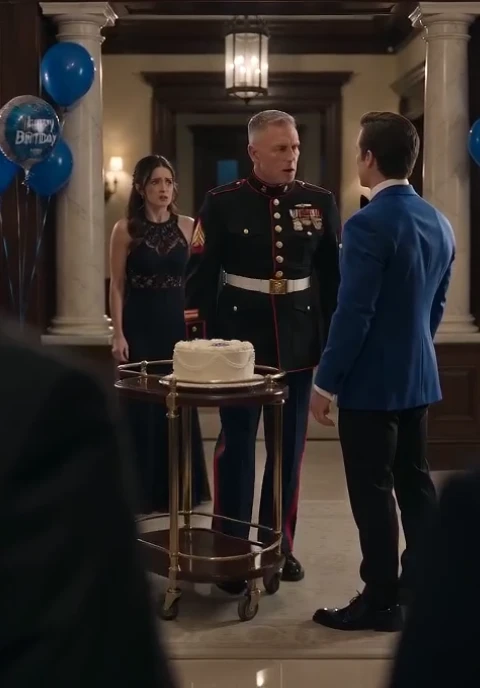
Major General Thomas Hale stood on the other side of the ballroom beneath a chandelier large enough to belong in a hotel lobby. He wore his dark blue dress uniform because Adrian had insisted the evening was formal. The silver in Thomas’s hair had grown more noticeable during the past year, but his posture had not changed. He was still straight-backed, controlled, and almost impossible to read when he was angry.
Elena knew that expression.
She had grown up with it.
Her father had looked exactly like that when a doctor told him Elena had broken her arm at twelve.
He had looked like that when one of his soldiers died during an overseas deployment.
He had looked like that when Elena’s mother passed away after a short illness seven years earlier.
Thomas Hale became quieter when something hurt him.
And right now, he was staring at the bruise on his daughter’s cheek.
Elena almost turned around.
For twenty minutes before coming downstairs, she had stood in the guest bathroom with three different concealers spread across the marble counter.
The bruise had been darker that morning.
Purple near her cheekbone.
Yellow around the edges.
She had done everything the beauty videos recommended. Cold compress. Color corrector. Foundation. Powder.
Under the bathroom lights, it had looked acceptable.
Under the chandelier, apparently it did not.
Her right shoulder was worse.
Adrian’s fingers had left four clear marks where he had grabbed her two nights earlier.
Elena had considered wearing a shawl.
Adrian had stopped her.
“You’ll look ridiculous,” he’d said.
“It’s cold downstairs.”
“It’s seventy-two degrees.”
“I just want something over my shoulders.”
He had looked at her for a long moment.
Then he had smiled.
“No.”
The word had been quiet.
That was how Adrian preferred giving orders.
He rarely shouted unless they were alone.
Elena had put the shawl back in the closet.
Then Adrian had given her one more instruction.
“Don’t disappear with your father tonight.”
She had stared at him through the mirror.
“What does that mean?”
“It means exactly what I said.”
“He’s my father.”
“And he hates me.”
“He doesn’t hate you.”
Adrian had laughed.
“Elena, your father has spent five years waiting for our marriage to fail. Don’t give him ammunition because you’re emotional.”
She had almost said, You hit me.
Instead, she had said nothing.
Now she understood why Adrian had cared so much about the shawl and the conversation.
He knew Thomas would notice.
He simply believed noticing would not matter.
Elena walked farther into the ballroom.
Gold letters on the wall read HAPPY 34TH, ELENA.
The irony made her almost laugh.
The Voss family had invited nearly ninety people to celebrate her birthday.
Most of them barely knew her.
There were bankers, lawyers, real estate developers, charity board members, two retired senators, three people Elena recognized from local television, and enough business partners to make the room feel more like a networking event than a birthday.
Adrian stood beside the cake shaking hands.
He looked perfect.
Navy suit.
White shirt.
Silver tie.
A watch that cost more than Elena’s first car.
He was smiling while a managing director from a private equity firm congratulated him on a hotel acquisition.
At Elena’s birthday party.
That was Adrian.
He could turn somebody else’s moment into evidence of his own importance.
Thomas moved his eyes from Elena’s cheek to her bare shoulder.
She saw the exact second he noticed the finger marks.
His jaw tightened.
Elena stopped walking.
For five years she had worried about her father confronting Adrian.
Now she wanted him to.
And at the same time, she was terrified he would.
Adrian finally noticed the silence around Thomas.
He excused himself from the man beside him and walked across the room.
“General Hale.”
His voice was warm.
Too warm.
“I’m glad you could come.”
Thomas did not shake the hand Adrian extended.
“Elena.”
Her stomach tightened.
“Dad.”
“Come here.”
Adrian’s hand moved immediately to the small of her back.
Not affectionately.
Possessively.
“She’s right here.”
Thomas looked at Adrian’s hand.
Then at Elena.
“What happened to your face?”
Several nearby conversations stopped.
Elena felt heat rise into her neck.
She had prepared three answers.
I fell.
I hit the bathroom cabinet.
I slipped getting out of the shower.
Adrian answered first.
“She walked into a door.”
Thomas continued looking at his daughter.
“Did you?”
Elena could not speak.
Adrian laughed.
“She’s always been clumsy.”
Thomas turned toward him.
“What happened to her shoulder?”
Adrian’s hand disappeared from Elena’s back.
Nobody spoke.
Richard Voss watched from the staircase.
Adrian’s father was sixty-five and had built Voss Capital from a regional property company into a business worth hundreds of millions of dollars. He liked telling people he came from nothing.
That wasn’t entirely true.
Richard had inherited three apartment buildings from his father.
But in his version, three buildings counted as poverty.
Beside him stood Lydia Voss, Richard’s second wife, wearing a black silk dress and enough diamonds to finance a small house.
Richard made no attempt to come closer.
He simply watched.
Elena understood the message.
Handle this, son.
Adrian smiled again.
“Thomas, this isn’t necessary.”
“General Hale,” Thomas corrected.
Adrian’s smile tightened.
“Of course.”
Thomas pointed toward Elena’s cheek.
“How did that happen?”
“I told you.”
“No. You told me she walked into a door.”
Thomas paused.
“I’m asking what happened.”
Adrian looked around.
People were watching now.
He hated being questioned in front of people.
Elena knew that.
His fingers flexed at his side.
“Maybe we could discuss this privately.”
“Why?”
“Because this is my home.”
Thomas looked at the gold letters on the wall.
“I was told this was my daughter’s birthday.”
Adrian took a small step forward.
Elena recognized the movement.
He did the same thing at home when an argument was about to become something else.
Thomas recognized it too.
“Stay where you are.”
The room became quiet enough that Elena heard a server set down a tray behind her.
Adrian stared at Thomas.
“You don’t give orders here.”
“No,” Thomas said. “I’m asking questions.”
“Then ask Elena.”
“I did.”
Adrian turned toward her.
The softness returned to his voice.
“Tell him.”
Elena looked at her father.
Thomas did not tell her what to say.
He did not say, Tell the truth.
He did not say, Come with me.
He simply waited.
Adrian leaned closer.
“Go on.”
Something inside Elena locked up.
She hated herself for it.
She hated that after five years of marriage, Adrian could still change the way she breathed with two quiet words.
Thomas saw it.
His face changed.
Only slightly.
But Elena knew her father.
He had finally understood.
Adrian noticed too.
His expression hardened.
“Don’t make this into something it isn’t.”
Thomas looked at him.
“Move away from her.”
“No.”
“Move.”
Adrian did not.
Instead, he gave a small laugh.
“Fine. Since everybody seems so interested, let’s stop pretending.”
Elena’s pulse jumped.
“Adrian.”
He ignored her.
He picked up his drink from a nearby table.
“You want to know if I hit her?”
Thomas said nothing.
Adrian took a sip.
“Yes.”
A woman near the piano inhaled sharply.
Elena felt the floor shift beneath her even though she knew it had not moved.
Adrian looked around the room.
Then he looked directly at Thomas.
“Once.”
Elena stared at him.
It had not been once.
But the ease with which he admitted even one time shocked her.
Adrian smiled.
“She was hysterical. I lost my patience.”
“Adrian, stop.”
He lifted one shoulder.
“What? Your father wants honesty.”
Thomas’s hands remained at his sides.
“What did you do?”
Adrian looked almost entertained now.
“I slapped her.”
Someone behind Elena whispered, “Jesus.”
Adrian heard it.
His face reddened.
“A slap. That’s all.”
Elena could hear her heartbeat.
He was confessing because he believed the room belonged to him.
His father owned half the businesses represented there.
His family funded hospitals, museums, campaigns, and universities.
People laughed at Richard’s jokes whether they were funny or not.
People apologized when Adrian interrupted them.
Adrian had lived his entire life surrounded by evidence that consequences belonged to other people.
Lydia Voss suddenly gave a soft laugh.
It lasted less than a second.
But Elena heard it.
So did Thomas.
Lydia lifted her champagne glass.
“Oh, please. You’d think nobody here has ever had an argument with a spouse.”
A man beside her smiled awkwardly.
Another guest gave a nervous laugh.
That was enough.
Adrian’s confidence returned completely.
He looked at Thomas.
“You see?”
Thomas’s eyes moved toward the birthday cake.
It was three layers of white buttercream with gold decorations around the edges.
A sugar flower sat on top beside two candles shaped like a three and a four.
Thomas removed the untouched glass of water from his hand and put it down.
Elena knew immediately that something strange was about to happen.
Adrian did not.
He was still smiling.
“What exactly are you going to do, General?”
Thomas picked up the birthday cake.
Elena had just enough time to say, “Dad—”
Then her father pushed the entire cake into Adrian’s face.
There was no dramatic swing.
No speech.
He simply lifted it and planted it directly against him.
Adrian stumbled backward into the table.
The cake collapsed across his shirt, tie, hair, and shoulders.
The string quartet stopped.
A champagne glass hit the marble floor.
For several seconds, nobody moved.
Adrian stood completely still with white icing covering half his face.
Thomas set the empty cake board down.
Then he removed his gold watch and put it beside his water.
Elena knew why.
Her father did not intend to damage it if Adrian came at him.
Adrian wiped frosting from his eyes.
“You son of a—”
Thomas raised one hand.
“Think carefully.”
Adrian froze.
Thomas was sixty-one.
Adrian was thirty-eight.
But nobody in the room seemed confused about which man was less frightened.
Thomas turned to Elena.
“Get your purse.”
Her lips parted.
“Dad—”
“We’re leaving.”
Richard Voss finally came down the staircase.
“No.”
Thomas looked at him.
Richard stopped at the bottom step.
“Nobody is leaving yet.”
Thomas’s voice remained calm.
“That’s not your decision.”
“You assaulted my son in my house.”
“Call the police.”
Richard stared at him.
Thomas nodded toward Adrian.
“Please.”
That answer seemed to surprise everyone.
It surprised Elena too.
Richard looked toward one of the security men near the front entrance.
“Close the doors.”
The security guard hesitated.
“Mr. Voss?”
“Lock them.”
Elena’s stomach dropped.
The two heavy front doors closed.
A second later, she heard the electronic locks engage.
People began murmuring.
Thomas looked toward the doors.
Then back at Richard.
“Unlock them.”
“Not until we settle this.”
“We aren’t settling anything.”
Richard’s face hardened.
“You come into my home, humiliate my family, assault my son, and expect to walk out?”
Thomas took his phone from his pocket.
Richard laughed.
“Calling your soldiers?”
Thomas looked at him.
“No.”
He typed something.
“I’m calling people who actually have jurisdiction here.”
Richard’s smile disappeared.
Adrian pulled a cloth napkin from the table and wiped his face.
“You’re going to regret this.”
Thomas looked at Elena.
“Are you afraid to go home with him tonight?”
The question hit her harder than anything else that had happened.
Not, Did he hurt you?
Not, Has this happened before?
Not, Do you want me to beat him half to death?
Are you afraid to go home with him tonight?
Elena looked at Adrian.
For the first time in five years, she did not try to predict what answer would make him less angry.
She looked back at her father.
“Yes.”
Adrian stopped wiping his face.
“Elena.”
She almost apologized.
The word rose automatically.
Sorry.
Then she swallowed it.
Thomas nodded once.
“All right.”
Adrian threw the napkin onto the floor.
“She’s upset.”
Thomas ignored him.
“Elena, where is your purse?”
“Upstairs.”
“Anything you need tonight besides that?”
She thought about her medication.
Her wallet.
Passport.
Laptop.
The little wooden jewelry box that had belonged to her mother.
Adrian saw her thinking.
“You’re not moving out because of one argument.”
Elena’s voice came out small.
“It wasn’t one argument.”
Adrian stared at her.
A terrible silence followed.
Thomas did not ask for details.
Not there.
Not in front of everyone.
He just said, “You can get the rest later.”
Lydia stepped forward.
“This is ridiculous.”
Thomas turned toward her.
“Was it funny?”
Lydia blinked.
“What?”
“When your stepson admitted hitting my daughter.”
Her face tightened.
“I laughed because this is being blown completely out of proportion.”
Thomas nodded toward the bruise.
“How much more proportion would you like?”
Lydia said nothing.
Richard stepped between them.
“We will discuss this as a family.”
Thomas’s expression changed.
“She’s my family.”
“She’s Adrian’s wife.”
“Both can be true.”
Richard moved closer.
“But a marriage has boundaries.”
Thomas stared at him.
“Yes. One of them is not hitting your wife.”
Elena heard someone near the bar whisper agreement.
It was tiny.
Almost meaningless.
But Adrian heard it too.
He spun around.
“If anyone has a problem, leave.”
Richard looked at him sharply.
“Enough.”
“No. Apparently everybody wants entertainment.”
Adrian pointed toward Elena.
“Ask her what she did before I slapped her.”
Thomas’s eyes remained on him.
“What did she do?”
“She went through my phone.”
Elena closed her eyes.
There it was.
The justification.
Adrian turned toward the guests like an attorney presenting evidence.
“She accused me of cheating because she saw messages with an employee.”
“You were sleeping with her,” Elena said.
The words escaped before she could stop them.
Adrian looked at her.
“What?”
Elena’s hands shook.
“You were sleeping with her.”
“Don’t.”
“I saw the hotel receipts.”
“Elena.”
“I saw the messages.”
“You don’t know what you saw.”
“You called her sweetheart.”
Adrian stepped toward her.
Thomas immediately moved between them.
“Stop.”
Adrian laughed.
“This is unbelievable.”
Thomas’s voice lowered.
“Take one more step toward her.”
Richard grabbed Adrian’s arm.
Not protectively.
Strategically.
“Enough.”
Adrian jerked away.
Then the lights above the entrance flashed.
Everyone looked toward the doors.
A small green light appeared beside the security panel.
The locks clicked open.
Richard turned.
“I said lock those.”
The security man stared at the panel.
“I didn’t unlock them.”
The right-hand door slowly opened.
A woman stood outside.
She was in her late fifties.
Gray threaded through shoulder-length brown hair. She wore a simple dark coat and low shoes, nothing like the gowns and jewelry in the ballroom.
For a moment Elena did not recognize her.
She had only seen photographs.
Old photographs.
A wedding photograph in Richard’s study.
A picture of a young Adrian on a sailboat.
A Christmas photo Elena had once found tucked behind another frame.
The woman in those pictures had been thirty years younger.
But the eyes were the same.
Adrian dropped the napkin in his hand.
His face went completely white beneath the remaining frosting.
Richard made a sound Elena had never heard from him.
Not a word.
More like the air had been knocked from his lungs.
Lydia took one step backward.
The woman entered the mansion.
A middle-aged female attorney came in behind her.
So did Margaret Doyle, the mansion’s longtime house manager.
Margaret was holding a key card.
“I opened the doors,” she said.
Richard stared at her.
“You are fired.”
Margaret nodded.
“I assumed so.”
Adrian was still staring at the woman.
“No.”
She stopped.
His voice cracked.
“No.”
The woman’s eyes filled with tears.
“Hello, Adrian.”
He stumbled backward.
“You’re dead.”
Richard found his voice first.
“Get out.”
Nobody moved.
Richard pointed toward the door.
“Both of you. Get out of my house.”
The woman looked at him.
“You told me for years it was your house.”
Her voice was quiet.
“I suppose some things never change.”
Elena’s father stepped beside her.
Adrian looked from Thomas to the woman.
“You knew?”
Thomas did not answer.
Adrian’s breathing became shallow.
“Who is she?”
Elena already knew.
She had known for three weeks.
The woman’s name was Marianne Voss.
And fourteen years earlier, the Voss family had held a private funeral for her.
Adrian had been twenty-four.
The story he had always told Elena was simple.
His mother had suffered from depression.
She had gone to Europe alone.
There had been a car accident in northern Italy.
The body had been badly damaged.
Richard had arranged a closed-casket funeral.
Adrian had never seen her.
He had spent fourteen years believing his mother was buried beside his grandparents.
Marianne looked at her son.
“I’m your mother.”
Adrian shook his head.
“No.”
“Yes.”
“No.”
Richard moved toward her.
“This woman is disturbed.”
Marianne did not look away from Adrian.
“That’s what he told people before I disappeared.”
Richard’s face darkened.
Thomas stepped between them.
“Stay back.”
Richard pointed at him.
“You brought her here?”
Thomas looked at Elena.
“No.”
Marianne did.
“You did.”
Elena’s throat tightened.
Adrian turned toward his wife.
The confusion on his face slowly changed.
“You?”
Three weeks earlier, Elena would have denied it.
She would have lied.
She would have begged him to understand.
Now almost ninety people were watching.
Her father was standing beside her.
And Adrian’s supposedly dead mother was ten feet away.
Elena took a breath.
“I found her.”
Six months earlier, Elena would have said she was happily married.
Not because she believed it.
Because the sentence had become automatic.
How’s married life?
Great.
How’s Adrian?
Busy, but good.
You two still traveling?
When we can.
She could answer an entire dinner table without telling one true thing.
It had not started badly.
That was what Elena struggled to explain later when people asked why she had stayed.
Adrian had once been kind.
Or he had seemed kind.
They met at a military charity dinner when Elena was twenty-eight.
She worked then as an architectural designer for a preservation firm in Alexandria. She loved old buildings, especially the imperfect ones. She liked finding traces of older walls hidden beneath renovations.
Adrian had been seated beside her.
He made her laugh.
He asked questions and remembered the answers.
When she mentioned her mother had started chemotherapy, flowers arrived at the hospital the next day.
When Thomas returned from an overseas assignment, Adrian insisted on meeting him properly.
He brought good whiskey.
He called him sir without sounding sarcastic.
For almost a year, Thomas liked him.
The first disagreement happened after the engagement.
Elena wanted a small wedding.
Adrian wanted four hundred guests.
“We’re not getting married for investors,” she told him.
“You don’t understand my family.”
“I understand weddings.”
“My father’s business relationships matter.”
“It’s my wedding too.”
He apologized the next morning.
They compromised at two hundred and fifty guests.
Elena considered it normal.
Then Adrian asked why she needed to keep working after the wedding.
“I like my job.”
“You complain about it constantly.”
“I complain about one manager.”
“You could do your own projects.”
“I might someday.”
“Why wait?”
It sounded supportive.
Six months later, she resigned.
Her own projects never happened.
Adrian needed her to help with charity events.
Then with a renovation of one Voss hotel.
Then with his mother’s foundation.
Then Lydia complained Elena wasn’t attending enough family dinners.
Her old coworkers eventually stopped inviting her for drinks because she canceled so often.
Her best friend, Nora, kept trying.
Adrian disliked Nora immediately.
“She doesn’t respect our marriage.”
“She barely knows you.”
“Exactly.”
The first time Elena realized something was wrong, she and Nora had tickets to a concert.
Adrian called one hour before it started.
He said he felt sick.
Elena went home.
He was sitting on the sofa watching basketball.
“I thought you were sick.”
“I had chest pain.”
“Do you want to go to the hospital?”
“It passed.”
She stared at him.
“You made me leave Nora.”
“I didn’t make you do anything.”
“You said you were having chest pain.”
“And you chose to come home.”
That became one of Adrian’s favorite sentences.
I didn’t make you.
When he took her credit card because she was “overspending,” he said she could ask for it back.
When he disabled location sharing on his phone but insisted hers remain active, he said married people shouldn’t hide things.
When he read her messages with her father, he said husbands and wives shouldn’t have secrets.
When he punched a hole in the bedroom door during an argument, he paid someone to repair it before anyone visited.
Then he bought Elena diamond earrings.
“I’m under pressure,” he said.
She wore the earrings to dinner.
The first time he grabbed her hard enough to bruise, she had tried to leave the room while he was talking.
He caught her wrist.
“Don’t walk away from me.”
“You’re hurting me.”
“Then stop pulling.”
The bruise lasted four days.
He bought her a bracelet to cover it.
After that came apologies.
Flowers.
Weekend trips.
Promises.
Then another incident.
Adrian never hit her where people would easily see.
Until her birthday week.
Two nights before the party, Elena had found hotel charges on one of their shared accounts.
She recognized the dates.
Adrian had told her he was in New York for meetings.
The hotel was twenty minutes from their house.
When Elena asked him about it, he called her paranoid.
She showed him a screenshot.
He grabbed her shoulder.
“Give me the phone.”
“No.”
“Elena.”
“No.”
He squeezed harder.
She cried out.
Then he slapped her.
The shock mattered more than the pain.
Adrian had never struck her face before.
They both froze.
He stared at his own hand.
For one second, Elena thought something had finally broken through.
He looked horrified.
“I’m sorry.”
She started crying.
He hugged her.
She let him.
He said it would never happen again.
Twenty minutes later, he was asking why she had looked at the bank account in the first place.
By morning, the story had changed.
He had not slapped her.
He had pushed her face away when she lunged at him.
By lunch, she had provoked him.
By dinner, he was the victim.
That evening, while Adrian was downstairs, Elena went into Richard’s study looking for an old photograph.
She had no clear reason.
She only wanted proof that there had once been another version of this family.
She found a box.
Inside were letters, old bank statements, and photographs of Marianne.
One envelope was addressed in Richard’s handwriting.
It had never been mailed.
Marianne Carter
P.O. Box 714
Port Townsend, Washington
The date was twelve years after Marianne’s supposed death.
Elena stared at it for several minutes.
Then she took a photograph.
She searched the name that night.
There were dozens of Marianne Carters.
She almost gave up.
Then she found a local nonprofit newsletter.
A woman named Marianne Carter had volunteered at a domestic violence shelter.
There was a photograph.
Older.
Different hair.
Same eyes.
Elena sent an email.
She expected nothing.
Two days later, her phone rang from an unknown number.
“Is this Elena Voss?”
The woman’s voice shook.
“Yes.”
“My name is Marianne.”
Elena sat down on the bathroom floor.
“Are you Adrian’s mother?”
Silence.
Then:
“Is he hurting you?”
Elena started crying before she answered.
Back in the ballroom, Adrian looked as though somebody had removed the floor beneath him.
“You spoke to her?”
Elena nodded.
“For three weeks.”
“You knew she was alive?”
“Yes.”
“And you said nothing?”
“I was afraid.”
“Of me?”
Elena said nothing.
That was answer enough.
Adrian turned toward Marianne.
“Where have you been?”
Marianne took a step forward.
Adrian backed away.
“Don’t.”
She stopped.
Richard interrupted.
“This has gone far enough.”
Marianne looked at him.
“No. It went far enough fourteen years ago.”
Lydia’s face had become pale.
“Richard, perhaps—”
“Be quiet.”
Marianne flinched.
Elena noticed.
So did Thomas.
Fourteen years could pass, and apparently two words could still make a person remember everything.
Marianne drew a slow breath.
“You told Adrian I died.”
Richard laughed without humor.
“You left.”
“You told him I was dead.”
“You abandoned your family.”
“You threatened to kill me if I tried to take him.”
Adrian stared between them.
“Stop.”
Marianne’s eyes filled again.
“I tried to reach you.”
“Stop.”
“Your father intercepted letters.”
“Stop.”
“He told me you wanted nothing to do with me.”
Adrian shouted.
“Stop!”
The sound echoed through the room.
Everyone became silent.
Adrian pressed both hands to his head.
“I went to your funeral.”
Marianne cried then.
Not dramatically.
She simply covered her mouth.
“I’m sorry.”
“I stood beside a coffin.”
“I know.”
“I was twenty-four.”
“I know.”
“You were alive?”
“Yes.”
“Where?”
“In Washington first.”
Adrian laughed bitterly.
“Washington.”
“Then Oregon.”
“You were living in Oregon while I buried you?”
“I was hiding.”
“From him?”
“Yes.”
Adrian pointed toward Richard.
“Why?”
Marianne looked at her son for a long time.
Then she glanced at Elena’s bruised face.
“Because he started the same way.”
Richard’s expression changed.
“Careful.”
Marianne looked at him.
“That word used to work better.”
Richard moved toward her.
Thomas stepped into his path.
Richard stopped.
Marianne continued.
“The first year, your father controlled money. Then friends. Then where I went. Then what I wore.”
Adrian stared at her.
“He never hit you.”
Marianne gave him a sad look.
“That’s what he told you?”
Adrian said nothing.
Marianne pulled back the left sleeve of her coat.
A thin scar ran across her forearm.
“The last night I lived here, he threw me against the glass doors in the old study.”
Richard shook his head.
“She fell.”
Marianne looked at Elena.
The room changed.
Everybody heard it.
Elena had walked into a door.
Marianne had fallen.
Different generation.
Same sentence.
Adrian seemed to hear it too.
His face tightened.
Marianne continued.
“I went to a hospital thirty miles away because I knew Richard donated to the one near us. A nurse connected me with a shelter.”
“You could have called me.”
“I did.”
“No, you didn’t.”
“I called seven times.”
Richard said, “She’s lying.”
Marianne ignored him.
“I sent letters.”
Adrian looked at his father.
Richard’s jaw tightened.
“She was unstable.”
Marianne nodded.
“That was the story.”
“Because it was true.”
“You had a doctor prescribe medication I didn’t need.”
“He treated you.”
“You paid him.”
Richard stepped forward.
“Enough.”
Marianne’s attorney moved closer.
“Mr. Voss, I strongly recommend you stop speaking.”
Richard looked at her.
“Who the hell are you?”
“Caroline Beck.”
She took a business card from her pocket.
“I represent Ms. Carter.”
“Ms. Carter is trespassing.”
Caroline nodded toward the open doors.
“Then you can explain that to the police officers coming up your driveway.”
The color left Richard’s face.
Thomas looked toward Elena.
“Did you call?”
“No.”
Margaret Doyle raised one hand.
“I did.”
The house manager looked almost embarrassed.
“When Mr. Adrian admitted striking Mrs. Voss.”
Adrian stared at her.
“You work for us.”
“Worked,” Margaret corrected.
Sirens became faintly audible outside.
Nobody moved.
Adrian looked at Elena.
His voice softened.
“Please don’t do this.”
Three years earlier, that voice would have broken her.
Maybe even three days earlier.
Elena looked at him.
“Do what?”
“Destroy everything.”
The answer came more easily than she expected.
“I didn’t hit me.”
His face twisted.
“You know what I mean.”
“No.”
“I made a mistake.”
“You keep calling choices mistakes.”
His eyes filled with anger.
“You went behind my back.”
“Because I was scared of you.”
“I said I was sorry.”
“Then you did it again.”
Several guests looked away.
Adrian lowered his voice.
“We can fix this.”
Elena shook her head.
“We’ve been fixing it for years.”
The first police officer entered less than a minute later.
Thomas raised both hands where they could be seen.
“I’m the one who put the cake in his face.”
The officer blinked.
Behind him, Adrian stood covered in frosting.
Even Elena almost laughed.
The officer looked from Thomas to Adrian.
“We received a call regarding a domestic disturbance.”
Thomas pointed toward his daughter.
“Start with her.”
That moment stayed with Elena.
Her father could have talked about his rank.
He could have explained who he was.
He could have controlled the conversation.
He did none of those things.
He stepped aside.
For the first time that evening, Elena told the truth from beginning to end.
She left the mansion at 11:43 p.m.
She remembered the time because she stared at the clock on her father’s dashboard for most of the drive.
Thomas did not take her to his house immediately.
He took her to an emergency clinic.
Elena almost refused.
“I don’t need a doctor.”
“Okay.”
She looked at him.
“Okay?”
“If you don’t want to go, we won’t.”
That surprised her.
She had expected an order.
Thomas had spent forty years giving orders.
He kept both hands on the steering wheel.
“I think having the injuries documented could help you later. But it’s your decision.”
Elena looked down at her shoulder.
“Let’s go.”
At the clinic, a nurse photographed the bruising with Elena’s consent.
She asked whether Elena felt safe returning home.
“No.”
It was easier the second time.
The nurse gave her information for an advocacy organization and explained protective orders.
Thomas stayed in the waiting room.
He did not demand details.
He did not call Adrian.
He did not pace.
When Elena came out forty minutes later, he was sitting beneath a television showing a cooking program and holding a paper cup of coffee.
“You ready?”
She nodded.
His house looked exactly as it had the last time she visited.
Shoes lined neatly near the door.
Mail in one stack.
Her mother’s framed photograph on the hallway table.
Thomas opened the linen closet.
“Your old room is full of boxes.”
Elena almost smiled.
“I thought you said you hadn’t changed it.”
“I lied.”
“You converted it into storage?”
“Only eighty percent.”
She laughed.
Then she started crying.
Thomas stopped.
Elena covered her face.
“I’m sorry.”
Her father frowned.
“For what?”
“I don’t know.”
He took one step toward her and stopped.
“Can I hug you?”
That broke something in her.
She nodded.
Thomas held his daughter while she cried into his uniform for several minutes.
He said almost nothing.
Eventually, Elena whispered, “Why didn’t I tell you?”
Thomas rested his chin against her hair.
“I don’t know.”
“I should have.”
“You were scared.”
“I knew you’d hate him.”
“I do hate him.”
She pulled back.
Thomas’s mouth moved slightly.
“That wasn’t helpful.”
It was the closest either of them came to laughing.
Elena sat at the kitchen table while Thomas made tea.
At midnight, she finally asked the question that had been sitting between them.
“How much did you know?”
“About Adrian?”
“About Marianne.”
Thomas sat across from her.
“Three weeks.”
Elena stared.
“She called you?”
“After you contacted her.”
“Why?”
“She was worried you might change your mind.”
Elena looked down.
“I almost did.”
“I know.”
“How?”
“Because you canceled lunch with me twice. Then you called me from a grocery store and asked whether Mom ever hid things from me because she was afraid of my reaction.”
Elena remembered.
She had been standing between cereal and canned soup.
She had hung up after thirty seconds.
Thomas continued.
“I knew you weren’t asking about your mother.”
“Why didn’t you come get me?”
The question came out sharper than she intended.
Thomas accepted it.
“Because you’re thirty-four.”
“So?”
“So I can show up with an army when you are twelve.”
A faint smile touched his face.
“When you’re thirty-four, I have to be more careful.”
Elena’s eyes burned.
“I wanted you to come.”
“I know that now.”
“You could have done something.”
“I wanted to.”
“Then why didn’t you?”
Thomas looked at her.
“Because I was afraid if I pushed too hard, you’d defend him and stop talking to me completely.”
Elena said nothing.
He was right.
She hated that he was right.
Thomas looked toward his wife’s photograph.
“Your mother would have known how to do this better.”
Elena wiped her eyes.
“No, she would’ve driven through the front gate.”
Thomas almost smiled.
“Also possible.”
They sat quietly.
Then Thomas said, “There is something else.”
Elena waited.
“I’ve spoken to a civilian attorney.”
“Dad.”
“Not a military attorney. Not anyone connected to my command.”
She relaxed slightly.
“I didn’t want this becoming about my position.”
“Good.”
“I also hired a private investigator.”
Elena stared at him.
“You what?”
“After Marianne called.”
“Why?”
“Because her story involved your husband’s family fabricating a death.”
“That sounds insane when you say it out loud.”
“It sounded insane when she said it.”
“Did you find anything?”
Thomas leaned back.
“No legal death certificate.”
Elena frowned.
“What?”
“There was never one filed in Virginia.”
“But there was a funeral.”
“Private memorial service. Closed coffin. The family claimed paperwork had been handled overseas.”
Elena stared.
“Adrian never checked?”
“He trusted his father.”
That sentence hurt in ways Elena could not immediately explain.
Thomas continued.
“Marianne had already changed her surname and disappeared voluntarily. Richard didn’t need to fake government records. He only needed to tell his son and his social circle a story.”
“Why didn’t she come back?”
“Ask her.”
Elena nodded.
“Is she staying nearby?”
“For now.”
“Does Adrian know where?”
“No.”
Elena exhaled slowly.
Then her phone began vibrating.
Adrian.
She stared at the screen until it stopped.
Thirty seconds later, it rang again.
Thomas looked at it.
“You don’t have to answer.”
“I know.”
The phone stopped.
Then messages arrived.
Please talk to me.
This got out of control.
I’m sorry about your face.
Your father assaulted me.
We need to talk about my mother.
Tell me where she is.
Elena read the messages.
Then another arrived.
Do not make me come looking for you.
Her hands went cold.
Thomas watched her expression.
“What?”
She turned the phone around.
He read it.
His jaw tightened.
“Screenshot that.”
She almost laughed.
“You sound like Mom.”
“Your mother was smarter than both of us.”
Elena saved the message.
Then another appeared.
I didn’t mean that as a threat.
Thomas nodded.
“Screenshot that too.”
The next morning, Elena woke at six because she had spent five years waking when Adrian did.
For several seconds, she forgot where she was.
Then she saw the old bookshelf her father had never removed.
Her college yearbook still leaned beside a row of mystery novels.
A box marked CHRISTMAS LIGHTS sat beside the closet.
The bruise on her cheek ached.
Everything returned at once.
Elena went downstairs.
Thomas was already in the kitchen wearing running clothes.
“Coffee?”
“Please.”
He poured her a cup.
No uniform.
No rank.
Just her father.
“I have to go to the base for two hours,” he said. “I can cancel.”
“No.”
“Elena.”
“I don’t need babysitting.”
“I didn’t say you did.”
She wrapped both hands around the mug.
“Go to work.”
Thomas studied her.
“Caroline Beck is coming at ten.”
“Marianne’s lawyer?”
“She also handles family law. Marianne suggested her.”
“Of course she did.”
“You don’t have to hire her.”
“I know.”
Thomas put his keys in his pocket.
“I’ll leave my personal car. Take it if you need to go anywhere.”
“What are you driving?”
“Government driver.”
Elena looked at him.
“You weren’t going to mention that?”
“I thought you’d accuse me of babysitting.”
She smiled despite herself.
“Go.”
At ten, Caroline arrived with a legal pad and no dramatic speeches.
She explained options.
Temporary protective order.
Divorce.
Financial records.
Property access.
Communication restrictions.
“Do I have to decide everything today?” Elena asked.
“No.”
“Good.”
“Today, decide what keeps you safe for forty-eight hours.”
That sounded manageable.
Elena applied for an emergency protective order.
She blocked Adrian’s number after saving his messages.
Then she emailed Nora.
Can you come over?
Nora arrived twenty-five minutes later.
When Elena opened the door, her best friend looked at the bruise and started crying.
“Oh my God.”
Elena hugged her.
Nora held on tightly.
“I knew something was wrong.”
“Why didn’t you say anything?”
“I did.”
Elena pulled away.
“When?”
“Last Christmas. I asked if he scared you.”
Elena remembered.
She had laughed.
Nora wiped her eyes.
“You told me I was projecting because my parents had a bad marriage.”
“I said that?”
“Yes.”
“I’m sorry.”
“Stop apologizing.”
“I don’t know how.”
Nora looked at her for a long time.
“Then start practicing.”
They sat in the living room.
For two hours, Elena told Nora things she had never said aloud.
The broken door.
The wrist bruises.
The credit cards.
The location tracking.
The hotel.
The slap.
When she finished, Nora was quiet.
Then she asked, “Do you remember my birthday dinner last year?”
Elena nodded.
“You canceled because Adrian said you had food poisoning.”
“I did have food poisoning.”
Nora shook her head.
“I called you the next morning. You said you were fine.”
Elena frowned.
The memory shifted.
Adrian had been angry because Nora invited a man he disliked.
He told Elena they weren’t going.
Then he texted Nora from Elena’s phone saying she was sick.
Elena had forgotten.
Or maybe she had trained herself not to remember.
That afternoon, Marianne came to Thomas’s house.
Without the coat, she looked smaller.
Ordinary.
Elena found that comforting.
They sat at the kitchen table.
For several minutes neither woman knew what to say.
Finally Elena asked, “Why didn’t you come back for him?”
Marianne closed her eyes.
“I tried.”
“Adrian thinks you didn’t.”
“I know.”
“You left him with Richard.”
“I know.”
There was no defensiveness in her voice.
That made Elena soften.
Marianne looked down at her hands.
“I was injured the night I left. A nurse helped me contact a shelter. Richard called my sister the next day and told her if I tried to take Adrian, he would have me committed.”
Elena frowned.
“Could he do that?”
“Probably not.”
Marianne gave a sad smile.
“But I believed he could.”
Elena understood that too well.
“Then what?”
“I stayed hidden for six weeks. I called Adrian’s school. Richard had already withdrawn him and sent him abroad for a semester.”
“Switzerland.”
Marianne looked surprised.
“He told me.”
“I sent letters there. They came back.”
She swallowed.
“I hired an attorney with money my sister gave me. Richard’s lawyers accused me of theft, substance abuse, instability. None of it was true. But every letter cost money to answer. I was terrified.”
“So you gave up?”
Marianne looked at Elena.
“For a while.”
The honesty was painful.
“Yes.”
Elena said nothing.
“I shouldn’t have.”
Marianne’s eyes filled.
“I was scared, broke, ashamed, and convinced Adrian would hate me because Richard had already told him I abandoned him.”
“But then Richard told him you died.”
“I didn’t know that for years.”
“How?”
“I saw an obituary online.”
Elena stared.
Marianne nodded.
“Richard had published one in a private alumni magazine almost a year after I left. It said I died while traveling.”
“Why didn’t you expose him?”
“I contacted a reporter.”
“What happened?”
“Richard threatened to sue. The reporter wanted proof. I didn’t have enough.”
“But you were proof.”
Marianne gave a bitter laugh.
“You’d be surprised how easily powerful people can make a frightened woman sound unstable.”
Elena was silent.
Marianne continued.
“By then Adrian had joined his father’s business. Photos of him were everywhere. He looked happy. Successful.”
“So you stayed away.”
“I told myself I was protecting him.”
“Were you?”
Marianne shook her head.
“No.”
Elena appreciated the answer.
Marianne looked toward the hallway.
“Sometimes survival turns into hiding, and hiding becomes a habit. Eventually you’re not sure whether you’re still escaping danger or just escaping your shame.”
Elena thought about her own marriage.
“I understand.”
“I hope you don’t understand for long.”
That evening, Adrian was served with the protective order.
The next morning, he filed for divorce before Elena could.
Caroline laughed when she heard.
“Why is that funny?”
“Because he thinks filing first matters.”
“Doesn’t it?”
“Not in the way he thinks.”
Richard’s attorney called within an hour.
He offered Elena two million dollars.
There was one condition.
Confidentiality.
“No,” Elena said.
Caroline looked at her.
“You don’t want to hear the rest?”
“No.”
The offer became three million.
Then five.
Elena said no again.
Adrian sent messages through his attorney saying he wanted counseling.
Two days later, the attorney accused Elena of manipulating his vulnerable mother.
The next day, Richard’s public relations firm released a statement saying a “private family disagreement” had been “distorted by emotional guests.”
They made the mistake of saying Adrian denied striking his wife.
Three separate guests had recorded his confession.
One video appeared online that afternoon.
Elena watched it once.
She never watched it again.
Adrian’s voice came clearly through the recording.
Yes.
A slap.
The clip ended just before Thomas lifted the cake.
By evening, Voss Capital’s board had scheduled an emergency meeting.
Richard blamed Elena.
Lydia called Nora.
Nora blocked her.
Adrian’s aunt sent Elena a six-paragraph email explaining that marriages had difficult seasons.
Elena replied with one sentence.
Physical violence is not a season.
Then she blocked her too.
Thomas received a call from the local police department about the cake.
He went in voluntarily.
Elena insisted on going with him.
“You don’t need to.”
“You did it because of me.”
“I did it because I temporarily lost judgment around baked goods.”
“Dad.”
Thomas sighed.
“Yes, you can come.”
Adrian wanted charges filed.
Thomas admitted exactly what he had done.
Caroline advised him to get his own lawyer.
Eventually, he received a misdemeanor citation.
Three months later, he agreed to community service and anger-management classes as part of a diversion program.
When Elena apologized, Thomas stopped her.
“I made a choice.”
“But—”
“My choice.”
He looked at her.
“That’s important, Elena.”
She understood.
Everybody needed to own their own choices.
Even the people protecting her.
Especially them.
The most difficult part was returning to the mansion.
Elena waited twelve days.
A sheriff’s deputy accompanied her while she collected personal property.
Adrian was not supposed to be there.
Richard was.
He waited in the library.
Elena ignored him and went upstairs with Nora and the deputy.
Her closet looked untouched.
So did the bedroom.
The broken door had been repaired again.
She packed clothes.
Documents.
Her mother’s jewelry box.
Photographs.
Laptop.
A ceramic bowl she had made in college.
Nora held it up.
“This ugly thing?”
“My mother loved it.”
“It’s hideous.”
“I know.”
“Then we’re taking it.”
They packed it.
In the study, Elena found something else.
A folder labeled MC.
Marianne Carter.
She opened it.
Inside were copies of letters Marianne had sent Adrian years earlier.
Some were still sealed.
Elena sat down.
“Oh my God.”
Nora looked over her shoulder.
“What?”
“Richard kept them.”
There were eleven letters.
The oldest was fourteen years old.
The newest was nine years old.
All addressed to Adrian.
All unopened.
Richard appeared in the doorway.
“Put that down.”
The deputy immediately looked over.
Elena stood.
“These belong to Adrian.”
“They are private.”
“They’re addressed to him.”
“They’re in my house.”
Elena photographed the folder.
Richard stepped closer.
The deputy moved between them.
“Sir.”
Richard stopped.
Elena looked at him.
“Why?”
His expression remained cold.
“You have no idea what she was like.”
“Then why not let your son decide?”
“Because I protected him.”
“From letters?”
“From chaos.”
Elena laughed softly.
Richard’s eyes narrowed.
“You find this amusing?”
“No.”
She looked around the enormous study.
“I just finally understand your family.”
Richard crossed his arms.
“You think my son is the villain and you’re innocent?”
“I don’t care what you think anymore.”
“He loved you.”
“Maybe.”
“He gave you everything.”
Elena shook her head.
“No. He gave me things.”
Richard stared.
“Same difference to people like you, apparently.”
She left with the letters.
Caroline advised her not to give them directly to Adrian because of the protective order.
His attorney received them.
Two days later, Adrian requested a meeting with Marianne.
She almost refused.
Then she agreed.
A therapist’s office was chosen as neutral ground.
Elena was not there.
Marianne told her about it afterward.
Adrian arrived with no lawyer.
He looked exhausted.
For the first ten minutes, he said nothing.
Then he placed the letters on the table.
“You wrote all of these?”
“Yes.”
“Every year?”
“For a while.”
“Why did you stop?”
“Because none were answered.”
“He kept them.”
“I know now.”
Adrian cried.
Marianne cried too.
Then Adrian asked the question that frightened her.
“Did Dad make me this way?”
Marianne did not answer immediately.
“What do you mean?”
“You know what I mean.”
“You saw him hurt me.”
“I was a kid.”
“Yes.”
“He told me you caused it.”
“I know.”
Adrian stared at his hands.
“Maybe I learned it.”
Marianne nodded slowly.
“Maybe you learned some terrible things.”
He looked up.
“Then this isn’t entirely my fault.”
Marianne’s heart sank.
She had told Elena that was the moment she understood how far her son still had to go.
She reached across the table but did not touch him.
“Adrian.”
“What?”
“What happened to you was not your fault.”
He waited.
“What you did to Elena is.”
He leaned back.
“Of course you take her side.”
“This isn’t a side.”
“You abandoned me.”
“Yes.”
The answer stopped him.
Marianne continued.
“I failed you.”
Adrian’s eyes filled.
“I was frightened, but I still failed you. I will live with that.”
She pointed toward the letters.
“Your father failed you.”
Then she looked directly at him.
“But Elena did not fail you.”
Adrian’s jaw tightened.
“You don’t know our marriage.”
“I know she is afraid of you.”
“She turned everyone against me.”
“No.”
Marianne shook her head.
“You did something in front of a room full of people because you believed nobody would challenge you.”
He looked away.
“You hit her and then bragged about it.”
“I wasn’t bragging.”
“You smiled.”
Adrian stood.
The therapist asked him to sit.
He did not.
Marianne remained seated.
“I love you,” she said.
He froze.
“I have loved you every day I was gone.”
He looked at her.
“But loving you does not require me to lie for you.”
Adrian left.
He did not contact Marianne for four months.
Elena’s divorce took almost a year.
It was less dramatic than outsiders expected.
Most divorces were.
There were spreadsheets.
Bank records.
Meetings.
Arguments over property.
Long emails between lawyers about furniture neither person actually wanted.
Adrian fought over a painting he had once called ugly because Elena wanted it.
Elena gave him the painting.
Caroline raised an eyebrow.
“You sure?”
“Completely.”
“What changed?”
“I realized I don’t want to spend three thousand dollars in legal fees arguing about something worth eight hundred.”
Caroline smiled.
“You’re learning.”
Elena returned to work.
Her old firm had no opening, but one of her former coworkers introduced her to a smaller preservation company.
The salary was lower than before.
She accepted immediately.
On her first day, she sat at a desk beside a window overlooking an alley and nearly cried because nobody asked where she was.
Nobody tracked her lunch break.
Nobody checked her phone.
Her first project was a hundred-year-old library with water damage.
She spent three weeks documenting plaster.
It was boring.
She loved every minute.
Thomas called every evening for the first month.
Eventually Elena said, “Dad, you don’t have to check on me every day.”
“I know.”
“So why do you?”
“Because you answer.”
She smiled.
“Every other day.”
“Agreed.”
He called the next evening anyway.
Elena answered.
“That is not every other day.”
“I had a calendar malfunction.”
“You’re a general.”
“Nobody’s perfect.”
She laughed.
The laughter came more easily now.
Nora helped Elena find an apartment.
It had two bedrooms, old hardwood floors, and a kitchen barely large enough for two people.
Elena loved it.
Thomas hated the locks.
He replaced them.
“Without asking,” Elena said.
“They were terrible.”
“Boundaries.”
Thomas stopped.
Then he nodded.
“You’re right.”
He handed her the new keys.
“Sorry.”
That mattered.
Not because of the locks.
Because he listened.
The Voss family changed too.
Richard’s board removed him as chairman after an internal review uncovered unrelated financial misconduct.
The investigation had begun because reporters started asking questions about Marianne.
Once people looked closely at Richard’s history, other things surfaced.
Improper company expenses.
Payments to private investigators.
Money transferred through consulting firms.
None of it made Elena happy.
She discovered revenge was less satisfying than safety.
Lydia filed for separation six months after the birthday party.
She never apologized to Elena.
Marianne was not surprised.
“Some people leave only when the house starts burning around them,” she said.
Adrian eventually pleaded guilty to a reduced domestic battery charge.
He received probation, mandatory intervention counseling, and restrictions on contacting Elena.
There were people online who called the punishment too light.
Others called Elena a liar.
She stopped reading comments.
The important part was that the court record existed.
The important part was that Adrian could no longer rewrite that night into nothing.
Almost eighteen months after the birthday party, Elena saw him again.
They were in the courthouse for the final divorce hearing.
Adrian looked older.
Not dramatically.
Just tired.
His suit was less perfect.
His shoulders slightly rounded.
He sat with his attorney on the opposite side of the room.
Elena sat with Caroline.
Thomas waited outside because Elena had asked him to.
“I can come in.”
“I know.”
“Are you sure?”
“Yes.”
Thomas hesitated.
Then nodded.
“Call if you need me.”
It was one of the proudest moments of Elena’s life.
Not because her father was there.
Because he could leave.
The hearing lasted less than an hour.
When it ended, Caroline squeezed Elena’s arm.
“Done.”
Elena stared at the papers.
Five years of marriage.
Almost a year of divorce.
Reduced to signatures.
Adrian approached her near the courthouse elevator.
His attorney stayed several feet away.
“Elena.”
She stopped.
There was no protective order anymore, but her body remembered him before her mind did.
Her shoulders tightened.
Adrian saw it.
For once, he did not move closer.
“I won’t touch you.”
Elena said nothing.
He looked toward the floor.
“My mother talks to me now.”
“I’m glad.”
“Once a week.”
“That’s good.”
“I started the program.”
She knew which one.
The court-ordered intervention group.
“I know.”
He swallowed.
“I spent months thinking everyone destroyed my life.”
Elena waited.
“My father. You. Your dad. My mother.”
His eyes lifted.
“Then one of the counselors asked me something.”
“What?”
“He asked what would have happened if your father hadn’t been at the party.”
Elena felt cold.
Adrian continued.
“I told him we would’ve gone upstairs afterward.”
She knew.
“He asked what I would’ve done.”
Elena did not want the answer.
Adrian looked away.
“I don’t know.”
“Yes, you do.”
He closed his eyes.
“Probably.”
They stood quietly.
Finally he said, “I’m sorry.”
Elena had imagined this moment many times.
In some versions, she screamed.
In others, she forgave him.
In others, she walked away without speaking.
The real moment felt smaller.
She looked at the man she had once planned to grow old with.
“I hope you mean it someday.”
His face tightened.
“I mean it now.”
“Maybe.”
She pressed the elevator button.
“But an apology isn’t something you say until the other person makes you feel better.”
The elevator arrived.
Elena stepped inside.
Adrian remained outside.
Before the doors closed, he said, “I did love you.”
Elena looked at him.
“I think you believed you did.”
The doors closed.
Thomas was waiting downstairs beside a coffee cart.
He stood when he saw her.
“Finished?”
“Finished.”
He looked at her carefully.
“How do you feel?”
Elena considered the question.
“Like I need lunch.”
Thomas nodded.
“That’s manageable.”
They walked outside.
No photographers.
No dramatic crowd.
Just a cold afternoon and people hurrying between buildings.
At the corner, Thomas said, “There’s a diner two blocks away.”
“You hate diners.”
“I’ve evolved.”
“You order plain eggs everywhere.”
“Eggs are dependable.”
Elena laughed.
They walked.
Two years after the party, Elena turned thirty-six.
She did not want a mansion.
She did not want a ballroom.
She did not want ninety people.
She invited twelve.
Thomas came early with groceries.
Nora brought wine.
Marianne brought flowers.
Elena had become close to her in a strange, careful way.
They were not family exactly.
Not anymore.
But they had survived different versions of the same house.
Sometimes that was enough.
Marianne had rebuilt a cautious relationship with Adrian.
She never discussed him unless Elena asked.
Elena appreciated that.
Her apartment was too small for twelve people, so they moved chairs from the bedrooms into the living room.
Someone sat on a storage box.
Thomas complained that the table leaned.
Nora told him to stop inspecting civilian furniture.
At eight, they brought out the cake.
It was one layer.
Chocolate.
No gold decorations.
No expensive bakery.
Nora had made it herself.
It leaned slightly to one side.
Elena loved it.
Thomas looked suspiciously at the cake.
Nora pointed at him.
“Don’t even think about it.”
Everyone laughed.
Thomas raised both hands.
“My cake-related violence is behind me.”
“Your court-mandated class worked,” Elena said.
“Apparently.”
Marianne laughed harder than anyone.
Elena looked around the room.
For a second, she remembered the other birthday.
The chandelier.
The gold letters.
The people avoiding her face.
Adrian smiling beside the cake.
Lydia laughing.
Her father’s expression when he saw the bruise.
The memory no longer felt like a room she was trapped inside.
It felt like a place she had left.
Nora placed two candles on the cake.
A three and a six.
“Make a wish.”
Elena closed her eyes.
Two years earlier, she would have wished for Adrian to change.
A year earlier, she would have wished to forget him.
Now she did not wish for either.
She thought about her new apartment renovation project.
She thought about the old library that had finally reopened.
She thought about Thomas learning to call before replacing anything in her home.
She thought about Marianne sitting beside the window, alive despite everything Richard had done to erase her.
She thought about Nora beside the cake.
Then Elena opened her eyes and blew out the candles.
“What did you wish for?” Thomas asked.
“You’re not supposed to ask.”
“I ask questions professionally.”
“No, you give orders professionally.”
“Not anymore.”
He had retired three months earlier.
Elena smiled.
“Still not telling you.”
Thomas cut the cake.
This time, he used a knife.
Later, after everyone left, Elena stood alone in the kitchen washing glasses.
There was frosting on the counter.
Music still played quietly from a speaker in the living room.
Her phone buzzed.
A message from Marianne.
Thank you for tonight. Happy birthday again.
Then another message appeared.
It was from an unfamiliar number.
Elena almost ignored it.
The text was short.
Happy birthday. I hope you’re doing well. No need to reply. —Adrian
She read it once.
Then she deleted it.
Not angrily.
Not sadly.
She simply did not need to keep it.
Elena put the phone down.
Outside the kitchen window, rain had started tapping softly against the glass.
For years she had believed freedom would feel dramatic.
She had imagined one huge moment when fear disappeared.
It had not happened that way.
Freedom had arrived in ordinary pieces.
Choosing her own clothes.
Turning off location sharing.
Going to lunch without explaining where.
Buying a sofa Adrian would have hated.
Taking a job because she wanted it.
Saying no without preparing for punishment.
Locking her own door at night.
Sleeping through until morning.
There had been no single moment when Elena became herself again.
She had simply made hundreds of small decisions until one day she realized she no longer needed to ask what Adrian would think.
The following morning, Thomas stopped by to return a serving dish.
He knocked.
Elena opened the door.
He held up the dish.
“You left this.”
“It’s yours.”
Thomas looked at it.
“It was in your kitchen.”
“Because you brought it.”
He frowned.
“Are you sure?”
“Dad.”
“Fine.”
He stepped inside, then stopped.
“May I?”
Elena smiled.
“Yes.”
He entered.
There was one last piece of birthday cake in the refrigerator.
They ate it with coffee at the little kitchen table.
For several minutes, neither said anything.
Then Thomas looked at his daughter.
“Can I tell you something?”
“You usually do.”
He ignored that.
“That night at the mansion, when I saw your face, I wanted to break every bone in his body.”
Elena put down her fork.
“I know.”
“I thought that’s what protecting you meant.”
She waited.
Thomas looked at his coffee.
“But it wasn’t.”
“No.”
“I had to learn that.”
“So did I.”
He nodded.
“The cake was still satisfying.”
Elena laughed.
“Dad.”
“What?”
“You literally had to take a class.”
“It was a good class.”
She shook her head.
Thomas became serious again.
“I am sorry I didn’t see it earlier.”
Elena looked at him.
“You saw more than most people.”
“Not enough.”
“Maybe.”
He accepted that.
Elena reached across the table.
“But when you did see it, you believed me.”
Thomas covered her hand with his.
“Always.”
Elena thought about the ballroom full of people who had noticed the bruise and looked away.
Some had been afraid of Richard.
Some needed Adrian’s business.
Some did not want to become involved.
Some probably told themselves it was private.
For years, Elena had done the same thing inside her own head.
She had looked away from what was happening because looking directly at it meant something would have to change.
Her father had done something imperfect that night.
Something impulsive.
Something that had consequences of its own.
But the cake had never been the thing that saved her.
Neither had his rank.
Neither had Marianne walking through the mansion doors.
Those things only broke the silence.
What saved Elena came afterward.
A nurse asking a simple question.
A friend believing her.
A lawyer explaining choices.
A father learning not to take control.
A woman who had disappeared fourteen years earlier deciding to stop hiding.
And Elena herself, waking each morning and choosing not to go back.
She squeezed Thomas’s hand.
“Do you remember what you said after the cake?”
He thought.
“I’ve said many wise things.”
“You said, ‘Outside. Now.'”
“That sounds like me.”
“I hated you for about three seconds.”
“Only three?”
“Maybe five.”
Thomas smiled.
Elena looked toward the window.
The rain had stopped.
“Then I realized I wanted to go.”
Thomas nodded.
“That’s why I said it.”
She looked at him.
“You knew?”
“No.”
He smiled faintly.
“I hoped.”
Elena laughed.
And in the small kitchen, with an ordinary cake between them and no one pretending not to see her, she finally understood what had changed most.
For years, Adrian had convinced her that strength meant controlling a room.
Richard believed it meant controlling a family.
Thomas had once believed it meant stepping between his daughter and anything dangerous.
Elena knew better now.
Strength was quieter.
Sometimes it was saying, “Yes, I’m afraid.”
Sometimes it was asking for help.
Sometimes it was accepting responsibility.
Sometimes it was leaving.
And sometimes it was simply opening your own front door the morning after your birthday and realizing that nobody on the other side had the power to tell you who you were anymore.
