
The Moment the Camera Caught Everything: A Young Man, a Police Officer, and the Truth No One Could Silence
Daniel could hear the sound of his own heartbeat.
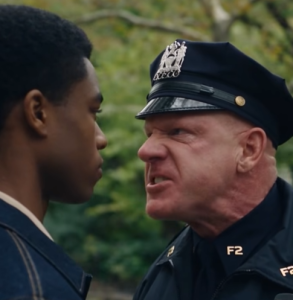
Sergeant Harlan stood before him, his face tense, his hands hovering near his belt. The officer seemed caught between two impulses: to end the confrontation and to prove that he remained in complete control of it.
Daniel had learned that there were moments when explaining yourself only made things worse. He had learned that anger could be interpreted as aggression, silence could be interpreted as guilt, and fear could be interpreted as an admission that you had something to hide.
So he stood still.
Elena continued recording.
Around them, the small crowd grew larger. A delivery driver stopped beside his van. A young mother pulled her child closer. An elderly man who had been reading a newspaper on a nearby bench folded it carefully and watched with growing concern.
Nobody knew exactly how the confrontation had begun.
They knew only what they could see.
A young man stood beside a bench, his jacket rumpled and his breathing uneven. An older police officer stood close enough to touch him. A woman held up her phone, documenting the encounter.
And the officer appeared furious that anyone was watching.
“Turn around,” Harlan ordered again.
Daniel swallowed.
“Officer, am I under arrest?”
“Turn around!”
“Please tell me what I’ve done.”
Harlan reached for Daniel’s wrist.
Daniel moved his arm away.
It was a small movement, an instinctive reaction to a hand reaching toward him. But the officer seized his forearm and twisted it behind his back.
Daniel cried out.
“Stop! You’re hurting me!”
“Stop resisting!”
“I’m not resisting!”
The officer forced him forward. Daniel’s knee struck the edge of the bench, and he stumbled, struggling to regain his balance.
Elena moved closer.
“He’s telling you that you’re hurting him!”
Harlan glanced toward her.
“Back away now!”
“I’m staying right here!”
Her voice shook, but she did not retreat.
She was terrified. Her mind was racing through every possible consequence of what she was doing. She imagined being arrested, losing her job, being dragged into a legal dispute that would consume months of her life.
Then she looked at Daniel’s face.
He was frightened, confused, and desperately trying to remain composed.
Elena realized that her own fear was not the most important thing happening on that sidewalk.
She kept recording.
Daniel’s voice broke through the confusion.
“Please call my sister. Her name is Maya. She’s waiting for me at the park.”
“Stop talking!”
“She doesn’t know where I am!”
“Be quiet!”
Daniel turned his head slightly, trying to see Elena.
“Please. If something happens, tell her I didn’t do anything.”
The words struck Elena with a force she had not expected.
He was not asking her to rescue him. He was not asking her to attack the officer. He was asking her to remember what had happened and make sure his family would know the truth.
“I will,” she said.
Harlan pushed Daniel toward the patrol car.
“You’re coming with me.”
“For what?” Daniel asked.
The officer did not answer.
He opened the rear door and ordered Daniel to sit down.
Daniel hesitated, looking at the narrow space inside the vehicle. He had never been arrested. He had never been inside a police car except once, when he was a child and an officer had visited his school to speak about road safety.
He could not understand how an ordinary walk had become this.
“Am I being arrested?” he asked.
Harlan grabbed his shoulder.
“Get in the car.”
Daniel sat down.
The officer pushed the door closed.
The sound echoed across the sidewalk.
For several seconds, nobody moved.
Elena stood with her phone raised, staring at the closed door. She had captured the entire confrontation, or at least everything that had happened since she first noticed the officer gripping Daniel’s jacket.
Her hands were trembling so badly that she nearly dropped the device.
She lowered it and checked the recording.
The video was still there.
The sound was clear.
She could hear Daniel asking whether he was being detained. She could hear the officer ordering him to turn around. She could hear Daniel repeatedly saying that he was not resisting.
She could hear the officer’s anger.
She could also hear her own voice asking him to be careful.
Elena watched the final few seconds again.
Then she looked at the patrol car.
Daniel was inside, sitting alone behind the metal partition. Through the window, she could see the outline of his shoulders.
She wanted to do something more.
She did not know what.
A voice behind her interrupted her thoughts.
“Did you get all of that?”
Elena turned.
A young man in a gray sweatshirt stood several feet away. He looked to be about twenty years old and held a bicycle helmet beneath one arm.
“Most of it,” she answered.
“Are you going to post it?”
“I haven’t decided.”
He glanced at the police car.
“You should. People need to see this.”
Elena looked back at her phone.
“People need to know what happened,” she said. “That’s not always the same thing as posting something immediately.”
The young man frowned.
“What do you mean?”
“I mean I want to make sure the original recording stays safe. I don’t want anything changed, cut out, or taken out of context.”
He considered that for a moment.
Then he nodded.
“Fair enough.”
Elena sent a copy of the original video to a secure account and backed it up to her computer. She also wrote down the time and location of the encounter while the details were still fresh in her memory.
She knew that memory could be unreliable, particularly when fear and confusion were involved.
A recording could preserve movements and words, but it could not explain every detail. A written account, made immediately afterward, could help her remember what the camera had not captured before she began filming.
She noted that Daniel had been walking toward the park. She recorded the officer’s badge number as best she could remember it, along with the patrol car’s identifying information.
Then she called the police department’s public information line.
A receptionist answered.
“Brookdale Police Department. How may I direct your call?”
“My name is Elena Martinez. I witnessed a police encounter near the public library a few minutes ago. A young man was placed in a patrol car, and I’m concerned about the force used during the arrest.”
There was a pause.
“Do you have a case number?”
“No. I don’t know why he was detained.”
“Then you’ll need to speak with the records department.”
“Can you tell me where he’s being taken?”
“I’m sorry, ma’am. I cannot provide that information.”
Elena closed her eyes briefly.
“I’m not asking you to disclose confidential information. I’m trying to make sure someone knows that an officer may have used unnecessary force.”
“I understand your concern. Would you like to leave a message?”
“Yes.”
She provided her name, phone number, the approximate time of the encounter, and the location.
When she finished, the receptionist thanked her and ended the call.
Elena stared at her phone.
The conversation had been polite, efficient, and almost completely useless.
She slipped the device into her pocket and looked toward the park entrance.
A young woman was approaching quickly, her long dark hair pulled into a loose ponytail. She wore jeans, a white sweater, and a canvas backpack covered with small university badges.
Elena recognized the expression on her face before the woman spoke.
It was the expression of someone searching for a person who should already have been there.
“Excuse me,” the young woman said. “Have you seen a man named Daniel Brooks? He’s tall, wears a blue jacket, and he was supposed to meet me here.”
Elena felt her stomach tighten.
“What’s your name?”
“Maya. I’m his sister.”
Elena looked toward the road.
The patrol car had already disappeared.
Maya noticed the change in her expression.
“What happened?”
Elena hesitated.
She did not want to frighten Maya unnecessarily, but she could not allow her to leave without knowing where her brother had gone.
“Your brother was stopped by a police officer,” she said carefully. “There was a confrontation, and the officer put him in a patrol car.”
Maya went completely still.
“What?”
“I’m sorry. I recorded what happened.”
Maya stared at her.
“Why would a police officer stop Daniel?”
“I don’t know.”
“Did Daniel do something?”
“I didn’t see him do anything that justified what happened.”
Maya’s eyes filled with tears.
“Where did they take him?”
“I don’t know yet.”
For a moment, Maya looked as though she might collapse.
Then she took a breath, pulled out her phone, and began dialing her brother’s number.
The call went directly to voicemail.
She tried again.
The same result.
“He’s not answering,” she whispered.
Elena placed a hand lightly on her shoulder.
“We’ll find out where he is.”
Maya shook her head.
“You don’t understand. Daniel has never been arrested. He doesn’t even like arguing with people. He apologizes when somebody else steps on his foot.”
Her voice broke.
“He was supposed to bring me a charger.”
Elena felt tears gathering in her own eyes.
A forgotten laptop charger.
A routine afternoon.
A brother who had left home expecting nothing more dangerous than a conversation with his sister.
Now Maya stood beside a stranger, wondering whether her brother was safe.
And Elena understood that the consequences of the confrontation had already reached far beyond the sidewalk.
They had entered a family.
They had entered a home where a mother would soon begin asking questions.
They had entered the life of a young woman who had believed that the person she loved most could walk through her neighborhood without having to fear an encounter like this.
Maya wiped her eyes.
“Can I see the video?”
Elena unlocked her phone.
The two women stood together near the library entrance as the recording played.
Maya watched her brother stop walking. She watched him raise his hands. She listened to him ask the officer why he had been stopped.
Then she saw the officer grab him.
Her hand flew to her mouth.
“No,” she whispered.
The video continued.
Maya watched Daniel stumble against the bench. She watched him try to explain himself. She watched him ask for his sister.
When the recording ended, she stood motionless.
Elena waited.
Finally, Maya spoke.
“He was trying to come to me.”
It was such a simple sentence that Elena did not know how to answer.
Maya pressed her phone against her chest.
“He was just trying to come to me.”
For several seconds, neither woman said anything.
Then Elena took Maya’s hand.
“We’re going to find him.”
And together, they began walking toward the library, where they could use a computer to contact the police department and determine which station was responsible for processing arrests in Brookdale.
Neither of them knew that the recording in Elena’s phone would soon become the center of a much larger story.
Neither knew that a detective would later watch it repeatedly, searching for the precise moment when a routine encounter became something that demanded an investigation.
Neither knew that Sergeant Harlan, sitting behind the wheel of his patrol car, had already begun constructing an explanation for his actions.
But the truth had started its journey.
And once the first piece of evidence existed, the people involved would discover that controlling a story was not the same as controlling what had happened.
The police station stood on a corner three miles from the library, a rectangular building of brick and glass surrounded by a parking lot that was always crowded during the afternoon shift change.
Daniel sat in an interview room with his hands resting on a metal table.
The room was cold.
A fluorescent light hummed overhead. A camera watched from the upper corner, and a small clock on the wall marked the passing seconds with a faint mechanical click.
He had been searched, photographed, and asked to provide basic identifying information. An officer had taken his phone and wallet, placing them in a plastic evidence bag.
Nobody had yet given him a clear explanation for his arrest.
He had asked three different officers why he had been detained.
Each had told him that someone would speak to him shortly.
Daniel leaned back in his chair and closed his eyes.
His shoulder hurt where Harlan had grabbed him. His wrist felt sore, and his neck was tender beneath his collar.
He could still hear the officer’s voice.
Stop resisting.
The phrase repeated itself in his mind.
He had heard those words in videos online. He had heard people argue about them in conversations at work. He had never imagined that he would become the person hearing them while struggling to explain that he was not resisting.
He opened his eyes.
A man in a plain shirt entered the room carrying a folder.
“Mr. Brooks?”
“Yes.”
“I’m Officer Bennett. I need to ask you some questions about the incident.”
Daniel sat straighter.
“Can you tell me why I’m here?”
Bennett placed the folder on the table.
“You’re being investigated for obstruction and resisting an officer.”
Daniel stared at him.
“Obstruction of what?”
“Your interaction with Sergeant Harlan.”
“I asked him why he stopped me. He grabbed my jacket, pushed me against a bench, and twisted my arm. I didn’t attack him.”
Bennett opened the folder.
“Sergeant Harlan reported that you refused lawful instructions and physically resisted his attempt to detain you.”
“Which instructions?”
“His report says you repeatedly refused to comply.”
“Did he say what crime he thought I committed?”
Bennett did not answer immediately.
Daniel felt something inside him sink.
He had expected confusion. He had expected paperwork, questions, perhaps an unpleasant conversation.
He had not expected to be treated as though asking for an explanation was itself evidence of wrongdoing.
“Officer,” Daniel said, “I want to cooperate. But I need to understand what I’m accused of doing.”
Bennett folded his hands.
“I can’t provide legal advice.”
“I’m not asking for legal advice. I’m asking what happened before the arrest.”
“The report is being reviewed.”
“Then can I speak to a lawyer?”
Bennett nodded.
“That can be arranged.”
Daniel looked down at his hands.
He thought of his mother, who would probably be preparing dinner. He imagined her checking the clock, wondering why he had not returned home.
He imagined Maya standing alone in the park.
The thought made his throat tighten.
“Can I make one phone call?”
Bennett glanced at the folder.
“That depends on the processing status.”
Daniel stared at him.
“My sister is waiting for me. She doesn’t know where I am.”
“I’ll check.”
Bennett left the room.
The door closed.
Daniel remained alone.
For the first time since the encounter began, he allowed himself to feel the full weight of his fear.
He had spent years trying to become the sort of man who could handle difficult situations without losing control. He worked hard, paid his bills, helped his family, and tried to treat people with fairness.
He had believed that these things mattered.
He still believed they mattered.
But sitting in that room, he understood that being a decent person did not guarantee that others would recognize your decency.
He pressed his palms against the table and took several slow breaths.
He would not let fear decide what kind of man he became.
He would not allow anger to make him careless.
He would tell the truth, seek legal assistance, and make sure that his family knew where he was.
That was all he could do.
For now, it would have to be enough.
Across town, Elena and Maya entered the library’s computer room.
Maya was moving so quickly that she nearly dropped her backpack.
She searched for the Brookdale Police Department’s official website and found a number for the detention center.
A clerk answered after several minutes.
“Brookdale Detention Services.”
“My name is Maya Brooks. My brother, Daniel Brooks, was detained by an officer near the public library. I need to know where he is.”
“Do you have his date of birth?”
Maya provided it.
The clerk typed something.
“One moment.”
Maya gripped the edge of the desk.
Elena stood beside her, listening.
After a pause, the clerk returned.
“Your brother is currently being processed.”
“Is he hurt?”
“I don’t have medical information available.”
“Can I speak to him?”
“Not at this time.”
“Why was he arrested?”
“I can only provide limited information over the telephone.”
Maya closed her eyes.
“Please. He’s never been arrested before. I just need to know if he’s safe.”
The clerk’s voice softened slightly.
“I understand, ma’am. You may contact the station again after processing is complete.”
Maya thanked her and hung up.
For a moment, she stood perfectly still.
Then she turned toward Elena.
“I need to call my mother.”
Elena nodded.
Maya dialed.
Their mother, Patricia Brooks, answered on the fourth ring.
“Hello, sweetheart.”
“Mom.”
Something in Maya’s voice made Patricia sit down immediately.
“What’s wrong?”
“It’s Daniel.”
“What happened?”
Maya struggled to speak.
“He was stopped by the police. They took him away.”
There was a long silence.
Then Patricia asked a question that revealed more about her fears than any speech could have done.
“Did he tell them he was going to call me?”
Maya began crying.
“I don’t know, Mom.”
Patricia’s breathing became uneven.
“Where is he?”
“We’re trying to find out.”
“Why did they take him?”
“I don’t know.”
Patricia pressed one hand against her mouth.
She had spent thirty years working in nursing homes, helping people through illness, confusion, and the final difficult stages of life. She had learned how to remain calm when others panicked.
But nothing in her professional experience had prepared her for the possibility that her son might be sitting alone in a police station, frightened and unable to reach his family.
“Listen to me,” she said finally. “Don’t go anywhere alone. Stay with the woman who saw what happened. Find a lawyer if you need one. And don’t let anyone convince you that your brother is guilty just because they put him in a police car.”
Maya wiped her face.
“Okay, Mom.”
“I am coming.”
“Mom, you don’t have to—”
“I am coming.”
The call ended.
Maya looked at Elena.
“My mother is on her way.”
“Good.”
Maya sat down heavily.
“I don’t know what we’re supposed to do.”
Elena pulled out a chair beside her.
“We start with what we know. We preserve the video. We write down what happened. We find out which charges, if any, have been formally filed. And we make sure Daniel has access to legal assistance.”
Maya looked at her.
“Why are you helping us?”
The question caught Elena off guard.
She thought about her classroom, her students, and the promise she had made to herself years earlier.
“Because somebody should have helped when I was too afraid to speak up,” she said.
Maya waited, but Elena did not elaborate.
Some stories required time before they could be told.
For now, there was work to do.
They saved another copy of the video, wrote down the location and approximate time of the encounter, and began searching for legal aid services in Brookdale.
Outside, the afternoon was turning into evening.
Cars moved through the intersection. Streetlights flickered on. The park where Daniel had intended to meet his sister grew quieter as families headed home.
The world continued as though nothing extraordinary had happened.
But for three people, the day had already become something they would remember for the rest of their lives.
For Daniel, it was the day an ordinary walk became a struggle to preserve his freedom and dignity.
For Maya, it was the day she discovered how quickly the person she trusted most could disappear from her reach.
And for Elena, it was the day she realized that witnessing injustice was not merely an experience to endure.
It was a responsibility to carry.
Sergeant Richard Harlan returned to the station shortly after five o’clock.
He parked his patrol car, collected his equipment, and walked through the rear entrance. His face had returned to its usual expression of controlled irritation, but his thoughts were less settled than he wanted to admit.
The confrontation had not unfolded as he had expected.
He had intended to question Daniel, establish control, and resolve the encounter quickly. Instead, Daniel had challenged his authority, a bystander had recorded the interaction, and the entire incident had become more complicated than it needed to be.
Harlan told himself that he had acted correctly.
He repeated the explanation in his mind as he walked down the corridor.
The young man had been uncooperative.
The young man had refused instructions.
The young man had moved his arms.
The young man had made the situation difficult.
Each statement made the next one easier to believe.
He had spent nearly thirty years developing a professional identity built around the idea that he could recognize danger before other people did. He trusted his instincts. He believed that experience had given him a better understanding of human behavior than most civilians possessed.
But experience could become a dangerous thing when it stopped being a source of knowledge and became a substitute for evidence.
Harlan had begun with an assumption.
Daniel had asked questions.
The officer had interpreted those questions as a challenge, and every subsequent action had been shaped by his desire to reassert control.
Now, rather than examining that sequence honestly, he focused on the parts of the encounter that supported his original belief.
It was a familiar habit.
He had used it in arguments with his wife, in disagreements with younger officers, and in conversations with supervisors who questioned his judgment.
He did not consider himself dishonest.
That was what made the situation so difficult.
People rarely needed to believe they were villains in order to justify harmful decisions. Sometimes they simply needed to believe that their intentions were more important than the consequences of their actions.
Harlan entered the report room and sat at a computer.
He began typing.
The report described Daniel as verbally confrontational and physically resistant. It stated that the officer had attempted to conduct a lawful investigation and that Daniel’s behavior had escalated the encounter.
The report contained no mention of the officer’s initial failure to identify a specific suspected offense.
It did not describe the force used against Daniel’s collar.
It did not mention the bystander who had recorded the confrontation.
Harlan paused before completing the final section.
He knew that the report would be reviewed.
He knew that another officer might ask questions.
But he also believed that a written report carried the weight of professional authority. If he described the encounter in confident language, perhaps the people reviewing it would accept his account.
He clicked the submit button.
A confirmation appeared on the screen.
The report had been filed.
Harlan leaned back in his chair.
For several seconds, he felt relieved.
Then his phone vibrated.
A message from a colleague appeared on the screen.
Did you hear? Someone was filming you near the library.
Harlan stared at the message.
Another message followed.
People are already talking about it.
His relief vanished.
He stood up and walked toward the break room, where two officers were speaking beside the coffee machine.
When he entered, their conversation stopped.
One of them, Officer James Miller, looked uncomfortable.
“Everything okay, Sergeant?”
Harlan studied him.
“Why wouldn’t it be?”
Miller hesitated.
“I heard there was a situation near the library.”
“There was a routine detention.”
“Right.”
Harlan waited.
Miller looked down at his cup.
“Someone recorded it.”
Harlan’s expression hardened.
“I know.”
“People are saying it looked bad.”
“People say whatever they want when they don’t know what they’re looking at.”
Miller nodded slowly.
“Of course.”
But his voice lacked conviction.
Harlan noticed.
“You have something to say?”
“No, Sergeant.”
“Then don’t stand there looking as though I’ve committed a crime.”
Miller’s face reddened.
“I didn’t say that.”
“Good.”
Harlan turned and left.
As he walked down the corridor, anger began to replace his uncertainty.
He was angry at the person who had recorded him. He was angry at Daniel for questioning him. He was angry at the possibility that people who had never worn a uniform would judge a situation they did not understand.
Most of all, he was angry because he could not control what the camera had captured.
He had spent years learning how to manage people through his voice, posture, and authority. He knew how to make an interview subject nervous, how to end a conversation before it became an argument, and how to project confidence even when he was uncertain.
A recording was different.
It did not care about his reputation.
It did not respect his seniority.
It did not become more convincing because he spoke firmly.
It simply preserved what had happened.
And that made it dangerous to him.
Harlan returned to his office and closed the door.
He sat alone for a long time.
Then he opened the report again and read it from beginning to end.
For the first time that afternoon, he wondered whether the written account would survive a careful comparison with the video.
He did not yet allow himself to consider what that possibility meant.
Instead, he began preparing an explanation.
At seven thirty that evening, Daniel was finally allowed to make a telephone call.
He dialed his mother’s number from the station’s designated phone.
Patricia answered immediately.
“Daniel?”
“Mom.”
Her breath caught.
“Are you all right?”
“I’m okay.”
“Are you hurt?”
“My shoulder hurts a little. My wrist too. But I’m okay.”
Patricia closed her eyes.
She wanted to ask a hundred questions, but she knew that her son was probably frightened and exhausted.
“Where are you?”
“Brookdale station.”
“Why did they take you there?”
Daniel looked at the officer standing near the door.
“They say I resisted an officer.”
Patricia was silent.
Then she spoke with a steadiness that came from years of having to remain strong when life offered her no alternative.
“Did you hit anyone?”
“No.”
“Did you threaten anyone?”
“No.”
“Did you try to hurt the officer?”
“No, Mom.”
“Then listen carefully. You do not have to convince everybody of everything tonight. You tell the truth. You ask for a lawyer. You do not sign anything you do not understand.”
Daniel felt tears gathering behind his eyes.
“Okay.”
“And you are not alone. Do you hear me?”
“Yes.”
“Maya is looking for you. She is with a woman who recorded what happened. We are coming to the station.”
Daniel’s shoulders relaxed slightly.
“She found the video?”
“Yes.”
“Please tell her not to worry.”
Patricia let out a quiet, painful laugh.
“Your sister has been worried about you since the day you were born.”
Daniel smiled despite himself.
For a moment, he could almost imagine being home.
He could imagine the kitchen light above the sink, the familiar smell of his mother’s cooking, and Maya sitting at the table complaining about an assignment she had left until the last minute.
The ordinary details hurt more than he expected.
He had never realized how much comfort was contained in a life he had considered unremarkable.
“Mom?”
“Yes, sweetheart?”
“I didn’t do anything wrong.”
“I know you, Daniel.”
Her voice softened.
“But knowing you is not the same as being there. We are going to make sure the truth is heard.”
The officer signaled that the call was ending.
Daniel hurried to speak.
“I love you.”
“I love you too.”
The line went dead.
Daniel placed the receiver down and stared at it.
For the first time since the encounter began, he felt something stronger than fear.
He felt connected to the people who knew him beyond the assumptions of strangers.
They knew the boy who had helped his mother carry groceries up three flights of stairs. They knew the teenager who had worked weekends to buy Maya her first laptop. They knew the man who still called home whenever he had a difficult day, even though he was old enough to live independently.
They knew that he was imperfect.
They knew that he sometimes became impatient, that he could be stubborn, and that he occasionally made mistakes.
But they also knew that none of those imperfections justified treating him as though his dignity no longer mattered.
Daniel lowered his head.
He was still afraid.
He was still uncertain about what would happen next.
But he was no longer entirely alone.
And sometimes, in the darkest moments of a person’s life, the knowledge that someone is waiting for you can become the first small light that makes the darkness bearable.
By nine o’clock, Maya and Patricia had arrived at the station.
Elena accompanied them.
A desk officer informed them that Daniel remained in custody while the relevant paperwork was reviewed. He explained that the family could seek legal assistance and submit any evidence they believed was relevant.
Maya asked whether she could see her brother.
The officer shook his head.
“Not at the moment.”
Patricia gripped Maya’s arm.
“Can we speak to the officer who arrested him?”
“He is not available right now.”
“Then we would like to speak with a supervisor.”
The desk officer looked uncomfortable but made a telephone call.
A few minutes later, Lieutenant Samuel Reed entered the reception area.
Reed was in his early forties, with close-cropped hair and a tired expression. He had spent fifteen years in law enforcement and had learned that most difficult situations became worse when people felt they were being dismissed.
He listened as Patricia explained what had happened.
Then he turned toward Elena.
“You recorded the interaction?”
“Yes.”
“Have you shared it publicly?”
“No. I preserved the original recording and made backup copies.”
Reed nodded.
“That was sensible.”
Elena handed him a written account of the incident.
He read it carefully.
“Did you capture the beginning of the encounter?”
“Not the first few seconds. I started recording when I noticed the officer holding Daniel’s jacket.”
“Do you have the original file?”
“Yes.”
“Would you be willing to provide a copy for review?”
“Yes, provided the original remains preserved and the transfer is documented.”
Reed looked up.
“You understand the importance of maintaining the integrity of evidence.”
“I’m a teacher,” Elena said. “I spend a lot of time explaining to students why sources matter.”
For the first time that evening, Reed smiled faintly.
“Then you understand more than most people realize.”
He asked Elena to describe what she had seen before she started recording.
She explained that Daniel had been standing with his hands raised when she first noticed the confrontation. She recalled hearing him ask why he had been stopped and repeatedly tell the officer that he was not resisting.
Reed wrote down her account.
He then asked whether she had noticed anyone else recording the encounter.
“There was a young man with a bicycle who might have been filming from another angle,” Elena said. “I don’t know his name.”
Reed noted that as well.
When he finished, he turned toward Patricia.
“I cannot promise you an immediate outcome. I can tell you that the incident will be reviewed, and the recording can be included in that process.”
Patricia studied him.
“Will my son be treated fairly?”
Reed did not answer immediately.
He understood that the question was larger than the situation in front of him. It carried the weight of every family that had ever waited outside a station, hoping that the person they loved would be heard rather than judged.
“I will make sure the available evidence is reviewed,” he said. “That is what I can promise you tonight.”
Patricia nodded.
It was not enough to erase her fear, but it was more than the silence she had expected.
Reed returned to his office and began reviewing the arrest report.
At first, the account appeared familiar. The officer described a subject who had refused instructions and physically resisted detention.
But when Reed compared the report with Elena’s written statement, he noticed several inconsistencies.
The report claimed that Daniel had repeatedly attempted to pull away before physical contact was initiated.
Elena’s account suggested that Harlan had grabbed Daniel first.
The report stated that Daniel’s movements created an immediate safety concern.
Elena described him raising his hands and asking for an explanation.
Neither account was conclusive by itself.
But the differences were significant enough to require further examination.
Reed requested the dispatch log, the patrol car’s available recordings, and any other relevant documentation. He also instructed the duty supervisor to preserve the evidence associated with the encounter.
Then he opened the report again.
He read the final paragraph twice.
It described Daniel as hostile and unwilling to cooperate.
Reed wondered whether those words reflected Daniel’s behavior or the officer’s interpretation of it.
The distinction mattered.
An official report was not supposed to be a record of an officer’s feelings. It was supposed to document observations, actions, and relevant facts.
If the report confused resistance with disagreement, or hostility with fear, it could distort the entire investigation.
Reed had seen this problem before.
He had also seen the opposite: officers accused of misconduct when a short video failed to capture an important part of an encounter.
That was why he did not intend to decide the case based on a single recording.
He wanted the full sequence.
He wanted the original evidence.
He wanted witnesses interviewed separately.
And he wanted every person involved to have an opportunity to explain what they believed had happened.
Justice, he had learned, was not served by replacing one premature judgment with another.
It was served by asking difficult questions and following the evidence wherever it led.
At eleven twenty, Reed sent a preliminary notice to the department’s internal review unit.
The case had officially become more than a routine arrest.
It had become an incident requiring scrutiny.
At home, Elena finally sat down on her living-room sofa.
Her apartment was quiet. A half-finished cup of tea sat on the coffee table, and a pile of books waited beside the television.
She should have been preparing lessons for the following morning.
Instead, she opened her laptop and reviewed the recording once more.
She watched Daniel’s expression as he asked the officer why he had been stopped. She watched Harlan’s hand close around the young man’s jacket. She watched the moment Daniel stumbled against the bench.
Then she stopped the video.
Something about the encounter troubled her beyond the obvious use of force.
It was the speed with which the officer’s assumptions had become facts in his own mind.
Harlan had not seemed interested in discovering what Daniel was doing. He had seemed interested in making Daniel demonstrate obedience.
Every question had become a test.
Every explanation had become an argument.
Every attempt to understand the situation had been treated as a challenge to authority.
Elena knew that people could behave badly under stress. She knew that officers sometimes faced genuine danger and that a recording could never capture every detail of a complicated encounter.
But she also knew that authority carried responsibilities precisely because it could influence the outcome of an encounter so dramatically.
An ordinary citizen could raise his voice and make a situation uncomfortable.
A police officer could make decisions that affected a person’s freedom, safety, employment, and future.
The power was not equal.
Neither was the responsibility.
Elena closed the video and opened a document.
She began writing a detailed timeline of what she remembered.
She included the approximate time she had started recording, the words she could clearly hear, the movements she had witnessed, and the moments when she could not see Daniel’s hands.
She resisted the temptation to add interpretations that she could not prove.
When she finished, she saved the document.
Then she opened a new email addressed to a local civil rights organization.
She explained that she had witnessed a police encounter, that she had preserved the original video, and that she wanted advice about how to ensure the evidence was handled appropriately.
She did not describe Daniel as a hero.
She did not describe Harlan as a monster.
She described what she had seen.
That distinction mattered to her.
She wanted the truth to be stronger than anyone’s assumptions, including her own.
After sending the email, she leaned back and rubbed her eyes.
Her phone vibrated.
A message from Maya appeared.
Daniel is still at the station. The supervisor said the video will be reviewed. Thank you for everything.
Elena typed a response.
You’re welcome. I’m sorry your family is going through this. I’ll cooperate with the investigation and preserve everything I recorded.
She sent it.
Then she turned off the laptop.
For several minutes, she sat in the darkened living room, listening to the distant traffic outside her window.
She wondered whether she would have acted differently if the officer had been younger, more polite, or less physically aggressive.
She wondered whether she would have stepped forward if she had been alone.
She wondered how many other people had witnessed similar incidents and decided that the safest choice was to remain silent.
The questions unsettled her.
But beneath them was another thought, one that felt both simple and difficult.
She could not control what happened next.
She could control whether she told the truth about what she had witnessed.
And for now, that was enough.
The following morning, the video began circulating online.
It started with a short message posted by the young man who had been standing near the bus stop. His name was Marcus Hill, a twenty-year-old college student who had recorded several seconds of the confrontation from a different angle.
Marcus had found Elena’s public profile through a neighborhood discussion group. After contacting her, he learned that she had preserved a longer recording.
He asked whether she would be willing to share the video with a local journalist.
Elena hesitated.
She did not want the incident reduced to entertainment. She did not want Daniel’s fear turned into a spectacle. She worried that people would watch a few seconds, form an opinion, and move on without considering the consequences.
But Marcus made an important point.
“If nobody sees it,” he said during their telephone conversation, “the department might treat it as another complaint that disappears into paperwork.”
Elena understood his concern.
She agreed to speak with a reporter from the Brookdale Gazette, provided the journalist preserved the original file, verified the recording’s authenticity as far as possible, and contacted the police department for a response.
The reporter, a woman named Rachel Kim, had spent six years covering local government and public accountability.
When she first watched the video, she did not immediately begin writing.
She watched it twice.
Then she asked Elena for the original file and a written account of the encounter.
Rachel contacted the police department and requested a statement.
A spokesperson confirmed that an incident involving Sergeant Harlan had occurred and that the department was reviewing the circumstances.
The spokesperson declined to comment further while the review was ongoing.
Rachel then contacted Daniel’s family.
Patricia agreed to speak with her, but she asked that the article avoid publishing unnecessary personal details about her son.
Rachel respected the request.
She wanted the story to focus on the encounter, the available evidence, and the questions raised by the arrest.
At eight forty-five that morning, the Brookdale Gazette published an article describing the incident.
The headline read:
VIDEO RAISES QUESTIONS ABOUT POLICE ENCOUNTER OUTSIDE BROOKDALE LIBRARY
The article did not claim that the video proved every allegation.
It reported what could be seen, included the department’s statement, and explained that the circumstances surrounding the initial stop remained under review.
By lunchtime, the article had been shared thousands of times.
People watched the video on their phones during breaks at work. Students discussed it in cafeterias. Residents posted comments in neighborhood groups.
Some expressed outrage.
Others defended the officer.
Many demanded a full investigation.
A few insisted that Daniel must have done something to provoke the confrontation, even though they could not identify what that something was.
The debate quickly became larger than the original encounter.
People argued about policing, public safety, racial prejudice, civil liberties, and the meaning of respect.
Some used the video to confirm beliefs they already held.
Others watched it with genuine uncertainty, attempting to understand how two people could experience the same event so differently.
Daniel’s family watched the public reaction with a mixture of hope and dread.
For the first time, people outside their immediate circle knew what had happened.
But attention brought its own risks.
Strangers searched for Daniel’s social media accounts. Anonymous commenters speculated about his character. Some questioned why he had not simply obeyed the officer.
Others attacked Harlan before the department had completed its review.
Maya found herself reading comments long after midnight.
She wanted to respond to every accusation.
She wanted to explain that Daniel had helped her through difficult years, that he had worked two jobs to pay for her school supplies when their mother was struggling, and that he had never deserved to be treated as though his questions made him dangerous.
Patricia eventually took the phone from her.
“Stop reading,” she said.
“But they’re lying about him.”
“Some are. Some don’t know anything about him. And some people have already decided what they want to believe.”
Maya looked at her mother.
“How can they judge him when they don’t even know him?”
Patricia sat beside her.
“Because knowing the truth takes work. Judging someone takes only a moment.”
Maya lowered her head.
Patricia placed an arm around her shoulders.
“We are going to tell the truth about Daniel. We are going to cooperate with the investigation. But we are not going to spend every hour trying to convince strangers to love your brother.”
Maya let out a shaky breath.
“What if they never believe us?”
“Then we keep telling the truth.”
Patricia paused.
“And we remember that your brother’s worth existed before any of these people watched that video. It will exist after they stop watching it, too.”
Maya leaned against her mother’s shoulder.
For the first time that day, she put the phone away.
Daniel was released later that afternoon after the prosecutor’s office declined to proceed with the initial charges pending further review of the evidence.
The decision did not amount to a formal finding that every aspect of the encounter had been unlawful. It meant that the available information did not justify moving forward with the charges at that stage.
Daniel understood the distinction.
He also understood that being released did not erase what had happened.
He walked out of the station carrying his belongings in a plastic bag. His shoulder still hurt, and he felt exhausted enough to sleep for a day.
Patricia was waiting outside.
The moment she saw him, she crossed the pavement and wrapped her arms around him.
Daniel held her tightly.
For several seconds, neither of them spoke.
His mother smelled faintly of laundry detergent and the hand cream she used at work. The familiar scent made him feel like a child again, standing in the doorway after a difficult day at school.
“I’m sorry,” Daniel whispered.
Patricia pulled back.
“Why are you apologizing?”
“For worrying you.”
Her expression changed.
“Daniel, you did not cause this by worrying me. You are my son. I am allowed to worry about you.”
He tried to smile.
Maya rushed forward and hugged him from the other side.
“You idiot,” she said through tears. “You were supposed to bring me a charger.”
Daniel laughed.
It was a weak, exhausted laugh, but it was real.
“I know.”
“You couldn’t even manage one simple errand.”
“I’m beginning to think I need a personal assistant.”
Maya laughed and cried at the same time.
Then she held him more tightly.
Daniel looked over her shoulder and saw Elena standing near the entrance.
He approached her.
“Thank you,” he said.
Elena shook her head.
“You don’t have to thank me.”
“Yes, I do.”
He paused, searching for words.
“I don’t know what would have happened if you hadn’t recorded it.”
Elena looked down.
“I don’t know either.”
“That’s why it matters.”
She nodded.
For a moment, they stood in silence.
Then Elena said something that Daniel would remember long after the incident had faded from the news.
“You deserve to be believed because your account should be examined fairly, not because a video makes you more convincing.”
Daniel looked at her.
“That’s a difficult distinction.”
“It is,” she admitted. “But I think it’s important.”
He considered her words.
He had spent much of the previous day wishing that someone would believe him. Now, standing outside the station, he realized that the larger question was not simply whether people believed his account.
It was whether the system would examine his account with the same seriousness it gave the officer’s report.
A video could help.
A witness could help.
A newspaper article could help.
But none of those things should have been necessary for an innocent person to receive a fair explanation of why he had been detained.
Daniel thanked Elena again.
Then he climbed into his mother’s car.
As they drove home, Maya sat beside him in the back seat.
She kept glancing at his shoulder.
“Does it hurt?”
“A little.”
“Are you sure?”
“Yes.”
“Should we go to the hospital?”
“Not unless it gets worse.”
Patricia looked at him through the rearview mirror.
“We are going to have a doctor examine you. And we are going to speak with a lawyer.”
Daniel nodded.
He was too tired to argue.
Outside the window, the familiar streets passed by. The grocery store where he bought vegetables every Sunday. The bus stop where he had waited for his first job interview. The small bakery where his mother sometimes purchased bread after an exhausting shift.
Everything looked ordinary.
Yet Daniel knew that he would never experience the neighborhood in quite the same way again.
The sidewalks were still there.
The trees still cast shadows across the road.
The park remained exactly where it had always been.
But he now understood how quickly the feeling of safety could disappear when another person possessed the power to control your movements.
He also understood that fear could remain long after the immediate danger had passed.
That evening, he stood in the shower for nearly twenty minutes.
He let the warm water run over his shoulders and tried to stop replaying the confrontation.
Every time he closed his eyes, he heard Harlan shouting.
Every time he heard a car slow outside, his body tensed.
When the telephone rang unexpectedly, he felt his heart jump.
He had not expected these reactions.
He had imagined that the worst part would be the physical pain or the humiliation of being arrested.
Instead, he found himself questioning ordinary situations.
Would a disagreement at work become dangerous?
Would an officer stop him again?
Would people look at him differently after watching the video?
He hated the questions because they made him feel powerless.
He had always believed that courage meant being able to face difficult situations without fear.
Now he began to understand that courage could also mean acknowledging fear without allowing it to determine every decision.
He dried himself, dressed, and went downstairs.
Patricia had prepared dinner.
Maya sat at the table with her laptop open, trying to finish an assignment she had postponed for several days.
The smell of rice, roasted vegetables, and chicken filled the kitchen.
Daniel sat down.
For a while, they spoke about ordinary things.
Maya complained about her professor.
Patricia described an amusing incident at work.
Daniel listened, occasionally smiling, grateful that his family was trying to give him something familiar to hold on to.
Eventually, Patricia placed her fork down.
“Daniel, we need to talk about what happens next.”
He nodded.
“I know.”
“We are going to find a lawyer. We are going to preserve the medical records and the video. We are going to make sure you understand your options before making any decisions.”
Daniel looked at his mother.
“What if this becomes a huge thing? I don’t want to spend the next year in court.”
Patricia reached across the table.
“Then we will make decisions one step at a time. You do not have to decide everything tonight.”
Maya closed her laptop.
“But if we do nothing, what stops it from happening to someone else?”
Daniel looked at his sister.
He understood her anger.
He felt it himself.
But he also knew that the road ahead would be difficult. Legal proceedings could consume time and money. Public attention could become exhausting. The department might resist admitting fault. The officer might defend his actions.
He was not certain he had the strength to face all of it.
“I don’t want revenge,” he said.
“Neither do I,” Maya replied. “I want accountability.”
Daniel looked down at his plate.
There was a difference between the two, but he had not yet figured out exactly where the line lay.
Revenge sought to make another person suffer.
Accountability sought to establish what had happened, acknowledge harm, and prevent it from happening again.
The distinction sounded clear in theory.
In practice, it was much harder.
Daniel knew that he would have to confront his anger before he could decide what justice meant to him.
And that process would take longer than any newspaper cycle.
The department’s internal review began in earnest the following week.
Lieutenant Reed assembled the available records and requested a formal interview with Sergeant Harlan.
Harlan arrived at the review office wearing a freshly pressed uniform. He carried himself with the confidence of someone who believed that his experience would eventually settle the matter in his favor.
Reed invited him to sit.
“This review is intended to establish a clear account of the incident,” he explained. “I need you to describe what happened from the beginning.”
Harlan folded his hands.
“I observed a male matching the general description of someone involved in a disturbance earlier in the day. I initiated contact to determine whether he was connected to the report.”
“Did you have a specific description of the individual involved in the disturbance?”
“Not a complete one.”
“Did you have a specific reason to believe Mr. Brooks had committed a crime?”
Harlan paused.
“I believed the situation warranted further investigation.”
“That isn’t quite the same question.”
Harlan shifted in his chair.
“I had concerns about his behavior.”
“What behavior?”
“He was evasive.”
“Before you approached him?”
Harlan did not answer immediately.
Reed continued.
“Your report states that Mr. Brooks became physically resistant. At what point did you first make physical contact?”
“After he refused instructions.”
“Which instructions?”
“Instructions to cooperate.”
“What specific action did you ask him to take?”
Harlan frowned.
“I asked him to show me what he was carrying.”
“Was he legally required to consent to a search at that point?”
“I’m not a lawyer, Lieutenant.”
“No. But you are an experienced officer.”
The room became quiet.
Reed did not raise his voice.
He did not need to.
“Sergeant, I need you to distinguish between a person refusing consent and a person resisting a lawful detention. Those are not automatically the same thing.”
Harlan’s expression hardened.
“He was challenging me.”
“How?”
“He questioned why I had stopped him.”
“Is asking why someone has been stopped, by itself, a physical threat?”
“No.”
“Did he strike you?”
“No.”
“Did he threaten to strike you?”
“Not directly.”
“Did he attempt to flee?”
Harlan hesitated.
“He moved away from me.”
“After you grabbed his jacket?”
The sergeant’s jaw tightened.
Reed opened a folder and placed a still image from the video on the table.
It showed Daniel standing beside the bench with his hands raised.
“This is the position Mr. Brooks appears to be in when the recording begins. Do you dispute that?”
“I cannot see what happened before the recording.”
“That’s correct. You cannot. Neither can I. That is why we are examining the available evidence.”
Reed placed another image beside the first.
It showed Harlan gripping Daniel’s jacket.
“Can you explain why you took hold of his clothing?”
“He was becoming increasingly noncompliant.”
“Did he attempt to strike you immediately before this frame?”
“I don’t recall him striking me.”
“Did he threaten you?”
“He was arguing.”
“Again, Sergeant, I am asking about a physical threat.”
Harlan stared at the photographs.
He could feel the conversation moving beyond his control.
He had expected questions about his experience, his judgment, and the general unpredictability of police work. He had expected to explain that officers sometimes had to make quick decisions without knowing everything.
Those were legitimate considerations.
But Reed was asking about specific actions.
What had Daniel done?
What had Harlan observed?
What justified the force?
The questions left less room for the broad explanations on which Harlan had relied.
“I made a judgment based on my experience,” he said.
Reed nodded.
“Then we need to determine whether that judgment was reasonable under the circumstances.”
Harlan leaned back.
“Are you saying I acted improperly?”
“I am saying the review is not complete.”
“Because somebody recorded a video?”
“Because there is evidence that raises questions about the sequence of events, and because those questions must be answered.”
Harlan looked away.
Reed closed the folder.
“We will continue the review after we obtain the remaining records and complete the witness interviews.”
The interview ended.
Harlan left the room with his expression carefully controlled.
But for the first time, he understood that his seniority would not automatically protect him from scrutiny.
The video had forced the department to ask questions that might otherwise have remained unanswered.
And those questions were not going away.
Daniel met with a lawyer named Rebecca Shaw three days later.
Rebecca specialized in civil rights and police accountability cases. She had represented clients who had been wrongfully detained, injured during arrests, or denied access to basic legal protections.
She listened carefully as Daniel described the encounter.
She did not interrupt when he struggled to remember the exact order of events. She did not demand that he produce a perfect account of every second.
Instead, she asked him to distinguish between what he clearly remembered and what he inferred afterward.
“Memory can become complicated after a frightening experience,” she explained. “That does not mean you are unreliable. It means we need to be precise.”
Daniel appreciated the approach.
He had spent days feeling that every hesitation might be interpreted as evidence against him.
Rebecca treated uncertainty as something to examine rather than something to punish.
She reviewed the video, the arrest report, the available medical information, and Elena’s written statement.
Then she explained the possible legal paths.
The family could submit a formal complaint.
They could request records through the appropriate procedures.
Depending on the findings and applicable law, they could consider a civil claim.
They would need to preserve evidence and avoid making unsupported public allegations.
“Will we win?” Daniel asked.
Rebecca did not offer false reassurance.
“I cannot promise you an outcome. The strength of a case depends on the evidence, the applicable law, and the findings that emerge during the investigation.”
Daniel nodded.
“What do you think happened?”
Rebecca paused.
“Based on the video and the information available so far, I have serious questions about the officer’s justification for the force used. But I want the full record before drawing a final conclusion.”
He looked down at his hands.
“Everyone keeps saying they need the full record.”
“That is because the full record matters.”
“I understand that. But I was there. I know what happened.”
Rebecca softened her voice.
“I believe you are describing your experience honestly. My job is to make sure that your account is supported by the strongest available evidence and that the people responsible for reviewing it cannot dismiss it because we overlooked something important.”
Daniel considered that.
It was not the immediate vindication he wanted.
But it was a path forward.
Rebecca continued.
“There is another thing I want you to understand. You do not have to become a public symbol to deserve justice.”
Daniel looked up.
“The video is already circulating. People may want you to give interviews, attend demonstrations, or become the face of this case. You can choose to participate, but you are allowed to protect your privacy.”
He felt a wave of relief.
For days, he had felt that the world was turning him into a character in a story he had never chosen to enter.
People called him a hero.
Others called him disrespectful.
Some wanted him to become an activist. Others wanted him to disappear.
Almost nobody asked what he wanted.
“I want to go back to work,” he said.
“Then that should be part of our plan.”
“I want to help my sister finish college. I want my mother to stop worrying every time I leave the house.”
Rebecca nodded.
“Those are reasonable goals. We will work toward them while we address the legal issues.”
Daniel sat quietly for a moment.
Then he asked the question that had been troubling him most.
“How do I stop being afraid?”
Rebecca did not pretend to have a simple answer.
“You may need time. If the anxiety continues, consider speaking with a qualified mental health professional. You do not have to handle the emotional effects alone.”
Daniel nodded slowly.
He had not expected a legal consultation to include that advice, but he was grateful for it.
He had always associated strength with self-sufficiency.
Now he was beginning to understand that accepting help was not the same as admitting weakness.
Sometimes it was the most practical decision a person could make.
Before he left, Rebecca gave him a list of documents to preserve and advised him to keep a written record of any continuing physical or emotional effects.
Daniel placed the papers in his backpack.
For the first time since the arrest, he felt that the next step was clear.
He did not know where the road would lead.
But he no longer had to walk it without guidance.
The following weeks brought a mixture of progress and frustration.
The department confirmed that the internal review was ongoing.
The city acknowledged receiving a formal complaint.
Rachel Kim published a second article examining the department’s policies on pedestrian stops, searches, and the use of force.
Community meetings were announced.
Residents who had never attended a public safety forum began asking questions about how complaints were investigated and how officers were held accountable.
At first, Daniel tried to ignore the growing attention.
He returned to work and resumed his normal routine as much as possible.
But ordinary life had changed in subtle ways.
When a patrol car passed him on the street, he noticed it immediately.
When someone approached him from behind, his shoulders tightened.
When a stranger raised his voice, he found himself preparing for a confrontation that might never occur.
He disliked these reactions.
He wanted to return to the person he had been before the arrest.
But healing did not follow the schedule he preferred.
One afternoon, his supervisor, Mr. Collins, called him into the maintenance office.
Daniel entered cautiously.
“Is everything all right?”
Collins nodded.
“Of course. I just wanted to check on you.”
Daniel sat down.
“I appreciate it.”
“I saw the news.”
Daniel looked away.
“Everyone has.”
Collins leaned forward.
“I want you to know that your job is secure. We are not going to punish you for something that happened outside work.”
Daniel felt his chest loosen.
“Thank you.”
Collins hesitated.
“If you need time off for appointments or legal matters, let me know. We will work out the schedule.”
Daniel nodded.
For the first time in days, he felt that someone outside his family was treating him as a person rather than a controversy.
“Can I ask you something?” he said.
“Of course.”
“Did you watch the video?”
“Yes.”
“What did you think?”
Collins took a breath.
“I thought you looked frightened. I also thought the officer should have explained the reason for the stop more clearly.”
Daniel waited.
Collins continued.
“But I don’t want you to feel that you have to explain yourself to everyone who asks. You are allowed to come to work, do your job, and live your life.”
Daniel smiled faintly.
“That’s what I want.”
“Then let’s make sure you can.”
After the meeting, Daniel returned to the workshop.
He repaired a faulty projector, replaced a damaged cable, and helped a lecturer connect a computer to the classroom display.
The work was familiar.
The problems were concrete.
A broken device could be examined, tested, and repaired. If a connection failed, he could trace the signal. If a component overheated, he could identify the cause.
Human behavior was less predictable.
People could insist that a mistake was a success. They could confuse confidence with correctness. They could defend a decision simply because admitting error would damage their pride.
Daniel had begun to see that the incident was not only about one officer’s behavior.
It was also about the structures that allowed people to make decisions without sufficient scrutiny.
The report had described him as hostile.
The officer had treated his questions as resistance.
The arrest had been justified by a narrative that did not fully match the witness’s account.
If nobody had recorded the encounter, the written report might have become the only official version of events.
Daniel wondered how often that happened to people who lacked witnesses, money, or access to legal assistance.
The thought stayed with him throughout the day.
That evening, he told Maya about it.
She listened while preparing a presentation for the youth center.
“Maybe that’s what we should focus on,” she said.
“What?”
“Not just what happened to you. What the department does when something like this happens to anyone.”
Daniel looked at her.
“That sounds bigger than I can handle.”
“It probably is.”
She smiled.
“But you don’t have to handle everything alone.”
Daniel laughed softly.
“You’re becoming very wise.”
“I have always been wise. You just haven’t been paying attention.”
For a moment, the kitchen felt normal again.
Then Maya’s expression grew serious.
“Daniel, I know you don’t want to become famous or spend your life fighting the police department. But what happened to you could happen to someone else.”
He looked at his sister.
“I know.”
“Wouldn’t you want someone to help if it happened to them?”
Daniel did not answer immediately.
He thought about Elena standing on the sidewalk with a trembling phone.
He thought about his mother waiting outside the station.
He thought about the people who had watched the video and recognized something familiar in Daniel’s fear.
Finally, he nodded.
“Yes,” he said. “I would.”
Maya returned to her presentation.
Daniel stood beside the kitchen window, watching the lights come on across the street.
He had not chosen to become involved in a public controversy.
But he was beginning to understand that he could choose what to do with the experience.
He could allow it to become only a source of bitterness.
Or he could use it to help create something that might protect someone else.
He did not yet know what that would look like.
For now, he would continue telling the truth.
And he would give himself permission to heal.
Sergeant Harlan’s life was changing, too, though not in the way he had expected.
The department placed him on temporary administrative duty while the investigation continued. He was instructed not to discuss the case publicly and was advised that the review could result in disciplinary action depending on the findings.
He told his wife, Susan, that the department was overreacting.
Susan had been married to him for twenty-nine years. She knew his habits, his silences, and the way his jaw tightened whenever he felt criticized.
She had also noticed that his patience had become thinner over the last decade.
He no longer spoke about the people he helped.
He spoke about the people who disrespected him.
He no longer described difficult encounters as problems to solve.
He described them as challenges to his authority.
At first, Susan had assumed the change was temporary. Police work was stressful, and Harlan had experienced several difficult incidents over the years.
But the behavior had followed him home.
He became impatient when she questioned his decisions. He interpreted small disagreements as personal criticism. He often returned from work too exhausted to speak, then became angry when she asked him what was wrong.
Now, with the video circulating online, he seemed unable to think about anything else.
“They are trying to destroy my career,” he said one evening.
Susan placed a cup of tea on the table.
“Have you watched the video?”
“Of course I have.”
“And what do you think?”
“I think people are taking it out of context.”
“Which part?”
Harlan looked at her sharply.
“What do you mean?”
“Which part do you think is being misunderstood?”
He stared at the cup.
Susan sat opposite him.
“I am not asking because I want to attack you. I am asking because I want to understand what happened.”
“I was doing my job.”
“That doesn’t answer the question.”
His expression hardened.
“You sound like everyone else.”
Susan felt a familiar sadness.
“I have been married to you for almost thirty years, Richard. I am not everyone else.”
He stood up and walked toward the window.
Outside, the street was quiet.
He watched a neighbor carrying groceries from a car to a front door.
“I have spent my entire life protecting people,” he said.
Susan remained silent.
“I have worked nights, missed holidays, and dealt with situations most people couldn’t handle. I have seen what happens when officers hesitate.”
“I know.”
“Then why does nobody seem to care about that?”
Susan took a slow breath.
“People can appreciate the difficult parts of your job and still ask whether you handled a particular situation correctly.”
Harlan turned toward her.
“You think I was wrong.”
“I think you need to be willing to ask yourself that question.”
The words landed heavily.
Harlan felt anger rising, but beneath it lay something he did not want to acknowledge.
Uncertainty.
He had built his identity around the belief that he was the person who knew what to do. He was the experienced officer, the husband who kept the family safe, the man who could enter a difficult situation and establish control.
Admitting that he might have made a serious mistake threatened more than his professional reputation.
It threatened the story he told himself about who he was.
Susan watched him struggle with the thought.
“Richard,” she said quietly, “making a mistake does not mean your entire life has been a lie. But refusing to examine a mistake can turn it into something much worse.”
He looked away.
“I need some air.”
He picked up his jacket and left the house.
Susan remained at the table.
She did not know whether her husband would eventually accept responsibility or become more defensive.
She only knew that the man she loved had become trapped inside a version of himself that could not tolerate being wrong.
And until he confronted that fear, no amount of public criticism would teach him what he needed to learn.
Several days later, Lieutenant Reed received the initial findings from the evidence review.
The patrol car’s recording system had captured portions of the incident, although its view did not cover every moment. Dispatch records confirmed that Harlan had received only a general report of a disturbance, without a sufficiently detailed description to establish that Daniel was the person involved.
The video from Elena and Marcus provided additional information.
The combined evidence raised serious concerns about the justification for the stop, the escalation of physical contact, and the accuracy of the arrest report.
Reed scheduled another interview with Harlan.
This time, he brought a department policy specialist and a representative from the internal review unit.
The atmosphere was formal.
Reed explained that the purpose of the interview was to address specific discrepancies between the officer’s written account and the available recordings.
Harlan listened without interruption.
When Reed finished, the sergeant folded his arms.
“I stand by my report.”
Reed nodded.
“Then explain why it differs from the video.”
Harlan began describing the uncertainty of street encounters, the need to maintain control, and the dangers officers faced when people refused instructions.
Some of those points were valid in general.
But Reed returned repeatedly to the specific events.
“Did Mr. Brooks strike you?”
“No.”
“Did he attempt to use a weapon?”
“No.”
“Did he make a direct threat of violence?”
“No.”
“Did you identify a specific suspected offense before initiating physical contact?”
Harlan hesitated.
“I was investigating a possible connection to a disturbance.”
“Was there evidence connecting him to that disturbance?”
“Not at that time.”
“Then why did you continue escalating the encounter after he asked for an explanation?”
Harlan’s face reddened.
“Because he was not cooperating.”
The policy specialist spoke for the first time.
“Sergeant, refusing to answer a question is not necessarily the same as physically resisting an officer. The distinction is important.”
Harlan turned toward him.
“I know the law.”
“Then you understand why we are asking.”
Silence filled the room.
Reed placed a copy of the report on the table.
“There is another issue. Your report describes Mr. Brooks as physically aggressive before you took hold of his clothing. The available video does not support that description, and we have not found independent evidence establishing the sequence you described.”
Harlan stared at the document.
“I was under pressure.”
Reed did not respond immediately.
It was the first time Harlan had offered something resembling an explanation rather than a defense.
“Pressure can affect judgment,” Reed said. “That is why officers receive training and why reports must be accurate.”
Harlan rubbed his forehead.
“I thought he was challenging me.”
“Did he threaten you?”
“No.”
“Did he strike you?”
“No.”
“Then what made you believe you needed to use that level of force?”
Harlan looked down.
For several seconds, he said nothing.
Finally, he answered.
“He wouldn’t do what I told him.”
Reed felt a deep sadness settle over him.
There it was.
Not a weapon.
Not a clear threat.
Not an immediate danger.
Disobedience.
Harlan had interpreted a young man’s questions as an intolerable challenge and responded by escalating the encounter until the disagreement became an arrest.
Reed closed the folder.
“Sergeant, authority is not measured by whether people obey every request without question. It is measured by whether officers use their authority lawfully, proportionately, and responsibly.”
Harlan said nothing.
The interview ended shortly afterward.
When he left the building, he did not return immediately to his car.
He walked around the parking lot, passing rows of vehicles beneath the pale afternoon sun.
For the first time, he allowed himself to consider a possibility he had avoided since the confrontation.
Perhaps Daniel had not been the person who lost control of the situation.
Perhaps the officer had.
And if that was true, then the video was not the source of his problem.
It was the evidence of it.
The department announced the preliminary findings two weeks later.
The statement acknowledged that the encounter raised concerns about the officer’s decision-making and that the review had identified inconsistencies between the arrest report and the available recordings.
Harlan remained on administrative duty while the disciplinary process continued.
The department also announced a broader review of its procedures for pedestrian stops, use of force, and documentation of arrests.
The announcement did not satisfy everyone.
Some residents wanted Harlan dismissed immediately.
Others argued that the investigation should be completed before any final decision was made.
Several officers expressed concern that the public reaction would make routine police work more difficult.
At a community meeting, one resident stood and addressed the department’s leadership.
“My question is simple,” she said. “If that woman had not recorded the encounter, would you have investigated it this carefully?”
The room became quiet.
The department representative adjusted the microphone.
“We take all complaints seriously.”
The woman shook her head.
“That is not what I asked.”
A murmur passed through the audience.
The representative paused.
“The recording provided additional evidence that allowed us to evaluate the incident more thoroughly.”
“Exactly,” the woman replied. “So what happens when nobody is there to record?”
The question remained unanswered for several seconds.
Then another resident stood.
“My son was stopped last year. He told us the officer threatened him, but there was no video. We filed a complaint and never heard anything beyond the initial acknowledgment.”
A third resident described an encounter involving her husband.
A fourth spoke about a teenager who had been questioned outside a convenience store.
Their accounts were different.
Some involved serious allegations. Others concerned confusing or unnecessarily confrontational interactions.
The meeting was not a trial, and none of the accounts could be treated as proven simply because they were spoken publicly.
But together, they revealed a problem that extended beyond one afternoon.
People did not trust the complaint process.
They believed that officers were more likely to be believed than civilians, that paperwork disappeared into administrative systems, and that meaningful consequences were rare.
Department leaders listened.
Some appeared defensive.
Others took notes.
Lieutenant Reed sat near the back of the room, paying attention.
He had spent years believing that a fair process was sufficient to maintain public trust.
Now he understood that a process could be technically fair and still fail to inspire confidence if people could not see how it worked.
Transparency mattered.
Consistency mattered.
And accountability had to be demonstrated, not merely promised.
After the meeting, Reed approached the department’s deputy chief.
“We need to review the complaint system,” he said.
The deputy chief looked tired.
“We already have a procedure.”
“Having a procedure is not the same as proving it works.”
“What are you proposing?”
“Clear timelines. Written acknowledgment of findings. Independent review when serious force allegations arise. Better preservation of recordings. And training that distinguishes lawful authority from personal authority.”
The deputy chief considered the suggestions.
“That will take time.”
“I know.”
“And money.”
“I know that too.”
The deputy chief looked toward the emptying room.
“Do you think the department can regain trust?”
Reed thought about Daniel standing beside the bench, asking a question that should not have been difficult to answer.
“I think trust can be rebuilt,” he said. “But only if we stop treating it as something people owe us automatically.”
The deputy chief remained silent.
For once, Reed believed the silence was productive.
Daniel attended the next community meeting with Maya and Rebecca.
He had resisted the idea at first.
The prospect of standing in front of strangers and discussing the most frightening experience of his life made him uncomfortable. He worried that he would lose his temper, forget important details, or become overwhelmed.
But Maya reminded him that he did not need to deliver a perfect speech.
He only needed to describe his experience honestly.
When the meeting began, Daniel sat near the back.
He listened as residents spoke about their experiences and concerns. Some were angry. Others were exhausted. Several seemed to have spent years trying to explain why small encounters with authority could produce lasting fear.
Daniel recognized the emotions in their voices.
He had felt them himself.
Eventually, the moderator invited him to speak.
Daniel walked to the microphone.
For a moment, the room seemed impossibly large.
He looked at the people sitting before him.
He could see curiosity, sympathy, skepticism, and anger.
He took a breath.
“My name is Daniel Brooks,” he began. “A few weeks ago, I was stopped by Sergeant Harlan while walking to meet my sister.”
He paused.
“I have been asked many times what I did to make the officer angry. I have been asked whether I could have handled the encounter differently. I have even been told that if I had simply obeyed him, none of this would have happened.”
A man in the second row shifted in his seat.
Daniel continued.
“I have thought about those questions a lot. I have wondered whether I should have said less, whether I should have moved differently, whether I should have tried harder to make the officer understand that I was not a threat.”
He looked down at his hands.
“But I keep coming back to one thing. I was walking to meet my sister. I was not trying to hurt anyone. I asked why I had been stopped, and the situation escalated.”
His voice grew steadier.
“I am not asking anyone to believe that I am a perfect person. I am not. I have made mistakes in my life, and I will make more. But nobody should have to be perfect to deserve a fair encounter with the police.”
The room became quiet.
Daniel looked toward the department representatives.
“I understand that officers have difficult jobs. I understand that they sometimes face real danger. I want them to be safe. I want the people in this community to be safe, too.”
He paused.
“But safety cannot mean that an officer gets to decide that a question is an insult, or that fear is proof of guilt, or that a person loses the right to be treated with dignity because he does not immediately understand what is happening.”
He felt his throat tighten.
“I did not record the encounter. I did not know someone was recording it. I was simply trying to get through the situation without being hurt.”
He looked toward Elena, who sat beside Maya.
“Someone decided that what she was seeing mattered. She kept recording even though she was afraid. I am grateful to her, but I also wish that no one had needed to record the encounter for people to take my account seriously.”
A few people nodded.
Daniel continued.
“I do not want my life to become only this incident. I want to return to work. I want to help my family. I want to walk through my neighborhood without wondering whether a simple question will become a dangerous situation.”
He took a slow breath.
“But if something useful can come from what happened, I hope it is this: that the next person who says they were mistreated will be heard. That complaints will be investigated fairly. That officers will be trained to understand that authority requires restraint. And that people will stop assuming they know someone’s character simply because they watched a few seconds of a video.”
He stepped away from the microphone.
For a moment, the room remained silent.
Then people began to applaud.
The applause was not deafening.
It did not transform the meeting into a celebration.
But it was genuine.
Daniel returned to his seat, his hands trembling slightly.
Maya squeezed his arm.
“You did well,” she whispered.
Daniel shook his head.
“I don’t know.”
“You told the truth.”
He looked toward the audience.
Perhaps that was enough for one evening.
He had not solved the problems facing the department.
He had not answered every question about justice.
He had simply explained what had happened to him and what he hoped would change.
Sometimes meaningful change began with something that small.
Not because one speech could repair a broken system, but because honest testimony could make it harder for people to pretend that the system had no problems.
Months passed.
The investigation continued through interviews, document reviews, and formal hearings.
The department’s review panel examined the use of force, the basis for the initial stop, and the inconsistencies in Harlan’s report.
The panel found that the officer had failed to establish a sufficient basis for escalating the encounter as he had. It also concluded that his written report did not accurately describe several important aspects of the incident.
The findings were serious.
Harlan was suspended without pay while the department completed its disciplinary process. He was required to undergo additional training and psychological assessment before any possible return to full duty could be considered.
The city also reached a separate agreement with Daniel concerning his civil claim. The terms were not presented as proof that every allegation had been legally established, but the agreement acknowledged the seriousness of the incident and included commitments to improve documentation, oversight, and complaint review.
For Daniel, the outcome brought relief.
It did not bring immediate peace.
He still felt uneasy when he saw a patrol car. He still occasionally woke during the night, remembering the pressure of Harlan’s hand against his jacket.
But the fear gradually became less intrusive.
He began meeting friends again.
He returned to the park.
He accepted an invitation to help Maya’s youth center organize a career workshop.
The workshop was held in a bright community room with folding tables, donated laptops, and posters advertising scholarships and vocational training programs.
Daniel helped teenagers prepare résumés and practice job interviews.
One afternoon, a sixteen-year-old boy named Jamal approached him after the session.
“Can I ask you something?”
“Sure.”
Jamal looked uncomfortable.
“People at school have been talking about what happened to you.”
Daniel nodded.
“I figured they might.”
“Some of them say you should have just done what the officer told you.”
Daniel considered the question.
“What do you think?”
Jamal shrugged.
“I don’t know. I think if a police officer tells you to do something, you should probably listen. But I also think the officer shouldn’t treat you like that.”
Daniel smiled faintly.
“Those ideas aren’t necessarily in conflict.”
Jamal looked confused.
Daniel pulled out a chair.
“Sometimes, following a lawful instruction is the safest thing to do. Sometimes, asking a question is reasonable. Sometimes, a situation becomes confusing, and you have to make a decision without knowing everything.”
“So what should you do?”
“Try to stay safe. Keep your movements calm. Avoid escalating a dangerous situation if you can. And remember that asking for help or speaking with a lawyer afterward is not a sign of weakness.”
Jamal nodded slowly.
“But what if the other person is wrong?”
Daniel looked at him.
“Then the truth still matters. But you have to think carefully about how you protect yourself while making sure the truth can be established.”
Jamal considered that.
“That sounds difficult.”
“It is.”
Daniel leaned back.
“I wish I could give you a simple rule that works every time. I can’t. But I can tell you that you should never confuse another person’s authority with proof that they are always right.”
Jamal smiled.
“Thanks.”
He returned to the workshop.
Daniel watched him go.
For the first time, he understood that his experience had become something he could use without allowing it to define him completely.
He could speak about what happened without reliving every second.
He could help someone else think more carefully about difficult situations.
He could contribute to a conversation about responsibility without becoming trapped inside the identity of a victim.
He was still Daniel.
He was still a maintenance technician, a son, a brother, and a friend.
He was also someone who had learned that dignity could be challenged, that institutions could fail, and that accountability required more than anger.
It required patience, evidence, persistence, and the willingness to confront uncomfortable truths.
Sergeant Harlan did not attend the community meetings.
He watched recordings of them at home.
At first, he watched only the portions in which residents criticized the department. He paused the video whenever someone made a claim he considered unfair and muttered responses to the empty room.
But one evening, he watched Daniel’s entire statement.
He listened as Daniel explained that he wanted officers to be safe.
He listened as Daniel acknowledged that he was not a perfect person.
He listened as the young man said that nobody should have to be perfect to deserve fair treatment.
Harlan paused the recording.
The words unsettled him because they were not the words of an enemy.
Daniel had not called for revenge.
He had not demanded that every officer be condemned.
He had asked for something more difficult than that.
He had asked the department to examine itself.
Harlan leaned forward, resting his elbows on his knees.
He remembered the confrontation differently now.
He remembered the moment Daniel asked whether he was being detained.
At the time, Harlan had interpreted the question as defiance.
But what if Daniel had simply been confused?
What if the officer’s own anger had transformed a routine question into a threat?
Harlan remembered the feeling of Daniel’s jacket beneath his fingers. He remembered pushing the young man toward the bench. He remembered the woman with the phone.
He had told himself that the camera showed only a small portion of the situation.
That remained true.
But it was no longer enough to protect him from the questions raised by what the camera had captured.
He turned off the recording.
For several minutes, he sat in silence.
Then he opened the drawer of his desk and removed an old photograph.
It showed him standing beside his father outside a small house. Harlan was seventeen, thin and serious, with his hair combed neatly and his hands resting at his sides.
His father had been a factory supervisor who believed that respect depended on discipline.
He had raised his children with strict rules and little patience for disagreement.
When Harlan questioned a decision, his father often responded with the same sentence.
“Because I said so.”
Harlan had hated the phrase as a teenager.
He had promised himself that he would become a man who could explain his decisions and earn respect rather than demand it.
Somewhere along the way, he had forgotten that promise.
He had begun using the authority of his uniform to silence questions that made him uncomfortable.
He had treated disagreement as a threat because he had become afraid of losing control.
The realization did not erase his responsibility.
It did not excuse his conduct.
But it offered an explanation for a pattern he had spent years refusing to examine.
He had inherited a belief about authority.
He had repeated it.
And he had allowed it to shape the way he treated another human being.
Harlan placed the photograph back in the drawer.
He did not suddenly become a different person.
He did not wake the following morning with every prejudice dissolved and every mistake understood.
Change, when it was genuine, would require more than a moment of regret.
It would require him to examine his assumptions, accept criticism without retaliation, and recognize that good intentions could not substitute for responsible behavior.
He would have to learn how to listen.
And he would have to accept that he might never regain the professional reputation he had once taken for granted.
For the first time, he began to understand that accountability was not something imposed on him by people who hated him.
It was the consequence of the responsibility he had accepted when he chose to exercise authority over others.
Nearly a year after the confrontation, Brookdale held a public forum on police accountability.
The department had introduced revised procedures for documenting pedestrian stops, expanded training on de-escalation, and established clearer timelines for reviewing serious complaints.
An independent advisory group had also been formed to examine how residents could access information about investigations and how the department could communicate findings more transparently.
The reforms did not solve every problem.
Some residents remained skeptical.
Some officers worried about the practical consequences of the new procedures.
The department still faced difficult questions about recruitment, supervision, and the pressures of policing a diverse community.
But the conversation had changed.
People were asking more precise questions.
They wanted to know what evidence supported a stop, how force decisions were reviewed, and what happened when reports conflicted with recordings.
They wanted accountability to be measurable.
Daniel attended the forum with Maya and Patricia.
Elena sat beside them.
When the moderator opened the meeting to questions, a young woman stood.
She explained that her younger brother had recently been questioned by an officer outside a shopping center. The encounter had ended peacefully, but she had been frightened because she did not know what her brother’s rights were or how to respond if the situation escalated.
She asked the panel what families could do to prepare for such encounters.
A legal aid representative explained the importance of knowing local law, remaining aware of immediate safety concerns, documenting events afterward, and seeking qualified legal assistance when necessary.
A police training officer discussed de-escalation and the importance of clear communication.
Then Daniel was invited to speak.
He approached the microphone slowly.
“I think the most important thing is to remember that a difficult encounter does not have to become a permanent definition of who you are,” he said.
He looked toward the young woman.
“If something frightening happens, seek help. Write down what you remember. Preserve any evidence. Talk to people you trust. You don’t have to handle everything alone.”
He paused.
“But I also want to say something about the people who witness these situations.”
Elena looked up.
“If you see something concerning, you don’t have to become a hero. You don’t have to put yourself in danger or physically intervene. Sometimes, the most useful thing you can do is observe carefully, call for appropriate help, and preserve an accurate record.”
He glanced toward Elena.
“That is what someone did for me.”
The room remained quiet.
Daniel continued.
“She didn’t know me. She didn’t know my family. She didn’t know what kind of person I was. She saw something that concerned her, and she decided it was worth documenting.”
He smiled faintly.
“I am grateful for that. But I hope we build a community where people don’t have to depend on luck to have their experiences taken seriously.”
The audience applauded.
Daniel returned to his seat.
Maya leaned toward him.
“You’re getting good at this.”
“At public speaking?”
“At telling people what they need to hear.”
Daniel smiled.
“I’m still trying to figure out what that is.”
“Maybe that’s why people listen.”
He looked at his sister.
She had grown more confident over the past year. Her work at the youth center had expanded, and she had begun helping students navigate applications for scholarships and vocational programs.
She had also learned something about justice.
It was not always a dramatic moment in a courtroom.
Sometimes it was a form completed correctly, a complaint acknowledged, a witness who returned a telephone call, or an official who admitted that a procedure had failed.
Sometimes it was simply the refusal to let an uncomfortable question disappear.
As the meeting ended, Daniel stepped outside.
The evening air was cool.
Streetlights illuminated the pavement, and the sound of traffic drifted from the main road.
Elena joined him near the entrance.
“How are you doing?” she asked.
He considered the question.
“Better.”
“That’s good.”
“I still think about it sometimes.”
“Of course.”
“But it doesn’t control my whole day anymore.”
Elena smiled.
“That sounds like progress.”
Daniel looked toward the street.
“I used to think justice meant proving that I was right.”
“And now?”
“Now I think it’s also about making sure that the next person doesn’t have to go through the same thing.”
Elena nodded.
“That is a good place to start.”
They stood quietly for a moment.
Then Daniel turned toward her.
“Can I ask you something?”
“Of course.”
“Were you afraid when you started recording?”
Elena laughed softly.
“Terrified.”
“Why didn’t you stop?”
She considered the question.
“Because I realized that being afraid didn’t automatically mean I was doing the wrong thing. It meant I needed to think carefully about what I was doing.”
Daniel nodded.
“I think I understand that now.”
They shook hands before leaving.
Neither of them knew what the future would bring.
The department would face additional challenges.
New complaints would be filed.
Other officers would make difficult decisions.
Residents would continue debating the balance between public safety, individual rights, and institutional accountability.
The work would not end because one case had received attention.
But something important had changed.
A community had been forced to examine the relationship between authority and responsibility.
A family had discovered that they could demand answers without allowing fear to silence them.
A witness had learned that ordinary people could make a difference by preserving the truth.
And a young man had learned that his dignity did not depend on whether the world agreed with him.
It had existed before the confrontation.
It had survived the arrest.
And it remained his long afterward.
On the anniversary of the incident, Daniel returned to the park where everything had begun.
The bench was still there.
The trees had grown fuller, and a fresh coat of paint covered the wooden slats. Children played near the entrance while an older couple walked slowly along the path.
Daniel stood beside the bench for a long time.
He remembered the sunlight that afternoon.
He remembered the officer’s voice.
He remembered the sudden pressure against his jacket and the confusion of trying to understand why a simple question had become dangerous.
He also remembered Elena’s voice.
Please keep recording.
He remembered his mother’s embrace outside the station.
He remembered Maya laughing through her tears when he finally came home.
And he remembered the first time he stood before a room full of strangers and explained what had happened without allowing anger to speak for him.
The memories were still painful.
But they no longer felt like pieces of a life that had been taken away from him.
They had become part of a larger understanding.
He had learned that institutions could make mistakes, that authority could become defensive, and that people could confuse obedience with respect.
He had also learned that truth required patience.
It required evidence.
It required the willingness to examine uncomfortable details, even when those details challenged the people we trusted or the beliefs we wanted to preserve.
Most importantly, he had learned that justice was not the same thing as victory.
A victory could be personal.
Justice had to consider the people who would come afterward.
Daniel sat down on the bench.
A little boy ran past him, chasing a ball that had bounced out of the playground. His mother called after him, reminding him to stay near the path.
The boy retrieved the ball and ran back.
Daniel smiled.
He thought about the future he had wanted before the incident: a stable job, a small house, enough money to help his family, and the freedom to enjoy ordinary days without worrying about what might happen next.
He still wanted those things.
The confrontation had not made him abandon his dreams.
It had made him appreciate them differently.
He no longer considered an ordinary afternoon unimportant.
An ordinary afternoon meant being able to walk without fear.
It meant being able to ask a question without worrying that the question itself would be treated as a threat.
It meant trusting that if something went wrong, there would be a fair process for finding out what happened.
It meant living in a community where people did not have to prove their humanity before they could expect to be treated humanely.
Daniel stood and walked toward the park entrance.
He had no grand speech prepared.
He did not feel the need to turn the anniversary into a public event.
He simply wanted to remember the day honestly, without pretending that it had been harmless and without allowing it to become the only story he could tell about himself.
As he reached the sidewalk, his phone vibrated.
A message from Maya appeared.
Mom wants to know if you’re coming home for dinner. She says she made too much food again.
Daniel laughed.
He typed a response.
Tell her I’m on my way. And tell her I’m bringing dessert.
He put the phone away and continued walking.
The street was quiet.
The sun was beginning to set.
For the first time in a long while, Daniel allowed himself to enjoy the simple fact that he was going home.
He was not going home because the world had become perfectly fair.
He was not going home because every question had been answered or every wound had healed.
He was going home because life continued, and he had decided that his life would not be defined entirely by the worst thing that had happened to him.
He would carry the lessons.
He would remember the people who had helped him.
He would continue speaking when speaking mattered.
But he would also laugh with his sister, cook with his mother, repair broken equipment, and make plans for the future.
He would live.
And that, too, was a form of courage.
The camera had captured a confrontation.
It had preserved evidence of fear, anger, and the misuse of authority.
But it had also captured the beginning of something that no camera could fully record: the slow, difficult process by which people learned to question their assumptions, accept responsibility, and build a more honest relationship with one another.
The recording had not created Daniel’s dignity.
It had not given him his rights.
It had not transformed him into a person worthy of respect.
Those things had belonged to him all along.
What the recording did was make it harder for others to ignore them.
And perhaps that was the most important lesson of all.
Truth does not always arrive with certainty.
Justice does not always come quickly.
Courage does not always look like fearlessness.
Sometimes courage is a young man asking why he has been stopped.
Sometimes it is a woman holding a phone steady while her hands tremble.
Sometimes it is a mother refusing to let her son be reduced to an accusation.
Sometimes it is an officer finally admitting that experience does not make him incapable of error.
And sometimes it is a community deciding that one person’s suffering should become an opportunity to improve the way everyone is treated.
The camera caught what happened that afternoon.
But the real story was what people chose to do after they saw it.
Because a society is not measured only by the laws it writes or the authority it grants.
It is measured by what it does when that authority is questioned.
It is measured by whether it listens to the frightened, protects the vulnerable, corrects its mistakes, and refuses to confuse power with righteousness.
And it is measured by whether ordinary people are willing to stand beside one another when silence would be easier.
Daniel Brooks had once believed that justice was something distant, something handled by courts, officials, and people whose names appeared in newspapers.
Now he understood that justice also lived in smaller decisions.
In a witness who preserved a recording.
In a supervisor who asked difficult questions.
In a lawyer who listened carefully.
In a family that refused to surrender hope.
In a community that demanded better.
And in a person who, after being frightened and humiliated, chose not to let bitterness become the only thing he carried into the future.
The afternoon had begun with an ordinary walk.
It had become a confrontation.
The confrontation had become evidence.
The evidence had become a public question.
And the public question had become a responsibility that could no longer be ignored.
Yet the most important change happened quietly, far away from the cameras and the headlines.
It happened when Daniel realized that he could seek justice without seeking revenge.
It happened when Elena understood that witnessing the truth carried obligations beyond the moment of recording.
It happened when Harlan began to see that admitting a mistake did not make accountability unnecessary; it made accountability possible.
And it happened when a community began to understand that fairness could not depend on who happened to be watching.
A camera could preserve a moment.
It could expose a contradiction.
It could challenge an official account.
But it could not, by itself, create wisdom, compassion, or courage.
Those things required choices.
Human choices.
Made repeatedly, sometimes imperfectly, by people who were willing to look at what had happened and ask what needed to change.
That was the work waiting beyond the recording.
That was the work waiting beyond the headlines.
And that was the work that would continue long after the world moved on to another story.
Daniel reached his mother’s house just as the kitchen light came on.
Through the window, he could see Maya setting plates on the table while Patricia stood near the stove.
He opened the door.
“Hey,” he called.
Maya turned.
“You’re late.”
Daniel smiled.
“I brought dessert.”
Patricia shook her head.
“You know you don’t have to bring anything.”
“I know.”
He placed the box on the counter and stepped forward to hug her.
For a moment, he held his mother tightly, grateful for the warmth of the kitchen and the familiar sounds of home.
Then Maya pulled him toward the table.
“Come on. Tell us about your day.”
Daniel sat down.
Outside, the evening deepened.
The streetlights glowed beneath the trees, and somewhere in the distance a car passed through the intersection.
Inside the house, three people shared a meal.
They spoke about work, school, and plans for the coming weekend. They laughed about a neighbor’s overly enthusiastic garden decorations. They argued playfully about which film to watch.
Nothing extraordinary happened.
And for Daniel, that was enough.
Because the goal had never been to become a symbol.
It had never been to win an argument on the internet or to prove that one person was entirely good and another entirely bad.
The goal was to return to a life in which dignity was ordinary, safety was not a privilege, and truth did not require extraordinary circumstances to be heard.
That goal remained unfinished.
But it was worth pursuing.
And as Daniel listened to his mother and sister talking across the table, he understood that the future did not have to be free of difficulty for it to be meaningful.
It only had to remain open.
Open to learning.
Open to responsibility.
Open to the possibility that people could become better than they had been.
And open to the quiet, persistent belief that justice was not merely something we demanded when we were hurt.
It was something we practiced in the way we treated one another.
Every day.
In every encounter.
Especially when nobody was watching.
