
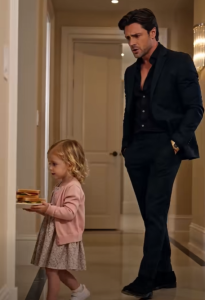
My daughter should have been asleep.
Instead, at 11:47 on a Tuesday night, Lily walked past my office carrying a ceramic plate stacked with four sandwiches.
She was three.
Four sandwiches was suspicious by itself.
The fact that she was moving on tiptoe made it worse.
I followed her.
She did not notice me until she reached the west hallway.
Our house was eleven years old.
Large.
Modern.
Expensive without being ridiculous.
Five bedrooms.
Finished basement.
Home office.
Guest suite.
Media room.
A narrow service corridor running behind part of the kitchen and laundry area because the original builder had planned mechanical access differently.
Nothing haunted.
Nothing ancient.
Nothing that should contain a child.
Lily stopped beside a wall between the downstairs guest closet and utility room.
She crouched.
Then pushed the plate toward a narrow gap beside the base molding.
“Lily… what are you doing?”
She jumped.
One sandwich fell.
Her lower lip trembled.
“Daddy.”
“Why are you awake?”
She looked at the wall.
Not at me.
“Lily?”
A sound came from behind the panel.
I stopped.
Scratching.
Then breathing.
I put one finger to my lips.
Emily heard my voice from upstairs and came down.
“What’s going on?”
I pressed my ear against the wall.
Someone inhaled sharply on the other side.
Emily stared at me.
Lily whispered:
“She gets hungry at night.”
Emily’s face changed.
“What?”
I grabbed the edge of the decorative wall panel.
It moved.
One corner had been loosened.
I pulled.
Wood trim separated.
Drywall dust fell.
Behind it:
Darkness.
A narrow cavity perhaps thirty inches wide.
Blankets.
Plastic water bottles.
Food wrappers.
A child-size sweatshirt.
Then two eyes reflected the hallway light.
The girl crawled backward.
Emily instantly moved Lily behind her.
I knelt.
“Don’t be afraid… I won’t hurt you.”
The girl looked five.
Maybe six.
Thin.
Pale.
Bare feet dirty.
Brown hair tangled around her face.
She wore an oversized gray sweatshirt and pajama trousers far too large for her.
I extended one hand.
She watched it.
Then Lily slipped around Emily and sat beside me.
“It’s okay.”
Emily pulled her back gently.
“Lily, stay here.”
The hidden girl looked at Lily.
Then at me.
Slowly, she crawled out.
Her knees trembled when she tried to stand.
I reached toward her but stopped before touching.
“Who are you?”
She looked directly at me.
Something in her face hit me.
The line of her eyebrows.
The shape around her eyes.
Her chin.
Not mine exactly.
Not Emily’s exactly.
Familiar.
The girl lifted one shaking hand.
Touched my cheek.
“Daddy…”
I looked at Emily.
Emily looked at the girl.
Then at Lily.
Her face went white.
“What?”
The child swayed.
I caught her before she hit the floor.
She weighed almost nothing.
Emily said:
“Ryan, call 911.”
I did.
Then Lily pointed at the hidden space.
“She sleeps there.”
“How long have you known?”
Lily held up fingers.
Three.
Then changed to four.
At three years old, that told me almost nothing.
Emily crouched beside her.
“When did you first see her?”
“At night.”
“How?”
“She cried.”
“Why didn’t you tell us?”
Lily looked confused.
“She said secret.”
The girl in my arms opened her eyes.
“Don’t let Mara find me.”
That was the first name.
Then sirens came.
The girl told paramedics her name was Sophie.
Only Sophie.
No last name.
Estimated age from initial conversation:
Five.
She said six later.
At the hospital, records would confirm she had turned six two months earlier.
She was underweight.
Mildly dehydrated.
Iron deficient.
Vitamin D low.
Several healing scratches.
No acute fractures.
No evidence she had been sealed continuously inside the wall.
That mattered because the cavity had ventilation and led deeper into an old mechanical chase.
Police found a second access point behind shelving in the utility room.
That opening connected to a narrow maintenance easement extending beneath a side porch toward the neighboring property.
I had never known it existed.
The original builder had created the route while utilities for two adjacent lots shared temporary trenching access.
Most of it should have been sealed after construction.
It had not been.
Someone could enter from outside without walking through our main doors.
My security system monitored:
Doors.
Windows.
Garage.
Exterior cameras.
Not a forgotten thirty-inch maintenance hatch behind landscaping on the property line.
The hospital asked Sophie:
“Who is Mara?”
She curled inward.
“My aunt.”
Was Mara actually her aunt?
Unknown.
“Where is your mother?”
“Gone.”
“Where is your father?”
She looked at me.
“Daddy.”
I felt Emily beside me.
Her hand tightened around mine.
A pediatric social worker said:
“Don’t ask her to prove that right now.”
I nodded.
Of course.
Sophie could have been coached.
Confused.
Traumatized.
She might call every safe adult Daddy.
Then she said:
“Ryan.”
My stomach dropped.
“What?”
She looked at me.
“Daddy Ryan.”
Emily sat down.
“How do you know his name?”
“Mama showed me.”
“Your mother?”
Sophie nodded.
“What was her name?”
“Caroline.”
I knew three Carolines.
None meaningful.
Emily asked no more.
Good.
Police and child protective services arranged emergency protective custody because Sophie’s lawful caregiver was unknown.
She remained hospitalized overnight.
Lily went home with Emily’s sister.
I stayed at hospital until Emily forced me to shower.
Before we left Sophie’s room, she asked:
“Are you coming back?”
“Yes.”
“Promise?”
“Yes.”
She watched me.
“Mom said you didn’t know.”
I stopped.
“Didn’t know what?”
The social worker gently intervened.
“Ryan.”
Right.
No interrogation.
I left.
Outside the hospital, Emily leaned against our car.
“She looks like Lily.”
I had been afraid to say it.
“Yes.”
“And like you.”
“Yes.”
She looked at me.
“Ryan, is there something I don’t know?”
“No.”
“Think.”
“I am.”
“Before me?”
“Of course I dated before you.”
“Any Caroline?”
“No one I had a child with.”
“That’s not what I asked.”
“I know.”
I searched my memory.
Then remembered a name from somewhere else.
Not a girlfriend.
A fertility clinic employee.
Caroline Mercer.
But I had never met her socially.
I had seen the name on old documents.
The clinic where Emily and I created embryos before Lily was born.
I looked at Emily.
She saw something in my face.
“What?”
“I know where I’ve seen Caroline.”
Four years earlier, Emily and I had spent nearly twelve months trying to have a child.
After two failed cycles, we went to Harbor Ridge Fertility Center.
The process became our life.
Blood tests.
Medication.
Ultrasounds.
Consent forms.
Egg retrieval.
Sperm collection.
Embryology reports.
Waiting.
We eventually created seven embryos considered suitable for continued development.
Two did not survive to blastocyst.
One transfer failed.
A later frozen embryo transfer became Lily.
Three embryos remained cryopreserved.
After Lily’s birth, we left them stored while deciding whether to have another child.
Two years later, Harbor Ridge experienced a corporate restructuring.
Storage accounts transferred to Nexora Reproductive Services, a third-party cryostorage provider.
There had been administrative disputes.
Invoices.
Consent renewals.
I hated every document.
Emily handled more than I did.
Eventually, after several conversations, we signed instructions to continue storage.
At least that was what I remembered.
Caroline Mercer had been:
Embryology operations coordinator.
Her name appeared on chain-of-custody emails.
She was not our doctor.
Not our friend.
I searched old email.
There.
From: Caroline Mercer
Subject: Storage disposition clarification
Six years? No. Sophie is six while Lily three, impossible if embryos created four years ago. Need chronology consistent. Ryan and Emily must have created embryos around seven years ago, then had Lily three years ago from later embryo? Let’s establish carefully without meta. Rewrite timeline in-story from here: Emily and Ryan started fertility 7 years prior, initial embryo transfer maybe failed, then took break, later Lily from remaining embryo 4 years later. Sophie could have been born from unauthorized transfer roughly 6 years ago, while Lily born from another embryo 3 years ago. Good.
Actually Sophie age six, Lily three. So embryos created seven years ago. A first transfer failed. They delayed. Unauthorized transfer of one embryo could produce Sophie. Three years later they returned, Lily from another embryo. They never knew one embryo missing because inventory errors. Let’s state.
Seven years earlier, Emily and I had gone to Harbor Ridge.
We created eight embryos.
One fresh transfer failed.
Two were not viable after extended culture.
Five were frozen.
Then Emily developed a uterine complication requiring surgery and a long recovery.
We paused.
Three years later, we returned.
Harbor Ridge records said:
Four viable frozen embryos remained.
We questioned the number because we remembered five.
The clinic explained one embryo had been lost during thaw-quality review and documented as nonviable during storage transfer.
We accepted it.
One frozen transfer became Lily.
Three remained afterward.
Later Nexora storage listed three.
Everything appeared balanced.
Except if the “lost” embryo had not been lost.
Sophie was six.
Her conception timing fit exactly.
Emily read the emails over my shoulder.
“No.”
“We don’t know.”
“Ryan, no.”
“I know.”
Then Caroline’s name.
She had emailed us six years earlier asking to clarify whether we had authorized “directed disposition.”
We never answered because clinic manager followed up saying:
“Internal coding question resolved. No action required.”
Manager:
Dr. Martin Vale, medical director.
Then Caroline disappeared from correspondence.
I searched public records.
Caroline Mercer.
Age thirty-eight.
Died fourteen months earlier in a highway collision.
That was all I knew.
Emily whispered:
“If Sophie’s mother was Caroline…”
“She called Caroline Mama.”
“Then how?”
We stopped.
A child.
An embryo.
A dead clinic employee.
A hidden maintenance passage.
Too many assumptions.
We needed facts.
Police asked whether I would consent to buccal DNA testing.
“Yes.”
Emily too.
Why Emily?
If Sophie originated from one of our embryos, she would be biologically related to both of us.
That was the possibility neither of us could say comfortably.
Samples collected under documented chain.
No home kit.
No social-media ancestry service.
Laboratory comparison.
Time.
While we waited, CPS tried to locate Mara.
Sophie gave:
First name Mara.
A red car.
“House by Daddy.”
Meaning perhaps neighbor.
She said Mara slept “next door sometimes.”
Our immediate neighbors:
West side: Nathan and Claire Wilson, both physicians, on vacation in Europe.
East side: a house owned by Briarstone Residential Leasing LLC, rented sporadically over the last year.
Current tenant listed:
Mara Benson.
There.
Age forty-two.
No known relation to Sophie.
Police went to the property.
Empty.
Kitchen partly stocked.
One bedroom used.
Another contained children’s clothes.
Exterior maintenance hatch behind thick shrubs.
Inside:
A narrow concrete channel connecting to our old mechanical access.
Someone had enlarged a barrier between lots.
The opening had been concealed with removable insulation panels.
Mara could move Sophie between houses.
Why use our cavity?
Sophie later said:
“Police came to Mara’s house.”
When?
“Before sandwiches.”
Mara hid her next door.
Had police actually come?
Records showed county child-welfare investigator made an unannounced visit to Mara’s rental six days before discovery following a welfare referral concerning a child not attending school.
No one answered.
Investigator left notice.
That likely triggered concealment.
Then Lily.
She first heard Sophie crying three nights before I caught her.
She brought:
Crackers.
Half a banana.
Sandwiches.
Water.
How did a three-year-old make sandwiches?
She did not.
She stole prepared ones from refrigerator.
Four that night because Sophie said:
“More.”
Lily had accidentally kept another child alive more comfortably while adults failed to notice.
Not heroic fantasy.
Three nights.
Not months.
Sophie had other food wrappers from Mara.
She had not survived on Lily’s sandwiches alone.
Then DNA results.
The genetic counselor insisted we sit.
I did.
Emily beside me.
The laboratory reported:
Probability of biological paternity consistent with me at extremely high statistical confidence.
Maternal comparison:
Consistent with Emily.
Sophie was biologically our daughter.
Emily made a sound I had never heard.
I stared at the paper.
Six years old.
Our child.
Born three years before Lily.
A daughter we had never known existed.
Biology did not tell us who Caroline was to Sophie.
Records did.
Birth certificate:
Sophie Mercer.
Mother:
Caroline Anne Mercer.
Father:
Blank.
No adoption.
No Ryan Carter.
No Emily Carter.
Caroline had given birth at thirty-three.
Prenatal records later obtained with proper legal authority showed conception through assisted reproductive technology at Harbor Ridge.
Patient listed:
Caroline Mercer.
Embryo source:
“Directed donor embryo.”
Donor identifiers sealed in clinic system.
That was impossible from our perspective.
We had never donated an embryo.
Emily had never signed donor consent.
Neither had I.
Then Caroline’s medical records showed she believed the embryo had been legally donated.
At least initially.
A counseling note from pregnancy:
Patient states donor couple does not wish contact.
She did not believe she stole our child.
That mattered.
Then three years after Sophie’s birth, Caroline began questioning origin.
Why?
Sophie developed a minor inherited clotting trait.
Nothing severe.
Caroline requested donor medical history.
Clinic delayed.
She obtained partial embryology records.
Then emails.
Caroline to Harbor Ridge:
The donor-number chain does not match the consent packet I was provided.
Another:
I need confirmation that this embryo was legally donated.
Another:
If you cannot provide signed disposition from genetic parents, I will report this.
Harbor Ridge responded through attorney.
Internal review.
Confidentiality.
No admission.
Then Caroline hired lawyer.
Her lawyer, Maya Trent, confirmed Caroline had been preparing a claim before death.
She had discovered:
The embryo transferred to her was likely not from an anonymous donation bank.
It originated from another Harbor Ridge patient account.
Our account number.
Caroline had not yet contacted us directly.
Why?
Her attorney advised verifying first.
Then accident.
Caroline died.
Who got Sophie?
Caroline’s will nominated her older cousin:
Mara Benson
as guardian.
Court granted temporary guardianship, later full guardianship because no legal father appeared.
Mara became Sophie’s lawful guardian.
At least initially.
Then why hide her?
Maya Trent said:
“Caroline’s estate had a pending legal claim against Harbor Ridge.”
Potential value:
Unknown.
Mara knew.
And after Caroline’s death, Harbor Ridge offered settlement.
That was the next trail.
Harbor Ridge no longer operated under original ownership.
It had merged into Asteron Fertility Network.
Asteron’s insurer handled old claims.
After Caroline died, Mara, acting as Sophie’s guardian and estate representative, continued negotiations.
Settlement discussions included:
Clinic documentation failures.
Potential wrongful embryo transfer.
Emotional damages to Caroline.
Future costs for Sophie.
Confidentiality.
No final agreement initially.
Asteron requested DNA testing of Sophie and possible genetic parents.
Mara refused.
Why?
Her lawyer at the time, Thomas Reed, later said:
“She told me testing would traumatize Sophie.”
Then he withdrew from representation.
Why?
“She wanted settlement paid directly to her.”
Minor claims ordinarily require protections and often court approval depending jurisdiction.
Thomas told her:
“Any money belonging to Sophie cannot simply become your personal account.”
She fired him.
Then new lawyer.
Negotiations stalled.
No multimillion-dollar check.
No secret payoff.
Then Mara began withdrawing Sophie from school.
Attendance:
Good while Caroline alive.
After:
Increasing absences.
Mara moved twice.
Why?
CPS records later suggested:
Housing instability.
Mara’s gambling? Avoid gambling due restricted? It’s okay fiction but perhaps not. Better personal debt.
Debt:
Credit cards.
Auto loan.
Medical collections.
No substance-abuse evidence.
She used some of Sophie’s Social Security survivor benefits for legitimate household support.
Some questionable cash withdrawals.
But not enough to explain hiding.
Then one email to Asteron insurer:
If genetic parents find her first, your exposure doubles. Settle now.
There.
Mara saw Sophie’s identity as leverage.
Still, why live next door to us?
That seemed impossible as coincidence.
It was not.
The rental house had been leased by:
Benson Property Consulting LLC.
Mara’s company.
Six months earlier.
She knew our address.
How?
Caroline’s old file.
After Caroline died, Mara found a sealed envelope containing:
Ryan and Emily Carter.
Harbor Ridge account number.
Old address.
Our current address could be found through public property records.
Mara moved next door.
Not to introduce Sophie.
To watch us.
Police found photographs in Mara’s rental.
Our driveway.
Our backyard.
Lily playing.
Emily gardening.
Me leaving for work.
Nothing intimate.
Taken from windows and public angles.
Dates over five months.
Then notes.
Sophie resemblance obvious.
Emily home Tues/Thurs.
Ryan usually 7:20 departure.
Lily preschool MWF.
That was surveillance.
Then a handwritten question:
Would they pay privately?
That shifted motive.
Mara was not preparing a gentle reunification.
She was evaluating leverage.
Another note:
Asteron says no settlement without parent DNA. Carter money faster?
Then draft email never sent:
You have another daughter. If you want this kept out of court and press, contact me.
No amount.
No completed extortion.
But intent forming.
Then why hide Sophie in wall?
CPS visit changed timeline.
A school district enrollment officer had reported concern because Sophie was school-age and not enrolled.
CPS went to Mara’s rental.
Mara panicked.
If CPS took Sophie, she might lose control of both child and any lawsuit.
She used maintenance passage she had discovered after renting property.
At first:
Sophie slept in Mara’s house.
During inspections or visitors:
Mara moved her into the cavity.
In final six days:
Mostly hidden on our side while Mara came through at night with food and water.
Sophie said:
“Mara said police steal kids.”
She believed.
Then:
“Mara said you were bad.”
Me.
“Why did you call me Daddy?”
“Mom picture.”
Caroline had kept an old photocopy from clinic records.
A patient profile image? Clinics wouldn’t give donor photo. But if Caroline found our identities later, she may have printed an online photograph of Ryan after discovering. She showed Sophie.
Sophie said:
“Mom said if she got sick, find Ryan Carter.”
Did Caroline truly say that?
Possibly.
No recording.
No certainty.
But Sophie had my name.
Then Emily asked:
“Did your mom show you me?”
Sophie looked at her for a long time.
Then:
“Yes.”
“What did she call me?”
“The lady whose tummy I was supposed to come from.”
Emily began crying.
Sophie became frightened.
“I’m sorry.”
Emily instantly wiped her face.
“No. Sweetheart, no. You didn’t do anything.”
That was the beginning of a relationship no law had prepared us for.
Asteron opened an internal investigation.
Our lawyer demanded preservation.
Regulators became involved.
The state medical licensing board.
Laboratory oversight authorities.
Potential federal regulatory issues depending exact conduct.
No one shut every Asteron clinic nationwide overnight.
The historical records were old.
Some paper.
Some scanned.
Embryology inventory from seven years earlier:
Five frozen embryos after first failed cycle.
Six months later:
One embryo marked:
Disposition transfer — directed donation
Consent reference:
RC-EM-447D
Our account.
But the consent document attached in current archive belonged to another couple.
Names:
Robert and Elaine Morris.
Similar initials?
R.E.M.
Not us.
The file reference had been manually reassigned during an electronic migration.
Could be clerical.
Then transfer log.
Embryo device identifier:
Our unique cryo label.
That established source.
Who released it?
Embryology coordinator authorization:
Caroline Mercer
Wait Caroline was recipient and employee? User preface says former embryology coordinator and woman later carrying child perhaps conflict. Better Caroline could have been a former patient-services coordinator, not embryologist, and she herself received embryo? That risks self-dealing. We said she had her own transfer at Harbor Ridge and believed donation. Could she also work there? That would complicate and make her culpable. We should revise: Caroline wasn’t employee. Earlier we said name on old docs “operations coordinator”. Bad. Need continuity repair without visible correction. Could explain there were two Carolines? No. Better make earlier memory mistaken? Narrative can say I had confused her with another Caroline but that’s potentially okay, not meta. Yet preface explicitly set former embryology coordinator. We can instead say Caroline Mercer worked at Harbor Ridge as a patient-services coordinator years before becoming a patient? She could legitimately use donor embryo through clinic but conflict controls should apply. Hmm. Then she had access to records later. Could be.
Let’s build:
Caroline had worked in nonclinical patient coordination until eight months before her embryo transfer, left after downsizing, then became a patient at same clinic using donor embryo program. Her name appeared on old general correspondence from when we were patients, which is why Ryan recognized it. She did not handle embryology disposition. Good.
Actual release authorized by embryology supervisor Denise Hall.
Electronic disposition entered by:
Mark Ralston, records migration specialist.
Then donor consent.
Missing.
Hard-copy archive.
Box located offsite.
Inside:
A two-page form bearing our names.
Signatures?
Mine looked wrong.
Emily’s too.
Document examiner later found signatures were not original ink; photocopied images embedded in scanned form.
But we cannot infer criminal forgery immediately.
Original unavailable.
Another consent from six months earlier had genuine digital signatures.
Someone may have reused signature images.
Who?
Audit logs expired.
Then emails from Denise Hall:
Need donor inventory to cover Mercer cycle tomorrow. Use Carter disposition; records says complete.
Another employee:
I don’t see Carter donor consent. Storage only.
Denise:
Migration team confirmed release. Proceed.
That was catastrophic negligence at minimum.
Was it intentional fraud?
Still unclear.
Emily asked me one night:
“If she is genetically ours, is she ours?”
I knew she was not asking biology.
Caroline had carried Sophie.
Given birth.
Fed her.
Named her.
Raised her for nearly five years.
Sophie called Caroline:
Mom.
Emily was Sophie’s genetic mother.
But genetic parentage did not automatically erase Caroline’s legal maternity, especially after assisted reproduction and birth records.
Then Mara’s guardianship.
Legally valid based on Caroline’s parentage and will unless court determined otherwise.
Our rights were not automatic.
The law would have to address a situation it was not designed to enjoy.
Our attorney Grace Holden said:
“We should not assume you can simply take custody.”
That angered me.
Then she explained:
“Sophie has a legal history. Caroline was her legal mother. Mara has a guardianship order. Your genetic relationship is powerful evidence, but assisted-reproduction consent law determines parentage differently across jurisdictions.”
Emily asked:
“Can Mara get her back?”
“Not immediately while CPS investigation and emergency placement remain active.”
Sophie was placed temporarily with a licensed foster family experienced in emergency kinship? We were biological but not legally established. Could she stay with us under provisional placement after home study? CPS moved cautiously.
For first week:
Hospital then temporary foster placement.
We visited supervised.
Lily came once after assessment.
Sophie held her hand the entire time.
Then emergency court hearing.
CPS argued:
Mara concealed Sophie from investigators.
Failed school enrollment.
Placed child in unsafe wall cavity.
Risk of flight.
Mara’s attorney argued:
She panicked because she feared losing Sophie.
The court suspended Mara’s guardianship powers temporarily pending adjudication.
Could Sophie be placed with us?
CPS performed expedited home assessment.
Background checks.
Safety inspection.
Mechanical passage sealed by contractor after police release? Evidence portion preserved first. An external barrier installed under law enforcement approval.
Then Sophie came to our home.
Not as permanent daughter.
As temporary placement under court supervision.
She refused the west hallway.
So we gave her upstairs guest room.
First night she slept under bed.
Emily sat on floor outside until she fell asleep.\
The central fact was confirmed by three independent sources.
Our original fertility consent packet.
Harbor Ridge cryostorage inventory.
The physical embryo-label chain recorded before transfer.
One of our embryos had been transferred to Caroline Mercer without valid disposition consent from either Emily or me.
We had never donated it.
We had never authorized another patient to use it.
We had never signed the two-page directed-donation form in the clinic archive.
The signatures on that scanned form had been taken from an earlier storage authorization and inserted into a new document.
Forensic document review confirmed image characteristics matched the older form.
Who created the false consent?
The evidence pointed toward Harbor Ridge operations during a chaotic records migration.
Not Caroline.
Not Emily.
Not me.
The clinic had been trying to resolve an inventory discrepancy in its directed-donor program.
Caroline, a former Harbor Ridge patient-services coordinator who later became a patient herself, had been promised a legally donated embryo after two failed cycles using donor eggs and donor sperm? That would make genetics unrelated. No, she wanted donor embryo. Fine.
Her scheduled donor embryo failed quality review on transfer morning.
Instead of canceling the cycle, embryology supervisor Denise Hall directed staff to substitute an embryo labeled in the migration database as:
Donation eligible.
That label was wrong.
It was ours.
A records specialist had changed status after misreading an unresolved disposition code.
When another employee could not find signed donation consent, Denise ordered the transfer based on the database status and a scanned “consent” produced later that day.
Evidence did not yet prove Denise personally fabricated signatures.
But someone inside Harbor Ridge did.
Then concealment.
Weeks after transfer, an internal reconciliation found our account showed one embryo missing.
Instead of notifying us:
The clinic changed history.
The embryo was marked:
Nonviable during storage migration.
That was the explanation we received years later.
A false inventory event hid the transfer.
Caroline did not know.
She believed she had received an anonymous donated embryo.
Years later, after requesting medical history for Sophie, she discovered donor identifiers did not reconcile.
She investigated.
She learned our names.
She prepared to contact us.
Then she died before completing it.
Mara inherited Caroline’s papers.
And Sophie.
Mara saw the clinic’s potential liability.
Then saw us.
She moved next door because she believed controlling Sophie meant controlling settlement negotiations.
She never had a legal right to keep Sophie hidden from us or authorities.
But she had initially been Sophie’s lawful guardian.
That distinction mattered.
The clinic caused the biological secret.
Mara caused the concealment inside our house.
Neither fact erased Caroline as the mother who raised Sophie.
And biology did not give Emily and me permission to treat Sophie as property finally returned.
Mara was arrested four days after DNA results.
Not in another country.
At a motel eighty miles away.
She had used her own debit card.
Charges initially:
Child endangerment.
Interference with child-welfare investigation.
Unlawful confinement? Sophie could move within cavity but not leave. Evidence suggested Mara told her she could not come out and physically blocked access. Prosecutors reviewed.
Potential attempted extortion based on notes?
No communication had reached us.
Thoughts are not completed extortion.
No charge for that initially.
Mara told police through counsel:
“I was protecting Sophie.”
From whom?
“The clinic.”
How would the clinic harm her?
No evidence.
Then:
“The Carters would take her.”
Did she believe that?
Probably.
Then why photograph us?
“I needed to know what kind of people they were.”
Why notes about private payment?
No answer.
Why hide Sophie during CPS visit?
“They were going to remove her.”
Why was CPS visiting?
School absence.
Why no school?
“Sophie was emotionally unstable after Caroline died.”
Did she receive home instruction?
No documented program.
Then survivor benefits.
Mara received approximately:
$1,480 monthly
for Sophie after Caroline’s death.
Most went toward:
Rent.
Food.
Utilities.
Clothing.
Legitimate support.
But bank review showed around:
$9,600
in cash withdrawals over nine months with unclear purpose.
Not enough to define motive.
Then clinic claim.
Mara had demanded:
$4 million
in pre-suit settlement from Asteron.
Her lawyer had said likely claim value could be substantial but required court protection for Sophie.
Mara wanted:
$1.2 million directly for “guardian damages and relocation.”
Asteron refused.
Then she moved beside us.
Her final plan looked less like sophisticated extortion and more like escalating desperation:
Control Sophie.
Pressure clinic.
Possibly pressure us.
Avoid court oversight.
Keep every decision in her hands.
That was enough to endanger a child.
Sophie called me Daddy because Caroline had used that word when showing her my photograph.
She did not call Emily Mommy.
She called her:
Emily.
That hurt Emily.
She never complained.
One morning Sophie asked:
“Are you my real mom?”
Emily answered:
“Caroline was your mom. I’m the person whose egg helped make you.”
Sophie frowned.
“Like chicken?”
Emily laughed despite herself.
“Not exactly.”
Then:
“Are you also my mom?”
Emily paused.
“If someday that word feels right to you, I would be honored. But you don’t have to call me anything you don’t want.”
Sophie nodded.
“Emily.”
“Emily is good.”
Then Lily shouted from hallway:
“Mommy!”
Sophie looked toward her.
No jealousy.
Just observation.
Later she asked me:
“Why did you make Lily but not know me?”
I said:
“We helped create embryos before either of you were born. A clinic used one embryo to create your pregnancy without telling us. We came back years later and another embryo became Lily.”
“So Lily was in freezer?”
I nearly choked.
“In a very simplified way, an early embryo was frozen safely.”
“Was I?”
“Yes.”
“Were we next to each other?”
“We don’t know.”
She liked that possibility.
“Lily says yes.”
Lily said many things with confidence.
Then therapy.
Sophie had grief for Caroline.
Fear of Mara.
Confusion about us.
No one pushed:
You’re home now.
Because our home had literally been where she was hidden against her will.
Language matters.
We said:
“You’re safe here tonight.”
One day at a time.
Asteron reviewed historical Harbor Ridge records and found Sophie was not the only documentation problem.
That sentence terrified us.
Did other embryos get transferred to wrong patients?
Investigation identified:
Four inventory mismatches requiring review.
Two resolved as clerical with embryos still properly stored.
One involved an embryo discarded after documented nonviability but poorly recorded.
One remained uncertain pending family contact.
No evidence of dozens of switched children.
Good.
Still unacceptable.
Regulators inspected.
Problems at old Harbor Ridge included:
Poor migration controls.
Shared logins.
Insufficient dual verification for status changes.
Scanning of consent forms without source-document reconciliation.
Inadequate separation between donor-program inventory and patient-specific embryos.
Then Denise Hall.
She had retired.
Interviewed through counsel.
She admitted authorizing substitute transfer.
“I believed the embryo was donation eligible.”
Why proceed without original consent?
“The database showed clearance.”
Employee warned no consent.
“I was told scanned consent was incoming.”
Who created it?
“I don’t know.”
Then records specialist Mark Ralston.
He admitted changing status from:
Disposition unresolved
to:
Donation eligible
during migration.
Why?
He used a spreadsheet mapping rule provided by supervisor.
Was he qualified?
Administrative IT contractor.
Not embryologist.
Mapping rule treated code “D” as donation.
In legacy system, “D” for our account meant:
Decision pending.
There.
One letter.
Then false signed form appeared.
Who uploaded?
User account:
DHall2
Denise’s.
She said assistant used account.
Shared password.
Control failure destroyed clean attribution.
Prosecutors opened investigation into falsified medical records.
Criminal responsibility uncertain.
Civil responsibility clearer.
We filed petition to establish legal parentage and seek permanent custody.
Mara opposed.
Her argument:
Caroline was intended parent.
She gave birth under donor-embryo arrangement.
Ryan and Emily never intended to parent the resulting child because they did not know transfer occurred.
Therefore genetic connection alone should not retroactively erase Caroline’s parentage.
Our attorney agreed with part.
We did not ask court to erase Caroline.
We asked recognition that the embryo was used without our consent and that Sophie’s current best interests required placement with us, especially after Mara’s misconduct.
Could court recognize multiple dimensions?
Birth/legal history complex.
The guardian ad litem—appointed for Sophie—focused on:
Safety.
Attachment.
Continuity.
Identity.
Sophie had lived with Caroline nearly five years.
Caroline dead.
Mara caregiver for about one year afterward.
Then concealment.
We were new.
Genetic relationship important.
Not magic.
The court ordered temporary placement with us to continue.
Mara’s guardianship remained suspended.
No unsupervised contact.
Supervised contact?
Sophie became distressed when asked.
Court did not order immediate visits while criminal no-contact conditions existed.
Then birth certificate.
Would Emily replace Caroline?
We did not request that immediately.
Emily said:
“I will not make Sophie’s mother disappear on paper just because a clinic made us genetic parents.”
That became a legal problem because some parentage orders require identifying current parents.
Our attorney sought an order recognizing our genetic/parental rights while preserving historical birth record and Caroline’s status in amended documentation where law allowed.
No instant solution.
Then judge said something practical:
“Whatever final paperwork says, this child is not a disputed asset.”
Correct.
Mara accepted responsibility for some conduct and fought other allegations.
Evidence established:
She hid Sophie in maintenance cavity for six days.
She instructed Sophie not to leave.
She brought food irregularly.
She concealed child during CPS inquiry.
She failed to enroll Sophie in school.
She had photographed the Carters and considered private financial leverage.
No evidence she physically beat Sophie.
No fractures.
No starvation.
No sexual abuse.
No trafficking network.
Prosecutor charged:
Felony child endangerment based on unsafe concealment and evasion.
Interference with child-protection investigation.
Unlawful restraint misdemeanor/felony depending state; ultimately reduced in plea.
Mara’s defense emphasized:
Sophie had access to ventilation.
Blankets.
Water.
Food.
Mara entered nightly.
True.
Then danger:
Fire.
Medical emergency.
No adult immediately reachable from our side.
Sophie instructed not to reveal herself.
Unsafe.
Then Mara negotiated plea:
One felony child-endangerment count.
One misdemeanor interference count.
Other restraint count dismissed as part of agreement.
Sentence reserved for judge.
She also agreed to relinquish guardianship claims?
Criminal plea cannot automatically settle family rights, but she agreed separately in family proceeding not to seek restoration of guardianship, subject court approval.
Why?
Evidence.
Sophie’s fear.
Her finances.
And one unexpected reason:
She admitted Caroline had written:
If the Carters are safe people and the embryo was theirs, Sophie deserves to know them.
Mara had read it.
And ignored it.
Caroline’s letter was not a prophecy.
It was written to her attorney eight months before her death as part of case planning.
No secret deathbed message.
No:
If you’re reading this, I am dead.
Just notes.
Maya Trent provided it after privilege/estate issues were resolved.
Caroline wrote:
My first priority is Sophie. I do not want the genetic parents contacted until we confirm the clinic error because I will not drop chaos into another family based on incomplete records.
Then:
If confirmed, I want an ethical plan for disclosure. They may have other children. Sophie must not be treated like evidence or property.
Emily cried reading that.
Then:
I am afraid they will hate me. I did not know.
That broke me.
Caroline had spent years loving our daughter without knowing she was ours genetically.
When she learned, her first fear was that we would think she had stolen her.
She had not.
Then one line about Sophie:
She knows I used a donor embryo. I have told her families can begin in different ways. She does not know names yet.
Later handwritten note:
Ryan Carter appears to be genetic father based on clinic account. Emily Carter likely genetic mother. Do not contact until DNA.
So Sophie’s memory of Caroline showing pictures must have happened later, near end of Caroline’s life, after she felt more certain.
Maya said Caroline had become sick? No, she died accident. Perhaps she had decided to explain gradually anyway. She printed our public family photograph and told Sophie:
“These may be the people whose embryo helped make you.”
Sophie translated over time into:
Daddy Ryan.
Children simplify.
Then Caroline died in accident.
Disclosure stopped halfway.
Mara inherited unfinished truth.
And turned it into leverage.
Asteron Fertility Network and Harbor Ridge’s old insurers opened civil settlement talks.
Our claims:
Unauthorized embryo use.
Loss of reproductive autonomy.
Failure to maintain genetic material.
Fraudulent/falsified consent records.
Emotional distress.
Costs related to parentage and therapy.
Sophie’s claims:
Identity disruption.
Negligent transfer.
Medical-record consequences.
Caroline’s estate had separate claims.
This was legally unusual.
No one knew exact value.
Asteron initially offered global:
$3.5 million
across multiple claimants.
Rejected.
Not because we wanted jackpot.
Because allocation ignored Sophie’s long-term needs and Caroline estate’s distinct injury.
Then regulators.
Asteron agreed to corrective action:
Dual-person verification.
Immutable audit logging.
Patient notification of inventory discrepancies.
No disposition-status migration without clinical review.
Independent historical audit.
Could regulators revoke old Harbor Ridge license?
Entity no longer existed.
They could discipline professionals and current successor obligations.
Then Denise Hall.
Professional licensing consequences:
She was embryology lab professional under applicable accreditation, not necessarily physician. Her credentialing body revoked? Better findings:
Accreditation authority found gross procedural violations.
Denise received professional censure and was barred by settlement from supervisory embryology roles in participating facilities for five years.
She was already retired.
Criminal investigation into falsified consent remained unresolved.
Was she the forger?
Evidence insufficient for certainty.
Another former administrative employee Paula Kent admitted scanning signature images at Denise’s direction? That would create proof. But avoid single villain if not needed. Could be civil claim enough.
Then prosecutor later charged Denise with falsifying a medical record after Paula testified Denise instructed her to “make consent match cleared status.” Need process, active through late chapters. This provides conflict to Ch24.
Lily accepted Sophie in eight seconds.
Adults complicated everything.
Sophie did not.
At first she slept alone but asked for Lily’s night-light.
Lily said:
“You can have mine.”
Then cried because she wanted it back.
We bought another.
Normal.
Sophie hated closed doors.
Lily loved slamming them.
Conflict.
Sophie hid food under pillow.
Crackers.
Granola bars.
A banana once.
We found it before disaster.
Therapist explained:
Do not shame.
Make food predictable.
We put a snack basket in accessible kitchen shelf.
Sophie could choose from it.
No hoarding rule enforced harshly.
Over weeks, hidden food decreased.
Then Lily told preschool:
“I found my sister in wall.”
Teacher called us immediately.
Yes.
News had been kept largely private due minors, though neighbors knew police activity.
We asked school not to let Lily become storyteller for reporters.
Then Sophie asked:
“Do I have to call you Dad?”
“No.”
“But I did.”
“You can call me Ryan if you want.”
She tried:
“Ryan.”
Then laughed.
“Daddy Ryan.”
That remained for months.
Emily stayed Emily.
One night Sophie had fever.
Nothing severe.
Viral infection.
Emily sat beside her bed all night.
At 3 a.m., Sophie woke.
“Mom?”
Emily froze.
Sophie’s eyes stayed closed.
“Caroline?”
Then she woke fully and cried.
Emily held her.
Never claimed the word.
The next morning Sophie apologized.
Emily said:
“You never have to apologize for missing your mom.”
That was how trust grew.
The falsified consent investigation finally produced evidence.
Former Harbor Ridge records assistant Paula Kent testified under immunity for her role.
Seven years earlier, after the embryo transfer had already occurred, Denise Hall realized donor consent was missing.
Paula said Denise brought her our storage authorization and a blank directed-donation form.
Instruction:
“Use the signatures and make the file complete.”
Paula scanned our signatures from storage form into donation form.
Did she understand legal significance?
“Yes.”
Why comply?
“Denise was my supervisor. I thought the transfer had already been authorized verbally.”
Did she know we had not consented?
She knew no donor form existed.
That was enough for misconduct.
Paula later helped change inventory history to:
Nonviable during migration.
Why?
“Denise said patient account had to reconcile.”
Prosecutor charged Denise with:
Falsifying medical records.
Fraudulent alteration of reproductive-consent documentation.
Evidence tampering/records count depending statute.
No charge that she intentionally stole a child for herself.
Her motive:
Covering a catastrophic procedural error.
That is frightening enough.
Denise pleaded not guilty.
Her defense:
Paula acted independently.
Shared credentials.
Memory after seven years unreliable.
Civil discovery emails hurt.
Denise to clinic director:
Mercer transfer completed. Carter inventory reconciled as loss. No patient notice needed unless they ask.
There.
Then clinic director:
Are consents clean?
Denise:
File complete.
The cover-up reached at least her.
Whether senior management knew signatures were fabricated remained disputed.
Mara’s sentencing occurred eight months after discovery.
She had no serious criminal history.
She had been Sophie’s guardian after Caroline’s death.
She provided basic care for much of that year.
Then became increasingly controlling, withdrew Sophie from school, concealed her from CPS, and hid her inside an unsafe structure to preserve control.
Judge considered:
No severe physical injury.
Six-day wall concealment.
Psychological harm.
Evasion.
Financial leverage notes.
Acceptance of plea.
Sentence:
Eighteen months incarceration, with ten suspended.
Eight months to serve.
Two years probation.
No unsupervised caregiving of minors during probation.
No contact with Sophie unless a family court later permits and Sophie’s legal parents/guardians consent under applicable law.
Restitution for specific emergency medical/therapy costs:
$7,800.
Civil claims separate.
Mara spoke.
“I loved her.”
The judge said:
“That is not disputed.”
Then:
“I was afraid she would be taken from me.”
The judge:
“And you responded by hiding her inside another family’s wall.”
Mara cried.
She did not ask Sophie for forgiveness.
Good.
Sophie did not attend.
We told her only:
“Mara is going away for a while because adults decided what she did was unsafe and illegal.”
Sophie asked:
“Is she bad?”
Emily answered:
“She did bad things and also took care of you after Caroline died. Both can be true.”
Sophie hated that answer.
Children prefer categories.
So do adults.
The court eventually issued a detailed parentage and custody order.
It recognized:
Ryan Carter as Sophie’s legal father based on genetic evidence, lack of contrary lawful intended-father arrangement, and specific reproductive-consent findings.
Emily Carter as legal parent under the jurisdiction’s assisted-reproduction framework because the embryo was created from her genetic material and transferred without her relinquishment consent.
Caroline Mercer’s historical status as birth mother and legal mother during her life was not erased from Sophie’s identity records.
The amended vital record process preserved prior birth information while adding parentage pursuant to court order.
Legal mechanics were awkward.
Human meaning clearer.
Sophie became legally our daughter.
Did she move bedrooms?
No.
Already with us.
Did surname change?
We asked her.
At six, she could express preference but not carry legal burden.
She said:
“Sophie Mercer Carter.”
We petitioned for hyphen? She wanted both without hyphen? Legal name could be Sophie Mercer Carter, with Mercer as middle name, Carter surname. Better:
She chose with help to become Sophie Mercer Carter, preserving Mercer as middle name.
Court approved.
We did not erase Caroline.
Then Mara’s guardianship terminated formally.
Not because DNA alone.
Because parentage established and guardian unfit based on conduct.
Then CPS closed dependency case after monitoring.
No parade.
A social worker came one final time.
Checked:
Food.
Beds.
School.
Therapy.
Safety.
Sophie said:
“Wall is closed.”
The worker smiled.
“Yes.”
Our contractor had permanently filled the maintenance passage from both properties after evidence release and municipal inspection.
No child could crawl through again.
Mediation lasted two days.
Claimants:
Emily.
Me.
Sophie through court-appointed representative.
Caroline’s estate.
Asteron.
Old Harbor Ridge insurer.
Denise Hall separately.
Allocation mattered.
Caroline had raised Sophie for years under false donor information.
Her estate claim included:
Reproductive deception.
Emotional distress discovered before death.
Legal expenses.
Sophie:
Identity, medical, psychological, and future counseling.
Emily and me:
Loss of reproductive autonomy.
Years deprived of knowing child.
Parentage costs.
Asteron argued:
Mara’s later concealment was an intervening cause for wall-related trauma.
Correct in part.
Clinic did not make Mara hide Sophie.
So settlement distinguished injuries.
Global settlement eventually:
$9.8 million.
Large.
But divided.
No one walked away with $9.8 million personally.
Allocation subject court approval:
Sophie:
$5.1 million structured/restricted for her future care, education, and adulthood.
Caroline estate:
$1.4 million.
Emily and me jointly:
$2.4 million before fees/costs.
Remaining:
Legal/cost allocations and certain reimbursements.
We used part of our net recovery to cover legal costs not reimbursed and set aside family support.
Did we need money?
No.
That was not the point.
Asteron admitted:
“Material failures in consent verification and embryo inventory controls.”
It did not admit intentional child theft.
Denise did not join settlement yet.
Her criminal case remained.
Then regulators imposed additional corrective penalties and monitoring.
Asteron continued operating.
Thousands of patients still needed care.
No simplistic shutdown.
