
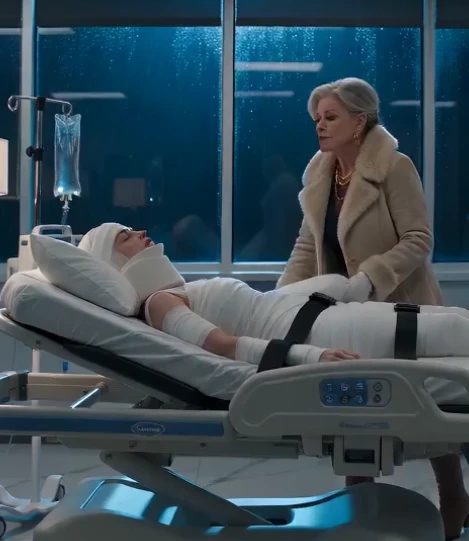
The perfume reached me before she did.
Soft powder, expensive flowers, and something faintly sweet that I had once associated with formal dinners and charity galas.
For two years, I had smelled it whenever my mother-in-law entered a room.
That night, lying beneath harsh hospital lights with most of my body trapped inside a rigid cast, the familiar scent made every muscle I could still control tighten.
Cordelia Voss was coming.
I could not turn my head.
I could not raise my shoulders.
I could barely shift the thumb of my right hand.
But I could hear.
That was the one thing Cordelia did not know.
Everyone believed the swelling around my spine had left me unaware of the world. My eyes opened sometimes, but I did not answer questions. I did not follow fingers when doctors moved them in front of me. I did not react when Adrian whispered my name.
The neurologist had carefully told my husband that the next few days would matter.
There was no certainty yet.
There were only possibilities.
Adrian had lowered his head and looked devastated.
Cordelia had asked about long-term care.
That told me almost everything I needed to know.
Now it was after eleven at night.
The ICU corridor had become quieter.
One nurse sat at the station around the corner. Another had gone to help with a patient in the next wing.
My room had a private door because Adrian had insisted on privacy.
At the time, everyone had praised him for protecting me from reporters.
I understood the real reason.
Privacy created opportunity.
The door opened.
Cordelia stepped inside.
Even through my narrow field of vision, I recognized the pearls.
She wore them almost every day.
Small, perfectly matched, passed down from some great-grandmother whose portrait hung in the west hall of the estate.
Her coat was cream.
Her shoes were low and sensible.
White gloves covered both hands.
She looked less like someone visiting an injured relative and more like a woman arriving for afternoon tea.
She closed the door.
Then she stood still.
I could hear the machines beside me.
A soft mechanical breath from the oxygen.
The pulse monitor.
The hum of the ventilation system.
Cordelia remained near the door for several seconds.
I imagined her studying me.
Making sure.
She moved closer.
The perfume grew stronger.
“Lillian.”
Her voice was quiet.
I did not respond.
She waited.
“Lillian, can you hear me?”
Nothing.
My right thumb rested beneath the edge of the cast.
Jonah Mercer had hidden the recorder there two days earlier.
Move once to begin recording.
Move twice to transmit an emergency signal.
I had practiced while nurses were gone.
The movement was so small that nobody watching from across the room would notice it.
I moved my thumb.
Once.
The device activated.
Cordelia approached the bed.
“Well.”
She exhaled.
“I suppose this is what stubbornness looks like in the end.”
Her voice no longer contained the sympathy she used around doctors.
This was the Cordelia I knew.
Cold.
Precise.
Almost bored.
She pulled the visitor chair closer and sat.
For a moment, she said nothing.
Then she looked toward the machines.
“You really created an astonishing amount of trouble.”
My heart began beating faster.
The monitor responded.
Cordelia glanced at it.
I worried she would understand.
Instead, she smiled faintly.
“Perhaps something in there still works.”
She leaned closer.
“I used to wonder whether Adrian would eventually get tired of you on his own.”
The monitor continued its steady rhythm.
“I hoped he would.”
A pause.
“He usually gets tired of people.”
I wanted to open my eyes wider.
I wanted to scream at her.
Instead, I did nothing.
That was the plan.
Jonah had warned me that anger would be my greatest enemy.
“They already think you’re gone,” he had whispered when he installed the recorder. “Let them talk to the version of you they think cannot answer.”
So I waited.
Cordelia adjusted one glove.
“You made him difficult.”
My mind went immediately to Adrian.
My husband.
The man who had stood beside me on the balcony.
The man who had said my childhood nickname just before the railing shifted.
Lily.
Don’t make this harder.
For two days, I had replayed those words.
I had searched for another meaning.
Shock.
Fear.
Warning.
Anything that would allow me to believe Adrian had not known.
But every time he visited my hospital room, hope became harder to maintain.
He never asked the doctors the questions a frightened husband should ask.
He asked about disability insurance.
He asked whether memory problems were likely.
He asked when a legal guardian might be needed.
Once, when he believed I was unconscious, he stood beside Cordelia at the foot of my bed.
“What if she remembers?” he whispered.
Cordelia answered, “Then we handle it.”
That was when I stopped trying to protect the man I had married.
Now Cordelia sat inches away.
“You should have accepted what we offered you.”
I listened.
“A comfortable life. A respectable husband. Access to things your mother could never have imagined.”
My mother.
The thought of her made my chest ache worse than the broken ribs.
She had been dead four years.
She had never met Cordelia.
I was grateful for that.
Cordelia continued.
“But you couldn’t simply enjoy it.”
Her voice sharpened.
“You had to look.”
I moved nothing.
“You had to examine accounts that had nothing to do with you.”
There.
The first piece.
I wanted Jonah to hear every syllable.
“You had to ask questions about the foundation.”
She gave a quiet, bitter laugh.
“You were always so proud of that career.”
Forensic accounting.
I had built my entire adult life around finding patterns people hoped nobody would notice.
That was how I found the first missing transfer.
Not because I suspected murder.
Not because I distrusted my husband.
Because a number was wrong.
The Voss Foundation supported medical research, children’s hospitals, and several scholarship funds. I occasionally helped with financial reviews after marrying Adrian, mostly because Cordelia enjoyed introducing me to donors as “our accountant in the family.”
She meant it as a way of reducing me.
I treated it like access.
Six months earlier, I noticed a consulting payment made to Brighton Advisory.
Forty-eight thousand dollars.
The company had no public website.
No employees I could identify.
The address belonged to an office suite used by more than sixty corporations.
That alone was not unusual.
The next month came another payment.
Then another.
Different descriptions.
Same company.
I began looking backward.
Brighton Advisory was only one name.
There were five others.
Medical consulting.
Event strategy.
Legal coordination.
Property management.
Over three years, nearly four million dollars had moved through companies connected indirectly to Voss family associates.
The foundation was not their only source.
Money also came from estate trusts.
Investment accounts.
A private holding company.
And then I found the insurance policy.
Seven million dollars.
On me.
The signature looked good.
Very good.
But it was not mine.
I stared at it for almost an hour the day I found it.
Then I checked the date.
The policy had been created eleven months after my wedding.
Adrian was the primary beneficiary.
Cordelia was trustee if Adrian could not collect.
That night, Adrian came home carrying takeout from my favorite Thai restaurant.
He smiled.
He complained about traffic.
He sat across from me at the kitchen island and asked whether I wanted to spend the weekend at the lake house.
I looked at him and understood for the first time that loving someone did not mean knowing them.
I hired Jonah the next morning.
Now, in the hospital, Cordelia lowered her voice.
“Adrian warned me you were getting close.”
My heart seemed to stop.
Cordelia continued.
“He never knew how to control you.”
The pulse monitor accelerated again.
She noticed.
This time she looked interested.
“Can you hear me?”
I did not move.
She rose from the chair.
Her shoes made almost no sound.
She leaned over the bed.
“Perhaps you can.”
Her perfume surrounded me.
I kept my breathing shallow.
Cordelia watched.
Then she said something that removed the last doubt I had been carrying.
“The balcony should have solved this.”
The words were almost casual.
My thumb moved.
A second time.
Emergency signal.
Somewhere outside the hospital, Jonah would receive it.
Cordelia did not notice.
She straightened.
“I told Adrian that weakened screws were unreliable.”
My mind went blank.
She had said his name.
Not implied.
Not suggested.
Adrian.
My husband knew.
The monitor began sounding faster.
Cordelia looked at the screen.
“Interesting.”
She leaned down again.
“You do hear me.”
I wanted to shut my eyes.
I did not.
Her face entered my limited vision.
Perfect makeup.
Smooth gray-blond hair.
Pearl earrings.
Cold blue eyes.
“Do you understand?”
I stared past her.
She smiled.
“I think you do.”
Then she moved toward the head of the bed.
My lungs tightened before anything happened.
The pillow beneath my head shifted.
Cordelia pulled the spare pillow from behind it.
She held it.
For the first time, genuine fear entered me.
Not the distant fear I had felt since waking after the fall.
Immediate fear.
The kind that empties every thought except survival.
Cordelia spoke softly.
“You should have stayed in Ohio.”
She lowered the pillow toward my face.
I moved my thumb repeatedly.
Once.
Twice.
Again.
The recorder would already be transmitting.
Jonah had promised officers would remain close.
But close was not inside the room.
The pillow covered my nose and mouth.
My body reacted violently even though the cast kept most of me still.
My chest tried to rise.
Pain shot through my ribs.
I attempted to turn my head but could move only slightly.
The monitor alarmed.
Cordelia pressed down harder.
“This will look merciful,” she whispered.
I could not breathe.
Every instinct told me to move, kick, scream, fight.
My body could do almost none of those things.
I shifted my thumb.
I tried to make sound.
Nothing useful came.
The room became strangely narrow.
Only pressure.
Only pain.
Only the desperate need for air.
Then Cordelia spoke again.
“This is what Adrian wanted from the beginning.”
The door opened.
The pressure disappeared.
Air rushed painfully into my lungs.
Someone shouted.
Cordelia turned.
The pillow dropped onto the side of the bed.
Detective Marcus Hale entered first.
Jonah was behind him.
A hospital security officer followed.
For one second, Cordelia simply stared at them.
She did not look frightened.
Not yet.
She looked offended.
“What is the meaning of this?”
Detective Hale’s eyes moved from the pillow to me.
“Step away from the bed.”
Cordelia straightened her coat.
“You cannot enter a private patient’s room like this.”
“Move away from Mrs. Voss.”
“I am her family.”
“Move.”
Something in his tone finally reached her.
Cordelia stepped backward.
Jonah came toward me.
“Lillian?”
I blinked twice.
His shoulders lowered slightly.
“She’s responsive.”
The nurse rushed in.
Another alarm had already drawn staff toward the room.
The next minute became noise.
Hands moving equipment.
A doctor giving instructions.
Cordelia demanding her attorney.
A security officer asking her to remain where she was.
Someone adjusting my oxygen.
My lungs burned.
But I could breathe.
That was enough.
Jonah remained beside me.
He leaned close enough that only I could hear.
“We got it.”
I closed my eyes.
He continued.
“All of it.”
A tear slipped toward my ear.
For the first time since the balcony, I let myself cry.
I met Adrian Voss five years earlier at a fraud conference in Chicago.
That fact embarrassed me later.
A forensic auditor meeting the man who would eventually deceive her at a conference about deception had the kind of irony people found clever when it happened to someone else.
Adrian was there because Voss Capital sponsored one of the panels.
I was there because I had helped trace missing funds in a healthcare network across three states.
He approached after my presentation.
“You made everybody in that room afraid to open their bank statements.”
I laughed.
“That wasn’t the goal.”
“It looked like the goal.”
He wore a dark suit without a tie.
He looked comfortable in a way wealthy men often did, but there was something uncertain beneath it.
Or I thought there was.
We had drinks with several people from the conference.
The next morning, he found me in the hotel lobby.
Coffee in each hand.
“One black,” he said. “You looked like someone who doesn’t have time for sugar.”
“That might be the worst opening line I’ve heard.”
“You still took the coffee.”
“I hadn’t slept.”
He smiled.
“I’ll take what I can get.”
For almost a year, Adrian seemed determined to prove he was not like his family.
He talked about growing up under Cordelia’s expectations.
How his mother chose schools, friends, even the first apartment he lived in.
His father, Charles, had died when Adrian was twenty-seven.
After that, Cordelia became even more controlling.
“She doesn’t understand boundaries,” he told me one evening.
I believed him.
That part was true.
What Adrian failed to tell me was that boundaries frightened him too.
He complained about Cordelia controlling his life, then called her before making important decisions.
He mocked family traditions, then panicked if we missed one.
He said money did not matter to him, but watched trust distributions with obsessive attention.
When we became engaged, Cordelia invited me to lunch at her private club.
She ordered for herself before I arrived.
I remember sitting across from her beneath a painting of hunting dogs while she stirred tea.
“You have an impressive career.”
“Thank you.”
“You intend to continue working?”
“Yes.”
She looked surprised.
“After marriage?”
“Yes.”
“Adrian won’t need your income.”
“I know.”
“Then why continue?”
“Because I like my work.”
She placed the spoon down.
“Women who enter families like ours often find that outside ambitions become unnecessary.”
I smiled.
“Then it’s lucky I didn’t enter the family because of your money.”
That was my first mistake with Cordelia.
I answered honestly.
She preferred obedience disguised as manners.
From then on, she treated me as if I had failed a test I had not known I was taking.
She never openly insulted my mother.
She was too polished for that.
Instead, she asked whether I found large formal dinners “overwhelming.”
She offered to have someone teach me how to manage household staff.
She once introduced me by saying, “Lillian came from such a wonderfully ordinary background.”
Adrian always apologized afterward.
“That’s just her.”
At first, I accepted that.
Eventually, I began hating those three words.
That’s just her.
They excused everything.
Her interference.
Her comments.
Her unannounced visits.
Her control over Adrian.
Every cruel choice became a personality trait everyone else had to accommodate.
I told myself Adrian was trying.
Sometimes he really was.
That was what made it difficult.
People imagine harmful marriages as constant misery.
Mine was not.
There were good mornings.
Vacations.
Private jokes.
Quiet dinners.
Adrian remembered how I liked my coffee.
He brought books home when he saw authors I loved.
Once, when I got sick during a business trip, he flew across the country simply because he did not want me alone.
Those memories remained real even after everything else became real too.
That was the hardest part.
A lie does not always erase every good moment around it.
Sometimes it simply poisons the meaning.
The morning after Cordelia’s arrest, Adrian came to the hospital.
He was not allowed inside my room.
Detective Hale had arranged that before I could even ask.
I was no longer pretending to be unaware.
The doctors knew.
The nurses knew.
My attorney knew.
Only a small number of people understood why I had maintained the act.
Jonah stood near the window while Detective Hale sat beside my bed.
My voice was weak.
Speaking required effort.
But I could speak.
“Did she call him?”
Hale understood immediately.
“Adrian?”
I nodded.
“She requested her attorney first.”
“Of course.”
“Then she asked to call her son.”
I closed my eyes.
“What did he do?”
“He came here.”
“Alone?”
“Yes.”
Jonah said, “He’s downstairs with counsel now.”
I looked at him.
“Counsel?”
“He arrived with an attorney.”
That hurt more than it should have.
Some part of me had still imagined Adrian rushing into the hospital confused and terrified.
Instead, he arrived prepared.
Detective Hale opened a folder.
“We need to ask you something difficult.”
“Ask.”
“Before the fall, did Adrian know about your investigation?”
“I never told him.”
“Could he have discovered it?”
“Yes.”
“How?”
“I used my office at the estate. I encrypted everything, but he knew I was reviewing foundation records.”
Jonah said, “We found access logs.”
I looked toward him.
“From my laptop?”
“Yes.”
“Who?”
“Someone entered your home office four nights before the fundraiser.”
My mouth went dry.
“Adrian?”
“We’re verifying.”
Hale continued.
“The recording from last night gives us probable cause to look harder.”
“What exactly did Cordelia say?”
Jonah’s face changed.
He had heard it live.
“You don’t remember?”
“Some.”
I remembered enough.
Adrian warned me you were getting close.
The balcony should have solved this.
This is what Adrian wanted.
I looked at Detective Hale.
“She named him.”
“Yes.”
“What will happen?”
“We investigate.”
“And if he knew?”
“Then we follow the evidence.”
I stared at the ceiling.
I had spent years telling clients and investigators the same thing.
Follow the evidence.
Now I hated the phrase.
Evidence did not care that I had slept beside Adrian.
It did not care about anniversaries.
It did not care that his toothbrush still sat beside mine.
Truth was not cruel.
But it was indifferent.
Sometimes that felt worse.
Adrian was allowed to see me two days later.
Detective Hale wanted the conversation recorded.
I agreed.
A small camera was already part of hospital security, and an investigator placed an additional audio device nearby.
My attorney sat outside.
Jonah remained down the hallway.
Adrian entered wearing yesterday’s clothes.
He looked terrible.
I had never seen him unshaven in public.
His hair was uncombed.
His eyes were red.
He stopped three feet from the bed.
“Lily.”
I said nothing.
The nickname sounded wrong now.
“You’re awake.”
“Yes.”
He covered his mouth with one hand.
For several seconds, he looked genuinely overwhelmed.
Then he stepped forward.
I watched him.
He stopped.
“I thought you were…”
“I know what you thought.”
His face tightened.
“Mom was arrested.”
“I know.”
“They’re saying she tried to…”
He could not finish.
I could.
“She came into my room with gloves. She spoke to me for several minutes. Then she covered my face with a pillow.”
Adrian turned pale.
“No.”
“Yes.”
“She wouldn’t.”
“She did.”
“No. I mean—”
He stopped.
I watched him realize how that sounded.
“You mean she wouldn’t do it herself?” I asked.
“That’s not what I meant.”
“What did you mean?”
Adrian looked toward the door.
“Are they recording this?”
“Yes.”
He stared at me.
“You agreed to that?”
“Yes.”
“Why?”
“Because I don’t trust you.”
The sentence seemed to physically change him.
His shoulders lowered.
“Lillian.”
“Did you know?”
“About what?”
“The insurance policy.”
He said nothing.
That was enough.
I waited.
His eyes shifted.
“It was estate planning.”
“My signature was forged.”
“I didn’t know that.”
“Who created the policy?”
“Mother handled most of the paperwork.”
“Who benefits?”
“I do.”
“Seven million dollars.”
He looked toward the floor.
“It wasn’t about money.”
I almost laughed.
“That’s an interesting sentence from the person receiving seven million dollars.”
“Please.”
“Did you know I was reviewing the foundation?”
“Yes.”
“How?”
“You were working late every night.”
“Did you enter my office?”
“No.”
“Did your mother?”
“I don’t know.”
“Did you tell her I was suspicious?”
Adrian’s face changed.
Very slightly.
I saw it.
“You did.”
“I told her you were asking questions.”
“Why?”
“Because I wanted to understand what was happening.”
“So you went to the person I was investigating.”
“You weren’t investigating her.”
“I was investigating missing money.”
“She ran the foundation.”
“Exactly.”
He rubbed his forehead.
“This is not as simple as you’re making it.”
I stared at him.
“I fell from your balcony.”
“Our balcony.”
“Do not correct me about ownership right now.”
He looked ashamed.
For a moment, neither of us spoke.
Then I asked the question I had been afraid to ask.
“Did you know the railing had been altered?”
Adrian’s eyes closed.
My chest tightened.
“Look at me.”
He opened them.
“Did you know?”
“I knew Mother wanted you frightened.”
Everything inside me went quiet.
Not surprised.
Not shocked.
Quiet.
“What does that mean?”
“She said you needed to stop digging.”
“And?”
“She said she would create an incident.”
“What kind of incident?”
“She didn’t say.”
“Did you ask?”
“I thought she meant embarrassing you.”
I stared.
“Embarrassing me.”
“Yes.”
“By damaging a third-floor railing?”
“I did not know about the railing.”
“You were standing beside me.”
“I swear.”
“You said, ‘Don’t make this harder.’”
Adrian looked sick.
“That wasn’t about the balcony.”
“What was it about?”
“You were arguing with Mother.”
“No.”
“You were.”
“She asked me outside.”
“And you told her you had documents.”
“I said I had questions.”
“She became angry.”
“So did you.”
“I was trying to stop the argument.”
“You told me not to make things harder.”
“Yes.”
“Then the railing moved.”
“I didn’t know.”
His voice cracked.
“I didn’t know you were going to fall.”
I watched him.
For one terrible moment, I believed him.
Not because he deserved belief.
Because I knew him.
Adrian had always been weak before he was cruel.
He let things happen.
Then he explained why stopping them had been impossible.
He stood in doorways while Cordelia insulted me.
He apologized afterward.
He watched her interfere in our marriage.
He complained privately.
He benefited from money he claimed not to understand.
Perhaps he had not loosened a single screw.
Perhaps he had never intended for me to fall.
But I suddenly understood something important.
A person does not have to create danger to help it grow.
Sometimes all they have to do is keep looking away.
I asked, “After I fell, why didn’t you tell police your mother had threatened me?”
His mouth opened.
No answer came.
“Why?”
“I was afraid.”
“Of her?”
“Yes.”
“Of losing the money?”
He looked away.
There it was.
“Both,” I said.
Adrian sat in the chair.
“I thought you were going to die.”
“And you still said nothing.”
He started crying.
I had seen Adrian cry only twice before.
At his father’s funeral.
And the night we learned I had miscarried our first pregnancy.
Once, his tears would have ended every argument.
Now they only made me tired.
“I loved you,” he said.
I looked at him.
“Maybe.”
His face collapsed.
“I did.”
“Then you loved me in a way that always came second to fear.”
He lowered his head.
“I can fix this.”
“No.”
“I can tell them everything.”
“You should.”
“I’ll testify.”
“You should.”
“I’ll separate myself from my mother.”
“You should have done that years ago.”
He looked up.
“Lillian, please.”
My ribs hurt.
My leg hurt.
My back hurt.
But the deepest exhaustion was not physical.
“For years,” I said, “I kept waiting for you to choose something without first checking whether your mother would approve.”
“This isn’t fair.”
I almost smiled.
“No?”
“I made mistakes.”
“You knew she wanted me frightened.”
“Yes.”
“You knew I was investigating money connected to her.”
“Yes.”
“You knew she was angry enough to threaten me.”
“Yes.”
“And when I fell from the balcony, you protected her.”
His silence answered.
“That isn’t a mistake, Adrian.”
“What is it?”
“A choice.”
He covered his face.
I looked toward the window.
“Leave.”
“Lily—”
“Don’t call me that.”
He stood.
He remained there for several seconds.
Then he walked to the door.
Before opening it, he looked back.
“I never wanted you dead.”
I believed him.
That was the saddest part.
“I know,” I said.
He looked confused.
I continued.
“You just kept making decisions that made my survival less important than your comfort.”
Adrian left without answering.
The police search of the Voss estate began the following morning.
I learned most of it through Jonah.
He arrived with coffee I was not allowed to drink and sat near the bed like someone visiting an old friend.
“They found the maintenance report.”
My eyes widened.
“Where?”
“Locked drawer in Cordelia’s office.”
“What did it say?”
“The railing had been inspected six weeks before the fundraiser. No structural problems.”
“Then somebody altered it.”
“Yes.”
“Contractor?”
“His name is Samuel Dwyer.”
“The missing one.”
“Not missing anymore.”
I looked at Jonah.
“They found him?”
“Hotel outside Philadelphia.”
“Why did he leave?”
Jonah gave me a look.
“Money.”
“Cordelia?”
“Company tied to one of the same entities you flagged.”
I stared at him.
“How much?”
“Eighty thousand.”
“What for?”
“His first lawyer is calling it consulting work.”
“And what is he calling it?”
“He hasn’t decided yet.”
Despite everything, I smiled faintly.
Jonah continued.
“Dwyer says he was asked to loosen two support anchors and make it appear like age-related failure.”
My smile disappeared.
“Asked by whom?”
“He claims he dealt with Cordelia’s property manager.”
“Does that person exist?”
“Yes.”
“And?”
“Gone.”
“Of course.”
Jonah leaned back.
“But Dwyer kept messages.”
I closed my eyes.
“For insurance.”
“Exactly.”
“People always keep insurance.”
“You taught me that.”
“No. People taught both of us.”
He placed a folder on the bedside table.
“The financial side is larger than we thought.”
“How large?”
“Maybe twelve million over seven years.”
I stared at him.
“Foundation?”
“Foundation, estate holdings, donor accounts.”
“Adrian?”
“We don’t know how much he understood.”
“He understood enough.”
Jonah watched me.
“That’s different.”
“Is it?”
“For court, yes.”
I knew he was right.
Morally guilty and legally guilty were not the same thing.
My job had taught me that too.
“Did he sign anything?”
“Yes.”
“What?”
“Several approvals.”
“Amounts?”
“Some significant.”
“Could he claim he didn’t understand?”
“He probably will.”
I looked away.
Jonah was quiet for a moment.
Then he said, “You don’t have to solve this from the bed.”
“I know.”
“You’re trying.”
“Yes.”
“Stop.”
I looked at him.
“I mean it.”
“That doesn’t sound like you.”
“You hired me to investigate, not to watch you work through multiple fractures.”
“My brain still functions.”
“Unfortunately.”
I smiled.
It hurt my ribs.
“Don’t make me laugh.”
“Then stop being difficult.”
“You sound like Cordelia.”
Jonah’s expression changed.
“Never say that again.”
For the first time since waking after the fall, I laughed.
Small.
Painful.
But real.
Recovery was slower than I wanted.
That sentence sounds obvious.
At the time, it felt like a personal betrayal.
I had spent my life believing effort solved problems.
Study harder.
Work longer.
Check the numbers again.
Find another document.
Make another call.
My body did not care about discipline.
Bones healed when they healed.
Nerves recovered on their own schedule.
The first time therapists helped me sit upright, I nearly fainted.
The first time they moved my left leg, I cried from frustration before I cried from pain.
A nurse named Melanie stayed with me most mornings.
She was in her forties, practical and direct.
“You’re angry again,” she said one day.
“I am not.”
“You’re glaring at the walker.”
“It started it.”
She laughed.
“I’ve seen patients blame equipment before.”
“I had plans.”
“You still have plans.”
“Different ones.”
“Yes.”
I hated how reasonable she was.
“Do you practice being annoying?”
“Hospital training.”
Weeks passed.
The cast came off in stages.
Braces replaced plaster.
I learned to sit.
Then stand between support bars.
Then move one foot forward.
The first step was less dramatic than people imagine.
No music.
No cheering crowd.
I moved my right foot three inches.
Then I became dizzy and had to sit.
Still, that night I cried because I had done it.
Three inches.
Mine.
During recovery, the legal case grew.
Cordelia was charged in connection with the balcony alteration, the hospital incident, insurance fraud, and financial crimes involving the foundation.
Adrian was not charged with planning the fall.
The evidence did not prove he knew the railing itself had been altered.
But he faced charges related to fraudulent financial approvals, insurance documents, and obstruction after investigators discovered that he had deleted messages following my fall.
That discovery hurt worse than the formal accusation.
Deleted messages meant action.
Adrian had not simply remained silent.
He had cleaned.
The messages were recovered from cloud backups.
One conversation happened the morning after my fall.
Adrian had written to Cordelia:
This has gone too far.
Cordelia responded:
Control yourself.
Adrian:
What if she wakes up?
Cordelia:
Then we will manage it.
Adrian:
I never agreed to this.
Cordelia:
You agreed to stop her. Do not become sentimental now.
Adrian did not answer for eleven minutes.
Then:
Delete everything.
I read the messages twice.
Jonah sat across from me in the rehabilitation center.
“Are you okay?”
“No.”
He nodded.
That was another thing I appreciated about Jonah.
He did not turn obvious pain into optimistic language.
I looked at the printed page again.
“He knew something.”
“Yes.”
“Maybe not the railing.”
“Maybe not.”
“But enough.”
“Yes.”
“He told her to delete everything.”
“Yes.”
I placed the pages down.
“I want to see the rest.”
“You don’t need to today.”
“I do.”
“Why?”
“Because I spent two years thinking I was married to one person.”
Jonah did not argue.
He handed me the next page.
Adrian began cooperating with investigators a month later.
His attorney called mine first.
They wanted a meeting.
I refused.
Then Adrian sent a letter.
I did not read it for six days.
When I finally opened it, I expected excuses.
There were some.
Cordelia had controlled him.
He had been afraid of being cut off.
He had not understood how serious the fraud was.
He had believed the insurance policy was routine estate planning.
He thought his mother only meant to intimidate me.
But buried beneath all of that was one paragraph I read several times.
I kept telling myself that because I did not create the worst parts, I was not responsible for them. I understand now that I helped make them possible every time I stayed quiet. I do not expect you to forgive me.
That sounded closer to truth than anything Adrian had said in the hospital.
I still did not answer.
Forgiveness and contact were not the same thing.
Understanding and reconciliation were not the same thing.
I filed for divorce from the rehabilitation center.
The paperwork arrived on a rainy Tuesday.
My attorney, Rachel Kim, sat beside me while I signed.
“You don’t have to rush,” she said.
“I’ve had months.”
“You were also injured.”
“I’m still injured.”
“Emotionally, I mean.”
“I know what you mean.”
Rachel watched me sign the final page.
“You’re sure?”
“Yes.”
I put down the pen.
Strangely, I did not cry.
The marriage had ended long before the signature.
Probably on the balcony.
Maybe earlier.
Maybe it ended one small compromise at a time and I simply did not notice until gravity forced me to look.
Cordelia’s first major court hearing happened five months after the hospital incident.
I attended remotely.
By then, I could walk short distances with a cane.
My left leg remained weak.
I had scars.
One along my hip.
Another near my knee.
A thin line beside my eyebrow.
The doctors told me some nerve pain might remain permanently.
I had stopped measuring recovery against who I used to be.
That helped.
The prosecutor played the hospital recording.
I had heard it before.
Still, hearing Cordelia’s voice in a courtroom was different.
No perfume.
No pearls.
No mansion.
Only sound.
“You made him difficult.”
“You had to look.”
“Adrian warned me you were getting close.”
“The balcony should have solved this.”
And finally:
“This is what Adrian wanted from the beginning.”
Cordelia sat beside her lawyers.
For the first time since I had known her, she looked small.
Not physically.
Socially.
All the things that normally protected her were gone.
The family name could not interrupt a recording.
Money could hire skilled attorneys.
It could not make her unsay words.
Afterward, reporters waited outside.
I released one short statement through Rachel.
No interviews.
No photographs.
No dramatic television appearance.
I had spent enough time being part of someone else’s spectacle.
Months later, Cordelia entered a plea after prosecutors added financial charges supported by additional records.
Adrian also accepted an agreement.
His cooperation helped identify more diverted funds and recover a portion of the charity money.
He admitted approving fraudulent transactions and destroying evidence after my fall.
He also testified that Cordelia had repeatedly spoken about “stopping” my investigation before the fundraiser.
He maintained that he did not know she planned to damage the balcony.
I believed that was probably true.
The legal system did too.
But the court record made something else clear.
He knew enough to be afraid.
And he chose himself.
I saw Cordelia once more.
Not in court.
Not at the mansion.
At a legal deposition involving the foundation.
Nearly a year had passed.
I walked with a cane by then.
Slowly, but without assistance.
Cordelia entered the conference room wearing navy.
No pearls.
Her hair was shorter.
She looked older.
She sat across from me.
Her lawyer spoke first.
Mine responded.
Documents were reviewed.
Numbers discussed.
For nearly two hours, Cordelia barely looked at me.
Then we took a break.
The attorneys left the room.
For a few seconds, we were alone except for a court reporter arranging papers.
Cordelia finally looked across the table.
“You seem well.”
It was such an ordinary sentence that I almost laughed.
“I am recovering.”
She nodded.
Then, after a pause, she said, “You always were resilient.”
I stared at her.
Once, I would have heard an insult hidden inside that.
Maybe there was one.
I no longer cared.
“You should have left us alone,” she said.
The court reporter looked up.
Cordelia ignored her.
I rested both hands over the handle of my cane.
“No.”
Her eyes narrowed.
“If you had not investigated things that weren’t your concern—”
“Money stolen from children’s medical programs was my concern.”
“You never understood what it took to maintain that family.”
“Apparently twelve million dollars.”
Her mouth tightened.
“You think you’re clever.”
“No.”
“You destroyed Adrian.”
I looked at her for a long moment.
Then I understood.
Even now.
After everything.
Cordelia still needed responsibility to belong elsewhere.
I said, “Adrian made choices.”
“You turned him against me.”
“He testified about what you did.”
“You forced him.”
“No.”
I stood slowly.
My leg protested.
I waited until I was balanced.
Then I looked at her.
“You spent your life calling control love. Adrian spent his life calling obedience helplessness. Neither one required me.”
Cordelia’s face remained still.
But her eyes changed.
For once, she had no answer ready.
I walked out.
That was the last private conversation we ever had.
Two years after the fall, I returned to work.
Not full time at first.
Three days a week.
Then four.
My first major case involved a nonprofit housing organization whose director had been quietly paying relatives through fake maintenance companies.
Jonah called when he heard.
“You have a type.”
“Financial fraud?”
“Rich people who think paperwork makes theft respectable.”
“That’s most of my career.”
“You sound happy.”
I looked around my office.
Smaller than my old one.
Brighter.
No family portraits watching from walls.
“I am.”
“You mean it?”
“Yes.”
That surprised me too.
Happiness after everything was not dramatic.
It did not arrive all at once.
It showed up in small things.
Making my own coffee.
Driving myself again.
Walking through a grocery store without thinking about whether my leg would hold.
Buying a house with one staircase and checking the railing because I wanted to, not because I was afraid.
Calling friends I had slowly stopped seeing during my marriage.
Eating breakfast at a diner that reminded me of my mother’s place.
Sleeping through an entire night.
I learned that peace is quieter than revenge.
And much more useful.
Adrian wrote occasionally during the first year.
Then less.
Eventually the letters stopped.
The last one arrived three weeks after the divorce became final.
He wrote that he had moved out of Virginia.
He had started therapy.
He had taken a job with a small company that did not carry the Voss name.
He did not ask me to respond.
I appreciated that.
I kept the letter for a month.
Then I threw it away.
Not because I hated him.
Because I did not need proof of his regret.
I had spent too much of my life collecting proof.
Three years after the night in the ICU, I visited the hospital again.
This time, nobody carried me inside.
I walked through the front entrance using only a slight brace beneath my trousers.
Melanie, the nurse who had cared for me during recovery, had invited me to speak privately with a hospital patient-advocacy group about communication with patients who appeared unresponsive.
I almost refused.
Then I remembered those forty-eight hours.
Doctors talking around me.
Visitors assuming silence meant absence.
Cordelia standing beside my bed and saying things she believed no conscious person could hear.
So I agreed.
After the meeting, Melanie found me near the elevators.
“You look annoyingly healthy.”
“You sound disappointed.”
“I put a lot of work into you.”
“I remember.”
She smiled.
“You want to see the old room?”
I hesitated.
Then nodded.
The ICU had been renovated.
Different paint.
Different chairs.
New monitoring equipment.
But when we reached the corridor, I recognized it immediately.
My body recognized it before my mind did.
My breathing changed.
Melanie noticed.
“We don’t have to go in.”
“I know.”
We stopped outside the door.
A different patient was there now, so we stayed in the hallway.
I looked through the narrow window.
The room seemed smaller than I remembered.
During those nights, it had felt like the entire world.
“You okay?” Melanie asked.
“Yes.”
I meant it.
That surprised me.
I thought about the recorder hidden beneath the cast.
A device smaller than my thumb.
At the time, I had believed it saved me because it captured Cordelia’s confession.
Later, I understood the recorder had done something else.
It removed the burden of persuasion.
For months before the fall, I had been explaining.
Explaining why Cordelia’s behavior bothered me.
Explaining why the accounts were suspicious.
Explaining why Adrian’s dependence on his mother damaged our marriage.
Explaining why certain jokes were not jokes.
Explaining why I needed boundaries.
Every explanation had been treated as an opinion.
Then a recording existed.
And suddenly nobody asked whether I was too sensitive.
Nobody asked if Cordelia had been misunderstood.
Nobody asked whether Adrian was merely caught between two women.
Facts changed the vocabulary.
Melanie said, “You went quiet.”
“Thinking.”
“Dangerous.”
I smiled.
We walked toward the elevators.
Before the doors opened, I looked back once.
I remembered Cordelia entering in pearls and white gloves, believing I was no longer a person capable of resisting her.
She thought silence meant emptiness.
She thought my stillness gave her control.
She thought the room belonged to whoever could speak.
She was wrong.
I had spent my career learning that truth often waits quietly.
Inside ledgers.
Inside deleted files.
Inside contracts.
Inside people everyone assumes have nothing left to say.
The elevator opened.
Melanie stepped inside.
I followed.
As the doors began closing, the old ICU corridor disappeared from view.
I did not feel victorious.
I did not feel afraid.
I simply felt finished.
For years, the Voss family had believed power meant controlling the story before anyone else could speak.
Cordelia controlled rooms.
Adrian controlled appearances.
Their lawyers controlled language.
Their money controlled access.
But none of those things had survived the simplest evidence.
A financial record.
A recovered message.
A damaged railing.
A frightened contractor.
And one small recorder hidden beside the hand of a woman they believed could not hear them.
The night Cordelia entered my hospital room, she thought she had come to erase the last witness.
Instead, she gave that witness everything she needed.
And for the first time since I had married into the Voss family, I did not have to argue with them.
I only had to let everyone listen.
