
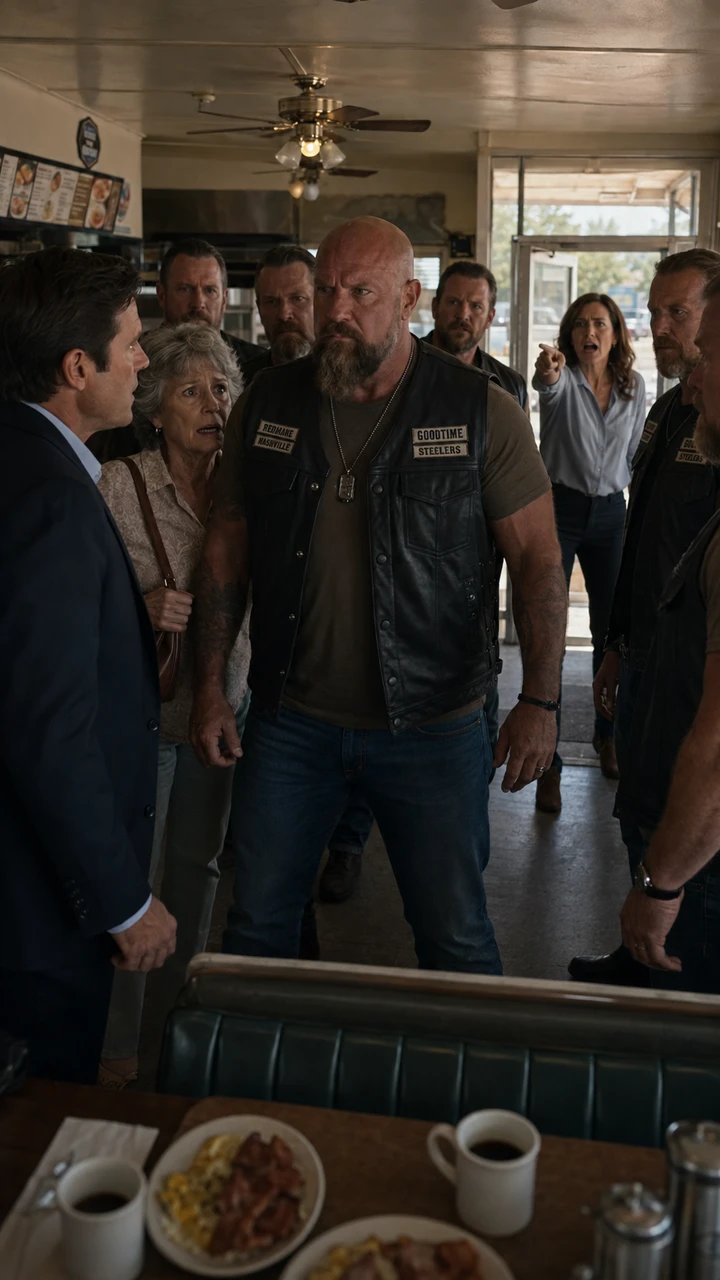
Emily’s words seemed to strike Daniel harder than a fist. For one unguarded instant, the color left his face. Then the calm smile returned, carefully fitted into place.
“She’s confused,” he said. “She hasn’t slept in two days.”
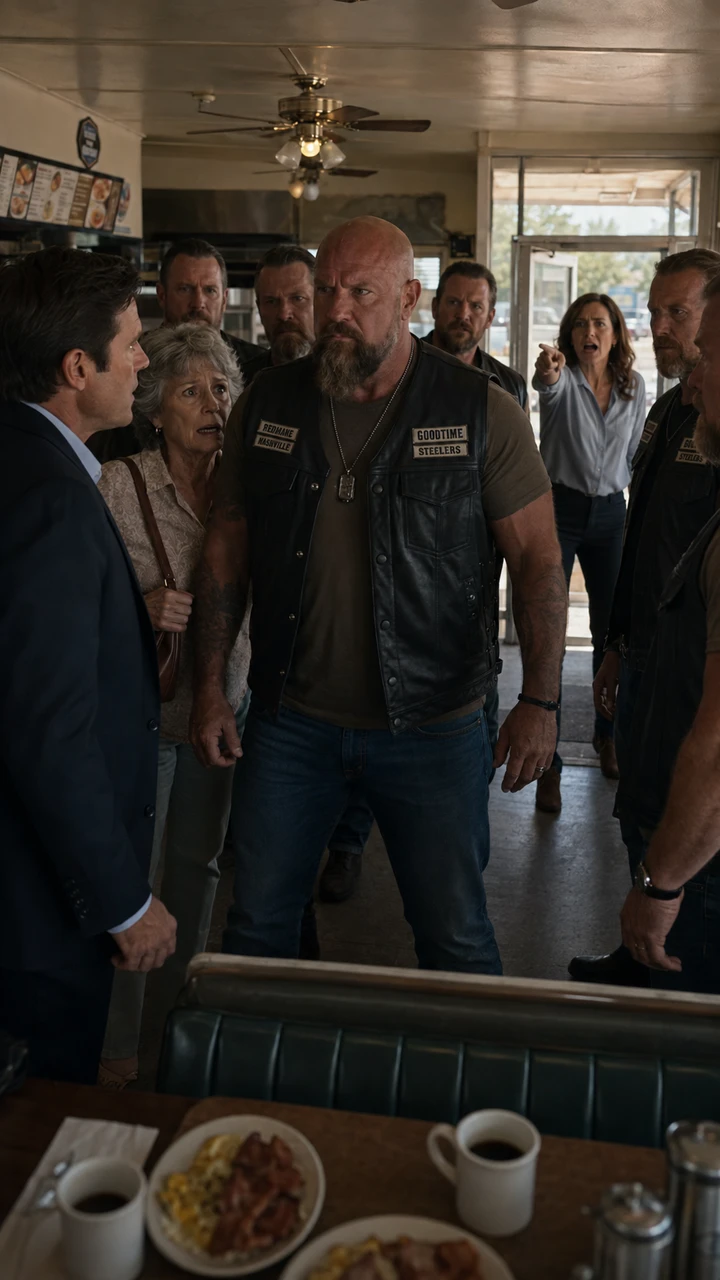
Emily recoiled when he took a step toward her. The movement was small, but everyone saw it. Bear shifted sideways, widening the wall of leather between Daniel and the two of us. Behind him, five chairs scraped across the floor. The sound was not loud. It did not need to be.
“Don’t come near me,” Emily said.
Daniel stopped. “Em, listen to yourself. Your mother has frightened you again. Give me your phone and come home.”
“You took my phone.” Her breath caught, but she forced out the rest. “You took my keys, locked me in the bedroom, and told me I’d never see Mom again unless I signed.”
A murmur moved through the diner. Daniel glanced at the customers and seemed to remember that he had an audience. He lowered his voice into the tender tone that had fooled my daughter, our neighbors, and for too long, me.
“We can discuss this privately.”
“No,” Emily said. “That’s where you win.”
The sentence broke something open inside me. I had spent three years mistaking her silence for agreement and her distance for rejection. Now I saw the swollen skin beneath one eye, poorly hidden by makeup, and the finger-shaped bruises above her wrist. I moved around Bear before fear could stop me. Emily met me halfway. When I held her, she trembled so violently that her teeth clicked against my shoulder.
“I’m sorry, Mom,” she whispered. “I’m so sorry.”
Daniel reached inside his jacket.
Every biker moved at once, but Bear was closest. He caught Daniel’s wrist before his hand cleared the leather. A black phone, not a weapon, slipped from Daniel’s fingers and struck the tile. Emily cried out.
“That’s mine.”
Daniel jerked against Bear’s grip. “Get your hands off me.”
“Gladly,” Bear said. “As soon as you stop reaching for things that belong to other people.”
The oldest of the bikers, a silver-haired woman with a narrow, observant face, picked up the phone with a napkin and placed it on the counter. “Nobody touches it,” she told the waitress. “And save your security footage. All of it.”
Sirens rose beyond the windows.
Daniel’s confidence returned with them. “Good. I called the sheriff before I came in. Margaret is wanted for questioning, and these people just assaulted me.”
Bear released him and raised both hands as two deputies entered. Daniel immediately began talking, presenting his reddened wrist as if it were a grave wound. I expected the deputies to see his pressed shirt, his expensive watch, and his practiced concern and believe him. That was what people always did. But Emily stayed wrapped around me and said, “Please separate us. Don’t let him speak for me.”
The younger deputy looked at her bruises. His expression hardened. He guided Daniel to the far end of the counter while his partner called for a woman officer and an ambulance. Bear returned to the booth and sat so there could be no suggestion that he was threatening anyone. The other bikers followed his example.
When the deputy asked my name, my voice failed. Bear looked up from his coffee.
“Breathe, Mom,” he said.
He did not say it as a performance this time. The word was offered like a handrail. I took one breath, then another, and told the deputy everything.
Three nights earlier, I had gone to Emily’s house after she missed our weekly lunch for the fourth time. Daniel had answered and told me she was sick. While he went upstairs, I heard Emily crying through the heating vent beside the hall table. I also saw a bank envelope addressed to me protruding from Daniel’s briefcase. Inside was a statement for an account I had never opened. Fifty thousand dollars had entered it from Emily’s inheritance and left the same afternoon through a cashier’s check made out to Cumberland Residential Consulting, a company I did not recognize.
Daniel caught me photographing the statement. His smile vanished. He took my phone, deleted the photograph, and told me that if I accused him, he would prove I had stolen the money. He knew my Social Security number, had copies of my driver’s license, and had already persuaded Emily that I was becoming forgetful. When Emily came downstairs, Daniel stood behind her with one hand on her shoulder. She would not meet my eyes. She told me to leave.
Yesterday morning, a deputy came to my house with questions about a theft report bearing Emily’s signature. Daniel arrived before the deputy left and offered to drive me to the station. I saw my packed suitcase in his trunk. He said Emily wanted me to stay at a “quiet care facility” until everything was sorted out. I pretended to agree, asked to use the bathroom, climbed through the back window, and walked through wet fields to the highway. A delivery driver brought me to the diner. I had chosen Bear because he was the largest person in the room and because Daniel respected only obstacles he could not move.
The deputy wrote without interrupting. When I finished, he asked why I had not called the police from the diner.
“Because the report was already signed,” I said. “And because Daniel always sounds reasonable.”
Across the room, Daniel was doing exactly that.
Emily pulled away just far enough to look at me. “The account statement is real. He opened it in your name. He made me transfer the money.”
“Why?” the deputy asked.
“My father left it to me for the music program at the community center. Daniel said he needed it for a short-term project and would replace it before the first grant payment. I refused. Then he showed me papers saying Mom had already taken it. I didn’t understand how she could have done that, but he kept telling me she was sick.” Tears filled her eyes. “When I said I wanted to call her, he threw my phone against the wall. Later he brought me another statement and said Mom would go to prison unless I signed a report. He said if I signed, he could arrange treatment instead.”
“That makes no sense,” Daniel called from the counter. “If I stole money, why would I put it in Margaret’s name?”
The silver-haired biker answered before anyone else could. “Because the transfer created a trail that ended with her.”
The deputy gave her a warning look. She raised both palms. “June Mercer. Retired forensic accountant. I’m only answering the question he shouted across a public room.”
Daniel stared at her. It was the first time I saw him understand that leather did not make these people simple.
The ambulance crew examined Emily in the kitchen, away from him. She refused transport but allowed the woman officer who arrived soon afterward to photograph her injuries. Daniel insisted the bruises came from Emily falling in the bathroom. Emily looked toward the black phone on the counter.
“He recorded me after he made me sign,” she said. “He wanted proof that I had accused Mom. But there’s something else on it.”
Daniel’s head snapped around.
“Yesterday, I started recording before he came into the bedroom. I slid the phone beneath the blanket. He thought he stopped it when he took it, but he only turned off the screen.”
The woman officer placed the phone in an evidence bag. Daniel said it was marital property and demanded its return. Nobody answered him.
For two hours, officers separated witnesses and preserved the diner recording. It showed Daniel advancing, Emily recoiling, and Bear restraining only the hand reaching into Daniel’s jacket. Every customer gave a name and number.
At last, Detective Sarah Keller arrived from the county investigations unit. She listened to the recording through headphones, then asked Daniel to stand. His confidence faltered.
“Daniel Price, you are under arrest on suspicion of domestic assault, unlawful imprisonment, and witness coercion.”
He looked at Emily, not at the detective. “If you do this, you lose the house. You lose everything.”
Emily flinched. I felt her fingers tighten around mine.
“Maybe,” she said. “But I won’t lose myself.”
As Keller led him out, he turned to me. The hatred in his eyes was naked now. “You think strangers can save you? Ask her what she did with the original statement.”
The door closed behind him.
Emily went still.
Detective Keller noticed. “What original statement?”
“The one Mom photographed,” Emily said. “Daniel told me it disappeared from his briefcase. He said she must have taken it.”
All eyes turned toward my purse. I remembered clutching it while climbing through my bathroom window, sleeping with it beneath my head in a farm shed, and never once examining its contents. Keller asked permission before opening it. Beneath my wallet and a packet of tissues lay the bank envelope.
Inside was the statement, along with five deposit slips and a cashier’s-check receipt. I had not put them there.
For a terrible second, even Emily looked uncertain.
Then Bear said, “He packed her suitcase.”
June nodded. “Which means he had access to her house and her purse. If he planned to deliver her to a facility, he could let the papers be found there later.”
Detective Keller did not declare me innocent. She did something more useful: she treated the envelope as evidence, asked who had handled my purse, and arranged for fingerprint and document testing. She also requested an emergency order barring Daniel from contacting either of us. Because the account and the cashier’s check still required investigation, she told me not to leave the county. Her caution frightened me, but it did not feel like disbelief.
Bear approached with the other five: June, his aunt; Luis, a paramedic; Otis, a mechanic; Carla, a veterinary nurse; and Finch, a carpenter. Their jackets bore a lantern above the words ROAD LANTERNS.
“You don’t owe us anything,” Bear said. “But neither of you should be alone today.”
“Why did you help me?” I asked.
He glanced at June. “My mother spent years hiding what my father did to her because she thought nobody would believe her. The night she finally ran, she asked for help at a gas station. People looked away.” His jaw tightened. “She died before morning. I promised myself I wouldn’t.”
I touched his sleeve. “I’m sorry.”
“So am I.” He looked at Emily. “Do you have somewhere safe?”
She shook her head. Daniel’s name was on the house deed, her cards were linked to his accounts, and her closest friends had gradually stopped calling after he accused them of interfering in the marriage. I still owned my small brick house, but Daniel had keys and knew every window. Detective Keller had offered the number of a shelter. Emily said she would go. I heard shame in her voice and told her there was none in surviving.
June knew the shelter director. Before noon, Emily and I were inside a clean, guarded building whose location Daniel would not receive. Bear and the others left only after the director promised that cameras covered every entrance. At the door, I tried to thank him.
“Breakfast next Sunday,” he said. “That’ll settle it.”
I almost smiled. “All six of you?”
“Family’s rarely convenient.”
The next day, Keller played the relevant portions of Emily’s forty-seven-minute recording. Daniel said no one would believe a “hysterical wife,” threatened to accuse her of helping move the money, and claimed he had a letter declaring me cognitively impaired. Hearing him without seeing his smile made the cruelty starker. Near the end, paper rustled.
“Where are you taking Mom?” Emily’s recorded voice asked.
“Somewhere she’ll be quiet.”
“And after she signs the house over?”
“Then none of this matters.”
Keller replayed another phrase three times: “I should have burned Hale’s second copy.” Martin Hale had helped Emily’s father establish the music fund. He told Keller that Daniel had first presented a forged power of attorney, then opened the account online at another branch using my license and Emily’s coerced authorization. Hale’s retained records included an authentication photograph of Daniel behind glasses and a surgical mask. The cashier’s check led to Cumberland Residential Consulting, a shell company that sent forty-two thousand dollars to Daniel’s brokerage account. Investigators froze the thirty-six thousand that remained.
The supposed medical letter came from a clinic form Daniel had copied after my only visit there. The named doctor had never evaluated me. He had not improvised after I found the statement; he had been building a cage for months.
Emily woke at the shelter choking on apologies. Daniel had made each lie about me small enough to swallow, then used my anger as proof that I was controlling her.
“Can you forgive me?” she asked.
I thought of the missed calls, the empty Christmas chair, and the report she signed in fear. “I already love you. Forgiveness can grow inside that, if we stay honest even when it hurts.”
Daniel posted bond after six days under a no-contact order and electronic monitoring. Keller warned that an order was not a wall. When two deputies escorted us home for medicine and trust records, we found drawers open and the photograph of Emily at her father’s piano turned facedown. Daniel had been searching.
Behind my checkbook, Emily found her late father Paul’s brass key to a cabinet at the community center. Daniel had claimed she lost it, replaced the cabinet lock, and planted the key as more evidence against me. Inside the cabinet, pages had been cut from Paul’s ledger. Finch studied the photographs at Sunday breakfast and noticed that Paul’s cedar back panel had been replaced with pine.
With a warrant, Keller removed the false panel. A hidden flash drive held contracts proving that Daniel had billed elderly homeowners for premium materials, installed cheap substitutes, and passed the difference through Cumberland. Paul had discovered the scheme while checking the center renovation and copied the evidence before his fatal heart attack. Daniel found and removed the ledger pages but missed the drive. Stealing the music fund had covered his debts; framing me would stop my questions and let him obtain my house. Keller ordered us to keep the discovery secret.
Two days later, an unknown number sent Emily a photograph of Paul’s missing pages beside a fuel can: Midnight. Locker 18. Come alone. Emily took it straight to Keller. A blue locker edge identified Daniel’s abandoned warehouse, while a reflection in a wrench showed the pale band beneath his removed monitor. He had strapped the device around a thermos in his attorney’s office and escaped.
Police moved us to the sheriff’s building and surrounded the warehouse. It was a decoy: photocopied pages, water in the fuel can, and a camera confirming that responders had arrived. Minutes later, the community center’s alarm failed. Daniel believed more evidence remained there and meant to burn it while emergency units waited across town.
“Twelve children are rehearsing there tonight,” Emily said.
Keller summoned fire crews, but the nearest engine was stationed at the warehouse. Bear and the Road Lanterns, repairing a church roof two blocks away, were closer.
They were finishing the church roof under portable lights when the center alarm died. Finch noticed smoke slipping from a basement vent. Before Keller could reach him, he had already called emergency services. Luis and Bear ran to the front doors. They found them chained from the inside.
“The children use the upstairs rehearsal hall,” Emily told Bear over Keller’s speakerphone. “There’s a rear stairwell, but the exit opens beside the boiler room.”
Bear’s answer was calm. “We’ll make a way.”
For four minutes, I could hear only orders, running feet, and the metallic blows of Finch’s roofing hammer. Then glass shattered. Carla shouted that she had found two children near a first-floor washroom. Luis led them out through a broken side window. Smoke thickened across the security camera that had switched to backup power.
The sheriff’s building was less than three miles away. Keller had ordered an officer to keep us there, but Emily looked at the wall cabinet beside the desk.
“The center’s master keys,” she said. “They took them from my bag when we arrived.”
The officer would not release us. He did, however, carry the keys himself and drive us behind a patrol escort after Keller confirmed that the exterior perimeter was secure. By the time we arrived, flames glowed in the basement windows. Bear stood beneath the second-floor fire escape, shouting to children clustered behind a locked rehearsal-room door. The replacement key turned in the exterior gate but not in the warped inner door.
Emily ran to the old upright piano visible through the glass. “There’s a service passage behind the stage,” she told the firefighters. “My father built it when he rewired the sound booth. It comes out behind the storage shed.”
Two firefighters followed her directions and disappeared around the building. A minute later, the children began emerging through the narrow passage, coughing and holding one another’s shirts. Eleven came out.
The music teacher counted twice. “Where’s Noah?”
One child said he had gone downstairs to find the breaker when the lights failed.
Luis fitted an air mask over his face and tried to enter, but a firefighter pulled him back. The boiler-room ceiling had begun to collapse. Bear seized a hall map from the wall and pointed to a maintenance door on the east side. It was the same door Paul used when carrying tools. Finch struck the hinges while firefighters cooled the frame.
The door burst outward.
Daniel stumbled through the smoke, dragging a terrified boy against his chest. One arm locked across Noah’s throat; his other hand held a utility knife. His hair was singed, and blood ran from a cut above his ear. He must have found the boy in the basement and seized the only shield available when the fire blocked his escape.
Everyone froze.
“Back away!” Daniel shouted. “All of you.”
Noah could not have been more than ten. He wore a yellow concert shirt and one untied shoe. His eyes searched the crowd until they found Emily.
Daniel followed his gaze. “You did this,” he told her. “You brought them here.”
Emily stepped past the patrol car before anyone could stop her. “Let him go.”
“Where’s the drive?”
“With the police. They copied it.”
The answer destroyed the last of his control. His face twisted. “You always choose them. Your father, your mother, strangers—anyone but me.”
“You made love a room with no doors,” Emily said. Her voice shook, but she kept walking until Keller caught her arm. “That wasn’t love.”
Daniel pressed the knife closer. Noah whimpered.
Smoke rolled through the doorway behind them. The structure groaned. Bear stood ten feet to Daniel’s left, empty hands visible. I saw him glance at Noah’s loose shoe, then at a fire hose curling across the pavement.
“You called Margaret your mother in the diner,” Daniel said. “Ready to die for her kid too?”
“The boy isn’t a bargain,” Bear said. “Send him to me. I’ll stand where he is.”
“Bear, no,” June said.
He did not look away from Daniel. “You want someone they care about. They care about me.”
It was true now, and Daniel heard it. He shifted his weight, tempted by a larger shield. Noah’s untied lace caught beneath his other shoe. The boy stumbled. Daniel’s knife hand jerked away as he tried to keep his grip.
Bear moved.
He drove his shoulder into Daniel’s chest while Keller pulled Noah free. The knife skittered beneath the hose. Daniel struck Bear twice and reached for it. Emily stepped backward into me. A firefighter opened the charged line. Water hit the pavement between Daniel and the knife, whipping the hose sideways. Daniel lost his footing and fell hard.
Deputies pinned his arms and locked handcuffs around his wrists.
For a moment, nobody moved. Then Noah began crying. Emily knelt and held him until his teacher reached them. Bear sat in the water, one hand pressed to his ribs. I dropped beside him.
“You reckless, impossible man,” I said.
He managed a painful smile. “That sounds like a mother.”
The firefighters contained the blaze before it reached the second floor. Investigators later found that Daniel had entered through the basement using an old contractor’s code, disabled the alarm, poured solvent over the records room, and set two delayed fires. He believed Paul’s original ledger and the evidence against him were still hidden there. The false warehouse threat had been meant to empty the neighborhood of responders. Instead, every choice he made supplied more proof: the prepaid phone was found in his truck, the warehouse camera account was logged in on his laptop, solvent marked his clothes, and the center’s backup system recorded him cutting the alarm cable.
Noah suffered smoke inhalation but recovered fully. Bear had two cracked ribs and a shoulder wound requiring eight stitches. He complained more about the hospital gown than the pain. All five Road Lanterns crowded his room, along with Emily, me, Noah’s mother, and three deputies who needed his statement. When a nurse asked which of us was family, June pointed at the entire room.
“Apparently all of us.”
Daniel’s bond was revoked. Paul’s files brought fraud charges and restitution claims from elderly homeowners. Daniel’s friend admitted Cumberland was a shell company, surrendered its records, and helped recover most of the missing money.
Healing came through ordinary choices. Emily opened her own account, changed every password, attended counseling, and reclaimed two friendships Daniel had broken. When she moved into my spare room, passing cars woke her for nine nights; on the tenth, she slept until sunrise. A specialist confirmed my mind was sound, the clinic disavowed the forged letter, the bank cleared my name, and the sheriff withdrew the theft allegation. Yet I still checked my purse for planted evidence.
Once, when Emily returned late, fear made my question sound like Daniel. I stopped. “You don’t owe me proof. Being scared doesn’t give me the right to cage you.” We learned that love could ask without commanding and answer without surrendering.
Bear healed at June’s farmhouse. Every Sunday, the Road Lanterns came for breakfast, repaired something I had not asked them to notice, and stayed until afternoon. They had formed to supply shelters and escort frightened families to court.
“Why Road Lanterns?” Emily asked.
“A lantern doesn’t rescue anyone,” Bear said. “It makes the next step visible.”
Three months after the fire, Daniel pleaded guilty after the judge admitted Emily’s recording, the financial records, and the center footage, sparing Emily and the children repeated trials. At sentencing, the courtroom was full.
I spoke first. I described the ease with which a respectable voice could turn a woman’s age into evidence against her. I told the judge that Daniel had tried to take more than money. He had attempted to make Emily doubt her own fear and make me doubt my own mind. I did not ask for vengeance. I asked for a sentence long enough to protect those he still regarded as tools.
Emily stood beside the prosecutor with both hands visible and steady.
“For years, I thought surviving meant keeping him calm,” she said. “I measured every word, every friendship, every visit with my mother by whether Daniel would punish me afterward. When I signed that report, I believed I had become part of what he was doing. That shame kept me silent for another day. I know now that telling the truth late is still telling the truth.”
Daniel watched her without expression.
“I don’t forgive you today,” she continued. “Maybe forgiveness is not something I will ever owe you. But I release the belief that your choices define me. They don’t. I will spend my life building what you tried to burn.”
The judge sentenced Daniel to twenty-eight years, with twelve before parole eligibility, ordered restitution, revoked his construction license, and permanently prohibited contact with us. His friend received home confinement and probation for cooperating; the unwitting attorney was cleared. Frozen funds, insurance, and Daniel’s sold equipment restored the entire music fund and compensated the homeowners.
After sentencing, Emily and I stood on the courthouse steps. Reporters waited below, but we had agreed not to speak further. Bear and the Road Lanterns formed no threatening wall. They simply stood nearby. Emily took my hand.
“I thought you’d hate me when you knew everything,” she said.
“I hated what happened to us.”
“That isn’t the same.”
“No.” I squeezed her hand. “It never was.”
She leaned her head against my shoulder, as she had when she was a girl waiting for her father to finish choir practice. This time neither of us was pretending the past had vanished. We were choosing not to live inside it.
Rebuilding the center took nearly a year. Insurance restored the rooms; the Road Lanterns repaired furniture, raised donations, and publicly accounted for every dollar. Emily directed her father’s music program. When Noah asked her to teach the piece interrupted by the fire, her first chord trembled and her second held. By spring, twenty-four children attended free lessons.
The false guardianship papers were voided. The bank and clinic strengthened their safeguards. Emily divorced Daniel, sold the house, donated his equity to legal aid, and bought a cottage three streets from me—close enough for dinner and far enough for freedom.
On moving day, I caught myself arranging her kitchen without asking. She raised one eyebrow. I withdrew my hand from the cabinet and waited.
“Plates there,” she said, pointing to the shelf I had chosen.
We both laughed. It was a small sound, but once there had been no laughter between us at all.
Two years after the morning in the diner, the community center held its first Margaret and Paul Ellis Scholarship Concert. I had protested the use of my name until Emily reminded me that Paul’s dream had survived because I refused to get into Daniel’s car. The auditorium filled with families, teachers, bank employees, deputies, shelter staff, and homeowners whose testimony had helped convict him.
Backstage, Noah paced in polished shoes. Emily straightened his yellow bow tie. He was twelve now, taller and confident until he heard the audience settle.
“What if I make a mistake?” he asked.
“Then make the next note honest,” she said.
He walked onto the stage and played the piece he had begun on the night of the fire. The melody was not flawless. It was brave. When he finished, the room rose around him.
Emily came to the microphone after the applause. She thanked the firefighters, investigators, donors, and shelter counselors. She thanked her father for leaving questions worth answering and evidence worth finding. Then she looked toward the back row, where six leather jackets caught the stage light.
“And I thank the family my mother invented in three seconds,” she said, “who decided to become real.”
Everyone turned. Bear lowered his head, embarrassed by attention. June elbowed him until he stood. The other Road Lanterns rose beside him. I watched the biggest man in the diner wipe his eyes with the heel of his hand.
After the concert, we returned to the same roadside diner. The waitress had reserved the corner booth, though no booth could hold all of us now. Two tables were pushed together. Noah and his mother joined us, as did Detective Keller after her shift. On the wall above Bear’s old seat hung a small brass plaque: WHEN SOMEONE ASKS FOR HELP, MAKE ROOM.
The waitress set a slice of pecan pie in front of me. “Your son ordered it.”
I glanced around the table. “Which one?”
Luis pointed at Bear. Otis pointed at Finch. Carla pointed at herself. June lifted both hands. Emily laughed so hard she had to lean against me.
Bear slid the plate closer. “Eat your pie, Mom.”
The first time he called me that, it had been a shield raised against a dangerous man. I had believed I was asking a stranger to perform one lie long enough to save me. But the word had become a promise none of us planned: to answer the phone, to show up at court, to repair what could be repaired, and to sit beside what could not.
I divided the pie into eight uneven pieces. Nobody complained. Outside, motorcycles waited beneath the neon sign, their chrome reflecting the warm diner windows. Inside, Emily was describing the next summer concert while June calculated its budget on a napkin. Noah argued with Finch about whether a cedar music stand would improve his playing. Keller drank coffee and, for once, had no questions to ask.
I looked at my daughter. The shadows Daniel had taught her to carry were not gone, but they no longer decided where she stood. She met my eyes without apology. Between us lay grief, truth, work, and a forgiveness that had grown slowly enough to be trusted.
For most of my life, I thought family was something established by blood, marriage, or names written on official forms. Daniel had used each of those things as a weapon. Bear and the others taught me a better definition. Family was the person who believed your frightened voice deserved time. It was the one who preserved the evidence, brought breakfast, rebuilt the cabinet, held the boundary, and remained after the danger stopped being dramatic.
When we finally stepped outside, dawn was beginning to pale the Tennessee sky, almost the same color it had been on the morning I ran. Bear offered me his arm. Emily took the other. Behind us came the rumble of laughter and chairs being stacked, ordinary sounds from a place where silence had once fallen because I begged strangers for help.
This time, I was not running from anyone.
We walked together toward the light.
