
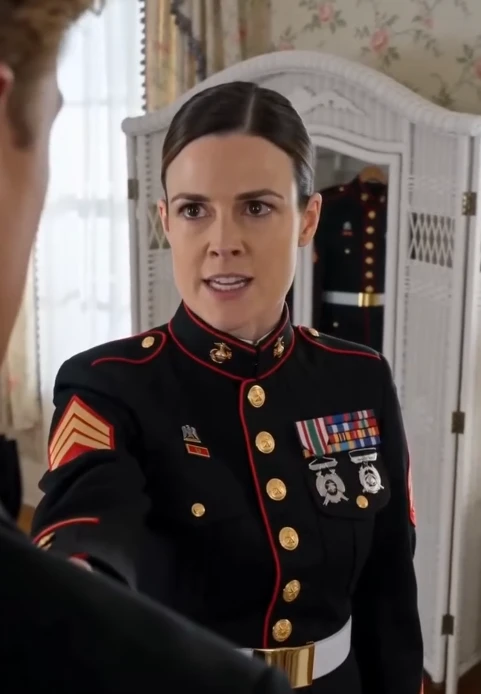
Two nights before my younger brother’s wedding, my mother stood in the doorway of my childhood bedroom and stared at my Marine dress blues as if I had brought home something embarrassing.
The uniform hung from the old wooden closet door.
I had steamed it that afternoon.
Every ribbon was straight. Every button caught the warm light from the bedside lamp. My shoes sat beneath it, polished until I could see the shape of the window reflected in the leather.
Beside the uniform hung a pale blue evening dress.
My mother had bought that one.
She had chosen the color, the length, even the shoes she expected me to wear.
“You look lovely in blue,” she had said when she brought it home three months earlier.
She had never asked whether I wanted it.
Now she folded her arms and looked from the dress to the uniform.
“Claire,” she said quietly, “your father and I need to talk to you.”
That sentence had followed me through most of my childhood.
We need to talk to you.
It had meant I was too loud at dinner.
It had meant I had embarrassed my mother by correcting an uncle who claimed women could not serve in certain military roles.
It had meant I should stop discussing promotions because my brother was struggling to choose a major.
It had meant I should avoid mentioning that I had paid off my student loans because Caleb was upset about his.
My accomplishments were never exactly forbidden.
They simply became inconvenient whenever someone else felt uncomfortable around them.
I turned away from the small suitcase on my bed.
“What happened?”
“Nothing happened.”
My mother came farther into the room.
At sixty-two, Marianne Dalton still carried herself like the woman who had managed school fundraisers, church committees, neighborhood holiday parties, and every family event since before I could remember. Her gray-blond hair was cut perfectly at her jaw. She wore cream pants and a soft green blouse even though she had spent the day arranging flowers and arguing with the caterer.
She never looked unprepared.
That was important to her.
Appearances had always mattered in our house.
My father appeared behind her.
Richard Dalton leaned one shoulder against the doorframe.
He was still wearing the navy polo shirt from the rehearsal brunch. His reading glasses rested on top of his head.
Seeing them together made me understand immediately that this had been discussed before they came upstairs.
Probably several times.
My mother glanced at the uniform again.
“We think you should wear the dress to the wedding.”
I waited.
She smiled a little.
Not because anything was funny.
It was the smile she used when she wanted something to sound reasonable before I had a chance to disagree.
“I already planned to wear the dress to the ceremony,” I said. “I was thinking about changing before the reception.”
My father cleared his throat.
“That’s exactly what we hoped you wouldn’t do.”
I looked at him.
“Why?”
Neither answered immediately.
Downstairs, someone dropped a pan in the kitchen.
My aunt laughed.
Caleb’s best man shouted something about beer.
The house was full of relatives who had arrived for the wedding weekend.
It smelled like coffee, perfume, baked chicken, and the lemon cleaner my mother had used on every visible surface before the guests came.
Everything felt painfully ordinary.
That almost made the conversation worse.
My mother lowered her voice.
“Natalie’s family is very formal.”
“So?”
“They’re not formal in the way you think.”
She looked toward the hallway before continuing.
“The Reeds know a lot of prominent people. There will be business executives there. Judges. People from the foundation board. Some very important clients of Thomas.”
Thomas Reed was Natalie’s father.
He had built a regional commercial real estate company into something large enough that financial magazines occasionally printed his photograph.
The Reeds were not celebrity rich.
They were the quieter kind.
Old houses. Private clubs. Charity boards. Vacation properties with names.
My mother had spent the last year becoming painfully aware of every difference between their family and ours.
Our house was nice.
The Reeds’ house had a library with a ladder.
My father had retired from managing a hardware distribution center.
Thomas Reed owned buildings with distribution centers inside them.
My parents had never been poor.
They had simply decided that meeting wealthier people required them to behave as though everything about our own family needed improvement.
Including, apparently, me.
I looked back at the uniform.
“Are you saying Marines aren’t formal enough?”
My father exhaled.
“Don’t turn this into something it isn’t.”
“I asked a question.”
“No one said there’s anything wrong with your service.”
My mother jumped in quickly.
“We’re proud of you.”
There it was.
The sentence that always came before the rest.
We’re proud of you, but…
We’re proud of you, but Caleb doesn’t want to spend dinner explaining what you do.
We’re proud of you, but your grandfather doesn’t understand why you joined.
We’re proud of you, but don’t wear your uniform to the Christmas fundraiser.
We’re proud of you, but Natalie’s family might misunderstand.
My mother continued.
“The wedding isn’t about anyone’s career.”
“I know.”
“And your uniform attracts attention.”
I almost laughed.
“It’s a uniform, Mom. Not fireworks.”
“You know what I mean.”
I did know.
That was the problem.
My father moved away from the doorframe.
“Your mother has worked extremely hard to make this weekend smooth.”
“So has Natalie.”
“Yes. Exactly. And Caleb.”
He rubbed his forehead.
“All we’re asking is that you wear the dress we already bought.”
I looked between them.
“You mean the dress Mom bought.”
My mother’s mouth tightened.
“You said you liked it.”
“I said it was pretty.”
“It is pretty.”
“That doesn’t mean I chose it.”
My father’s voice became firmer.
“Claire.”
I knew that tone too.
It meant the conversation had reached the point where my questions were becoming disrespectful simply because they had not produced the answer my parents wanted.
I was thirty-four years old.
I had lived away from home for sixteen years.
I had commanded Marines older than Caleb.
I had briefed officers who controlled budgets larger than my parents could imagine.
Yet standing in that bedroom, with the same faded mark on the wall where my high school bookshelf had been, I felt seventeen again.
My mother stepped closer to the uniform.
She did not place her hands on it.
I noticed that.
She only stared at the medals.
“The medal is part of the problem,” she said.
My expression changed.
“What problem?”
She seemed to realize too late that she had said more than she intended.
My father answered.
“People ask questions.”
“About what?”
“You know what.”
“No, Dad. I want you to say it.”
He looked tired.
For several seconds, I thought he might walk away.
Then he said, “About why you received it.”
I stared at him.
The medal they were discussing had been awarded two years earlier.
I rarely talked about it.
That had not stopped my mother from printing the announcement and mailing copies to half the family.
At first she had been proud.
Very proud.
She had cried when I called.
My father had opened a bottle of bourbon he had been saving for twenty years.
Caleb had sent me a message that said, Knew you’d do something ridiculous eventually.
That was his version of affection.
But once people began asking questions about what had happened, my parents became uncomfortable.
The details were not glamorous.
There had been no dramatic battlefield story.
During an overseas training operation, an accident had damaged part of a temporary communications facility. Electrical equipment had caught fire, smoke had filled an enclosed section, and several people became trapped after a structural support shifted.
I had been close enough to help.
So had others.
I had gone back inside after the first group came out because two Marines were still missing.
A citation later described my actions with language far more heroic than I ever used myself.
I remembered coughing for three days.
I remembered one Marine refusing to leave without his radio.
I remembered arguing with him while both of us could barely see.
I remembered sitting on the ground afterward with my hands shaking so badly I could not open a bottle of water.
The medal did not make me feel impressive.
It reminded me that ordinary days could change very quickly.
Apparently, to my parents, it had become socially inconvenient.
“People don’t need the story at the wedding,” I said.
My mother nodded eagerly.
“Exactly.”
“So I won’t tell it.”
“That isn’t really the point.”
“Then what is?”
Again, silence.
I finally understood.
“You don’t want them asking about it at all.”
My father looked at the floor.
My mother adjusted the bracelet on her wrist.
“That family is very polished, Claire.”
Something cold settled in my stomach.
“What does that have to do with me?”
“No one is saying you aren’t polished.”
“You just did.”
“I did not.”
“You didn’t have to.”
My mother looked frustrated now.
She hated conversations that could not be repaired by changing the wording.
“You’ve always been more… independent.”
“Independent?”
“You chose a very different path.”
“From Caleb?”
“From all of us.”
I gave a short laugh.
“I joined the Marines, Mom. I didn’t disappear into the forest.”
My father frowned.
“Lower your voice.”
I looked toward the open door.
No one was nearby.
Still, I lowered it.
“Does Caleb know you came up here to ask this?”
My parents exchanged a look.
That was answer enough.
I felt something inside me sink.
“I want to hear it from him.”
My mother immediately shook her head.
“Don’t drag your brother into an argument two days before his wedding.”
“He’s already in it.”
“No, he isn’t.”
“You just looked at Dad before answering.”
“Claire.”
“Did Caleb ask you to talk to me?”
My father finally said, “He agreed it might be easier.”
Easier.
Another family word.
Normal.
Appropriate.
Easier.
They had spent years collecting gentle words for making me smaller.
I walked to the closet and removed the uniform from the hook.
My mother watched me.
For one second, fear crossed her face.
Not fear of me.
Fear that I might put it on immediately and walk downstairs.
Instead, I placed it carefully inside the garment bag.
“I’m tired,” I said.
My father looked relieved.
“Good. We all are.”
“That wasn’t agreement.”
His expression hardened again.
“No one said it was.”
“I’m going to bed.”
My mother remained where she was.
“Promise me you’ll think about what we said.”
“I’ve been thinking about what you say for most of my life.”
She looked wounded.
I regretted the sentence almost immediately.
Not because it was untrue.
Because I knew exactly how she would hear it.
As an accusation.
As evidence that I was making the wedding weekend about old family problems.
I closed my suitcase.
“Good night.”
My father walked into the hallway.
My mother stayed another moment.
Then she said, “The pale blue really does look beautiful on you.”
I almost smiled.
That was my mother.
Even after a conversation went badly, she needed the final sentence to sound nice.
“I know,” I said.
She left.
I closed the door.
For several minutes, I stood alone in the room.
My childhood trophies were gone.
The posters had disappeared years earlier.
My mother had turned the room into a guest room with beige walls, floral curtains, and decorative pillows nobody actually used.
Only one thing remained from when I was young.
A tiny dent near the closet baseboard.
Caleb had made it with a hockey stick when he was eleven.
He blamed me.
My parents believed him for almost three years.
I sat on the bed.
My phone buzzed.
For a moment, I expected a message from Caleb.
Instead, it was from my cousin Jenna.
You awake?
I typed back.
Unfortunately.
Three dots appeared.
Then disappeared.
Then appeared again.
Jenna had been my closest cousin since childhood.
She was two years younger than me and possessed the family’s most dangerous quality: she noticed things.
Another message arrived.
I’m sending you something. Please don’t call me until you read it.
Before I could answer, an image appeared.
A screenshot.
At first I did not understand what I was seeing.
Then I recognized the names.
Mom.
Dad.
Caleb.
Aunt Denise.
Wedding Planning Final.
I was not in the group.
Jenna apparently was.
My pulse became louder in my ears as I enlarged the image.
My mother had written:
Claire’s table assignment needs to stay where we discussed. Near the west service entrance works best. She can still see everything.
My aunt Denise had replied:
Isn’t that table mostly vendors and Thomas’s office assistants?
Mom:
It’s fine. Less chance she ends up in every family picture.
Then my father:
Make sure nobody starts asking about the service medal. We don’t need that becoming the conversation.
Another message from my mother:
I already mentioned it to the photographer. Just immediate family photos, and keep the military angle minimal.
Then Caleb.
Okay. Fine. I just want everything normal.
I read the final sentence three times.
The room seemed very quiet.
Not empty.
Quiet.
There is a difference.
Empty rooms feel peaceful.
Quiet rooms sometimes feel as though they are waiting for you to understand something.
I zoomed in again.
The screenshot included another line lower down.
My mother:
The Reed family has a certain image. Please everyone help me keep things elegant.
I set the phone beside me.
For several seconds, I did nothing.
Then I picked it up again.
I wanted the words to rearrange themselves.
They did not.
I called Jenna.
She answered immediately.
“I’m sorry.”
“Why are you in that group?”
“Aunt Marianne added me last month because I’m helping with welcome bags.”
“How long has this been going on?”
Silence.
“Jenna.”
“Maybe two weeks.”
I closed my eyes.
“What else?”
“Nothing horrible.”
“That means there’s something.”
“They discussed table arrangements. Pictures. Your uniform.”
“Anything else?”
Jenna exhaled.
“Your mother asked Denise not to mention your promotion.”
My throat tightened.
I had been selected for major earlier that spring.
I had not expected any announcement at the wedding.
I had barely mentioned it myself.
But knowing my mother had actively instructed relatives not to bring it up felt different.
“Why?”
“She said she didn’t want Natalie’s weekend becoming a military reunion.”
I laughed once.
There was no humor in it.
“I’m one person.”
“I know.”
“Did Caleb ever defend me?”
Jenna took too long to answer.
“That’s what I thought.”
“Claire, he’s stressed.”
“Everybody is stressed.”
“I’m not defending him.”
“It sounded like you were.”
“I’m trying to make sure you don’t drive away tonight and never come back.”
That stopped me.
Jenna knew me well.
I looked at the garment bag.
“Did you send this because you want me to confront them?”
“No.”
“Then why?”
“Because if people were arranging where I sat and what could be said about me, I’d want to know.”
I rubbed both hands over my face.
“Thank you.”
“I’m sorry.”
“Stop apologizing.”
“I feel awful.”
“You didn’t write it.”
“I still feel awful.”
We stayed on the phone without speaking.
Finally Jenna asked, “What are you going to do?”
“I don’t know.”
“Please don’t do anything that ruins Caleb’s wedding.”
I stared at the screenshot.
“Interesting.”
“What?”
“That’s the first thing everybody thinks I might do.”
“I didn’t mean it like that.”
“You did.”
“Claire.”
“It’s fine.”
“No, it isn’t.”
I stood.
“I’m going to talk to my brother.”
“Tonight?”
“Yes.”
“Maybe wait until morning.”
“No.”
“Why?”
“Because if I wait until morning, I’ll spend all night inventing excuses for him.”
I ended the call before she could stop me.
Caleb was staying in our father’s old office at the opposite end of the second floor.
His college friends had taken over the basement.
I could hear them laughing beneath the floor as I walked down the hallway.
His door was partly open.
I knocked against the wood.
Caleb looked up from his laptop.
He was wearing sweatpants and a white T-shirt.
For a second, I saw the twelve-year-old who used to sleep with the hallway light on.
Then I saw the man who had typed Okay. Fine.
“Hey,” he said. “What’s up?”
I walked in and closed the door.
His expression changed.
“What happened?”
I held out my phone.
“Did you know?”
He looked at the screen.
His shoulders dropped.
That movement told me everything before he spoke.
“Claire.”
“Did you know?”
He placed the laptop on the desk.
“I knew Mom was worried.”
“About what?”
“The wedding.”
“Try again.”
He stood.
“I don’t want to fight.”
“That’s useful, because neither do I.”
“You came in here at eleven at night with screenshots.”
“Because I just received them.”
He stared at the phone.
“Jenna sent that?”
“That’s your concern?”
“No.”
“Then answer me.”
He walked toward the window.
Outside, strings of warm lights crossed the backyard where relatives had gathered earlier.
Mom had hired a company to install them.
They were still glowing over empty tables.
“I knew about the seating,” Caleb said.
“And the photographer?”
He did not answer.
“The medal?”
Another silence.
My chest tightened.
“All of it?”
He turned.
“I just want everything normal.”
The same words from the screenshot.
Hearing them spoken directly hurt more.
“What does normal mean?”
“You know what I mean.”
“I actually don’t.”
“Claire, please.”
“No. Explain it.”
He dragged both hands through his hair.
“It means I don’t want every conversation turning into your career.”
“When has that ever happened?”
“At Christmas.”
My eyebrows lifted.
“Uncle Paul asked me about Okinawa.”
“For forty minutes.”
“Because he kept asking questions.”
“And everyone listened.”
I stared at my brother.
“That bothered you?”
“No.”
“It clearly did.”
“It’s not about me.”
“Then who?”
“Natalie.”
That surprised me.
“What does Natalie have to do with this?”
“She’s nervous about our families mixing.”
“Why?”
He hesitated.
I felt another answer approaching that I would not like.
“Her mother thinks Mom can be a little much.”
I nearly smiled despite myself.
“Her mother is correct.”
“This is serious.”
“I am serious.”
“Mom has been trying really hard.”
“To do what?”
“Fit in.”
There it was.
I leaned against the desk.
“And I make that difficult.”
“That isn’t what I said.”
“It’s what all of you are saying.”
“You don’t understand.”
“Explain it.”
Caleb paced once across the room.
“The Reeds are… different.”
“Wealthy?”
“Yes.”
“Congratulations. I noticed their six-bedroom house.”
“Don’t be sarcastic.”
“I’m trying very hard not to be angry.”
“You think I’m ashamed of you.”
“Are you?”
“No.”
“Then why am I sitting near the service doors?”
He stopped.
“That was Mom.”
“You agreed.”
“I didn’t want another argument.”
“So you gave her what she wanted.”
“I’m getting married in two days.”
“And that makes me furniture?”
“Come on.”
“No, Caleb. You come on.”
My voice rose.
I lowered it before our relatives heard.
“You could have said no.”
“To Mom?”
“Yes.”
He gave me a look that almost made me laugh again.
We both knew what saying no to our mother could become.
Still, he was thirty-one.
He had decided to marry another adult.
Eventually he needed to learn how to say no to Marianne Dalton.
“She kept talking about the pictures,” he said. “Then the table. Then the uniform. I finally told her fine because I wanted her to stop.”
“And you didn’t think to tell me?”
“I hoped it wouldn’t matter.”
“That is an incredible thing to say.”
“I mean I thought you’d wear the dress.”
“Why?”
“Because Mom bought it.”
“She buys decorative towels too. I don’t wear those.”
Caleb stared at me.
For one second his mouth almost moved into a smile.
Then he remembered we were arguing.
“This is what I mean.”
“What?”
“You make everything into a joke when you’re angry.”
“It’s that or start shouting.”
“I don’t want this weekend destroyed over clothing.”
My anger cooled instantly.
“That’s what you think this is about?”
He rubbed his forehead.
“What else would it be about?”
I showed him the screenshot again.
“This.”
He barely looked.
“Your family planned to hide you near a service entrance.”
“That sounds dramatic.”
“It is literally what your mother wrote.”
“Our mother.”
“Right now I’m having trouble with that word.”
His face tightened.
“Don’t say things like that.”
“Why? Because it makes you uncomfortable?”
“Because she loves you.”
“People can love you and still make you feel small.”
He looked away.
That was the first moment I realized Caleb understood more than he wanted to admit.
Our mother loved both of us.
There had never been a question about that.
She attended every school event.
She mailed care packages to me overseas.
She sat beside Caleb for three nights when he had pneumonia at nineteen.
She remembered birthdays, favorite foods, allergies, old friends, new jobs.
Her love was constant.
So was her need to control the version of us other people saw.
With Caleb, she polished.
With me, she edited.
There was a difference.
“You don’t understand what it’s been like this year,” he said.
“What has it been like?”
“Every dinner with Natalie’s parents, Mom tries too hard. Dad barely talks. Then Mom comes home and analyzes everything she said.”
“That sounds like Mom.”
“She thinks they look down on us.”
“Do they?”
“No.”
“You sure?”
“Yes.”
“Then this is her insecurity.”
“I know.”
“And you let her make it my problem.”
He sat on the edge of the bed.
For the first time, he looked ashamed.
“I should’ve said something.”
“Yes.”
“I’m sorry.”
The words should have helped.
They didn’t.
Maybe because he still seemed more tired than sorry.
Maybe because I knew nothing would change unless I forced it.
I looked at the pale blue dress visible through my open bedroom door down the hallway.
Then I looked back at him.
“Do you want me at your wedding?”
His head came up.
“Of course.”
“Not the version Mom wants.”
“What does that mean?”
“It means me.”
“Claire.”
“It’s a simple question.”
“Yes. I want you there.”
“Then where am I sitting?”
He sighed.
“I’ll fix it.”
“When?”
“Tomorrow.”
“And the photographer?”
“I’ll fix that too.”
“And if I wear my uniform?”
He froze.
There it was.
The limit.
“Could you not?” he asked.
I felt something inside me settle.
Not break.
Settle.
Like sediment sinking to the bottom of a glass.
“Why?”
“Because I’m asking.”
“You just said you want me there.”
“I do.”
“But only if I wear the approved costume.”
“It’s not a costume.”
“That dress isn’t mine.”
“It literally is. Mom bought it for you.”
“That isn’t what I mean.”
He stood again.
“I cannot do this tonight.”
“Okay.”
I walked toward the door.
“Claire.”
I stopped.
He looked miserable.
“I love you.”
I believed him.
That was the hardest part.
“I love you too.”
I opened the door.
He said, “Please don’t make Saturday into a statement.”
I looked back at him.
“I’ve spent fifteen years trying not to make anyone uncomfortable.”
“That isn’t fair.”
“Probably not.”
I went to my room.
The two outfits remained beside each other.
Pale blue silk.
Dark Marine dress blues.
One represented my mother’s idea of elegance.
The other represented choices I had made when nobody in my family understood them.
I sat on the edge of the mattress for almost an hour.
At midnight, the house became quiet.
At twelve-thirty, someone in the basement laughed so loudly that my father shouted down the stairs.
At one, I got up.
I placed the pale blue dress in my suitcase.
Then I zipped the garment bag around my uniform.
I had made my decision.
But it was not the decision my family would later claim I had made.
I was not planning revenge.
I was not trying to embarrass anyone.
I did not want guests whispering.
I did not want a confrontation.
I wanted to attend my brother’s wedding as myself.
For years, everyone else had been allowed that basic privilege.
I decided I was done asking permission for it.
The next morning, my mother behaved as though our conversation had never happened.
She made pancakes for twelve people.
She complained about the florist.
She reminded everyone about rehearsal times.
When I entered the kitchen, she smiled.
“Coffee?”
“Please.”
She poured it into my old high school mug.
WORLD’S OKAYEST SISTER.
Caleb had given it to me when I graduated.
I glanced toward him.
He was eating at the island with Natalie.
He looked at me.
Then quickly returned his attention to his plate.
Natalie noticed.
She was twenty-nine, with dark hair that she usually wore loose but had pulled into a knot that morning.
Unlike her parents, she never made wealth look like part of her personality.
She wore old college sweatshirts.
She drove a six-year-old SUV.
She ate cereal for dinner when Caleb worked late.
I genuinely liked her.
That made everything more complicated.
“Morning,” she said.
“Morning.”
“You okay?”
“Just tired.”
My mother answered for me.
“Everyone is tired.”
Natalie looked between us.
I wondered how much she knew.
Probably very little.
Caleb had always believed hiding problems was the same thing as solving them.
After breakfast, Natalie left with her bridesmaids.
Caleb went to meet the groomsmen.
My mother spent the day moving through the house with lists.
I helped anyway.
That surprised her.
At one point, she handed me forty small cards and asked me to tie them onto welcome bags.
We sat at the dining table together.
For half an hour, neither of us mentioned the uniform.
Then she said, “Thank you for not making last night worse.”
I tied another ribbon.
“I didn’t realize the standard was that low.”
“Claire.”
“I’m tying cards, Mom.”
“I can see that.”
We worked in silence.
Eventually she said, “Caleb told me you’re upset about the seating.”
“Upset is one word.”
“I was going to change it.”
“Were you?”
“Yes.”
“Before or after Jenna sent me the screenshot?”
Her hands stopped.
“So it was Jenna.”
“That’s what you care about?”
“No.”
“You should stop asking that question if the answer is always yes.”
She placed the ribbon spool down.
“That group was for wedding logistics.”
“And apparently managing me is part of wedding logistics.”
“It wasn’t like that.”
“I read it.”
“Messages sound harsher without context.”
“What context makes ‘less chance she ends up in every family picture’ sound good?”
My mother’s face reddened.
“I was frustrated.”
“With my face?”
“Don’t be ridiculous.”
“My uniform?”
“Yes.”
At least that was direct.
I appreciated it more than the excuses.
She continued.
“Your uniform changes the mood of photographs.”
I stared at her.
“How?”
“It becomes the first thing people notice.”
“Why does that matter?”
“Because this is Caleb and Natalie’s wedding.”
“I’m aware.”
“And the photographs should focus on them.”
“They will.”
“You don’t understand visual balance.”
That sentence was so absurd I put the ribbon down.
“Mom.”
“What?”
“I have attended military ceremonies with hundreds of people. I understand how clothing looks in photographs.”
“This is different.”
“Yes. Because you’re embarrassed.”
Her eyes widened.
“I am not embarrassed by you.”
“Then stop treating me like something that has to be placed carefully out of frame.”
My mother stood.
“I refuse to be spoken to like this in my own home.”
I remained seated.
“Then walk away.”
She did.
Ten minutes later, my father entered the room.
“Could you please stop fighting with your mother?”
“I’m sitting here tying ribbons.”
“You know what I mean.”
“Do you know about the group messages?”
He leaned against a chair.
“Yes.”
“And you were okay with them?”
“No.”
“But you participated.”
His jaw tightened.
“I was trying to prevent a bigger issue.”
“With whom?”
“Your mother.”
“And the easiest solution was me.”
He did not answer.
I nodded.
“Understood.”
He looked older suddenly.
My father had always been quieter than my mother.
When we were children, Caleb and I considered him the reasonable parent.
As adults, I had started wondering whether his reasonableness was simply avoidance with better manners.
“Claire,” he said, “your mother is terrified of being judged.”
“By the Reeds?”
“By everybody.”
I looked toward the kitchen, where she was rearranging flowers.
“That isn’t new.”
“No.”
“Then why are we all still building our lives around it?”
My father had no answer.
Neither did I.
That evening was the rehearsal dinner.
I wore a dark green dress I had packed myself.
My mother looked surprised but said nothing.
The dinner was held at an old restaurant beside the river.
Exposed brick walls.
White tablecloths.
Candles in small glass holders.
Thomas and Elaine Reed greeted everyone near the entrance.
Thomas was tall, silver-haired, and surprisingly informal.
He wore no tie.
When I approached, he smiled.
“Claire. Finally.”
“Finally?”
He extended his hand.
I placed mine in his and we moved them once.
“I’ve heard about you for years,” he said.
I looked toward my mother.
She was speaking with Elaine.
“Hopefully nothing too alarming.”
Thomas laughed.
“Mostly that you’re impossible to schedule.”
“That’s true.”
“And still active duty?”
“Yes.”
“What rank now?”
I hesitated.
For reasons I hated, my mother’s warning entered my mind.
Before I could answer, Caleb appeared.
“Hey, Thomas, Uncle David is looking for you.”
Thomas glanced toward the dining room.
“Of course he is.”
He smiled at me.
“We’ll finish this conversation later.”
“Sure.”
He walked away.
I looked at Caleb.
“Really?”
“What?”
“That.”
“I needed him.”
“No, you didn’t.”
“Claire.”
I lowered my voice.
“Relax. I wasn’t about to give him a three-hour lecture.”
“Can we not do this here?”
“That seems to be everybody’s favorite sentence this weekend.”
Natalie approached before he could respond.
“Do what?”
“Nothing,” Caleb said immediately.
I looked at him.
Natalie looked at him too.
Unlike me, she did not allow silence to rescue him.
“What’s going on?”
“Wedding stress.”
“Caleb.”
He glanced around.
“Can we talk later?”
She folded her arms.
“That means definitely something.”
I could have told her.
Part of me wanted to.
Instead I said, “It’s family nonsense. I don’t want you dealing with it tonight.”
Her expression softened.
“You sure?”
“Yes.”
That was true.
Whatever happened between me and my family, Natalie deserved to enjoy the night before her wedding.
During dinner I sat beside Jenna.
She leaned toward me.
“You look calm.”
“I’m eating salmon.”
“That wasn’t what I meant.”
“I know.”
“What did Caleb say?”
“He wants normal.”
She winced.
“Yikes.”
“Exactly.”
Across the table, my mother laughed at something Elaine said.
They looked like old friends.
I wondered how much of this pressure existed only in my mother’s imagination.
Thomas Reed gave a short speech after dessert.
He welcomed our family warmly.
He joked about Caleb taking six months to ask Natalie out.
He thanked my parents for raising a man who made his daughter happy.
My mother cried.
Then Thomas said something I remembered later.
“Families are funny things. We spend years learning who our children are, and then one day we realize they’ve been becoming themselves while we were busy expecting them to become somebody else.”
Several people laughed softly.
Thomas lifted his glass.
“So here’s to giving them enough room to surprise us.”
I looked at my mother.
She was wiping her eyes with a napkin.
I wondered whether she heard the same speech I did.
The wedding ceremony was Saturday afternoon.
I wore the pale blue dress.
That had always been my plan.
The ceremony took place in a stone chapel connected to the hotel property.
Natalie looked beautiful.
Not perfect.
Beautiful.
There was a difference.
Perfect things seemed arranged.
Natalie looked happy, nervous, overwhelmed, and real.
When Caleb saw her walking down the aisle, his face changed completely.
For a few minutes, I forgot everything else.
That was my brother.
My annoying, cowardly, funny, generous, conflict-avoiding brother.
He had once driven eight hours through a snowstorm because my leave got canceled and I could not come home for Christmas.
He had mailed me a box of cereal during deployment because I mentioned missing it.
He had defended me in high school when boys called me strange for wanting to join the military.
People are rarely only one thing.
That is what makes disappointment so difficult.
If Caleb had been cruel, I could have dismissed him.
Instead, he loved me.
He had simply chosen his own comfort over standing beside me.
When the ceremony ended, we gathered outside for photographs.
The photographer was a woman named Sasha.
She had two cameras hanging from straps and the exhausted expression of someone trying to organize forty adults in formal clothing.
“Immediate family first,” she called.
We moved toward the garden.
My mother immediately became tense.
I could see it.
She kept looking at me.
I was still wearing the pale blue dress.
Her relief was almost insulting.
Sasha arranged Natalie and Caleb in the center.
Parents beside them.
Then siblings.
I stepped into position.
Sasha looked at her clipboard.
Then at me.
Then at my mother.
Something passed between them.
I knew immediately.
“Actually,” Sasha said, “let’s do parents first.”
My stomach dropped.
Natalie turned.
“What about Claire?”
“We’ll add siblings after.”
My mother smiled too quickly.
“That works.”
Natalie frowned.
“No. Let’s do everyone together first. The light’s better right now.”
Sasha hesitated.
“Absolutely.”
I looked at Natalie.
She had no idea what she had just interrupted.
Or maybe she did.
We took the photograph.
Then another.
Then one with grandparents.
Then cousins.
I remained exactly where any sister would normally stand.
Nothing terrible happened.
The camera survived.
The family image remained elegant.
My mother’s fears did not materialize.
Afterward, as we walked toward the hotel, Natalie fell into step beside me.
“Did my mother do something weird with the photos?”
I looked at her.
“Why would you ask that?”
“Because Caleb has been acting strange for two days and your mother looked like she was directing air traffic.”
I laughed.
“That is a very accurate description.”
“What’s going on?”
I considered lying.
Then I remembered how many people had already decided what Natalie needed to be protected from.
“The short version?”
“Please.”
“My mother thinks my uniform will make your family uncomfortable.”
Natalie stopped walking.
Guests moved around us.
“What?”
“She asked me not to wear it at the reception.”
“Why would my family care?”
“That is an excellent question.”
Natalie stared at me.
“Caleb knows?”
“Yes.”
“And?”
“He wants everything normal.”
Her expression changed.
“Of course he said that.”
“You’ve heard it before?”
“He says normal when he means please make this problem disappear without asking me to be brave.”
I nearly laughed again.
“You two really are getting married.”
She shook her head.
“Claire, wear whatever you want.”
“It’s your wedding.”
“And you’re his sister.”
“I don’t want to create drama.”
“You wouldn’t be creating it.”
I studied her face.
“Are you sure?”
“Yes.”
Then she added, “My dad is going to lose his mind.”
That worried me.
“In a bad way?”
She looked confused.
“No. Why would it be bad?”
She started walking again.
“My father has been trying to ask you about the Marines for two years. Caleb keeps changing the subject.”
I stopped.
“What?”
Natalie turned.
“You seriously don’t know?”
“No.”
“My dad served.”
I stared at her.
“What?”
“Marine Corps. Eight years. Before business school.”
My mind went blank.
“How has nobody mentioned this?”
“I thought you knew.”
“No.”
“He has photographs in his office.”
“I’ve been in his office.”
“Not the home office. The one downtown.”
I looked toward the hotel entrance, where Thomas was speaking with two older men.
Suddenly details I had ignored made sense.
His posture.
The small Marine Corps emblem on a shelf in the study.
The way he had asked whether I was still active duty.
Natalie continued.
“Uncle David served too. So did two of Dad’s cousins.”
I almost laughed from disbelief.
“My mother has spent a year worrying that your family would be embarrassed by a Marine uniform.”
Natalie stared at me.
“That is insane.”
“Yes.”
“How many of them know you serve?”
“Apparently fewer than you’d expect.”
“My dad definitely knows.”
“He asked about my rank last night.”
“What did you tell him?”
“Caleb redirected him.”
Natalie closed her eyes.
“Oh, Caleb.”
“Please don’t fight with him before your reception.”
“I’m not fighting.”
“You have the face.”
“What face?”
“The face of somebody constructing a very organized argument.”
She pointed toward the ballroom doors.
“I am getting married once. I can spend ten minutes of my reception telling my husband he’s an idiot.”
“That’s fair.”
She smiled.
“Wear the uniform.”
Then she went inside.
I stood outside for another minute.
The pale blue dress suddenly felt heavier.
Not ugly.
Not wrong.
Just chosen for me.
My hotel room was on the seventh floor.
I went upstairs before cocktail hour ended.
The garment bag lay across the bed.
I unzipped it.
For a moment, I hesitated.
Not because I was afraid of my parents.
Because I genuinely loved my brother.
This was his wedding day.
I did not want him to remember it as the day his sister proved a point.
Then I thought about what I was actually doing.
Changing clothes.
That was all.
No speech.
No announcement.
No confrontation.
I removed the pale blue dress.
I put on the uniform.
White belt.
Dark coat.
Medals aligned.
Shoes polished.
Hair arranged neatly.
When I looked in the mirror, I did not feel rebellious.
I felt familiar.
The woman in the reflection was not trying to make anybody uncomfortable.
She was not trying to steal a wedding.
She was simply no longer pretending that the easiest version of herself was the truest one.
I picked up my phone.
There was a message from Jenna.
Please tell me you’re doing it.
I wrote back.
Doing what?
She replied with six eye-roll emojis.
I smiled.
Then I went downstairs.
The reception ballroom occupied most of the hotel’s ground floor.
Large chandeliers hung above round tables covered in white linen.
Tall arrangements of greenery and white flowers stood in glass vases.
A band played near the dance floor.
Servers carried trays between tables.
I paused outside the doors.
I could hear hundreds of conversations blending together.
For the first time all day, I became nervous.
Not about the uniform.
About my family.
I entered.
At first, nobody noticed.
A server passed me carrying glasses.
Two women beside the guestbook continued talking.
Then a man near the bar looked over.
His conversation stopped.
Another guest followed his gaze.
Then another.
The change moved gradually through the room.
Not silence.
Just attention shifting.
My mother was near the head table.
She was speaking to Elaine Reed.
Then she saw me.
Her face froze.
Her wineglass stopped halfway to her mouth.
My father stood beside her.
His eyes widened.
Caleb was across the room with Natalie.
He saw me next.
His expression was impossible to read.
Surprise.
Fear.
Maybe resignation.
Then, from three different tables on the opposite side of the ballroom, chairs began moving backward.
One.
Then another.
Then several at once.
Thirteen people stood.
For one terrifying second, I thought I had misunderstood everything.
Then Thomas Reed turned toward me.
He was among them.
His expression had changed completely.
Beside him stood his brother David.
Two older men from the rehearsal dinner stood near the next table.
A woman with short silver hair rose from another.
Several younger guests stood as well.
Thirteen in total.
Some were former Marines.
Some were active duty.
I would learn the full list later.
At that moment, I only recognized the way they stood.
Not theatrically.
Not for attention.
They simply came to their feet almost instinctively.
Thomas looked at the medals on my uniform.
Then at me.
His eyebrows lifted.
He said something to David.
David stared at my chest for half a second and then smiled.
My mother looked as though she had forgotten how to breathe.
I continued walking.
Thomas stepped away from his table.
“Major Dalton?”
The title sounded strange in that ballroom.
I nodded.
“Yes, sir.”
He laughed.
“Don’t ‘sir’ me. I haven’t earned that in twenty-five years.”
A few nearby guests smiled.
He extended his hand.
I placed mine in his, and we moved our hands once firmly.
“You’ve been hiding from me.”
I glanced toward my mother before I could stop myself.
Thomas followed my gaze.
Then looked back at me.
“I’ve been trying to have a proper conversation with you since Caleb first brought Natalie home.”
“I didn’t know.”
“That makes two of us.”
David approached.
He indicated one of my medals.
“That the one from the training accident?”
My stomach tightened.
“How do you know about that?”
Thomas looked genuinely surprised.
“Your citation is public.”
“I know, but—”
“Natalie sent it to me.”
Across the room, Natalie gave me a small smile.
Caleb stood beside her looking deeply uncomfortable.
Thomas shook his head.
“Major, I had no idea that was you.”
“It wasn’t a big thing.”
Every Marine within hearing distance gave me the same expression.
The expression that says stop lying.
David laughed.
“That is exactly what people say when it was a big thing.”
“I had help.”
“I’m sure you did.”
The silver-haired woman stepped closer.
Thomas introduced her.
“Colonel Rebecca Shaw. Retired.”
I straightened automatically.
She smiled.
“Relax, Major.”
“Yes, ma’am.”
“That is not relaxing.”
Several people laughed.
My mother remained near the head table.
She had not moved.
I suddenly became aware of how this must look to her.
Everything she had feared was happening.
People were noticing me.
They were asking about the uniform.
They were asking about my service.
My medal had become part of the conversation.
But no one seemed embarrassed.
No one seemed confused.
No one seemed to think our family looked less elegant.
If anything, Thomas Reed looked delighted.
He called another guest over.
“Michael, you need to meet Caleb’s sister.”
Within minutes, I learned that the thirteen people who had risen included former Marines from different periods, two active-duty officers, a Navy physician who had worked with Marines overseas, and one elderly gentleman who had served decades earlier.
They had not coordinated anything.
They had simply seen the uniform, recognized it, and reacted.
The moment lasted perhaps ninety seconds.
In my memory, it occupies much more space.
Not because of the attention.
Because of my mother’s face.
I had spent years assuming she understood the world better than I did.
She knew which fork to use.
Which thank-you note to send.
Which dress was appropriate.
Which stories were acceptable.
Which parts of ourselves belonged in public.
Standing in that ballroom, I watched her realize that she had built an entire fear around people she had never actually understood.
Thomas looked toward her.
“Marianne, you never told me Claire was still serving.”
My mother opened her mouth.
“I thought you knew.”
“I knew she served. I didn’t know she was a major.”
My father looked at the floor.
Thomas continued.
“And certainly nobody told me about the commendation.”
My mother gave me a quick look.
“She doesn’t like to discuss it.”
That was technically true.
It was also an escape route.
I decided not to close it.
“No,” I said. “I usually don’t.”
Thomas nodded.
“Well, tonight isn’t the time to interrogate you.”
I felt immediate gratitude.
“Thank you.”
“But before the weekend ends, I’m buying you coffee.”
“That sounds fair.”
He smiled and returned to his table.
The thirteen guests sat.
Conversation resumed.
That was it.
No applause.
No announcement.
No dramatic speech.
The ballroom simply returned to normal.
Real normal.
Not the version my family manufactured.
I went to find my seat.
Then I stopped.
My place card was no longer near the service entrance.
It was at the family table beside Jenna.
I looked toward Caleb.
He met my eyes.
He had fixed it.
Late.
But he had fixed it.
I sat down.
Jenna stared at me.
“What?”
She leaned closer.
“I would pay actual money to know what Aunt Marianne is thinking.”
“Don’t.”
“Why?”
“Because I don’t want to spend the night enjoying her discomfort.”
Jenna studied me.
“You’re better than I am.”
“No. I’m tired.”
She smiled.
“That too.”
Dinner began.
My mother did not speak to me during the first course.
Or the second.
My father came over before speeches.
He stood beside my chair.
“You look good.”
I looked up.
“Thanks.”
He placed both hands in his pockets.
“Your mother is upset.”
“I assumed.”
“She thinks you did this intentionally.”
“I did intentionally put on clothes, yes.”
“You know what I mean.”
“I didn’t know thirteen Marines would stand up, Dad.”
“I know.”
“Does she?”
“She will.”
He looked around the ballroom.
“Thomas served.”
“I found out about forty minutes ago.”
My father looked embarrassed.
“I knew.”
I stared at him.
“You knew?”
“He mentioned it at golf last year.”
“And nobody thought that information might be relevant?”
“I didn’t realize your mother thought they disliked military people.”
I rubbed my forehead.
“You all need to start talking to each other.”
He almost smiled.
“I’m beginning to understand that.”
Then he said, “I’m sorry.”
I looked up again.
“For what part?”
“All of it.”
My father was not a man who apologized easily.
Not because he believed he was always right.
Because apologizing required entering conflict instead of waiting for it to pass.
He looked directly at me.
“I should have stopped the messages.”
“Yes.”
“I should have stopped the seating plan.”
“Yes.”
“And the photographer.”
“Yes.”
He nodded.
“I’m sorry.”
“Thank you.”
He started to walk away.
“Dad.”
He turned.
“Why didn’t you?”
His face changed.
He knew exactly what I meant.
Why had he allowed it?
Not just this weekend.
For years.
He looked toward my mother.
“Because disagreeing with your mother is exhausting.”
I almost laughed.
“That’s not good enough.”
“No.”
He nodded slowly.
“It isn’t.”
Then he returned to his table.
The speeches began.
Caleb’s best man told stories from college.
Natalie’s sister made everyone cry.
Thomas gave a shorter version of his rehearsal dinner speech.
Then Caleb took the microphone.
I had not expected him to speak beyond thanking guests.
He thanked both families.
He thanked the wedding staff.
He thanked Natalie for marrying him despite what he called his “long documented history of avoidable stupidity.”
People laughed.
Natalie nodded enthusiastically.
Then Caleb looked toward me.
My stomach tightened.
He said, “My sister Claire taught me something this week.”
I wanted to disappear under the table.
My mother became rigid.
Caleb continued.
“She taught me that trying to keep everybody comfortable can sometimes be another way of refusing to do the right thing.”
The room became quieter.
He did not explain.
He did not expose our parents.
He did not mention the screenshots.
For that, I was grateful.
He looked at me.
“I’m still learning.”
I held his gaze.
Then he smiled slightly.
“So, Claire, thank you for coming exactly as yourself.”
Several guests clapped.
Not everyone understood.
They did not need to.
I looked at my brother and nodded.
That was enough.
Later, after dinner, the band started.
People moved toward the dance floor.
I stayed at the table talking with Rebecca Shaw.
She had retired as a colonel six years earlier.
She asked about my next assignment.
I asked about her consulting work.
For fifteen minutes, we talked like two people with something in common.
Nobody stared.
Nobody thought I was stealing attention.
At some point, my mother disappeared.
I noticed because I always noticed where she was.
Old habits.
I found her outside on a terrace overlooking the hotel gardens.
She stood beside the railing.
I considered leaving her alone.
Then she said without turning, “I know you’re there.”
“Mother powers?”
“I recognized your shoes.”
I walked beside her.
For a while, neither of us spoke.
Music came through the closed doors behind us.
She finally said, “You made your point.”
“I didn’t have a point.”
She looked at me.
“Claire.”
“I wore my uniform.”
“You knew people would react.”
“I knew strangers might notice. I did not know half of Natalie’s family had military connections because apparently nobody in our family communicates.”
Her lips tightened.
“You embarrassed me.”
I expected anger.
Instead, I felt sad.
“How?”
“Everyone knows now.”
“Knows what?”
“That I asked you not to wear it.”
I stared at her.
“I didn’t tell anyone.”
“Thomas looked at me.”
“He asked why you never told him my rank.”
“You looked at me.”
“Because I was wondering the same thing.”
She folded her arms.
“You could have worn the dress.”
“I wore it to the ceremony.”
“You know what I mean.”
“Yes.”
She turned toward the garden.
“I wanted one weekend where everything looked right.”
There was the truth.
Not elegant.
Not socially acceptable.
Not considerate of Caleb.
Right.
I rested my hands on the stone railing.
“What looks wrong about me?”
She closed her eyes.
“Don’t do that.”
“I’m asking.”
“Nothing looks wrong with you.”
“Then why have you spent years trying to soften everything I do?”
“I haven’t.”
“You have.”
“That is your interpretation.”
“No, Mom. It’s my life.”
Her face changed.
I continued before I lost my nerve.
“When I joined, you told relatives I was doing it because I needed discipline.”
“You were twenty.”
“I joined because I wanted to.”
“You were impulsive.”
“When I got promoted, you told people not to make a big deal because Caleb was changing careers.”
“He was having a difficult year.”
“When I received the medal, you were proud until people started asking what happened.”
“Because the story frightened me.”
That stopped me.
My mother’s voice cracked.
She looked down at the gardens.
“I hated hearing about it.”
For the first time that weekend, I heard something beneath her control.
Fear.
Not embarrassment.
Not exactly.
Fear.
She continued.
“You called and said you were fine. You always say you’re fine. Then the citation came months later and described smoke and collapsed equipment and you going back inside.”
She wiped beneath one eye quickly.
“I read it alone in the kitchen.”
I said nothing.
“I kept imagining you there.”
Her voice became quieter.
“You were my daughter before you were a Marine.”
“I’m still your daughter.”
“I know.”
“Then why hide it?”
“Because I don’t know how to talk about that part of you.”
The anger inside me shifted.
It did not disappear.
Understanding is not the same as forgiveness.
But it changed shape.
“You could ask,” I said.
“You hate talking about it.”
“I hate being treated like a story.”
She looked at me.
“There’s a difference.”
I continued.
“If you ask how I’m doing, I’ll answer. If someone wants to know what my job is, I can tell them. If someone asks about the medal, I can decide how much to say.”
My mother looked toward the ballroom.
“I thought the Reeds would see us as unsophisticated.”
“Why?”
She gave a weak laugh.
“Look at them.”
“I have.”
“They have everything.”
“So?”
“You don’t understand what it feels like.”
“I understand exactly what it feels like.”
She turned.
“How?”
“Because you spent this entire weekend making me feel like I was the part of our family that needed to be improved before they saw it.”
Her face fell.
I had not said it cruelly.
That made it land harder.
“I didn’t mean that,” she said.
“I know.”
“You think that makes it better?”
“No.”
That surprised her.
I looked through the glass doors.
Caleb and Natalie were dancing.
My father was clapping badly off rhythm.
Jenna was laughing at him.
“This can’t keep happening,” I said.
My mother stared at me.
“What can’t?”
“You deciding what parts of my life are acceptable to other people.”
“I’m your mother.”
“Yes.”
“That doesn’t stop because you’re thirty-four.”
“I’m not asking it to stop.”
I turned toward her.
“I’m asking you to be my mother instead of my public relations manager.”
For several seconds, she said nothing.
Then, unexpectedly, she laughed.
A small, tired laugh.
“That sounds terrible when you say it like that.”
“It feels terrible too.”
She looked at me.
“Did Jenna send you only one screenshot?”
“Yes.”
“There were worse ones.”
I blinked.
“What?”
My mother looked ashamed.
“I complained about the table arrangements. I said you had a way of taking over rooms.”
I frowned.
“I barely talk at family events.”
“I know.”
“Then what did you mean?”
She shook her head.
“I don’t know anymore.”
That answer felt more honest than anything she had said all weekend.
Maybe she had meant my uniform took over rooms.
Maybe my career.
Maybe the fact that I had built a life outside the family’s expectations.
Maybe nothing specific at all.
Sometimes people repeat a story about you so long that even they forget where it started.
“I’m sorry,” she said.
I looked at her.
She did not add but.
She did not explain.
She did not say she had only wanted the best.
She simply said it again.
“I’m sorry.”
I nodded.
“Thank you.”
She looked at my uniform.
“You do look very handsome in it.”
I smiled.
“Handsome?”
“Sharp. Impressive. Whatever word I’m supposed to use.”
“Handsome works.”
She laughed again.
Then she asked, “Is the medal really as significant as Thomas made it sound?”
I looked down at it.
“It matters to me.”
“That isn’t what I asked.”
“It’s the answer I’m giving.”
She nodded.
“Fair.”
We stayed outside another minute.
Then she moved toward the door.
Before opening it, she stopped.
“Will you take one photograph with me?”
I looked at her.
“In this?”
“Yes.”
“Are you sure it won’t disrupt visual balance?”
She gave me a long look.
“I deserved that.”
“Yes.”
She opened the door.
We found Sasha near the dance floor.
My mother asked for a photograph.
Just us.
No staged arrangement.
No hiding.
We stood beside the terrace doors.
She wrapped one arm around my back.
I placed one arm around hers.
Sasha raised the camera.
“Closer.”
My mother and I looked at each other.
Then moved half a step nearer.
The camera clicked.
That photograph became my favorite from the wedding.
Not because I looked good.
Not because of the uniform.
Because my mother looked slightly embarrassed, slightly emotional, and completely real.
For once, neither of us was performing.
Later that night, Caleb found me near the bar.
He held two glasses of sparkling water.
He handed me one.
“Peace offering.”
“You already gave me cake.”
“This is hydration.”
“Responsible.”
He looked toward the dance floor.
Natalie was dancing with her father.
“You talked to Mom?”
“Yes.”
“Am I allowed to ask how bad it was?”
“No furniture was damaged.”
“That bad?”
I smiled.
He became serious.
“I’m sorry.”
“You said that already.”
“I know. I’m saying it better.”
I waited.
He leaned against the bar.
“When Mom first brought up the uniform, I thought it was ridiculous.”
“Good start.”
“Then she kept talking.”
“Very Mom.”
“And eventually I stopped arguing.”
I nodded.
“I know.”
“That’s what I’m sorry about.”
He looked at me.
“I’ve done that my whole life.”
“Yes.”
“You fight with her.”
“I disagree with her.”
“You fight.”
“Sometimes.”
“I disappear.”
“That’s also true.”
He looked toward our parents.
“I thought disappearing made me the easy kid.”
“It did.”
“That isn’t necessarily a compliment, is it?”
“No.”
He laughed softly.
“I’m starting to realize that.”
I took a sip.
“Marriage should help.”
“Please don’t curse me on my wedding night.”
“I think Natalie already knows.”
“Oh, she knows.”
He smiled.
Then his expression softened.
“I really do want you in my life, Claire.”
“I know.”
“I don’t want normal if normal means this.”
I looked at him.
“Good.”
“What do we want instead?”
“Honest would be a start.”
“That sounds exhausting.”
“It probably will be.”
He lifted his glass.
“To exhausting honesty.”
I raised mine.
“To your poor wife.”
We drank.
The next morning, I woke at seven despite going to bed after one.
Years of early mornings had destroyed my ability to sleep late.
I changed into jeans and a sweater, packed my uniform, and went downstairs for coffee.
The hotel lobby was almost empty.
Thomas Reed sat near the windows reading something on a tablet.
He looked up.
“Major.”
“Mr. Reed.”
“Thomas.”
“Claire.”
He indicated the chair opposite him.
“Coffee?”
“I was about to get some.”
He stood.
“I’m buying. I made a promise.”
We took our cups outside.
The morning was cool.
Workers were already removing wedding decorations from the garden.
For twenty minutes, Thomas asked about my career.
Not the medal.
Not the dramatic parts.
My actual work.
Leadership.
Logistics.
People.
What I liked.
What frustrated me.
Where I thought I might go next.
I asked him about his service.
He told me he had been a captain before leaving for business school.
“I thought I’d miss it every day,” he said.
“Did you?”
“For about ten years.”
“And then?”
“I got children. Then I missed sleep instead.”
I smiled.
He became quieter.
“I hope you know something.”
“What?”
“No one in my family was uncomfortable with you last night.”
“I know that now.”
“I’m not saying that to criticize your parents.”
“Thank you.”
“I’m saying it because sometimes families invent audiences.”
I thought about the phrase.
Invent audiences.
He continued.
“We decide what strangers will think of us, then we start changing ourselves before those strangers even arrive.”
“That sounds familiar.”
“Most people do it.”
He looked toward the garden.
“Money makes it worse, by the way.”
“That surprises me.”
“It shouldn’t.”
He smiled.
“The more people have, the more imaginative they become about losing status.”
I laughed.
“That is depressingly believable.”
He lifted his coffee.
“Welcome to the family.”
When I returned to my room, my phone contained a message from my mother.
She had sent the photograph of us.
Below it she wrote:
I asked Sasha for the full-resolution copy.
Then another message appeared.
I’m putting this one in the living room.
I stared at the screen.
For several seconds, I did not know how to answer.
Finally I typed:
Make sure the visual balance is okay.
Three dots appeared immediately.
Then:
Don’t push it.
I smiled.
Things did not magically change after the wedding.
That would have been easier.
Real families rarely transform because of one conversation.
My mother still worried about appearances.
My father still avoided arguments until avoidance became impossible.
Caleb still said “whatever is easiest” too often.
And I still became defensive faster with them than I did with anyone else.
But certain things did change.
Three months later, I came home for Thanksgiving.
The photograph from the wedding was in the living room.
Exactly where my mother promised.
She had framed it in silver.
When relatives arrived, she did not hide it.
She did not explain it.
She did not tell anyone not to ask questions.
At dinner, Uncle Paul noticed the medal in the photograph.
He started to ask about it.
My mother looked at me.
Not at him.
At me.
She waited.
That tiny pause mattered more than she probably realized.
I said, “I’d rather talk about something else.”
Uncle Paul nodded.
“Fair enough.”
And the conversation moved on.
No management required.
A few weeks later, Caleb called.
He and Natalie had received the final wedding album.
“You’re in a ridiculous number of photographs,” he said.
“Sorry about the visual balance.”
“I knew you’d say that.”
“Did Mom survive?”
“She ordered twelve extra prints.”
I laughed.
“Of course she did.”
He became quiet.
Then said, “I keep thinking about that screenshot.”
“So do I.”
“I hate that I wrote that.”
“You did write it.”
“I know.”
“You can’t change it.”
“I know.”
“But you can change the next one.”
He was silent for a moment.
“That sounds annoyingly wise.”
“I’m older.”
“By three years.”
“Three very important years.”
He laughed.
Then he said, “For what it’s worth, normal was never the right word.”
“No.”
“What word should I have used?”
“Easy.”
He thought about it.
“Yeah.”
“You wanted everything easy.”
“I did.”
“And sometimes easy is expensive.”
“What did it cost?”
I looked at the photograph on my desk.
The one my mother had sent me after the wedding.
Her arm around my back.
My uniform visible.
Neither of us hiding.
“Trust,” I said.
Caleb became quiet.
Then he answered, “I’m working on paying that back.”
“I know.”
And he was.
That mattered.
I did not leave my family after the wedding.
I did not cut them out.
I did not make them apologize publicly.
Nothing dramatic happened.
The truth was simpler.
For years, I had mistaken peace for acceptance.
If no one was arguing, I assumed everything was fine.
If my mother said she was proud, I ignored the requests that followed.
If my father remained quiet, I treated his silence as neutrality.
If Caleb avoided choosing sides, I pretended no choice had been made.
The wedding changed that.
Not because thirteen people stood.
Not because Thomas Reed recognized my uniform.
Not because my mother was proven wrong in front of wealthy guests.
Those things only made the problem visible.
The real change happened upstairs two nights earlier, when I looked at two outfits hanging beside each other and finally understood what the choice represented.
One had been selected because it would make everybody else comfortable.
The other belonged to a life I had built for myself.
I could love my family without letting them edit me.
I could understand my mother’s fear without carrying it.
I could forgive my brother without pretending his silence had not hurt.
I could accept my father’s apology while still expecting him to speak next time.
And I could walk into a room without wondering whether the real version of me fit the picture someone else had planned.
Years later, when I think about Caleb’s wedding, I remember the important moments first.
Natalie laughing during her vows because Caleb accidentally dropped the ring.
My father dancing badly.
Jenna stealing flowers from a centerpiece because she insisted they were “already paid for.”
My mother asking for that photograph.
Caleb raising a glass to exhausting honesty.
And yes, I remember walking into the ballroom.
I remember thirteen chairs moving backward.
I remember thirteen people rising before I even understood why.
But the part I remember most clearly happened just before that.
I was alone outside the ballroom doors.
Music was coming through the walls.
My family was inside.
My uniform felt familiar against my shoulders.
For one second, I almost went back upstairs.
I almost changed clothes.
I almost chose easy.
Then I thought about how many years I had spent helping everyone else remain comfortable with a smaller version of me.
I opened the doors.
And walked in.
