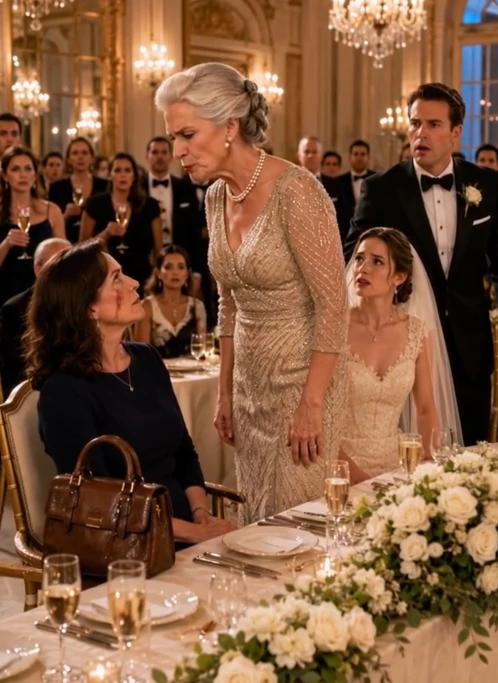
The slap came so suddenly that Anna Mercer did not understand what she had heard until she saw Rose’s face turn to the side.
The string quartet continued for another two notes before the violinist nearest the dance floor lowered her bow. A fork slipped from someone’s hand and struck a plate. Across the ballroom, nearly two hundred guests became silent at once.
Rose remained seated.
A red mark spread across her left cheek where Celeste Lawson’s hand had struck her. Rose’s simple navy dress had no sequins, embroidery, or designer label. Her gray-streaked brown hair was pinned neatly at the back of her neck, and her only jewelry was a silver watch Anna had given her for her sixtieth birthday.
Beside Rose’s chair sat the same worn leather handbag she had carried for more than fifteen years.
Celeste stood over her in an ivory gown that had been chosen to look elegant without appearing too much like a bridal dress. Pearls circled her neck. Her pale hair had been arranged by the same stylist who had prepared Anna that morning.
“Stand up,” Celeste said.
Rose slowly turned her face forward.
“You do not belong at this table.”
Anna sat three seats away, still holding the champagne glass she had lifted during the toast. For several seconds, her fingers would not move.
The wedding ballroom had looked perfect only minutes earlier.
Cream roses filled tall glass vases. Candles glowed along the walls. The ceiling was covered in small lights designed to resemble stars. Every napkin had been folded into a fan and secured with a silver ring carrying the Lawson family crest.
Anna had spent the day believing that the hardest part was over.
She had survived the photographs, the speeches, the formal greeting line, and Celeste’s constant corrections. She had married Luke beneath an arch of white flowers while a harp played softly behind them. She had repeated her vows without stumbling. Luke had smiled when he placed the ring on her finger.
For one quiet hour, Anna had allowed herself to believe that the tension between the two families might finally fade.
Then Celeste slapped Rose.
“That’s my mother,” Anna whispered.
Celeste turned.
Her expression did not soften.
“Your mother?” she said. “Anna, please do not make this more embarrassing than it already is.”
Anna placed the champagne glass on the table before she dropped it.
“My birth parents died when I was six,” she said. “Rose raised me.”
“A woman agreeing to care for an orphan does not automatically give her a place in every part of your adult life.”
“She is my mother.”
Rose finally looked toward Anna.
There was no anger in her eyes. Only concern.
That made Anna feel worse.
Throughout the ballroom, guests watched with the uncomfortable attention people gave to a car accident. Some leaned toward one another. Others stared openly.
Celeste laughed, but the sound was thin.
“A country woman takes in a child, and suddenly she believes she should be seated beside people who built something with their lives.”
Rose’s lips pressed together.
Luke pushed his chair backward.
“Mom, stop.”
Celeste did not even look at him.
“This reception reflects our family,” she continued. “The hotel, the flowers, the guest list, the music. I paid for it. I arranged it. I protected it from becoming another one of Anna’s sentimental little projects.”
Anna felt the heat rise in her face.
Celeste pointed toward Rose’s handbag.
“Look at her. She arrived carrying that thing as if she had wandered in from a bus terminal.”
A few guests shifted uneasily.
No one spoke.
Anna looked around the table.
Luke’s father, Richard Lawson, studied his wine. Luke’s older sister, Vanessa, stared at the flower arrangement. Two of Celeste’s cousins lowered their eyes.
These were people who had hugged Anna after the ceremony.
They had told her she looked beautiful. They had welcomed her into the Lawson family. They had raised glasses and spoken about love, loyalty, and new beginnings.
Now they sat quietly while Celeste humiliated the woman who had raised her.
“Mom,” Anna said.
Her voice broke.
Rose turned toward her.
“It’s all right.”
“No, it isn’t.”
“Please,” Rose said gently. “Not tonight.”
Celeste’s mouth tightened.
“Do not perform dignity now. You accepted a seat you had no right to take.”
“I was invited,” Rose replied.
“By a girl who does not understand how these events work.”
Luke stood.
“Do not speak about my wife that way.”
Celeste faced him at last.
“Sit down.”
“No.”
For twenty-nine years, Luke Lawson had avoided direct conflict with his mother.
He had learned early that Celeste rarely shouted. She did not need to. She could withdraw affection, money, introductions, employment, and family approval with a calm telephone call.
When Luke was sixteen, he had wanted to attend a public university with two school friends. Celeste arranged a private campus tour at a more prestigious institution and informed him that the family would support only the school she preferred.
At twenty-three, he wanted to take a job at a small architectural firm. Celeste had already secured him a position inside Lawson Development.
When he had first introduced Anna, Celeste had smiled warmly, taken Anna to lunch, and then asked Luke whether he was certain he wanted to connect himself to “such a limited family background.”
Luke had always argued quietly.
He had negotiated, delayed, and softened.
He had never simply said no.
Now he remained standing.
Celeste looked at him as if he were a stranger.
“If you choose this embarrassment over your own family,” she said, “you will regret it.”
Anna knew what the warning meant.
Celeste controlled the voting shares in Lawson Development. She had influence over Luke’s position in the company and the trust established by his grandfather. She also controlled the social network that surrounded the Lawsons.
She could close doors without appearing to touch them.
Luke’s hands trembled at his sides.
“Rose is family,” he said.
“No. Rose is Anna’s obligation.”
Anna stood so quickly that her chair caught against the carpet.
“She is not an obligation.”
Several guests near the next table turned in their seats.
Celeste glanced around the ballroom, noticing the attention for the first time.
Her voice became quieter.
“Sit down, Anna. We will handle this privately.”
“You slapped her in front of everyone.”
“She refused to leave when asked.”
“No one asked her to leave.”
“I did.”
“That does not give you the right to hit her.”
Celeste looked past Anna and addressed Rose again.
“You have disrupted enough of this evening. Get up.”
Rose placed both palms flat against the tablecloth.
“Mrs. Lawson,” she said calmly, “I think you have said enough.”
Celeste gave a small, disbelieving laugh.
“You think you can correct me?”
“No. I think you corrected yourself.”
Celeste’s cheeks flushed.
“Security!”
The word carried through the ballroom.
Two hotel security employees near the entrance looked toward the table but did not move immediately.
Celeste raised her voice.
“Remove this woman.”
Anna stepped beside Rose.
“If she leaves, I leave.”
Luke moved to Anna’s side.
“So do I.”
A murmur spread through the guests.
Celeste stared at her son.
“Then go,” she said. “Perhaps that will save us from pretending this marriage ever made sense.”
The quartet lowered their instruments completely.
Rose rose from her chair.
She did not touch her cheek. She did not look toward the guests or the security officers.
Instead, she reached for her old leather handbag.
Anna caught her arm.
“Mom, don’t.”
Rose covered Anna’s hand with her own.
“I’m not going anywhere yet.”
She placed the bag on the table and opened it.
Celeste crossed her arms.
“No one wants your life story.”
“I am not offering it.”
Rose removed a thick stack of papers secured by a black clip.
The top page carried the crest of the Royal Meridian Hotel.
Beneath it was a signature.
Celeste saw it and stopped smiling.
Rose placed the documents on the table.
“Property agreements,” she said. “Corporate ownership records. Board resolutions and current voting certificates.”
Luke frowned.
“Rose, what are those?”
“Twelve years ago, I purchased the controlling interest in Royal Meridian Hospitality through Mercer Holdings.”
Someone at the neighboring table whispered, “Mercer Holdings?”
Another guest answered in a low voice.
“They own the Palisade hotels. And the Aston clubs.”
Celeste gripped the edge of the table.
“This hotel belongs to Royal Meridian Hospitality.”
“Yes,” Rose replied. “Royal Meridian is one of our subsidiaries.”
Luke looked at Rose, then around the ballroom.
“You own this hotel?”
“I own the company that owns it.”
For the first time since the slap, no one moved at all.
Even the security employees near the entrance remained still.
Celeste’s face changed slowly.
Shock came first, followed by confusion, and then anger.
“You let us believe you were nobody.”
Rose looked at her.
“I came here as myself.”
“You deceived us.”
“No. I allowed you to speak.”
The words were quiet, but they moved across the table with more force than the slap.
Anna stared at the documents.
She had known Rose owned several businesses. She knew about Mercer Agricultural Supply, the small company Rose had operated while Anna was growing up. She knew Rose had made successful investments and that she sat on the board of a charitable foundation.
But Rose lived in the same modest farmhouse where she had raised Anna. She drove a six-year-old car and repaired her kitchen cabinets rather than replacing them.
Anna had never imagined anything like this.
“Why didn’t you tell me?” she asked.
Rose’s expression softened.
“You never asked how much I owned. You asked if I was happy.”
Celeste shook her head.
“This is ridiculous. Anyone can print documents.”
Rose looked toward the hotel’s general manager, Mr. Patel, who stood near the ballroom doors.
“Arun?”
Mr. Patel approached the table.
He was a careful man in his early fifties who had spent the entire reception ensuring that every detail met Celeste’s demands.
He stopped beside Rose.
“Ms. Mercer is chairwoman of Mercer Holdings,” he said. “She is also the majority voting owner of Royal Meridian Hospitality.”
Richard Lawson finally looked up from his wine.
“How long have you known?”
“Since I accepted this position seven years ago.”
“And you said nothing?”
Mr. Patel’s expression remained professional.
“It was not my information to share.”
Celeste turned toward Rose.
“You sat through every planning meeting and allowed me to speak to you as though—”
“As though I were what?” Rose asked.
Celeste did not answer.
Rose removed another document from the stack.
“I brought these papers because your attorney contacted our legal office last week.”
Luke looked sharply at his mother.
“What?”
Rose placed a printed email chain in front of Anna.
“Mrs. Lawson requested that an unnamed guest be removed from the family table shortly before dinner.”
Anna looked down.
The message had been sent from the law office that represented Lawson Development.
The unnamed guest was described as a nonrelative who had inserted herself into the bride’s life and might behave unpredictably during the reception.
Anna’s stomach tightened.
The hotel’s legal department had refused to authorize the removal without the bride’s written request.
A second email from Celeste’s attorney threatened to cancel future Lawson events at Royal Meridian properties.
Anna lifted her eyes.
“You knew she was my mother before tonight.”
Celeste’s expression became flat.
“You use that word too easily.”
“You had her background. Her name. Her photograph.”
“I was protecting the event.”
“From what?”
“From this.”
Celeste waved toward the table as if Rose had created the confrontation.
Anna continued reading.
Her tears had stopped.
The last email contained another request.
Rose reached for the final page before Anna turned it.
“And that,” she said, “was not the only reason I brought the file.”
Richard straightened.
“What else was requested?”
Rose looked at him.
“Lawson Development is currently bidding for the renovation of three Royal Meridian properties.”
Luke’s eyes moved toward his father.
“I thought the bid was still under preliminary review.”
“It is,” Rose said. “Our internal review uncovered serious problems.”
Richard placed both hands on the table.
“This is neither the time nor the place for a business discussion.”
“I agree,” Rose replied. “I would have preferred not to discuss it tonight.”
Celeste gave a bitter laugh.
“Then don’t.”
“You made that impossible when you struck me.”
Rose removed a report from the stack.
“Last week, your attorney asked our company to remove several safety documents from the Lawson bid file.”
Richard’s face lost color.
Luke looked between his parents.
“What safety documents?”
Rose did not take her eyes from Richard.
“Inspection reports from the Wellington parking structure.”
A silence fell between the family members that felt different from the silence after the slap.
It was not shock.
It was recognition.
Vanessa Lawson looked down at her lap.
Luke noticed.
“What happened at Wellington?” he asked.
Richard’s voice was controlled.
“Nothing happened.”
Rose opened the report.
“Cracking was discovered in several load-bearing columns. Two independent engineers recommended immediate repairs and restricted use of the lower levels.”
Luke stared at his father.
“Lawson Development built that structure.”
“Fifteen years ago.”
“The age is not the issue,” Rose said. “The original reinforcement schedule does not match the approved structural drawings.”
Anna felt her skin turn cold.
She was not an engineer, but she understood enough from Rose’s explanation.
Luke did too.
He worked in planning and design coordination for Lawson Development.
“Are you saying the structure wasn’t built according to the approved plan?” he asked.
Rose nodded.
“Sections of steel reinforcement appear to have been reduced during construction. The change orders contain signatures from a consulting engineer who died six months before the documents were dated.”
The room remained silent.
Richard pushed his chair back slightly.
“That is an outrageous accusation.”
“It is a finding from our due diligence review.”
“Our attorneys will respond.”
“They already did,” Rose said. “They asked us to remove the reports.”
Celeste turned toward Richard.
“You told me it was paperwork.”
Richard did not answer.
Rose looked at Celeste.
“Your attorney wrote that continued attention to old technical records could damage the long-standing relationship between Lawson Development and the Royal Meridian group.”
Luke’s voice was low.
“Mom, did you approve that email?”
Celeste looked at him.
“I approved a request to correct irrelevant information.”
“Did you know the reports involved structural safety?”
“I knew there were questions.”
“Questions about a building Dad’s company constructed?”
Celeste’s expression hardened.
“You do not understand how major contracts work.”
“I understand that you tried to make the hotel remove evidence.”
“This is not evidence. It is an opinion from engineers being paid to create problems.”
Rose glanced toward Anna.
Anna knew what Rose was thinking.
Rose had spent much of Anna’s childhood working with builders, farmers, surveyors, and insurance inspectors. She respected records because records remained after people changed their stories.
Rose returned her attention to Celeste.
“The engineers were not hired to create problems. They were hired to identify them before someone was injured.”
Richard stood.
“This conversation is over.”
Rose closed the report.
“For tonight, yes.”
“You cannot threaten my family in front of our guests.”
“I did not invite the discussion.”
“You arrived carrying confidential documents.”
“I arrived prepared because your wife had already attempted to remove me.”
Richard looked toward Mr. Patel.
“I want every copy of those documents collected.”
Mr. Patel did not move.
“You do not have authority to issue that instruction here.”
Richard stared at him.
Celeste looked around the ballroom.
The guests were no longer whispering politely. Several had taken out their phones. A man from one of the tables near the stage stepped into the hallway, speaking rapidly into his.
Celeste’s face tightened.
“No photographs,” she announced. “Everyone put your phones away.”
Few people obeyed.
Anna watched her mother press the papers back into order.
Rose’s hands were steady.
The mark on her cheek had deepened from red to purple near her jaw.
“Mom,” Anna said. “We should have someone look at your face.”
“I’m all right.”
“You were hit.”
Rose met her eyes.
“Yes.”
The word seemed to settle something inside Anna.
She turned toward Mr. Patel.
“Please call the police.”
Celeste looked at her sharply.
“Do not be absurd.”
Anna ignored her.
Mr. Patel nodded to a security officer.
Celeste moved closer to Anna.
“You will not bring the police into my son’s wedding.”
“You slapped my mother.”
“She refused to leave.”
“You planned to remove her before the reception started.”
“I was trying to prevent exactly this spectacle.”
“No,” Anna said. “You were trying to make her disappear.”
Luke stepped between them.
“Stay away from Anna.”
Celeste stared at him.
“Do not speak to me like that.”
“I’m asking you to step back.”
“I am your mother.”
“And Anna is my wife.”
The words sounded simple.
For Luke, they were not.
Celeste’s eyes narrowed.
“You think one ceremony changes where your loyalty belongs?”
Luke looked at his father, his sister, and the relatives seated around the table.
“No. I think tonight showed me where it never belonged.”
Celeste struck him across the face.
The second slap was quieter than the first because Luke turned slightly as her hand rose.
Still, everyone saw it.
Luke did not move for several seconds.
Celeste lowered her hand.
Something close to regret appeared in her eyes, but it vanished before she spoke.
“You have always been weak.”
Luke’s face went pale.
Anna took his hand.
He looked down at their joined fingers as if he needed proof that something in the room was real.
Then he faced his mother.
“We’re leaving.”
Celeste laughed.
“You will be back by morning.”
“No.”
“You have a position at Lawson Development.”
“I know.”
“You have a home owned by the family trust.”
“I know.”
“You have accounts you cannot access without authorization.”
Luke nodded.
“I know.”
Anna felt his hand tighten.
Celeste waited for him to surrender.
He did not.
Rose closed her handbag.
“We can go upstairs,” she said. “The hotel has a private suite available.”
Celeste’s head turned.
“You will not take over my son’s wedding night.”
Rose looked at her with tired patience.
“It is not yours to control.”
The police arrived twenty minutes later.
By then, most of the guests had moved away from the family table. Some gathered near the bar. Others stood in small groups throughout the ballroom, pretending to discuss transportation arrangements while watching the doors.
The officers separated Rose, Celeste, and the immediate witnesses.
Mr. Patel provided security footage from the ballroom cameras.
Celeste’s attorney arrived before Rose finished giving her statement.
He was a short man named Howard Crane who had attended the ceremony but left before dinner. He entered through a side door, still wearing formal clothes, and spoke to Celeste near the lobby.
Rose sat in a quiet conference room with Anna and a female police officer.
“Did she threaten you before the assault?” the officer asked.
“No.”
“Had there been previous conflict between you?”
Rose considered the question.
“She never wanted me involved in the wedding.”
“Did she tell you that directly?”
“Several times.”
Anna leaned forward.
“She changed Mom’s seat three times. First, she was supposed to sit beside me. Then she moved her to a table near the kitchen.”
The officer looked at Rose.
“How did you return to the family table?”
“Anna corrected the seating chart yesterday.”
The officer wrote something down.
“Did Mrs. Lawson know?”
“Yes.”
“And the documents?”
“They concern my business. I brought them because Mrs. Lawson’s attorney had contacted our office about removing me.”
The officer glanced toward Anna.
“Were you aware of that request?”
“No.”
The word came out harder than Anna intended.
The officer asked to see the emails.
Rose handed them over.
Anna watched her mother answer every question carefully.
Rose did not exaggerate. She did not insult Celeste or claim that the assault had been worse than it was. She simply described what happened.
That was how Rose had handled almost everything in Anna’s life.
When Anna was six, her parents died in a highway accident during a winter storm. Her father, Michael, had been Rose’s younger brother. Anna’s mother, Ellen, had grown up beside Rose and had been her closest friend before marrying Michael.
Rose was thirty-three at the time.
She was unmarried and living in a two-bedroom farmhouse outside Cedar Grove, nearly two hours from the city.
Social workers discussed placing Anna with a distant aunt in another state. Rose refused.
She completed the home inspections, background checks, legal appointments, and parenting classes. She moved her small business office into a converted shed so Anna could have the second bedroom.
The first night Anna slept in the farmhouse, she woke screaming at three in the morning.
Rose sat beside her until sunrise.
She did the same thing the second night.
And the third.
For months, Anna asked questions no adult could answer.
Why did the accident happen?
Did her parents know they were going to die?
Would they have survived if they had driven more slowly?
Rose never invented comforting stories.
She said, “I don’t know.”
Then she added, “But I’m here.”
She attended school meetings, learned to braid hair, packed lunches, and worked after Anna went to bed.
At the time, Rose’s company sold irrigation parts and agricultural equipment to farms across three counties. It was not glamorous work. She spent mornings checking inventory and afternoons driving between customers.
Anna remembered falling asleep in the passenger seat of Rose’s truck while boxes rattled in the back.
She remembered Rose heating canned soup after returning home late.
She remembered money being tight enough that Rose repaired Anna’s winter coat twice rather than buying a new one.
What Anna had not understood was that the company began growing when she was in middle school.
Rose had developed a water-monitoring system with an engineer she knew through a farm cooperative. A regional distributor purchased the licensing rights. Rose invested most of the money rather than changing how they lived.
Years later, she used those investments to purchase struggling commercial properties.
One was an old roadside hotel.
Rose renovated it carefully, hired an experienced manager, and sold it at a profit.
That led to another property.
Then another.
By the time Anna left for college, Rose controlled Mercer Holdings, though the company used professional managers and rarely placed her photograph in public material.
Rose had never hidden that she was comfortable.
She paid Anna’s tuition, helped with her first apartment deposit, and donated generously to local schools.
But she hated public displays of wealth.
“Money is useful,” she once told Anna. “It is not a personality.”
When Anna met Luke, she told him Rose owned several businesses.
Luke never asked for details.
He said he admired that Rose still worked in her garden.
Celeste asked many questions.
How much land did Rose own?
Was the farmhouse valuable?
Did she have other children?
What would Anna inherit?
Anna refused to answer.
Celeste concluded that Rose was a small-town businesswoman with modest savings.
Rose allowed her to believe it.
After the officers finished taking statements, Celeste was escorted from the hotel through a private entrance.
She was not placed in handcuffs, but she received a citation and a notice to appear concerning the assault. Her attorney argued that the slap had caused no serious injury.
Rose declined medical transport but agreed to be examined by the hotel physician.
In the private suite upstairs, a doctor placed a cold compress against her cheek and checked her jaw.
“No fracture,” he said. “There may be swelling for a few days.”
Anna stood near the window, still wearing her wedding gown.
The dress suddenly felt heavy.
Luke sat on the edge of a sofa with his tie loosened. A faint red mark remained on his cheek.
None of them had spoken much since leaving the ballroom.
Rose thanked the doctor and waited until he left.
Then she looked at Anna.
“You should change clothes.”
Anna laughed once.
The sound became a sob.
She covered her face.
Rose crossed the room and held her.
“I’m sorry,” Anna said against her shoulder.
“For what?”
“For all of it. For inviting her. For letting her control everything. For not seeing what she was doing.”
Rose stroked the back of her hair.
“You did see it.”
“Too late.”
“You saw it when it mattered.”
Anna pulled back.
“She hit you.”
“Yes.”
“And you’re comforting me.”
“I have more practice.”
Luke lowered his head.
“I should have stopped this before tonight.”
Rose looked at him.
“You did not know she planned to remove me.”
“I knew she hated having you involved.”
“That is not the same thing.”
“I kept asking Anna to be patient with her.”
Anna turned toward him.
“You said she needed time.”
“I know.”
“You told me she would calm down after the wedding.”
“I know.”
His voice was tired and ashamed.
Rose sat opposite him.
“What are you going to do now?”
Luke looked up.
“My mother will fire me.”
“That is not what I asked.”
He rubbed his hands together.
“I don’t know.”
Rose waited.
Luke looked toward Anna.
“I want to stay with my wife.”
Anna sat beside him.
“That isn’t the whole question.”
“No.”
“Can you walk away from them?”
Luke breathed out slowly.
“I don’t know how.”
It was the most honest thing he had said all evening.
For most of Luke’s life, Lawson Development had been the center of his world.
His grandfather founded the company. His father expanded it. Celeste managed its finances and public relationships after Richard proved too impatient for administrative work.
Family gatherings often became business meetings. Birthdays were used to introduce investors. Vacations included tours of future development sites.
Luke was never forced to apply for work.
A position waited for him after university.
His apartment belonged to a family trust. His car was leased through the company. His health insurance, retirement account, and credit cards were connected to Lawson Development.
Celeste called these things support.
Luke now understood them as strings.
Rose leaned back in her chair.
“You do not have to decide everything tonight,” she said. “But do not confuse discomfort with impossibility.”
Luke nodded.
Anna took his hand.
“What was in those safety reports?” she asked Rose.
Rose’s expression became serious.
“Enough to stop Lawson Development from receiving our renovation contracts.”
“Could the parking structure collapse?”
“We do not know. The current engineers found cracking and incomplete reinforcement. The lower floors have already been closed.”
“Did anyone get hurt?”
“Not yet.”
Luke looked toward the carpet.
“I worked on the Wellington redevelopment file last year.”
Rose watched him.
“Did you see the reports?”
“No. Dad said maintenance wanted unnecessary repairs. He asked me to prepare a cost comparison.”
“What happened?”
“I recommended a limited repair program based on the information they gave me.”
“Did you sign anything?”
“A planning memo. Nothing structural.”
“Do you still have a copy?”
“Probably in my work email.”
Rose nodded.
“You should preserve it.”
Luke looked at her.
“You think my parents would alter records?”
“I think your mother asked my company to remove records.”
Anna sat very still.
“Are they in legal trouble?”
“Possibly.”
Luke stood and walked toward the window.
Below them, wedding guests were leaving through the hotel entrance. Cars moved slowly along the circular drive.
“The company employs almost four hundred people,” he said.
Rose nodded.
“I know.”
“If this becomes public, people could lose their jobs.”
“If the structural problems are ignored, people could lose more than jobs.”
Luke closed his eyes.
“I’m not defending them.”
“I know.”
“I just keep thinking about everyone who had nothing to do with this.”
“That is exactly why the truth matters,” Rose said. “Companies survive bad leadership when problems are faced early. They fail when everyone protects the people at the top.”
Anna looked at her mother.
“Is that why you brought the documents?”
“I brought the ownership papers because I expected Celeste to challenge my authority after the hotel refused to remove me.”
“And the safety reports?”
“I did not bring the complete reports. Only the emails from her attorney and a summary showing why the request was improper.”
“You expected her to confront you?”
Rose gave a tired smile.
“I expected cruelty. I did not expect the slap.”
Anna lowered her eyes.
“Why didn’t you tell me?”
“Because it was your wedding morning.”
“You could have warned me.”
“I considered it.”
“Then why didn’t you?”
Rose looked at Luke.
“Because I wanted to see what kind of family you were marrying into when they believed there would be no consequences.”
The room became quiet.
Luke turned from the window.
“That sounds like a test.”
“It was not a test of you,” Rose said. “It was an opportunity for them to behave as themselves.”
“And if they had removed you before dinner?”
“I would have told Anna.”
“And stopped the wedding?”
“No. That decision would have belonged to both of you.”
Anna studied Rose’s face.
“You already knew they were hiding the Wellington reports.”
“Yes.”
“Before the ceremony?”
“Yes.”
“And you still let me marry Luke?”
Rose’s expression sharpened.
“Luke is not his parents.”
Luke looked away.
Rose continued.
“I will never decide who you are allowed to love. That is the difference between protection and control.”
Anna sat silently for several moments.
Then she nodded.
Near midnight, Mr. Patel brought them trays of food from the closed kitchen.
None of them had eaten more than a few bites during dinner.
Anna changed into a hotel robe. Her wedding dress hung in the bedroom, its long train draped over a chair.
She picked at a plate of rice and grilled chicken while Luke made telephone calls.
The first call was to his father.
Richard answered immediately.
“What have you done?” he demanded loudly enough for Anna to hear.
Luke moved toward the hallway.
“I’m still at the hotel.”
“Your mother has been charged because your wife’s guardian wanted attention.”
“She slapped Rose.”
“She lost her temper.”
“She also slapped me.”
“You challenged her publicly.”
Luke glanced toward Anna.
“Did you know about the Wellington reports?”
A pause followed.
“This is not a conversation for tonight.”
“It became a conversation tonight.”
“Rose Mercer is trying to damage the company because she was insulted.”
“Did you know the reinforcement schedule was changed?”
“Structural details are handled by engineers.”
“The consulting engineer’s signature may be false.”
“You do not know what you are talking about.”
“Then explain it.”
Richard’s voice became colder.
“Come home. We will discuss it as a family.”
“I am with my family.”
Anna looked down at her plate.
Richard said something else that she could not hear.
Luke’s face tightened.
“No. I’m not leaving Anna.”
Another pause.
Luke ended the call.
“What did he say?” Anna asked.
Luke placed the phone on the table.
“He said my company access will be suspended by morning.”
“Can he do that?”
“Yes.”
“What about our apartment?”
“It belongs to the Lawson family trust.”
Rose lifted her gaze.
“They may ask you to leave.”
“They will.”
Anna looked around the suite.
Only hours earlier, she had expected to spend the night in a honeymoon room filled with champagne and rose petals.
Now she and Luke might not have a home.
“We can stay here tonight,” Rose said.
Luke shook his head.
“That isn’t a long-term answer.”
“No. But you only need tonight’s answer tonight.”
The next morning, Luke received an email terminating his employment.
The message was sent at 6:12 a.m.
A second email notified him that his building access, company accounts, and corporate credit cards had been disabled.
At seven, the family trust’s attorney contacted him about the apartment. The lease allowed the trust to reclaim it after thirty days if Luke was no longer employed by Lawson Development.
Luke read the messages without speaking.
Anna watched him from the hotel bed.
“How much money do you have that they can’t reach?” she asked.
He opened his banking app.
“About eleven thousand dollars.”
Anna stared.
“You make almost two hundred thousand a year.”
“I know.”
“Where does it go?”
“Company retirement account. Trust investments. The apartment. Travel. The car.”
“How much is in your personal savings?”
“That is my personal savings.”
Anna had seventy-four thousand dollars in her own accounts.
She worked as an occupational therapist at a rehabilitation clinic and had saved carefully since college.
Luke had known that.
She had assumed he possessed far more.
For the first time, she understood that his family had not merely supported him.
They had prevented him from building anything separate.
Luke sat beside her.
“I should have told you.”
“Yes.”
“I kept thinking it didn’t matter because the trust would eventually become mine.”
“And now?”
“Now I think it was never supposed to become mine. It was supposed to keep me obedient.”
Anna reached for his hand.
“We’ll find an apartment.”
“I don’t have a job.”
“You can get one.”
“My entire professional history is tied to Lawson Development.”
“You still have experience.”
“My mother knows every major developer in the city.”
“Then apply somewhere else.”
Luke looked at her.
“You make it sound easy.”
“No. I make it sound possible.”
Rose, standing near the coffee machine, smiled slightly.
Luke noticed.
“You said the same thing last night.”
“Anna learned it somewhere.”
The first week after the wedding was filled with practical problems.
Anna and Luke collected their belongings from the trust-owned apartment under the supervision of a property manager.
Celeste had already entered the unit.
Several framed photographs had been removed from the walls. Anna’s wedding invitation, which had been displayed on the kitchen counter, had been torn in half and left beside the sink.
Luke stared at it.
Anna picked up the pieces and dropped them into the trash.
They rented a small furnished apartment near Anna’s clinic.
It had one bedroom, a narrow kitchen, and windows facing another building.
Luke apologized the first night.
“For what?” Anna asked.
“This isn’t what I promised you.”
“You promised to marry me.”
“I also promised we would build a life.”
“We are.”
He looked around the cramped room.
“It doesn’t feel like building.”
“It feels like the ground floor.”
Luke gave a tired laugh.
The honeymoon was canceled.
Instead of flying to Italy, they spent their first married week opening new bank accounts, returning the company car, and purchasing basic furniture.
Rose offered money.
Anna refused at first.
“You already paid for my education,” she said.
“I am not trying to pay for your marriage.”
“We need to do this ourselves.”
Rose nodded.
“Then do it yourselves. But remember that refusing all help can become another kind of pride.”
Anna accepted an interest-free loan for the apartment deposit.
Luke began applying for jobs.
Three companies interviewed him and then stopped responding.
A former colleague quietly told him that Celeste was calling senior executives and describing him as emotionally unstable.
“She says you disclosed confidential company information at your wedding,” the colleague said.
“I didn’t disclose anything.”
“She is also saying your wife’s family is involved in a hostile takeover attempt.”
Luke laughed.
There was no humor in it.
“Rose doesn’t want Lawson Development.”
“I know. But people believe what protects their relationships.”
Luke applied to smaller firms outside the city.
He also began meeting with an attorney.
The safety issue at the Wellington structure moved quickly.
Royal Meridian notified the city and the property’s current owner. Engineers closed the parking structure completely while testing continued.
Investigators discovered that portions of the original construction file had disappeared from Lawson Development’s archive.
Luke turned over his planning memo and the emails his father had sent him the previous year.
One message instructed him to describe the cracking as cosmetic until a refinancing package was complete.
Luke had followed the instruction.
He felt sick when he read it again.
“I should have questioned him,” he told Anna.
They were sitting at their small dining table after dinner.
“You were given incomplete information.”
“I knew he was minimizing it.”
“Did you know people could be in danger?”
“No.”
“But you knew something was wrong.”
Luke stared at the email.
“Yes.”
Anna did not rush to comfort him.
She had learned from Rose that love did not always mean making another person feel innocent.
“What are you going to do?” she asked.
“Tell the investigators everything.”
“Even if it hurts the company?”
“Especially then.”
Luke testified before a regulatory panel six weeks later.
He explained the cost-comparison memo, the instructions from his father, and the way senior managers avoided creating written records.
His testimony did not prove that Richard had ordered the original construction changes fifteen years earlier, but it showed a recent effort to minimize known concerns.
Two former project managers came forward after Luke.
One had retained copies of old invoices showing that less reinforcing steel had been purchased than the approved plans required.
The second described pressure from Richard to approve changes without notifying the project engineer.
The company’s insurers began their own investigation.
Several clients suspended Lawson Development from current bidding processes.
Celeste blamed Rose publicly.
Through a public relations consultant, she released a statement describing the Wellington issue as a competitive dispute created by an aggressive hotel conglomerate.
The statement never mentioned that Rose controlled the conglomerate.
It described her only as “a private investor with personal ties to a former Lawson employee.”
Anna read the statement on her phone during lunch.
Her coworker Jasmine sat across from her.
“They make your mother sound like some secret criminal,” Jasmine said.
“They cannot admit they treated her like she was poor.”
“Because then they would have to admit the real problem.”
Anna looked at her.
“What real problem?”
“They weren’t angry that she had power. They were angry they couldn’t recognize it.”
Anna thought about that for days.
Celeste had measured everyone through clothing, addresses, family names, and visible influence.
Rose had arrived without signals Celeste respected.
Therefore, Celeste believed Rose had no value.
The ownership documents had not changed Rose.
They had only exposed Celeste.
The criminal case concerning the slap was resolved in three months.
Security footage showed the assault clearly. Celeste’s attorney advised her to accept a plea for misdemeanor battery.
She received probation, community service, and mandatory anger-management counseling.
Outside the courthouse, she made no statement.
Howard Crane spoke for her.
“Mrs. Lawson regrets that a private family disagreement became a public matter.”
Rose watched the news clip at the farmhouse.
Anna sat beside her.
“Private family disagreement,” Anna repeated.
Rose turned off the television.
“People use soft words when hard words make them look guilty.”
“Are you satisfied with the outcome?”
“No.”
Anna looked at her.
Rose touched the faint discoloration that remained near her jaw.
“But courts are not built to provide emotional satisfaction.”
“Would you have wanted jail?”
“I wanted her to understand.”
“Do you think she does?”
“No.”
Rose was right.
Celeste’s anger increased as Lawson Development’s problems grew.
Royal Meridian formally rejected the company’s bid for the renovation contracts. Two other hotel groups followed after reviewing the Wellington reports.
Banks tightened the terms of Lawson Development’s credit.
Richard insisted the company could survive.
Celeste began selling personal assets to provide cash.
Vanessa Lawson called Luke in late autumn.
He had not heard from his sister since the wedding.
“Dad wants to meet,” she said.
“Why doesn’t he call me?”
“Because he thinks you’ll record him.”
“I might.”
Vanessa sighed.
“Luke, the company is in trouble.”
“I know.”
“People are going to lose their jobs.”
“I know.”
“You could help.”
“How?”
“Tell Rose to stop.”
Luke stood at the kitchen window of the apartment while Anna listened from the sofa.
“Stop what?”
“The audits. The reports. The lawsuits.”
“Rose doesn’t control the city investigation.”
“She controls Royal Meridian.”
“She disclosed a safety problem.”
“She could say the issue has been resolved.”
“It hasn’t been resolved.”
“Repairs have started.”
“After years of being delayed.”
Vanessa lowered her voice.
“Dad made mistakes.”
“Did you know?”
A long silence followed.
“Vanessa?”
“I knew there were old documents.”
“Did you know the engineer’s signature was false?”
“No.”
“Did you know Mom tried to have reports removed from the Royal Meridian file?”
“She said they were being used unfairly.”
“Did you believe her?”
“I wanted to.”
Luke closed his eyes.
“Why are you calling?”
“Because she is falling apart.”
“Mom?”
“She barely sleeps. She thinks everyone has betrayed her.”
“She assaulted Rose and tried to throw Anna out of her own wedding.”
“She regrets that.”
“Has she apologized?”
Vanessa did not answer.
Luke nodded to himself.
“That’s what I thought.”
“She is still our mother.”
“Yes.”
“Does that mean nothing to you?”
“It means I spent my whole life making excuses for her.”
Vanessa began to cry.
Luke’s voice softened.
“What do you want from me?”
“I want things to go back to normal.”
“They cannot.”
“Why not?”
“Because normal was built on everyone being afraid of her.”
After the call, Luke sat beside Anna.
“I feel terrible.”
“You told the truth.”
“That doesn’t stop me from feeling terrible.”
“No.”
“I keep thinking maybe I could have handled it differently.”
“How?”
“I could meet Dad. I could ask Rose whether there’s a settlement.”
“Would the building be safe?”
“Eventually.”
“Would the records be honest?”
Luke looked down.
“No.”
Anna took his hand.
“Then you don’t want a settlement. You want the guilt to stop.”
He leaned back against the sofa.
“When did you become so direct?”
“I was raised by Rose.”
Luke smiled weakly.
Rose rarely spoke publicly about the wedding.
Reporters contacted Mercer Holdings after learning that its chairwoman had been assaulted at one of her own hotels.
The story spread because of the contrast.
A wealthy family had humiliated a woman they believed was poor, only to discover that she owned the venue.
Online headlines exaggerated nearly every detail.
Some claimed Rose had fired the entire hotel staff. Others said she had canceled the wedding while Celeste was giving a speech. One article described Rose as a billionaire who arrived in a limousine disguised as a cleaner.
None of that was true.
Rose had arrived in her own car.
She had worn the navy dress because she liked it.
She had not planned revenge.
When a business magazine requested an interview, Rose declined twice.
The third time, Anna persuaded her to consider it.
“People keep telling the story as if your money is what made the slap wrong,” Anna said.
Rose looked up from the invoices on her desk.
“That is what interests them.”
“Then tell them they’re wrong.”
The interview took place at the farmhouse.
Rose insisted that the photographs include her garden boots near the back door and the old kitchen table where she still reviewed reports.
The reporter asked why she had hidden her wealth.
“I did not hide it,” Rose replied. “I simply did not advertise it.”
“Did you allow Mrs. Lawson to underestimate you intentionally?”
“I allowed her to decide what she thought I was worth.”
“And what did the incident teach you?”
Rose paused.
“That some people behave well only when they believe another person has the power to punish them.”
The reporter leaned forward.
“Do you think Mrs. Lawson would have slapped you if she knew who you were?”
“No.”
“Does that make you feel vindicated?”
“It makes me concerned for everyone she believes has no power.”
That quote appeared in the article’s title.
For the first time, public attention shifted away from Rose’s wealth.
Former employees of Lawson Development began describing Celeste’s behavior toward assistants, contractors, and junior staff.
A receptionist said Celeste once threw a cup of coffee at her because a visitor arrived early.
A former driver described being dismissed after taking two days off when his father died.
Several stories could not be verified, but the pattern damaged Celeste’s reputation more than the wedding video had.
Lawson Development’s board began to split.
Three independent directors demanded that Richard and Celeste step away during the investigations.
They refused.
Lenders then required governance changes as a condition of extending credit.
Richard resigned as chief executive.
Celeste was removed from her financial oversight role.
Vanessa remained with the company temporarily to help stabilize operations.
Luke was offered an advisory position by the restructured board.
He declined.
“I don’t want my life tied to whether that company survives,” he told Anna.
By then, he had found work at a small architectural consulting firm in Portland.
The salary was less than half what he had earned at Lawson Development.
The firm occupied one floor of an old brick building and employed twenty-three people.
Luke loved it.
He prepared his own project schedules, met clients without his mother arranging introductions, and received criticism from supervisors who did not care about his surname.
After three months, he came home carrying a paper bag from a bakery.
“What is this?” Anna asked.
“My first performance review.”
“Was it good?”
“I was told I need to improve my documentation.”
Anna laughed.
“And we’re celebrating?”
“He also said I’m good with clients and that I might lead a small project next quarter.”
Luke placed two pastries on plates.
“No one called my father before saying it.”
That mattered more to him than the promotion.
Anna transferred to a rehabilitation center in Portland.
They rented a two-bedroom apartment with wooden floors and a narrow balcony overlooking a grocery store.
It was not luxurious.
The refrigerator made a clicking noise at night, and the upstairs neighbor walked heavily at six each morning.
Anna loved it.
Everything inside belonged to them.
No trust controlled the lease. No company paid the bills. No family accountant reviewed the expenses.
Luke began automatically moving part of every paycheck into a savings account.
The first time the balance reached five thousand dollars, he showed Anna as if he had won an award.
“I know this is not much,” he said.
“It’s yours.”
“Ours.”
Anna smiled.
“Ours.”
Their marriage was not magically healed by leaving Celeste.
The wedding night remained between them.
Anna became angry when Luke hesitated to criticize his mother. Luke became defensive when Anna questioned every message from his family.
They began seeing a counselor.
During one session, Anna said, “I’m afraid you will go back to them if they offer enough.”
Luke stared at the carpet.
“That hurts.”
“It’s true.”
“I walked away.”
“You walked away after your mother hit us.”
“What else was I supposed to do?”
“I wanted you to see who she was before that.”
“I did see parts of it.”
“You kept asking me to ignore them.”
Luke’s eyes filled.
“I thought keeping peace was the same as protecting you.”
“It protected her.”
The counselor let the silence remain.
Luke nodded slowly.
“You’re right.”
It was not the last disagreement, but it was the first time they stopped arguing about intent and spoke honestly about damage.
Rose visited them the following spring.
She arrived with vegetables from her garden, three boxes of kitchen supplies they did not need, and the old leather handbag Celeste had mocked.
Anna noticed it on the table.
“You still carry that?”
“The zipper works.”
“It looks ready to fall apart.”
Rose opened it.
“The lining was repaired.”
Luke smiled.
“You could buy a new one.”
“I could buy many unnecessary things.”
They took her to a small restaurant near the river.
No one recognized her.
Rose seemed relieved.
After dinner, they walked along the waterfront.
Luke stopped near a bench.
“There’s something I’ve wanted to ask you.”
Rose waited.
“Did you know my mother planned to use the wedding to pressure Royal Meridian about the contracts?”
“I suspected.”
“Did you attend because of the business issue?”
“I attended because Anna invited me.”
Luke nodded.
“If Mom had not slapped you, would you have exposed the emails?”
“I would have reported them through the proper business channels.”
“And the Wellington documents?”
“The investigation had already begun.”
“So the company would have lost the contracts anyway.”
“Yes.”
Luke looked across the water.
“My parents still believe you destroyed them.”
“I know.”
“Does that bother you?”
Rose thought for a moment.
“It bothers me that they may never understand the difference between consequence and revenge.”
Luke sat on the bench.
“I spent years thinking consequences were things my mother decided for other people.”
Rose sat beside him.
“That is often how control works.”
“Do you hate her?”
“No.”
Luke looked surprised.
Rose continued.
“Hate requires more attention than I want to give her.”
Anna sat on Rose’s other side.
“Would you forgive her if she apologized?”
“A real apology?”
“Yes.”
“I would consider it.”
Luke gave a small laugh.
“She would probably apologize for the misunderstanding.”
“Then that would not be an apology.”
Celeste never apologized.
She sent one letter to Luke almost a year after the wedding.
The envelope was addressed by hand.
Inside were four pages describing the damage done to the family.
She wrote about Richard’s resignation, the loss of contracts, the sale of their country property, and Vanessa’s exhaustion.
She said Luke’s grandfather would have been ashamed.
Near the end, she wrote:
I can forgive you for being manipulated during an emotional evening, but I cannot understand why you continue to choose strangers over your own blood.
Luke read the letter twice.
Then he handed it to Anna.
“She called you a stranger,” he said.
Anna folded it carefully.
“What are you going to do?”
He took the pages back.
“Nothing.”
He placed the letter in a desk drawer.
Several months later, he threw it away.
The Wellington parking structure required extensive repairs.
Investigators concluded that original construction records had been altered and that reinforcement had been reduced without proper approval.
Because too much time had passed, proving criminal responsibility for the construction decisions was difficult.
However, Lawson Development faced civil claims, regulatory penalties, and the loss of multiple licenses.
Under new leadership, the company sold several divisions and continued as a smaller regional contractor.
Hundreds of employees kept their jobs.
Richard and Celeste lost control.
Their personal finances had been more closely tied to the company than most people knew. They sold their estate and moved into a large but ordinary house in a gated community.
Vanessa visited Luke after the sale.
She arrived in Portland alone and asked to meet at a coffee shop.
Anna offered to stay home, but Luke wanted her there.
Vanessa looked older than she had at the wedding.
“I left the company,” she said.
Luke raised his eyebrows.
“When?”
“Last month.”
“What happened?”
“I couldn’t keep defending them.”
Luke waited.
Vanessa wrapped both hands around her cup.
“Mom made me call former clients and tell them the reports were exaggerated. Dad wanted me to say you stole confidential information.”
“I didn’t.”
“I know.”
“Did you tell anyone that?”
“Eventually.”
Anna watched her.
Vanessa looked toward her.
“I owe you an apology.”
Anna said nothing.
“I knew Mom planned to move Rose away from the family table,” Vanessa continued. “I didn’t know she had contacted the hotel. But I knew she was going to create a problem.”
“Why didn’t you warn us?”
“I thought it would be easier if Rose just sat somewhere else.”
“For whom?”
Vanessa lowered her eyes.
“For me.”
Anna nodded.
“That’s honest.”
“I was afraid if I challenged Mom, she would turn on me.”
“She did eventually.”
“Yes.”
“What changed?”
Vanessa’s eyes filled with tears.
“I watched the wedding video again.”
Luke looked at her.
“Why?”
“I don’t know. I had avoided it for months. Then one night I watched the whole thing.”
She wiped beneath one eye.
“When Mom slapped Rose, I looked down at my plate.”
Anna remembered.
“Yes.”
“I could see myself in the video. I knew what had happened, and I chose not to see it.”
No one spoke.
Vanessa took a breath.
“I don’t want to be that person anymore.”
Luke reached across the table.
Vanessa held his hand.
Rebuilding their relationship took time.
Vanessa still spoke to Celeste. Luke did not ask her to stop.
He only asked that information about his marriage remain private.
At first, Vanessa defended their mother out of habit. She would say Celeste had been under stress or had always struggled with rejection.
Luke learned to answer simply.
“Stress did not make her slap Rose.”
“Fear did not make her lie.”
“Losing control is not the same as being abandoned.”
Over time, Vanessa stopped making excuses.
Three years after the wedding, Anna and Luke returned to the Royal Meridian Hotel for the first time.
Rose had invited them to a charity dinner supporting rural health clinics.
Anna hesitated when she saw the ballroom entrance.
The hotel had been renovated. The old flowered carpet was gone, and the walls had been repainted in softer colors.
Still, she remembered everything.
The music stopping.
Rose’s red cheek.
Celeste’s voice telling her she did not belong.
Luke touched her back.
“We can leave.”
Anna looked through the open doors.
Rose stood near the stage speaking with two doctors. She wore a dark blue dress, different from the one she had worn at the wedding but almost as simple.
The old handbag hung from her shoulder.
Anna smiled.
“No. We’re staying.”
Their table was near the front.
Mr. Patel greeted them personally, though Rose had asked him not to make a special announcement.
During dinner, the charity director introduced Rose as the founder of a new program bringing rehabilitation services to isolated communities.
The room applauded.
Rose stood briefly and thanked the medical teams, local organizers, and donors.
She did not mention the hotels she owned.
She did not mention the wedding.
After dessert, Anna joined her near the terrace doors.
“You hate speeches,” Anna said.
“I survived.”
“You were good.”
“I was brief.”
“That helped.”
Rose smiled.
Across the ballroom, Luke was speaking with a young architect from his firm. He looked relaxed.
Anna watched him for a moment.
“We’re thinking about buying a house,” she said.
Rose raised her eyebrows.
“Here?”
“Outside Portland. It’s small. Two bedrooms and a yard.”
“Can you afford it?”
“With a mortgage.”
“Most houses arrive that way.”
Anna laughed.
“We’ve saved the down payment.”
Rose nodded approvingly.
“Luke is very proud of the savings account.”
“He sends me screenshots.”
“He sends me screenshots too.”
Anna looked at her.
“You could buy us the house.”
“I could.”
“But you won’t.”
“Not unless you need me to.”
Anna leaned her head against Rose’s shoulder.
“Thank you.”
“For not buying a house?”
“For knowing the difference.”
A waiter passed carrying champagne.
Rose accepted two glasses and handed one to Anna.
They stepped onto the terrace.
Below them, city traffic moved beneath the hotel lights.
Anna touched Rose’s old handbag.
“Do you remember what was inside this the last time we were here?”
“Documents, reading glasses, aspirin, and a packet of mints.”
“You changed everything with those papers.”
Rose shook her head.
“No.”
“You exposed them.”
“They exposed themselves.”
Anna looked back through the ballroom doors.
For years, she had thought of the wedding as the night her marriage almost ended.
Later, she understood it as the night her marriage truly began.
Before that evening, she and Luke had built their future around promises supported by someone else’s money.
They lived in a family apartment, used a family car, and relied on a family company.
Celeste’s approval touched every part of their lives.
When it disappeared, they discovered which promises remained.
Luke had lost his position, his home, and access to the world in which he had been raised.
He had also learned to earn his own money, admit his mistakes, and choose his wife without expecting praise.
Anna had learned that avoiding conflict did not create peace.
Rose had taught her that lesson many times, but Anna had needed to live it.
A year later, Anna and Luke purchased the small house outside Portland.
The kitchen cabinets were outdated. The backyard fence leaned toward one side, and rainwater collected near the garage.
Luke spent weekends repairing things.
Anna planted lavender beside the front steps.
Rose gave them the lemon tree from her farmhouse window.
“It needs more sunlight than I can give it,” she said.
They placed it in the yard.
The following spring, it produced five small lemons.
Luke photographed them and sent the picture to everyone they knew.
Vanessa replied first.
Rose responded with instructions about watering.
Anna stood in the kitchen looking at the message and smiling.
Their life was smaller than the one Celeste had designed for them.
There were no family chauffeurs, trust-owned apartments, or private clubs.
They compared grocery prices. They delayed replacing the old bathroom tile. They argued about where to store Luke’s bicycle.
It was also the first life that belonged completely to them.
Celeste remained outside it.
She sent birthday cards to Luke without mentioning Anna.
He returned them unopened for the first two years.
On the third year, he opened one.
It contained a brief message.
I hope you are well. Your father’s health has declined. Vanessa tells me you have bought a house.
Luke read it and placed it on the counter.
Anna waited.
“Do you want to call her?”
“I don’t know.”
“You can.”
“What if nothing has changed?”
“Then you can leave again.”
He called the following Sunday.
The conversation lasted eighteen minutes.
Celeste did not apologize.
She spoke about Richard’s health and asked whether Luke was still working for “that little design firm.”
Luke corrected her.
“It is an architecture and planning consultancy.”
She asked whether Anna intended to continue working after they had children.
Luke said they had not decided whether they wanted children.
Celeste said Anna had always been too focused on herself.
Luke ended the call.
He sat at the kitchen table for several minutes.
Anna brought him coffee.
“How do you feel?”
“Sad.”
“That she has not changed?”
“That I kept believing I could find the right words to make her change.”
Anna sat beside him.
“You don’t need the right words.”
“I know.”
This time, he truly did.
Rose turned seventy in the spring.
Anna organized a dinner at the farmhouse with friends, employees, neighbors, and people Rose had known for decades.
There were no crystal chandeliers or string quartets.
They ate beneath lights hung across the backyard. Children ran through the garden. Someone burned the first tray of bread.
Rose wore comfortable shoes and complained that seventy candles would ruin the cake.
During dinner, Luke stood to make a toast.
Rose immediately shook her head.
“Keep it short.”
Everyone laughed.
Luke raised his glass.
“The first time I met Rose, I thought she was quiet.”
Rose looked amused.
“I later learned that she simply waits until she has something worth saying.”
More laughter followed.
Luke’s expression became serious.
“She taught me that family is not the person who controls your choices. Family is the person who tells you the truth, even when the truth is uncomfortable.”
Anna looked at Rose.
Rose lowered her eyes.
Luke continued.
“She also taught me that a person’s value does not become greater when you discover what they own. It only becomes more obvious how poorly you judged them before.”
The yard grew quiet.
“I am grateful she allowed me to become better than the man I was when I first joined her family.”
Rose lifted her glass.
“You are still working on it.”
Everyone laughed again.
Luke smiled.
“I know.”
After the guests left, Anna helped Rose collect plates from the tables.
The farmhouse kitchen became crowded with leftovers, flowers, and half-empty glasses.
Rose placed her old handbag on a chair.
Anna noticed the leather had been polished.
“You repaired it again.”
“The strap was loose.”
“You know, that bag has become famous.”
“Only because people spend too much time online.”
Anna carried plates to the sink.
“Do you ever wish the wedding had happened differently?”
“Of course.”
“How?”
“I wish Celeste had behaved kindly.”
“That’s all?”
“That would have changed everything.”
Anna leaned against the counter.
“Sometimes I wonder what would have happened if she had known who you were from the beginning.”
“She would have welcomed me.”
“She might never have slapped you.”
“No.”
“Luke would still be working at Lawson Development.”
“Probably.”
“We might still live in that apartment.”
“Yes.”
Anna thought about their small house, the lemon tree, Luke’s job, and the difficult marriage counseling sessions that had forced them to become honest.
“Would that have been better?”
Rose dried her hands on a towel.
“It would have been easier.”
“That isn’t what I asked.”
Rose smiled.
“No. I don’t think it would have been better.”
Anna picked up the handbag.
It was heavier than expected.
“What do you keep in this now?”
“The usual things.”
Anna opened it.
Inside were reading glasses, mints, a small notebook, a wallet, and a thick envelope.
She looked at Rose.
“More secret company records?”
“House documents.”
“What house?”
Rose took the envelope.
“The farmhouse.”
Anna frowned.
“What about it?”
“I placed it in a family trust.”
“For me?”
“For you and any family you choose to build.”
Anna stared at her.
“You said money shouldn’t control people.”
“It shouldn’t.”
“Then why a trust?”
“To protect the property, not control you.”
Rose handed her the envelope.
“There are no conditions about where you work, whom you marry, or how often you visit me. You may live here, rent it, or sell it. The decision will be yours.”
Anna looked down at the papers.
“That’s the difference, isn’t it?”
“Yes.”
“Celeste used property to make Luke obey.”
“I am using paperwork to make sure no one can do that to you.”
Anna placed the documents on the table and hugged her.
Rose held her tightly.
Outside, Luke was folding chairs under the backyard lights.
The celebration was over, but the house still carried the sound of people who had been happy to be there.
Years earlier, Celeste had looked at Rose’s plain dress, old handbag, and quiet manner and decided she had no right to sit among important people.
She believed dignity came from being invited by someone powerful.
She believed wealth announced itself.
She believed a person without visible status could be dismissed, moved, or struck without consequence.
The documents in Rose’s handbag had revealed how wrong she was.
But the papers were never the true secret.
The true secret was not that Rose owned the hotel.
It was not that she controlled a large company or possessed enough evidence to damage the Lawsons’ business.
The real secret was that Rose had never needed their approval.
She had raised a frightened child into a strong woman. She had built businesses without allowing money to decide who deserved respect. She had entered the ballroom as Anna’s mother, and no title could have made that role more valuable.
Celeste had believed the wedding table belonged to the people who paid for it.
Rose knew it belonged to the people who loved the bride.
That was why she had remained seated when Celeste told her to stand.
That was why she had stayed calm after the slap.
And that was why, when everyone else in the ballroom waited for her to disappear quietly, Rose opened her handbag and allowed the truth to take her place at the table.
