
Chapter 1 – THE LOCKET VIVIAN RECOGNIZED
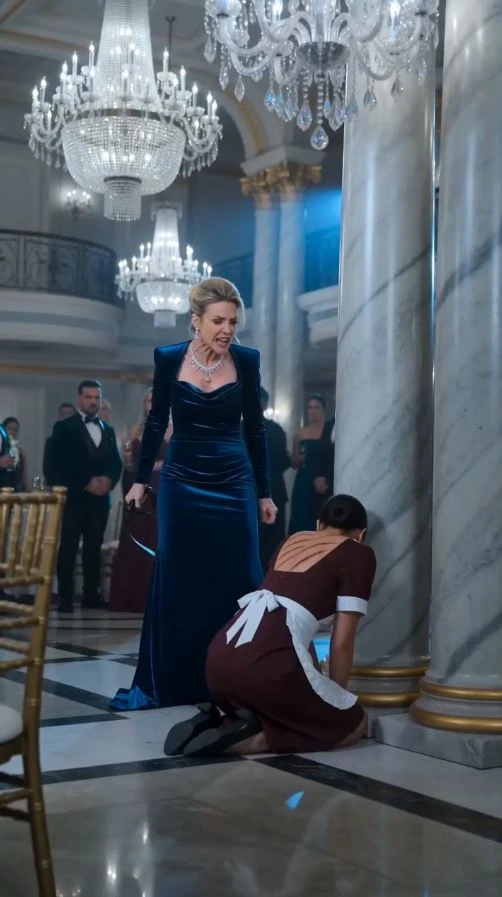
The first strike of the thin leather riding crop knocked a silver serving tray from my hands.
Champagne glasses crashed across the black-and-white marble floor.
Two hundred guests went silent.
The second strike caught the sleeve of my dark burgundy maid’s uniform.
Vivian DeMarco lifted the crop a third time.
It never came down.
A hand closed around it.
“Enough.”
Every face in Belladonna House turned toward the ballroom entrance.
Vincent Moretti had arrived three hours early.
Snow melted across the shoulders of his charcoal overcoat. Four security men stood silently behind him.
Vincent ignored the politicians, celebrities, and wealthy donors gathered for his engagement party.
He looked at Vivian.
Then at me.
I was kneeling beside the shattered glasses, my black apron soaked with champagne.
Vivian’s expression changed instantly.
“Vincent! Thank God.”
He didn’t release the crop.
“Why are you holding this?”
“She attacked me!”
The lie came effortlessly.
Vivian pointed at the dark stain across her silver-blue evening gown.
“She deliberately spilled champagne on me.”
“I tripped when she stepped into my path,” I said.
Vivian glared at me.
“She laughed.”
“I apologized.”
“She insulted me.”
“I asked for my wages before leaving.”
Vincent’s eyes narrowed.
“Leaving?”
“I fired her,” Vivian said.
“You tried to send me outside without my purse, coat, or phone.”
“She was disrespectful!”
I slowly stood.
Vivian snapped, “I told her to kneel and clean my shoes. She refused.”
The ballroom became painfully quiet.
Vincent looked at her.
“You ordered her to kneel?”
“She’s a maid, Vincent.”
His expression hardened.
“My mother was a maid.”
Vivian hesitated.
“That was different.”
“How?”
She had no answer.
Then Vincent looked back at me.
His attention suddenly dropped to my neck.
During the struggle, the top button of my uniform had torn loose.
A small antique silver locket had slipped into view.
Vincent stopped breathing.
The anger disappeared from his face.
Something else replaced it.
Recognition.
He released the riding crop.
“Where did you get that?”
I instinctively covered the locket.
“My mother gave it to me.”
Vincent stepped closer.
“What was her name?”
“Teresa.”
His face went pale.
Across the room, one of Vincent’s oldest guards, Salvatore Greco, stared at the necklace and whispered:
“Boss… that’s impossible.”
Vivian looked between us.
“What are you talking about?”
Vincent ignored her.
He gently turned the locket over.
Engraved on the back was a tiny letter M surrounded by an olive branch.
His family’s symbol.
A symbol that had never been sold publicly.
Never reproduced.
And according to Vincent, only three lockets like it had ever existed.
His mother had owned one.
His grandmother had owned another.
And the third had disappeared twenty-eight years earlier along with a woman the Moretti family had been told was dead.
Vincent slowly looked into my eyes.
“What’s your full name?”
I hesitated.
“Isabella Teresa Romano.”
A glass shattered somewhere behind us.
This time, Vivian had dropped it.
Vincent turned toward her.
And for the first time all evening, she looked genuinely terrified.
“Why did that name frighten you?” he asked.
“It didn’t.”
“Vivian.”
“I was surprised.”
“By a maid’s name?”
She lifted her chin.
“You’re making a scene.”
“You made the scene.”
Vincent’s voice was quiet.
That frightened everyone more than shouting would have.
He turned toward Salvatore.
“Close the doors.”
Several guests murmured.
Vivian stepped forward.
“You cannot lock two hundred people inside your house.”
“I can keep everyone here until I know why my fiancée recognized the name Teresa Romano.”
“I did not recognize it.”
I stared at her.
“Yes, you did.”
Vivian’s eyes snapped toward me.
“You don’t know anything.”
“I know you called me Teresa’s daughter before I ever told you my mother’s name.”
Silence.
Vincent slowly turned.
“When?”
I swallowed.
“Earlier tonight. In the servants’ corridor.”
Vivian’s composure cracked.
“That’s not what I said.”
“You said, ‘Women like Teresa always think they can come back through their daughters.’”
Vincent’s face changed.
Even Salvatore looked stunned.
“Vivian,” Vincent said, “how do you know Teresa Romano?”
She took one step backward.
“My father mentioned her.”
“Carlo DeMarco?”
“Yes.”
“Why?”
“I don’t remember.”
“You remembered enough to recognize her daughter.”
Vivian’s eyes moved toward the ballroom exit.
Two guards quietly stepped into her path.
Vincent noticed.
“So this engagement party was never just an engagement party.”
“Don’t be ridiculous.”
I looked at Vivian.
Something she had said when the agency assigned me to Belladonna House suddenly returned.
She had insisted personally on reviewing every temporary staff member.
At the time I thought she was simply controlling.
Now I understood.
“You chose me.”
Vivian said nothing.
“You saw my employment application.”
“No.”
“My full name was on it.”
She looked at Vincent.
“Don’t listen to her.”
“Why did you hire Isabella?” he asked.
“I didn’t.”
The estate manager, Mrs. Bell, stepped forward from among the frozen staff.
Her face was pale.
“Miss DeMarco did request her specifically.”
Vivian whipped around.
“Margaret.”
Mrs. Bell lowered her eyes.
“I’m sorry.”
Vincent walked toward Vivian.
“Why?”
No answer.
“Why did you bring Teresa Romano’s daughter into my house?”
Vivian’s lips pressed together.
I suddenly remembered the instructions I received that afternoon.
Do not enter the west hallway.
Do not use the main staircase.
Do not enter the old chapel.
And under no circumstances enter Vincent’s mother’s suite.
Rules for a maid.
Or directions meant to make me curious.
“You wanted me to find something,” I whispered.
Vivian looked at me.
That was enough.
“What?” Vincent asked.
I pulled the locket from beneath my collar.
“My mother gave this to me when I was twelve. She told me never to open the inside panel.”
Vincent frowned.
“Inside panel?”
“The locket opens normally.”
I pressed the clasp.
Inside was a tiny photograph of my mother as a young woman.
But behind the photograph was a second metal plate.
I had never been able to move it.
Salvatore stepped closer.
“May I?”
I handed it to him.
He examined the edge.
Then his face changed.
“This isn’t decorative.”
“What is it?” Vincent asked.
“A key mechanism.”
He pressed the engraved olive branch.
A tiny compartment sprang open.
Inside was a folded piece of paper no larger than a postage stamp.
My hands began shaking.
Vincent used tweezers from a nearby bar set to pull it free.
The paper contained three things.
A date.
November 4, 1997.
A number.
And one sentence.
IF THEY SAY I DIED, ASK ELENA WHAT HAPPENED IN THE CHAPEL.
Vincent looked at me.
“Elena was my mother’s name.”
My breath caught.
“What?”
“Elena Moretti.”
The room felt suddenly colder.
My mother had never mentioned Elena.
Never mentioned Belladonna House.
Never mentioned the Morettis.
Yet she had carried a Moretti family locket and hidden a message telling me to ask Vincent’s mother what happened in the chapel.
“There’s a problem,” Salvatore said quietly.
Vincent looked at him.
“My mother died twenty-five years ago.”
I stared at the message.
Then Vivian laughed.
Not loudly.
Just enough for us to hear.
“You really have no idea, do you?”
Vincent turned.
“What?”
Vivian’s eyes glittered.
“Elena Moretti didn’t die.”
Salvatore went completely still.
“Watch yourself.”
Vivian smiled.
“Oh, Salvatore. You’ve guarded this family for thirty years and you still don’t know where all the bodies are buried.”
Vincent stepped closer.
“Where is my mother?”
Vivian’s smile vanished.
“I don’t know.”
“But your father does?”
She said nothing.
Vincent grabbed his phone.
“Bring Carlo DeMarco here.”
One of his guards nodded.
Vivian suddenly shouted, “No!”
Everyone turned.
Too late.
Her fear had confirmed it.
Carlo knew.
Then I noticed an older woman among the catering staff staring at my locket.
She had tears in her eyes.
“Ma’am?” I asked.
She backed away.
Vincent saw her.
“Who are you?”
She whispered, “Maria Santos.”
Salvatore frowned.
“I don’t know you.”
“I worked here before you became head of security.”
Vincent stepped toward her.
“You knew Teresa?”
The woman started crying.
“Yes.”
My heart stopped.
“She worked here?”
Maria nodded.
“She wasn’t a maid.”
“Then what was she?”
Maria looked toward Vivian.
Vivian whispered, “Don’t.”
Maria’s fear hardened.
“For twenty-eight years, your family has lied about what happened that winter.”
Vincent’s expression went cold.
“What happened?”
Maria pointed toward the west side of the mansion.
“The old chapel.”
The room seemed to hold its breath.
“Your mother Elena was there.”
She looked at me.
“So was Teresa.”
Then she looked at Vincent.
“And so was your father.”
Vincent’s father, Antonio Moretti, had supposedly been killed in Sicily twenty-eight years earlier.
Maria shook her head.
“No.”
“Antonio died overseas,” Vincent said.
“No, Mr. Moretti.”
Her voice trembled.
“Your father died inside Belladonna House.”
No one moved.
“And Teresa Romano saw who killed him.”
Vivian’s face went white.
Maria continued.
“That is why Teresa had to disappear.”
Then she looked directly at me.
“And why someone brought you back tonight.”
The engagement party ended without an engagement.
Vincent ordered every guest escorted out through the front entrance while his own security team collected names, photographs, and staff records.
Vivian was moved to a private sitting room.
Not locked.
But guarded.
Carlo DeMarco could not be reached.
His driver claimed he had left his Manhattan townhouse thirty minutes earlier.
No destination.
That told us enough.
I should have left too.
I wanted to.
My hands were still shaking from the humiliation in the ballroom, and the idea of staying inside a house connected to my mother’s disappearance made every instinct scream at me to run.
Vincent stopped me near the servants’ stairs.
“You’re free to go.”
I looked at him.
He understood immediately.
“You thought I was going to order you to stay.”
“I don’t know you.”
“That’s fair.”
He stepped aside.
“I won’t trap you in this house.”
Those words mattered more than he probably realized.
I looked at the locket in my palm.
Then toward the west hallway.
“I’m staying.”
“Why?”
“Because my mother spent my whole childhood afraid of something she never explained.”
I swallowed.
“And tonight I finally learned what.”
Vincent nodded.
“Then we do this together.”
The old chapel had been sealed for twenty-five years.
Vincent said Elena had loved it.
She attended Mass there every Sunday even after Antonio’s businesses expanded and the Moretti family became one of the most feared names in New York.
When Elena supposedly died from pneumonia, Vincent was nine.
The chapel closed after her funeral.
At least that was the story.
Maria led us through a narrow hallway behind the library.
Salvatore carried a flashlight.
Mrs. Bell came too.
Vivian remained upstairs under guard.
The chapel door was carved oak.
A brass cross hung at eye level.
Vincent inserted an old key from his mother’s desk.
It turned.
The smell hit first.
Dust.
Cold stone.
Old wax.
The pews were covered in white sheets.
A faded painting of the Virgin Mary hung behind the altar.
Nothing looked like a crime scene.
Then Maria pointed.
“Third stone.”
“Where?” Vincent asked.
“Beside the altar.”
Salvatore knelt.
A square marble tile looked slightly different from the others.
He inserted a knife into the edge.
The tile lifted.
Underneath was a metal ring.
Vincent pulled.
A hidden compartment opened.
Inside was an old revolver wrapped in cloth.
A rosary.
And a small ledger.
Maria crossed herself.
“I thought they removed it.”
“Who?” I asked.
She looked at us.
“Carlo.”
Vincent opened the ledger.
Names.
Dates.
Payments.
Most were twenty-eight years old.
One appeared repeatedly.
Antonio Moretti.
Another:
Carlo DeMarco.
Then:
Teresa Romano.
My stomach tightened.
Beside my mother’s name was an amount.
$75,000.
Purpose:
HOUSEHOLD ACCOUNTING REVIEW.
“She was an accountant?” I asked.
Maria nodded.
“She worked for Antonio.”
Not cleaning.
Accounting.
My mother had always told me she was a bookkeeper before I was born.
She never said for whom.
Vincent turned pages.
His expression darkened.
“These are protection payments.”
Maria nodded.
Antonio had begun questioning money disappearing from Moretti businesses.
The records pointed toward Carlo DeMarco, then a trusted lieutenant.
Carlo managed shipping contracts.
Construction.
Political payments.
And something much worse.
Human trafficking routes hidden inside legitimate cargo operations.
Vincent’s jaw tightened.
“My father would never allow that.”
“He didn’t,” Maria said.
“That’s why he died.”
Silence.
According to Maria, Antonio discovered Carlo was using Moretti-controlled warehouses to move vulnerable women through forged employment contracts.
Antonio planned to expose him internally and turn over evidence to federal authorities through an intermediary.
Teresa had found the accounts.
Elena knew.
The night of November 4, 1997, Antonio summoned Carlo to Belladonna House.
They met in the chapel because Antonio believed nobody had listening devices there.
Maria was serving tea in the hallway.
She heard shouting.
Then a gunshot.
“What happened?” Vincent asked.
Maria’s hands shook.
“I opened the door.”
Antonio lay near the altar.
Carlo held the gun.
Elena was screaming.
Teresa stood beside the wall with blood on her dress.
Not her blood.
Antonio’s.
“Was he alive?”
“Barely.”
“And Carlo?”
“He said Antonio had attacked him.”
“Did you believe him?”
“No.”
Maria looked at me.
“Teresa didn’t either.”
My mother had grabbed the ledger.
Carlo tried to stop her.
Elena helped Teresa escape through a servants’ passage.
Then everything fractured.
Salvatore asked, “Where were Antonio’s guards?”
“Reassigned.”
“By who?”
“Carlo.”
Vincent closed his eyes.
His father’s death in Sicily had been invented.
Antonio died in Manhattan.
His body removed through an underground service tunnel.
The family was told he had been killed while negotiating overseas.
Why create such an elaborate lie?
“Because Carlo needed Vincent’s uncle to believe Sicily was responsible,” Maria said.
A family war followed.
Three men died.
None had killed Antonio.
Carlo used the chaos to strengthen his own influence.
My stomach turned.
“And my mother?”
Maria wiped tears.
“Teresa escaped that night.”
“For twenty-eight years?”
“No.”
Maria looked at Vincent.
“She came back three days later.”
“What?”
“She wanted Elena.”
Vincent stepped forward.
“Why?”
“Because Elena had been taken.”
“By Carlo?”
“Yes.”
Vincent’s breathing changed.
“Where?”
“I don’t know.”
Maria had tried to help Teresa.
But Carlo caught them in the servants’ tunnel.
He threatened Maria’s children.
Then made Teresa a choice.
Disappear permanently.
Or Isabella would disappear too.
I stared.
“I was alive?”
Maria nodded.
“You were six months old.”
My mother had never told me we had lived anywhere near Belladonna House.
“She chose me.”
“Yes.”
Carlo provided a new identity arrangement.
Teresa Romano remained Teresa Romano, but every connection to the Moretti estate vanished.
She was ordered never to return.
Never contact Elena.
Never tell Isabella.
If she did, Carlo would know.
“How?”
“He had people watching.”
I thought about my childhood.
The apartment changes.
My mother refusing family photographs online.
The way she panicked whenever unfamiliar black cars parked outside.
I had assumed she was anxious.
She had been hunted.
Vincent looked at the revolver.
“Is this the murder weapon?”
Maria nodded.
“Antonio’s blood should still be on the original cloth.”
Salvatore immediately called a trusted forensic investigator.
Then I noticed the rosary.
A tiny silver medal hung from it.
The same M and olive branch as my locket.
Vincent picked it up.
“My mother’s.”
The chapel door slammed.
We all turned.
Vivian stood there.
Two guards behind her.
She had apparently insisted on coming.
Her face was pale.
“You’re digging up things you don’t understand.”
Vincent stared.
“You knew my father died here.”
“No.”
“You knew Teresa.”
“My father told me stories.”
“What stories?”
“That Teresa stole from the family.”
Maria shouted, “Liar!”
Vivian flinched.
I stepped toward her.
“You brought me here because of the locket.”
She looked at me.
“Yes.”
The admission surprised everyone.
“Why?”
Vivian’s eyes filled with something that looked dangerously close to panic.
“Because my father found out Teresa was dying.”
My heart stopped.
“My mother isn’t dying.”
Vivian looked at me.
“You haven’t spoken to her in eight months.”
That hit hard.
It was true.
My mother and I had fought.
She wanted me to move back to New Jersey.
I refused.
She stopped answering after Christmas.
I assumed she was angry.
Vivian whispered, “Teresa disappeared again three months ago.”
My legs nearly gave out.
“What?”
“I thought you knew.”
“No.”
“Carlo found her.”
Vincent’s face hardened.
“Where is she?”
Vivian started crying.
“I don’t know.”
“Why bring Isabella here?”
“Because my father was searching for the locket.”
She looked at me.
“He believed Teresa hid something inside it.”
The message.
November 4.
Elena.
But maybe there was more.
“Why humiliate me?”
Vivian looked ashamed.
“To make you leave the house angry.”
I stared.
“That makes no sense.”
“I was supposed to have your coat and purse searched after you were thrown outside.”
My blood went cold.
The firing.
The crop.
The demand that I leave without my belongings.
All staged.
Vivian wanted my locket separated from me.
“Why didn’t you just steal it?”
“Because Carlo said if you realized it was missing, you’d call Teresa.”
“And that mattered because?”
Vivian’s lips trembled.
“Because Teresa is still alive.”
My heart slammed against my ribs.
“Where?”
“I said I don’t know.”
Vincent stepped closer.
“What is 317?”
Vivian looked toward the altar.
Then whispered:
“Not a room.”
“What?”
“A grave.”
Maria crossed herself.
Vivian continued.
“Plot 317 at Saint Michael’s Cemetery.”
Vincent went pale.
“My mother is buried there.”
“No.”
Vivian looked directly at him.
“The woman in Elena Moretti’s grave isn’t your mother.”
Then she turned to me.
“It’s the reason Teresa spent twenty-eight years hiding.”
We reached Saint Michael’s Cemetery shortly before dawn.
Snow covered the rows of headstones.
Plot 317 belonged to Elena Maria Moretti.
Beloved Wife.
Devoted Mother.
1958–2001.
Vincent stood before the grave in silence.
He had been thirteen when the family told him his mother died after a long illness overseas.
He had not been allowed to see the body.
Now every detail looked suspicious.
The grave was opened under emergency authorization after evidence from Belladonna House suggested a homicide investigation.
I stood beside Vincent while forensic technicians worked.
Vivian remained with investigators.
Maria waited in a heated car.
Hours passed.
Finally, Detective Gabriel Russo approached.
“This is preliminary.”
Vincent’s jaw tightened.
“Say it.”
“The remains appear female.”
“Age?”
“Approximately late twenties to early thirties.”
Elena would have been forty-three.
My stomach dropped.
“Not my mother,” Vincent said.
“Probably not.”
“What else?”
Russo hesitated.
“The skull shows evidence of trauma.”
I looked away.
Vincent didn’t.
“Identity?”
“Not yet.”
Then a technician carried over a sealed evidence bag.
Inside was a ring.
I knew it immediately.
My mother owned its twin.
A plain gold band engraved inside:
T.R.
My breath disappeared.
“No.”
Russo looked at me.
“You recognize it?”
“My mother.”
Vincent turned sharply.
“No.”
“She wore one exactly like that.”
But Teresa was supposedly alive.
Vivian said Carlo found her three months ago.
Had she lied?
Russo examined the engraving.
“It could belong to someone else.”
I shook my head.
“My father’s initials were R.R. Her initials were T.R. She told me he gave it to her.”
“What was your father’s name?”
“Robert Romano.”
Maria, who had approached behind us, made a strange sound.
I turned.
“What?”
She looked terrified.
“Robert Romano didn’t exist.”
The world tilted again.
“What are you talking about?”
Maria’s eyes filled.
“Teresa was never married.”
“Yes, she was.”
“My father died when I was two.”
“That is what she told you.”
I stepped closer.
“Then who was my father?”
Maria looked at Vincent.
Then away.
“Maria.”
“I promised Teresa.”
“Twenty-eight years ago.”
“She was trying to protect you.”
“From what?”
Maria started crying.
Vincent’s face changed.
He understood before I did.
“No.”
Maria covered her mouth.
I stared at him.
“What?”
He shook his head once.
“Nothing.”
“Vincent.”
Maria whispered, “Antonio.”
My hearing seemed to disappear.
“What?”
“Antonio Moretti was your father.”
Silence.
No.
Impossible.
Vincent was staring at me with the same horror I felt.
Antonio Moretti.
His father.
My father.
That would make Vincent—
“My brother.”
The words barely came out.
Maria nodded.
“Half brother.”
I stepped backward.
For a moment, every guest at the engagement party, every insult Vivian threw at me, every look Vincent gave the locket became insignificant.
I had walked into Belladonna House as a temporary maid.
I was standing beside the man who might be my brother.
“Did Elena know?” Vincent asked.
“Yes.”
“How?”
“Antonio told her.”
His expression hardened.
“Why?”
“Because Teresa was pregnant and wanted to leave.”
Maria explained.
Antonio and Teresa had an affair while she worked as his accountant.
It began during a period when Antonio and Elena were separated privately but remained married publicly.
Teresa became pregnant.
Antonio wanted to acknowledge the baby.
Elena was devastated.
But something unexpected happened.
She befriended Teresa.
Not immediately.
Not easily.
But Elena understood Antonio had lied to both women.
When Isabella was born, Elena gave Teresa the third Moretti locket.
The one around my neck.
“She said Isabella was innocent,” Maria whispered.
I touched it.
The locket had never been stolen.
It had been given.
By Vincent’s mother.
“Why did Teresa tell me Robert Romano was my father?”
“To protect you from Carlo.”
Because Antonio’s illegitimate daughter would have inheritance rights.
Not merely emotional significance.
Under Antonio’s private trust, every acknowledged biological child received an equal protected share of Belladonna Holdings.
Carlo knew.
If Isabella existed publicly, Vincent would not be the sole heir.
Carlo feared divided control.
More importantly, Teresa had evidence of his crimes.
“So he buried both truths,” Vincent said.
“Yes.”
I looked toward the open grave.
“Then whose body is that?”
Maria’s face crumpled.
“I think I know.”
“Who?”
“Cecilia Hart.”
The name meant nothing to me.
It meant everything to Vincent.
“My mother’s nurse.”
Cecilia cared for Elena after Antonio’s death.
According to the family story, Cecilia later returned to Ireland.
She didn’t.
Carlo needed a female body for Elena’s staged death.
Cecilia discovered too much.
He killed her.
Placed her in Elena’s coffin.
Then produced false travel and death records for both women.
“Where was Elena?” Vincent asked.
Maria shook her head.
“Carlo moved her repeatedly.”
“For twenty-five years?”
“I don’t know how long she survived.”
The forensic team later confirmed the body was not Teresa.
Relief hit so hard I nearly collapsed.
Dental records identified Cecilia Hart.
Another murdered woman.
Another family lie.
But the ring?
Maria explained Cecilia had been given Teresa’s ring deliberately.
Carlo wanted anyone who eventually opened the grave to believe Teresa died too.
A false trail inside a false grave.
Everything he did relied on confusion.
Then Detective Russo received a call.
He walked away.
Returned with a grim expression.
“We located Carlo DeMarco’s vehicle.”
“Where?” Vincent asked.
“New Jersey.”
“Carlo?”
“Gone.”
“Any sign of Teresa?”
Russo looked at me.
“There was blood in the trunk.”
My knees weakened.
Vincent caught my arm.
I immediately pulled away.
Not because I feared him.
Because the thought of my mother injured made me unable to tolerate anyone touching me.
“Is it hers?”
“We need DNA.”
“How long?”
“As fast as possible.”
Vincent looked at Salvatore.
“Search every DeMarco property.”
Russo interrupted.
“No private raids.”
Vincent turned.
“My mother may be alive. Her mother may be alive.”
“And if you storm properties, you could destroy evidence or get them killed.”
Vincent hated it.
But he nodded.
That told me something important about him.
The man everyone called a mafia boss had enough power to ignore the police.
Instead, he chose not to.
Maybe he was different from the men before him.
Later that morning, we returned to Belladonna House.
I showered.
Changed into clothes Mrs. Bell found for me.
When I entered the library, Vincent was studying Antonio’s old trust documents.
He looked up.
“If Maria is right, you’re entitled to part of everything.”
“I don’t want anything.”
“You should know what exists before deciding.”
“I said I don’t want it.”
“Fair.”
No argument.
Again, unexpected.
I sat.
“What was Antonio like?”
Vincent’s expression shifted.
“I was eight when he died.”
“You remember him?”
“Yes.”
“Was he good?”
Vincent looked toward the window.
“No.”
The answer surprised me.
“He loved me. He loved my mother. Apparently he loved Teresa.”
He gave a bitter laugh.
“He also lied to all of them.”
“So not good.”
“Not simple.”
I understood that.
My mother had spent my childhood lying too.
Maybe for protection.
Still lies.
A guard entered.
“Boss.”
“What?”
“We found something in Miss DeMarco’s room.”
He placed a tablet on the desk.
Security footage.
Three nights earlier.
Vivian inside Belladonna House’s private office.
She opened Vincent’s safe.
Removed a folder.
Photographed every page.
Then sent the images to someone.
The recipient number belonged to Carlo.
Vincent’s face hardened.
Vivian had been spying on him for her father.
But that wasn’t the worst part.
One photographed page showed a private DNA report commissioned by Vincent six months earlier.
I frowned.
“Why did you have a DNA test?”
Vincent stared at the screen.
“Because I found out Antonio might have had another child.”
My pulse jumped.
“You knew?”
“Not who.”
“How?”
“A letter from my mother.”
“Where?”
“Hidden inside her piano.”
The report compared Vincent’s DNA to an unknown female sample.
“Whose sample?”
“I didn’t know. Salvatore found hair inside the locket case that belonged to my mother.”
He looked at me.
“The result said the unidentified female was likely my paternal half sibling.”
My chest tightened.
He had known a sister might exist.
But not me.
Then another security alert appeared.
The front gates.
A woman stood outside in the snow.
Thin.
Gray coat.
Dark hair streaked with silver.
Mrs. Bell whispered:
“Oh my God.”
Vincent stood.
I stared at the woman on the monitor.
I knew that face.
Older.
Exhausted.
But unmistakable.
“Mom.”
I ran.
No one stopped me.
The front doors opened before I reached them.
Teresa stood under the stone portico.
Snow covered her hair.
The gun in her hand pointed at the ground.
I hadn’t seen my mother in eight months.
I had spent those months angry.
Now I could barely breathe.
“Mom.”
Her face crumpled.
“Bella.”
I crossed the distance between us.
She dropped the gun.
I threw my arms around her.
She held me so tightly it hurt.
I didn’t care.
“You’re alive.”
“I’m sorry.”
“Where have you been?”
She pulled back.
Her eyes moved past me.
Vincent stood in the doorway.
Teresa froze.
For several seconds, she simply stared.
Then whispered:
“Antonio’s eyes.”
Vincent looked almost as shaken.
“Teresa?”
She nodded.
“I’m sorry I never told you.”
“Is Isabella my sister?”
Teresa looked at me.
Then at him.
“Yes.”
There it was.
No test yet.
But truth in her face.
“Antonio was her father.”
Vincent closed his eyes briefly.
I felt something strange.
Not happiness.
Not grief.
Something between.
A missing piece that had arrived with too much blood around it.
Detective Russo approached slowly.
“Mrs. Romano, I need you to step away from the weapon.”
Teresa complied.
“I came to surrender it.”
“Why?”
“Because I shot Carlo DeMarco.”
Silence.
I stared.
“What?”
“He isn’t dead.”
“How do you know?”
“I missed anything important.”
Despite everything, Vincent almost smiled.
Russo did not.
“Where?”
“A warehouse in Newark.”
“When?”
“Last night.”
That explained the blood.
Carlo’s blood, perhaps.
Teresa had been hiding for three months after Carlo located her in New Jersey.
She discovered he was searching for the locket.
Then she learned Isabella had been hired for Vincent’s engagement party.
“I knew it was a trap.”
“Why didn’t you call me?” I demanded.
“Because Carlo monitored you.”
“So you let me think you disappeared?”
Her eyes filled.
“I made the same mistake everyone in this family made.”
“What mistake?”
“Deciding fear gave me the right to choose what you knew.”
That stopped my anger.
Not erased.
Stopped.
Teresa surrendered herself for questioning.
But before police took the gun into evidence, she told us why she had returned.
“Elena is alive.”
Vincent’s expression shattered.
“What?”
“I saw her three months ago.”
“Where?”
“Carlo moved her.”
“From where?”
“A private care home in Pennsylvania.”
“For twenty-five years?”
Teresa nodded.
Vincent gripped the back of a chair.
“Why?”
“Elena knew everything.”
Antonio’s murder.
Carlo’s trafficking operation.
The bribed judges.
The false war after Antonio’s death.
And Carlo could not kill her easily.
Elena had placed documents with an attorney, scheduled to be released if her death was confirmed.
“So he kept her alive,” Vincent whispered.
“A living hostage.”
“Yes.”
“And you?”
“I thought she died.”
“When did you learn?”
“Three months ago.”
Carlo found Teresa because he believed she knew where Elena’s contingency documents were hidden.
He kidnapped Teresa.
Held her in the Pennsylvania facility.
That was where she saw Elena.
Older.
Weak.
But mentally clear.
The two women recognized each other immediately.
Carlo made another mistake.
He assumed women who had spent decades afraid would remain afraid forever.
Teresa escaped during a medical transfer.
Then spent weeks following Carlo.
Trying to locate where he moved Elena.
“Why shoot him?”
“He found me first.”
Carlo cornered Teresa at the Newark warehouse.
He admitted Vivian had successfully brought Isabella into Belladonna House.
Then laughed about how easy it would be to take the locket.
Teresa grabbed a gun from one of his men.
Fired once.
Carlo escaped.
She drove directly to us.
Vincent asked, “Where is my mother now?”
Teresa reached inside her coat.
Russo stiffened.
She slowly removed a key card.
“North Haven Rehabilitation Center.”
Salvatore frowned.
“That’s one of DeMarco’s properties.”
“Not officially.”
Teresa handed the card to Russo.
“Basement medical wing.”
Police moved immediately.
Vincent wanted to go.
Russo refused.
This time Vincent argued.
“That is my mother.”
“And we may be entering a hostage site.”
“I’m coming.”
“You are not law enforcement.”
“No.”
Vincent’s voice turned quiet.
“But half the men guarding that property worked for me before Carlo paid them.”
Russo stared.
“You know the security?”
“Yes.”
That changed things.
Vincent provided floor plans, access routes, names, shift patterns.
He stayed outside during the actual entry.
So did I.
So did Teresa.
Those forty-two minutes felt like hours.
Then Russo called.
“We found her.”
Vincent stopped breathing.
“Alive?”
“Yes.”
He sat down on the hood of the car.
For the first time, the feared Vincent Moretti looked like a boy.
“She knows her name?”
“Yes.”
“Does she know mine?”
Russo’s voice softened.
“She keeps asking for you.”
We entered after the site was secured.
Elena Moretti lay inside a small medical room.
Her hair was white.
Her body frail.
But her eyes—
Vincent’s eyes.
She looked at him.
“Vincenzo.”
He fell to his knees beside the bed.
“Mom.”
She touched his face.
“My boy.”
I turned away.
Some reunions belonged to the people who lost them.
Teresa took my hand.
Then Elena saw her.
“Tessa.”
Teresa started crying.
“I’m sorry.”
“You came back.”
“Too late.”
“No.”
Elena’s gaze moved to me.
She studied my face.
Then smiled.
“Antonio’s daughter.”
I stepped closer.
“You knew me?”
“I held you once.”
My throat tightened.
“When?”
“The day you were baptized.”
I had no memory.
Of course.
Elena reached toward the locket.
“I gave that to your mother.”
“I know.”
“Did it keep you safe?”
I looked at Teresa.
“Eventually.”
Elena laughed weakly.
Then her expression changed.
“Carlo?”
“Missing,” Vincent said.
“He will go to the tunnels.”
“What tunnels?”
She looked alarmed.
“Belladonna.”
Vincent frowned.
“There are tunnels under the house?”
“Antonio built them during Prohibition.”
Salvatore swore.
Elena gripped Vincent’s wrist.
“Carlo knows.”
“What’s down there?”
Her voice weakened.
“The original ledgers.”
Teresa went pale.
“The trafficking records?”
Elena nodded.
“And the recording.”
“What recording?” I asked.
Elena looked at Vincent.
“The night Antonio died.”
A hidden audio recorder had captured the entire confrontation.
Antonio accusing Carlo.
Carlo admitting the trafficking.
The gunshot.
Everything.
If Carlo reached it first, the strongest evidence disappeared.
Vincent called Belladonna House.
No answer.
Then another number.
Nothing.
Salvatore’s face changed.
“The internal cameras are offline.”
Carlo had gone home.
Not his home.
Ours.
And Vivian was still inside.
By the time we reached Belladonna House, smoke was rising from the west wing.
Fire crews surrounded the estate.
One security officer had been found unconscious near the kitchen entrance.
Another was missing.
Vivian was gone.
So was Carlo.
Vincent stepped toward the burning house.
Salvatore grabbed his arm.
“No.”
“My mother’s evidence is under there.”
“And you being dead won’t help.”
Vincent looked ready to hit him.
Then he stopped.
That mattered.
Again.
Control.
Not impulse.
Firefighters contained the blaze before it reached the ballroom.
The west library suffered heavy damage.
The old chapel survived.
So did the basement.
Elena gave investigators directions to a concealed entrance behind the wine cellar.
The tunnels were brick.
Narrow.
Cold.
They ran beneath the estate toward an old carriage house and wooded property beyond.
Police entered first.
Then Vincent, under escort.
I was told to stay outside.
I agreed.
For seven minutes.
Then a guard came running from the cellar.
“They found Miss DeMarco.”
Vivian.
I followed.
She sat against a tunnel wall, wrists bound with plastic ties.
Her silver-blue engagement gown had been replaced by dark pants and a sweater.
Her lip was split.
She looked terrified.
Vincent crouched.
“Where is Carlo?”
She shook her head.
“He left me.”
“Why?”
“I wouldn’t burn the files.”
Something changed.
“You helped him enter.”
“Yes.”
“You disabled security.”
“Yes.”
“But then?”
“He told me to pour gasoline into the archive room.”
“And you refused.”
“I didn’t know what was inside until I saw photographs.”
Her voice broke.
“Women. Girls. Passports.”
Her father’s trafficking operation.
Vivian had known Carlo was corrupt.
She claimed she never knew the full scope.
Was that true?
Maybe.
The woman who struck me with a riding crop had already shown what she believed about people beneath her.
Ignorance was not innocence.
Still, she had drawn a line.
Late.
But a line.
“Where did he go?” Vincent asked.
“Archive chamber.”
“Why?”
“The recording.”
Exactly what Elena feared.
Police found the chamber open.
Shelves emptied.
Boxes scattered.
A reel-to-reel recorder lay smashed.
The tape was gone.
Vincent punched the wall.
Then I noticed something.
A row of photographs.
Antonio.
Elena.
Teresa.
Carlo.
One picture showed my mother holding me as an infant.
Antonio stood beside us.
His hand rested on my tiny head.
I stared.
Proof of a father I never knew.
Behind the photograph was a handwritten notation:
COPY STORED WITH R.M.
“R.M.?” I asked.
Vincent looked.
His face changed.
“Rafael Moretti.”
His uncle.
Antonio’s younger brother.
The man who had led the Moretti family after Antonio’s supposed death.
Rafael retired to Naples twelve years earlier.
Or so Vincent believed.
“He might have a copy.”
Salvatore called.
No answer.
Then Vincent looked toward Vivian.
“Does Carlo know?”
She nodded.
“He left for the airport.”
Everyone moved.
Carlo DeMarco was arrested at Teterboro Airport before his private plane departed.
He carried three passports.
$600,000 cash.
The original tunnel recording.
And a photograph of Rafael Moretti tied to a chair.
Taken recently.
Carlo had already kidnapped him.
The image background showed an industrial freezer.
Salvatore recognized the location.
An abandoned meatpacking facility in the Bronx once owned by Moretti Foods.
Police found Rafael alive.
Barely.
Inside the facility was more evidence.
Carlo had been preparing to eliminate every surviving witness.
Teresa.
Elena.
Rafael.
Vivian, eventually.
Maybe me.
Carlo’s arrest should have ended everything.
It did not.
Because when federal investigators played Antonio’s recording, another voice appeared.
A woman.
Antonio said:
“You knew what Carlo was doing.”
She answered:
“I knew enough.”
Vincent went pale.
The voice belonged to Elena.
His mother.
Antonio accused her of protecting Carlo’s financial transfers.
Elena responded:
“I was protecting Vincent.”
The recording continued.
Carlo threatened to expose something about the boy.
Something that could destroy Antonio’s succession plans.
Then the gunshot.
Chaos.
The tape ended.
Vincent stared at Elena’s hospital bed later that night.
“What did Carlo have on you?”
She closed her eyes.
“Vincent.”
“No more lies.”
Her expression crumpled.
“You are not Antonio’s biological son.”
Silence.
I felt my stomach drop.
Vincent didn’t move.
“What?”
Elena began crying.
“I was pregnant before I married Antonio.”
“By who?”
“Rafael.”
Vincent stepped backward.
His uncle.
Antonio’s brother.
This family tree was collapsing by the hour.
Elena explained.
She and Rafael had loved each other when they were young.
But Antonio was the heir.
Their father insisted Elena marry Antonio to merge two Italian-American families.
Elena was already pregnant.
Antonio discovered it before the wedding.
He married her anyway.
Raised Vincent as his son.
Rafael remained silent.
The secret mattered because the Moretti trust transferred controlling shares specifically to Antonio’s biological descendants.
If Vincent was Rafael’s son, his inheritance could be challenged.
Then Antonio fathered me with Teresa.
Suddenly I was Antonio’s only known biological child.
Carlo learned.
That was why he needed me erased even more than anyone realized.
If the truth came out, Vincent might lose control.
I would gain it.
Carlo could manipulate whichever heir remained.
My stomach turned.
“I don’t want the company.”
Vincent looked at me.
“I know.”
Elena whispered, “Antonio intended to change the trust.”
“Why?” Vincent asked.
“To protect both of you.”
She looked at me.
“He wanted Isabella acknowledged.”
Then at Vincent.
“And you kept as his son legally, regardless of blood.”
“But he died first.”
“Yes.”
Carlo’s murder stopped the amendment.
For twenty-eight years, the Moretti empire had rested on a succession structure built on false parentage.
Vincent sat.
I expected anger.
Instead he laughed.
A tired, bitter sound.
“All this time everyone called me the Moretti heir.”
Elena reached for him.
“You are my son.”
“That isn’t what I said.”
“No.”
He looked at me.
“You’re Antonio’s daughter.”
“Apparently.”
“And the trust may make you controlling heir.”
“I don’t want it.”
“I know.”
“Stop saying that like you’re about to hand me an empire.”
A tiny smile appeared.
“Would you prefer cash?”
Despite everything, I laughed.
It shocked both of us.
Then Vincent became serious.
“We need DNA.”
“Yes.”
“And lawyers.”
“Unfortunately.”
“And Vivian.”
I looked toward the hall.
She had been arrested for conspiracy, unlawful restraint, assault, and assisting Carlo’s access to Belladonna House.
The engagement was over.
Obviously.
But the betrayal ran deeper.
Vivian had not merely planned to marry Vincent.
Her father had raised her to control him.
And when she realized I might be the legitimate Moretti heir, she brought me into the mansion so Carlo could steal the locket and eliminate the last proof connecting Teresa to Antonio.
The riding crop had not been an impulsive act of cruelty.
It had been part of a plan to force me outside alone.
If Vincent had arrived three hours later as scheduled, I might have disappeared before the party ended.
The thought left me cold.
Then Salvatore entered.
“We found something else in Carlo’s airport bag.”
“What?”
“A marriage certificate.”
Vincent frowned.
“Whose?”
Salvatore looked at Elena.
Then Teresa.
“Antonio Moretti and Teresa Romano.”
My mother stopped breathing.
“What?”
The document was dated six months after my birth.
Antonio had secretly married Teresa.
But he was still legally married to Elena.
Unless—
Elena whispered:
“We were divorced.”
Vincent stared.
“You and Antonio divorced?”
“Privately. In Nevada.”
“And nobody knew?”
“We planned to announce it after Antonio changed the trust.”
Then Antonio married Teresa.
Legally.
That meant my mother had not been his mistress when he died.
She was his wife.
And I was not merely an illegitimate daughter hidden from the family.
Under Antonio’s last valid will, I might be his direct legal heir.
Vincent slowly looked at me.
The nightmare had just become a succession war.
And every surviving Moretti relative would know by morning.
The first person to challenge me was Vincent’s aunt.
Carmela Moretti arrived at Belladonna House with three attorneys, two sons, and enough outrage to fill the ballroom.
“You are not a Moretti.”
I stood at the same place where Vivian had humiliated me three days earlier.
This time I wore my own clothes.
Black trousers.
Cream sweater.
My locket openly visible.
“I never said I was.”
“You are claiming Antonio’s estate.”
“No.”
One attorney whispered in Carmela’s ear.
She ignored him.
“You expect us to believe a maid’s daughter is suddenly Antonio’s legal heir?”
My jaw tightened.
“My mother was an accountant.”
Carmela laughed.
“Convenient.”
Vincent stepped between us.
“That’s enough.”
She turned on him.
“You should be the one fighting this.”
“Why?”
“Because she can take everything.”
I looked at Vincent.
He looked almost bored.
“She doesn’t want everything.”
“You believe her?”
“Yes.”
Carmela stared.
“You’ve known her three days.”
“She had the chance to exploit this immediately. She didn’t.”
“Naive.”
Vincent’s voice hardened.
“Careful.”
Family lawyers confirmed the situation.
Antonio and Elena’s Nevada divorce was valid.
Antonio’s marriage to Teresa was also valid.
The certificate had never been publicly recorded in New York but remained legally enforceable.
Antonio’s will, written two months later, named:
My wife, Teresa Romano Moretti.
My son, Vincent.
My daughter, Isabella.
There was no ambiguity.
Antonio knew Vincent wasn’t biologically his.
He still called him son.
That mattered.
The will divided personal assets equally between Teresa, Vincent, and me.
But Belladonna Holdings followed the separate family trust.
That trust remained more complicated.
A biological descendant of Antonio could claim controlling voting rights.
Me.
Carmela’s sons challenged immediately.
They argued the marriage was fraudulent.
My paternity unproven.
The locket staged.
Teresa lying.
Then DNA returned.
Antonio’s stored medical tissue was preserved from surgery a year before his death.
The result:
99.99%.
Antonio Moretti was my biological father.
No one spoke when the attorney read it.
Vincent looked at me.
“Sister.”
I swallowed.
“Apparently.”
He smiled slightly.
Carmela did not.
“This changes nothing.”
“It changes quite a lot,” the attorney said.
Under the trust, I held fifty-one percent voting authority.
Vincent held twenty-four percent through Antonio’s legal acknowledgment and additional family provisions.
Carmela’s branch held the rest.
I had become controlling shareholder of a criminal-adjacent empire I wanted absolutely nothing to do with.
“I resign.”
Everyone stared.
The attorney blinked.
“From what?”
“Whatever role I just inherited.”
“You cannot simply resign ownership.”
“Then sell it.”
Carmela nearly exploded.
“You cannot sell Moretti family holdings.”
“Watch me.”
Vincent laughed.
Actually laughed.
Carmela glared at him.
“This is amusing?”
“A little.”
I turned to the attorney.
“What does Belladonna Holdings own?”
The answer was massive.
Real estate.
Restaurants.
Shipping.
Construction.
Security firms.
Legitimate businesses.
And old entities tied historically to illegal operations Vincent claimed he had been dismantling for years.
I looked at him.
“You still run mafia businesses?”
His expression became serious.
“No drugs. No trafficking. No extortion.”
“That wasn’t the question.”
“No.”
“What remains?”
“Old protection arrangements. Gambling interests. Political leverage.”
I stared.
“That sounds like a yes wearing a suit.”
Vincent almost smiled.
“You’re not wrong.”
“Then clean it.”
Carmela scoffed.
“Excuse me?”
I looked around the table.
“If the trust says I control fifty-one percent, then my first vote is simple.”
I turned to Vincent.
“Every illegal operation ends.”
The room went silent.
One cousin stood.
“You have no idea what that would cost.”
“Good.”
“People depend on those arrangements.”
“Then build legal ones.”
“You think the world works like that?”
“I think women shouldn’t be trafficked through warehouses while rich families call it business.”
Carmela’s face tightened.
“That was Carlo.”
“And how many people looked away?”
Nobody answered.
Vincent stared at me.
Then said, “I vote yes.”
Carmela spun.
“You cannot be serious.”
“I’ve been trying to dismantle the old structure for six years.”
“Then why haven’t you?”
“Because every time I moved too fast, Carlo and the older families threatened war.”
I understood.
That did not excuse everything.
But again, not simple.
With my fifty-one percent and Vincent’s twenty-four, the vote passed.
Belladonna Holdings would undergo independent forensic audit.
Illegal enterprises terminated.
Victim compensation funded from frozen legacy accounts.
Protection money transformed into legitimate security contracts or ended.
Carmela called it betrayal.
I called it Tuesday.
Then Teresa entered.
She had spent two days giving statements.
She looked tired.
Carmela stared at her.
“The servant who married Antonio.”
Teresa stopped.
I expected her to react.
Instead she smiled.
“I balanced Antonio’s books while your husband failed algebra.”
Vincent choked on his coffee.
Even I laughed.
Carmela left furious.
That evening, Teresa and I finally talked alone.
“You lied about my father.”
“Yes.”
“For twenty-eight years.”
“Yes.”
“You let me think Robert Romano existed.”
“Yes.”
“Did you ever plan to tell me?”
“When Carlo was dead.”
“He could have lived another twenty years.”
“I know.”
I looked away.
She sat beside me.
“I thought keeping you ignorant made you safe.”
“It didn’t.”
“No.”
“I took jobs where Carlo’s people could find me.”
“I watched.”
My head snapped around.
“What?”
“I had people check on you.”
Anger surged.
“So you monitored me too?”
“Yes.”
“Do you hear how insane that sounds?”
“I do now.”
I stood.
“I need space.”
She nodded.
That mattered.
No argument.
No guilt.
No “I’m your mother.”
Just acceptance.
At the door, she said:
“One thing.”
I turned.
“I never brought you into Belladonna House.”
“I know.”
“Vivian did.”
“Yes.”
“Because Carlo wanted the locket.”
“Yes.”
Teresa’s face hardened.
“But Vivian wanted something else.”
“What?”
“She knew Antonio’s will existed.”
I frowned.
“How?”
“Carlo showed her.”
“Why would she care?”
“Because if she married Vincent before your identity became public, she could challenge your inheritance through a spousal consolidation clause.”
I stared.
“This gets more ridiculous every hour.”
Teresa almost smiled.
Vivian had planned to marry Vincent.
Then reveal that Vincent might not be Antonio’s biological child.
As his wife, she could attempt to seize his trust management authority.
If Isabella never appeared, Vivian and Carlo could effectively control Belladonna Holdings.
But when Carlo learned Teresa still possessed the locket, he needed Isabella close enough to search.
Vivian selected me from the staffing agency.
She knew exactly who I was.
Her cruelty had two purposes.
Steal the locket.
And test whether I knew the truth.
The bigger I reacted to references about Teresa, the more Vivian would know.
Then Teresa added:
“Vivian is not Carlo’s biological daughter.”
I stared.
“Please stop.”
She actually laughed.
“I’m serious.”
“Of course you are.”
Vivian’s mother had been Elena’s younger sister, Sofia.
Carlo married Sofia after Antonio’s death.
Vivian was born seven months later.
Carlo publicly claimed paternity.
But Teresa believed Antonio was the real father.
My stomach dropped.
“No.”
“If that’s true…”
“Vivian is your half sister too.”
I sat down.
The woman who hit me with a riding crop might be my sister.
And the man she planned to marry—
Vincent—
might be her cousin by blood, though not Antonio’s biological son.
Family dinner was going to require a diagram.
“Proof?”
“None.”
Teresa looked toward the hall.
“But Carlo had Antonio’s old DNA results in his files.”
The truth might be there.
And if Vivian was Antonio’s daughter, the inheritance I supposedly controlled would be split again.
Suddenly Vivian’s role in the conspiracy looked different.
Maybe Carlo had not merely raised her to marry Vincent.
Maybe he had spent her entire life hiding who she really was.
And when she recognized my locket, she wasn’t only afraid of losing money.
She was looking at another woman carrying the symbol that should have belonged to her too.
Vivian agreed to DNA testing from jail.
Not because she trusted us.
Because she wanted proof Carlo had lied.
The result came forty-eight hours later.
Antonio Moretti was not Vivian’s father.
Carlo DeMarco was.
For once, a secret ended without another hidden sibling.
I nearly celebrated.
Vivian did not.
She stared at the report through the glass partition of the detention center.
“So he was actually my father.”
“Yes.”
She laughed bitterly.
“And somehow that makes it worse.”
I sat across from her.
Vincent had refused to come.
I didn’t blame him.
Vivian had betrayed him for years.
She had helped Carlo spy on Belladonna House.
She had helped lure me there.
She assaulted me publicly.
Whatever her father did to her did not erase her choices.
“Why did you ask to see me?”
She looked at my locket.
“Because there was a fourth one.”
I frowned.
“Vincent said only three existed.”
“That’s what Elena wanted everyone to think.”
Vivian reached into an evidence envelope her lawyer had brought.
A photograph.
Four silver lockets arranged on velvet.
Each carried the M and olive branch.
“What was the fourth?”
“For the woman Antonio trusted if everything collapsed.”
“Who?”
Vivian looked at me.
“Rosa DeMarco.”
Her grandmother.
Carlo’s mother.
This was unexpected.
Rosa had served as Belladonna House’s head housekeeper before Maria.
She was close to Elena.
She also knew Carlo’s darkest secrets.
Antonio gave her the fourth locket as insurance.
Hidden inside was a tiny bank key.
Carlo never found it.
“Where is Rosa?”
“Dead.”
“When?”
“Ten years ago.”
“Locket?”
“Missing.”
Of course.
Vivian believed Rosa hid it inside Belladonna House.
Why did it matter?
Because Antonio’s strongest evidence was not the chapel recording.
It was a deposit box containing names of every official paid by Carlo.
Judges.
Police.
Customs officers.
Politicians.
Some remained powerful.
Carlo’s arrest had frightened people.
If the box surfaced, the scandal would expand far beyond one family.
“Why tell me?”
Vivian looked exhausted.
“Because two nights ago someone tried to kill me in custody.”
My expression changed.
“What happened?”
“A guard switched my medication.”
“Proof?”
“The nurse caught it.”
“Who ordered it?”
“I don’t know.”
She laughed bitterly.
“But apparently Dad’s friends don’t believe family loyalty survives prison.”
I studied her.
“Where do you think the locket is?”
“Servants’ quarters.”
“Why?”
“Grandma always said the safest secrets stay where rich people never look.”
That sounded plausible.
We searched.
Mrs. Bell helped.
Behind an old wooden panel in the former head housekeeper’s room, we found a loose floorboard.
Underneath:
A child’s shoe.
A rosary.
A photograph of young Carlo.
And the fourth locket.
Inside was a small brass key stamped:
FIRST FEDERAL TRUST — 4481.
The bank still existed under another name.
Federal agents obtained the box.
What they found detonated careers.
Carlo’s network reached into city government.
Ports.
Labor organizations.
Private security companies.
The evidence also showed something about Vincent.
For years, people assumed he had inherited Carlo’s corruption.
Instead, records proved Vincent had secretly been paying victims and dismantling routes from inside the organization.
He had cooperated anonymously with federal investigators through an intermediary.
I confronted him.
“You were working with the FBI?”
“Not officially.”
“For how long?”
“Seven years.”
“Why keep the Moretti image?”
“Because if the older families believed I was weak, someone worse would replace Carlo’s network before I could tear it apart.”
I leaned against his desk.
“So the feared mafia boss thing was partly theater.”
“Partly.”
“And partly?”
He looked at me.
“I’ve done things I’m not proud of.”
That was the right answer.
Not denial.
“What things?”
“Violence.”
My expression tightened.
“Against who?”
“Men who tried to kill people under my protection.”
“That doesn’t make it legal.”
“No.”
“You expect me to excuse it?”
“No.”
Again.
Choice.
Accountability.
A recurring theme nobody in this house had understood until now.
Vincent looked toward the ballroom.
“I wanted out.”
“Then get out.”
“It isn’t that simple.”
“I’m beginning to hate that sentence.”
He smiled slightly.
Then became serious.
“If I walk away too fast, dozens of crews become independent.”
“So dismantle it properly.”
“With you?”
“No.”
He laughed.
“I had to try.”
“I’m not becoming a mafia accountant.”
“You’d be excellent.”
“Vincent.”
“Sorry.”
That was when I realized I liked him.
Not romantically.
God, no.
As a brother.
The idea felt strange.
But good.
Later that evening, Elena returned to Belladonna House for the first time in twenty-five years.
She entered slowly with a cane.
Vincent walked beside her.
Teresa waited in the foyer.
The two women looked at each other.
No music.
No dramatic reconciliation.
Teresa simply said:
“You’re alive.”
Elena nodded.
“So are you.”
Then they hugged.
I cried.
Vincent pretended not to.
Salvatore definitely did.
Elena asked to see the ballroom.
She stood where Vivian had struck me.
Then looked at my burgundy uniform, which Mrs. Bell had preserved because police considered it evidence.
Elena touched the torn sleeve.
“My mother cleaned houses.”
I looked at Vincent.
Same phrase.
He smiled sadly.
Elena continued.
“So did Antonio’s mother.”
She looked around Belladonna House.
“Families become rich and start forgetting the women who scrubbed the floors beneath them.”
Her eyes hardened.
“That ends.”
We turned the servants’ wing into offices for the independent audit team.
Mrs. Bell became operations director.
Staff wages doubled.
Carmela complained.
I enjoyed that part.
Then federal investigators brought unexpected news.
Carlo wanted a plea deal.
He would testify against every official in exchange for protection.
But he demanded one thing.
A meeting with Vivian.
She agreed.
The meeting was recorded.
Carlo looked at his daughter through glass.
“I did everything for you.”
Vivian laughed in his face.
“You trained me to marry a man I didn’t love so you could control his family.”
“You would have been queen.”
“I wanted to be a lawyer.”
Carlo blinked.
That small detail seemed to hurt more than accusations.
“You never asked.”
“No.”
Vivian continued.
“You told me power was the only safety a woman had.”
Carlo leaned forward.
“I was right.”
Vivian shook her head.
“No. You were scared of every person you couldn’t control.”
Carlo’s face changed.
His daughter finally understood him.
That was his defeat.
Then he looked toward the camera.
He knew we were watching.
“There is one last thing Belladonna House doesn’t know.”
I groaned.
Vincent muttered, “Of course there is.”
Carlo smiled.
“Antonio Moretti didn’t die from my bullet.”
The room went silent.
“What?”
Carlo leaned back.
“I shot him.”
A pause.
“But someone else finished it.”
Vincent went pale.
Elena did not deny it.
When Vincent asked, she closed her eyes.
“I killed Antonio.”
Teresa sat beside me.
No one moved.
Vincent’s voice was barely audible.
“Carlo shot him.”
“Yes.”
“Maria saw him bleeding.”
“Yes.”
“Then what did you do?”
Elena looked at her son.
“I ended his suffering.”
Vincent stared.
“That sounds too convenient.”
“It is.”
She nodded.
“So I’ll tell you everything.”
After Carlo shot Antonio, the bullet entered his abdomen.
Severe.
But survivable.
Carlo fled after Teresa escaped with the ledger.
Elena remained.
Antonio begged her to call a doctor.
She went to the phone.
Then he said something.
“He told me he would protect Carlo.”
“What?” Vincent asked.
Antonio feared exposure.
If Carlo’s trafficking came out, the Moretti family could collapse.
Political allies would abandon them.
Rivals would attack.
He wanted to describe the shooting as an accident.
Keep Carlo inside.
Handle the criminal operation privately.
Elena realized Antonio still valued the family empire more than the victims.
Even after Carlo shot him.
“You killed him because he wouldn’t expose Carlo?” I asked.
“No.”
She looked at me.
“I killed him because he threatened Teresa.”
My mother froze.
Antonio told Elena he would retrieve Teresa and Isabella.
Not to hurt them, he claimed.
To control the evidence.
He wanted Isabella raised secretly with family money.
Teresa silenced permanently through legal pressure.
The same pattern.
Protect the name.
Control the women.
Elena snapped.
Antonio had been losing blood.
His gun lay near the altar.
She picked it up.
Antonio thought she was helping.
Instead—
She fired once.
Into his chest.
No graphic details.
Just one choice.
Final.
Teresa whispered, “Elena.”
“I thought I was saving you.”
Tears filled Elena’s eyes.
“I was also furious.”
She did not hide behind noble reasons.
“I hated him.”
Vincent stood.
“You murdered my father.”
Elena looked at him.
“Yes.”
The word broke him.
He left.
I followed eventually.
Not immediately.
He stood outside in the snow.
“I spent twenty-five years thinking Carlo stole both my parents.”
“He did steal your mother.”
“But she killed my father.”
“Yes.”
“Do you know how many times I imagined revenge?”
I said nothing.
He laughed bitterly.
“Every version was wrong.”
“Most family myths are.”
He looked at me.
“You’re good at this.”
“At what?”
“Making terrible things sound simple.”
“They’re not simple.”
“No.”
He stared into the dark.
“Do I turn her in?”
That was not my choice.
“I don’t know.”
“She confessed.”
“Yes.”
“She was protecting your mother.”
“And she was angry.”
“Yes.”
“She was abused too.”
“Probably.”
“Still murder.”
“Yes.”
He looked annoyed.
“You’re not helping.”
“I’m not supposed to.”
Eventually, Elena surrendered.
Voluntarily.
Her lawyers argued diminished capacity from years of coercive abuse and extreme circumstances.
Prosecutors considered the age of the crime, evidence, her cooperation, and Antonio’s condition.
She still faced consequences.
Vincent visited her before arraignment.
When he returned, he looked exhausted.
“What did she say?”
“That she’s sorry.”
“And?”
“That she doesn’t expect forgiveness.”
I nodded.
“Good answer.”
“I hate that you’re right.”
The Moretti family scandal became national news.
Not because of organized crime alone.
Because of the women.
Teresa.
Elena.
Cecilia.
Maria.
Rosa.
Victims of Carlo’s trafficking network.
Employees silenced for decades.
The public story shifted.
No longer:
MAFIA DYNASTY IN CHAOS.
Instead:
DECADES OF COERCION HIDDEN BEHIND MORETTI WEALTH.
Federal cases followed.
Carlo accepted a plea deal but received a sentence long enough that he would likely never leave prison.
Vivian pleaded guilty to lesser charges connected to assault, unlawful restraint, and conspiracy.
She received prison time.
Before sentencing, she asked to speak to me.
I went.
She looked different without designer clothes.
Smaller.
Still proud.
“I’m sorry I hit you.”
I stared.
“That’s where you’re starting?”
She almost smiled.
“Apparently.”
“You tried to set me up to be kidnapped.”
“I didn’t think he would hurt you.”
“You knew enough.”
“Yes.”
She looked down.
“My father taught me that employees weren’t people who could hurt us.”
“That sentence says a lot.”
“I know.”
“Do you regret it because you’re in prison?”
“Partly.”
At least she was honest.
“And partly because you were right.”
“About?”
“My mother was a maid.”
She looked confused.
I explained Vincent’s response in the ballroom.
Vivian nodded.
“I thought being above people meant I was safe.”
“And?”
“It just made me like Carlo.”
She did not ask forgiveness.
I did not offer it.
But something changed.
She was finally looking at me as a person.
Maybe that was where accountability began.
Meanwhile, the Belladonna audit uncovered hundreds of millions in hidden assets.
I voted to establish a restitution fund.
Carmela sued.
Lost.
Vincent sold the gambling interests.
Converted several warehouses into legitimate logistics businesses under independent compliance oversight.
Old crews rebelled.
Some left.
Some threatened him.
One night, a brick came through a Belladonna House window with a note:
TRAITOR.
Vincent framed it.
I asked why.
“Motivation.”
“You’re strange.”
“Family trait.”
Teresa moved into a small cottage on the estate temporarily.
Not because she wanted Moretti luxury.
Because Elena’s legal proceedings kept her nearby.
Our relationship remained difficult.
We talked.
Argued.
Paused.
Tried again.
One afternoon, I asked:
“Did Antonio love me?”
“You were a baby.”
“That wasn’t the question.”
Teresa thought.
“He loved the idea of you.”
I felt something sink.
Then she added:
“He also held you every morning before work when he could.”
Better.
Not perfect.
Real.
“Would he have been a good father?”
“No.”
I laughed.
“Thanks.”
“You asked.”
“True.”
She touched my hand.
“But Vincent became a better man without his blood.”
I looked toward my brother outside with Salvatore.
Blood.
Names.
Inheritance.
None predicted character.
We had learned that painfully.
Then the court finalized Antonio’s trust distribution.
Vivian’s legal challenges ended.
I remained controlling shareholder.
Vincent asked what I wanted to do.
I answered immediately.
“Give Belladonna House away.”
He stared.
“Our home?”
“Not the whole property.”
“To whom?”
I looked toward the servants’ wing.
“To the women.”
He understood.
Belladonna House had been built as a symbol of Moretti power.
Now part of it would become the Elena-Teresa Center for Coercion Recovery.
Temporary housing.
Legal services.
Financial training.
Job support.
No requirement to be grateful.
No one forced to kneel.
When I told Mrs. Bell, she cried.
Then asked for a bigger kitchen.
Approved.
But one question remained.
What would I do with myself?
For twenty-nine years, I had been Isabella Romano.
Temporary server.
Caregiver.
Plus-size woman employers often underestimated before I opened my mouth.
Now newspapers called me:
THE MORETTI HEIRESS.
I hated it.
So I made my own announcement.
“My name is Isabella Romano.”
A journalist asked:
“Not Moretti?”
“Antonio was my father.”
I touched the locket.
“But Teresa raised me.”
That ended the debate.
At least for me.
Then Vincent walked onto the stage beside me.
A reporter shouted:
“Mr. Moretti, if Isabella controls the company now, what does that make you?”
Vincent looked at me.
I shrugged.
He faced the cameras.
“Her annoying older brother.”
For the first time since the riding crop struck my serving tray, I laughed without fear.
One year later, Belladonna House no longer hosted engagement parties.
It hosted a graduation.
Twenty-three women completed a financial independence program run through the new center.
One had escaped a controlling husband.
Another had survived trafficking.
One was a former household employee whose employer withheld her passport.
That case nearly broke Teresa when she heard it.
Too familiar.
I stood near the ballroom doors.
Same marble.
Same chandeliers.
Different room.
No one serving because they were considered invisible.
Staff still existed, of course.
But they were paid well.
Protected.
Respected.
Mrs. Bell personally wrote the employment policies.
Rule one:
No guest may mistreat staff.
Rule two:
Anyone who violates rule one leaves.
Rule three:
Mrs. Bell decides how fast.
Vincent claimed rule three frightened senators.
Good.
He had changed too.
The criminal organization once associated with the Moretti name had been legally dismantled.
That process was neither easy nor romantic.
Threats came.
Old allies vanished.
Some legitimate businesses failed when illegal advantages disappeared.
Vincent accepted the losses.
He moved his office from the private top floor into an ordinary downtown building.
“Do you miss being feared?” I asked once.
He thought.
“Sometimes.”
I appreciated the answer.
“Why?”
“Fear is efficient.”
“And expensive.”
“Yes.”
“Respect?”
“Slower.”
“But?”
He smiled.
“Better sleep.”
Elena served eighteen months under a negotiated sentence, followed by supervised release because of age, medical condition, and extraordinary circumstances.
Some people considered it too lenient.
Others considered any punishment cruel.
Neither opinion mattered much inside our family.
Elena herself said:
“I took a life. I can live with people disagreeing about what justice should look like.”
She moved into a small apartment near Teresa after release.
The two women drank coffee together every Thursday.
I once asked why.
Teresa said:
“We have twenty-eight years to argue about.”
Elena added:
“And she makes terrible coffee.”
They were not sisters.
Not exactly.
But trauma had tied them together in ways language could not simplify.
Vivian remained incarcerated.
She began taking law courses.
When I heard, I laughed.
Of course.
The woman who once believed she needed power through marriage was learning how power actually worked.
She wrote me one letter.
I almost threw it away.
Then read it.
Isabella,
I don’t expect you to answer.
My counselor says apologies should not be invoices demanding forgiveness, so this is not one.
I humiliated you because I believed your body, job, and clothes made you safe to humiliate.
I need to say that clearly.
My father gave me the plan, but he did not lift my hand.
I did.
That sentence mattered.
She continued.
I also knew you were Teresa’s daughter when I selected your staffing application.
I wanted to see whether you knew who you were.
When you didn’t, I felt superior.
Now I understand I was simply better informed about a lie.
I folded the letter.
No forgiveness.
But recognition.
I kept it.
Not because Vivian deserved a place in my story.
Because the apology was finally about what she did, not why.
I had also changed.
The plus-size maid newspapers had once described as “humiliated servant turned heiress” had become something else.
I took business classes.
Not because Vincent asked.
Because I wanted to understand the assets suddenly attached to my vote.
I learned finance had been in my blood in a less literal sense.
Teresa taught me accounting.
Rebecca’s old notebooks—no, wrong family, different story; there was no Rebecca here.
My mother’s own meticulous habits had passed to me.
I became chair of the Belladonna Restitution Foundation.
Not Belladonna Holdings.
Vincent remained chief executive there under independent oversight.
I controlled voting shares but placed most of them into a long-term ethical trust.
No single Moretti descendant would ever again control everything alone.
Carmela called me a socialist.
I told her she could file another lawsuit.
She stopped.
Then something happened nobody expected.
I fell in love.
Not with Vincent.
Again, absolutely not.
With Dr. Noah Bennett, a trauma physician who volunteered at the center twice a month.
He had no interest in Moretti gossip.
The first time we met, he handed me a box of medical supplies and said:
“Can you move these to exam room three?”
I stared.
He looked confused.
Then Mrs. Bell burst out laughing.
“Doctor, that’s the woman who owns the building.”
Noah looked horrified.
I smiled.
“Technically a trust owns it.”
He apologized five times.
I liked him immediately.
Our relationship moved slowly.
On purpose.
Teresa interrogated him.
Vincent background-checked him.
I nearly killed Vincent.
“You did what?”
“Basic security review.”
“He’s a doctor.”
“So was Carlo’s physician.”
“That logic means nothing.”
“Family duty.”
“Stop.”
Vincent stopped.
Mostly.
Noah eventually learned the full story.
He touched the locket one night and asked:
“Do you ever wish you hadn’t worn it to the party?”
I thought about that.
If the button had not torn—
If the locket stayed hidden—
Vincent might never have seen it.
Vivian might have stolen it from my coat.
Carlo might have found the message.
Elena might still be imprisoned.
Teresa might still be hiding.
Cecilia’s body might still lie under Elena’s name.
Antonio’s murder might remain a lie.
Thousands of documents might never surface.
My life would be simpler.
But simpler was not always better.
“No.”
Noah nodded.
Then asked:
“Do you miss being anonymous?”
“Yes.”
“Do you miss being a maid?”
“Sometimes.”
He looked surprised.
“Why?”
“Work made sense.”
“What do you mean?”
“You clean a table, the table is clean.”
I smiled.
“Family empires are less cooperative.”
He laughed.
Eventually, he proposed.
Not at Belladonna House.
Not with cameras.
Not in front of two hundred people.
In my apartment kitchen.
I was wearing sweatpants.
There was flour on my shirt.
He said:
“I know your family has strong opinions about marriage.”
“Understatement.”
“So I’m asking you. Not them.”
That mattered.
I said yes.
When Vincent learned, he stared at Noah for a full ten seconds.
Then hugged him.
Too hard.
A warning disguised as affection.
I elbowed my brother.
Elena cried.
Teresa cried louder.
Mrs. Bell immediately began planning.
I stopped her.
“Small wedding.”
She looked personally offended.
“How small?”
“Forty people.”
“Impossible.”
“Mrs. Bell.”
“Seventy.”
“Forty.”
“Fifty-five.”
We settled at fifty.
Then I made one request.
No silver-blue dresses.
Everyone understood why.
On the morning of my wedding, Teresa fastened the old locket around my neck.
“Still want this?”
“Yes.”
“It carries a lot.”
“So do I.”
She smiled.
“You always did.”
I looked at myself.
Not thin.
Not transformed.
Not “finally beautiful.”
I hated stories where a woman had to lose weight before everyone discovered she mattered.
I wore an ivory gown tailored to my body exactly as it was.
No hiding.
No apology.
Teresa kissed my cheek.
“You look like yourself.”
Best compliment possible.
Outside, Vincent waited to walk with me.
Not give me away.
Walk with me.
Important difference.
Before we entered, he whispered:
“You know, the last formal event in this ballroom ended badly.”
“This one isn’t in the ballroom.”
“Excellent planning.”
We walked into the garden.
Fifty people stood.
Noah smiled.
And for once, the Moretti family gathered for something that required no lies.
Five years after Vivian DeMarco knocked the silver tray from my hands, I stood in the Belladonna House ballroom again.
This time I was holding champagne.
By choice.
No uniform.
No apron.
No one ordering me to kneel.
My daughter, Teresa Elena Bennett, was asleep upstairs.
She was six months old.
Vincent complained that her name was too sentimental.
Then cried when we told him.
Noah had become medical director for the center.
I remained chair of the restitution foundation.
Vincent ran the legal businesses.
Teresa Romano lived nearby.
Elena spent summers at Belladonna House and winters somewhere warmer because, in her words:
“I survived Carlo DeMarco. I refuse to be defeated by New York arthritis.”
Salvatore retired.
Then returned three weeks later because retirement bored him.
Mrs. Bell still ran everything.
Some institutions could not be reformed too quickly.
The house itself had changed.
The west servants’ wing became transitional apartments.
The chapel became a memorial space.
Antonio’s bloodstained history remained documented there.
Not glorified.
Not hidden.
The underground tunnels were partially sealed for safety, but one section became an archive accessible to investigators and historians.
The ballroom floor still had one tiny scratch where Vivian’s riding crop knocked my tray down.
Contractors offered to polish it out.
I said no.
Not every scar needed removal.
Vivian was released after serving her sentence.
She did not return to Belladonna House immediately.
She worked at a legal aid organization in Albany.
When she finally asked to visit, I hesitated.
Vincent said the decision was mine.
Again.
Choice.
I said yes.
Vivian entered quietly.
No designer entourage.
No silver-blue gown.
She wore a navy suit and carried nothing.
Her eyes dropped to the scratch in the marble.
“You kept it.”
“Yes.”
“Why?”
“Because pretending it never happened would feel too much like our parents.”
She nodded.
Fair.
She looked at me.
“You look happy.”
“I am.”
“Good.”
No resentment.
Maybe some sadness.
That was allowed.
She asked about Teresa and Elena.
Then Vincent entered.
The former fiancés looked at each other.
No romance.
No dramatic reunion.
Vivian said:
“I’m sorry.”
Vincent answered:
“I know.”
She swallowed.
“I did love you.”
He nodded.
“I know that too.”
“But I loved what marrying you meant more.”
“Yes.”
“Do you hate me?”
Vincent thought.
“No.”
She looked surprised.
“I don’t trust you.”
That hurt her.
But she nodded.
“Fair.”
Trust was not charity.
It could not be donated.
Vivian left after an hour.
Maybe she would return someday.
Maybe not.
The story did not need everyone seated around the same Thanksgiving table.
Some families heal through closeness.
Others heal through distance.
Both count.
Carlo died in federal prison two years later.
Vivian claimed the body.
No public funeral.
No Moretti representatives attended.
She buried him beside her mother.
When someone asked whether I felt relieved, I said:
“I stopped letting him control my life before he died.”
That was true.
Antonio became more complicated in memory.
My father.
My biological father.
A man who loved me as an infant.
A man who wanted to acknowledge me.
A man who also tried to protect a corrupt family structure and control Teresa when fear took over.
He was neither hero nor monster alone.
Elena killed him.
Carlo shot him first.
History judged all of them imperfectly.
I stopped needing a clean version.
One afternoon, my daughter grabbed the locket around my neck.
“Mine?”
She had recently discovered ownership as a concept.
“No.”
She frowned.
“Mama’s?”
“Yes.”
“Mine later?”
I looked at the silver M and olive branch.
For generations, lockets had been passed through Moretti women.
Grandmother.
Mother.
Witness.
Secret keeper.
Evidence.
For one second, tradition pulled at me.
Then I shook my head.
“No.”
Teresa looked over from the couch.
“You’re not giving it to her?”
“No.”
“Why?”
I opened the locket.
The tiny compartment was empty now.
The original message was preserved in the archive.
IF THEY SAY I DIED, ASK ELENA WHAT HAPPENED IN THE CHAPEL.
That sentence changed our lives.
But my daughter did not need to inherit the responsibility of uncovering us.
“She gets something new.”
Teresa smiled.
“Good.”
So for Teresa Elena’s first birthday, Noah and I commissioned a small silver pendant.
No M.
No olive branch.
No family crest.
Just her initials.
T.E.B.
On the back:
YOUR STORY IS YOURS.
When Vincent saw it, he went quiet.
“What?”
“Nothing.”
“You’re crying.”
“I have allergies.”
“In December?”
“Very serious allergies.”
I hugged him.
He complained.
Did not move away.
That evening, Belladonna House hosted its annual survivor dinner.
More than three hundred people attended.
Some wealthy.
Some not.
No separate entrances.
No servants required to lower their eyes.
Staff worked the event, of course.
Professionally.
Respectfully.
At one point, a donor snapped his fingers at a server.
Mrs. Bell appeared beside him like divine punishment.
He apologized within twenty seconds.
I watched from across the ballroom and smiled.
Noah joined me.
“Thinking about the night you met your brother?”
“I met him before I knew he was my brother.”
“Technicality.”
“I was on the floor.”
He looked toward the marble.
“And now?”
I considered.
Now I controlled a fortune I never expected.
But that was not the important part.
I had a mother who finally told me the truth.
A brother I chose as much as inherited.
A husband who never mistook protection for ownership.
A daughter who would grow up knowing exactly where she came from.
A home transformed from a symbol of fear into something useful.
“I’m standing.”
Noah smiled.
Simple.
True.
Later, Vincent raised a glass.
He hated speeches but enjoyed pretending he didn’t.
“Five years ago, I came home early.”
People laughed.
He continued.
“I thought my biggest problem was that I was about to marry the wrong woman.”
More laughter.
Vivian was not there.
That joke belonged to us, not to cruelty.
“Then I saw a locket.”
He looked at me.
“And found a sister.”
His voice tightened.
“Found my mother.”
Elena wiped tears.
“Found the truth about my father.”
Then he looked around.
“And lost an empire I never should have wanted in the form it existed.”
Silence.
“But we gained something better.”
He raised his glass.
“A family nobody has to fear.”
Everyone drank.
I touched the locket.
For years, Teresa carried it because she believed it was the only object connecting her to a dangerous past.
Vivian tried to steal it.
Carlo hunted it.
Vincent recognized it.
Elena had given it away.
Antonio’s bloodline made people fight over it.
But eventually the locket stopped being a key.
It became simply a piece of silver.
And that was exactly what I wanted.
Objects should not control families.
Names should not control children.
Money should not decide whose pain matters.
And love should never require someone to kneel.
I walked across the ballroom.
Past the place where the tray shattered.
Past the scratch in the marble.
Past the staircase where Vivian once stood believing she would become queen of Belladonna House.
My daughter was awake upstairs.
I heard her crying through the monitor.
Noah smiled.
“Your turn.”
“Convenient.”
“I changed the last diaper.”
True.
I climbed the stairs.
Halfway up, Vincent called:
“Bella.”
I turned.
He stood beneath the chandelier.
“What?”
He smiled.
“Glad I came home early.”
I looked down at my brother.
“So am I.”
Then I went upstairs to my daughter.
Five years earlier, a woman holding a riding crop believed humiliating a maid would prove who held power in Belladonna House.
She was wrong.
Power was never the ability to make someone kneel.
It was having every reason to repeat what was done to you—
and choosing not to.
That was the inheritance I kept.
Everything else was just money.
