
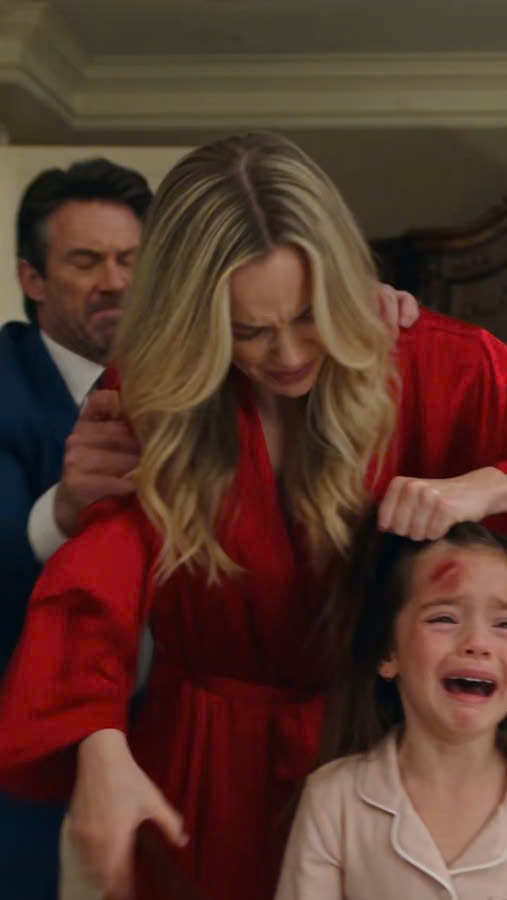
The knocks came again.
Three.
A pause.
Then two.
Sophie tightened her arms around my neck.
“That means she needs water.”
Vanessa stopped shouting.
Her fear became visible.
Not fear of me.
Fear of the wall.
I carried Sophie toward the hallway.
Vanessa blocked the door.
“You are not opening that closet.”
“Move.”
“She’s dangerous.”
“Who?”
Vanessa looked toward the memory card.
“That woman filled Sophie’s head with lies.”
Another knock came from behind the wall.
Weaker this time.
I placed Sophie inside the hallway bathroom.
“Lock the door.”
“No!”
“I’m staying outside.”
“Vanessa has keys.”
I looked at the frightened child in my arms.
She had learned the house better than I had.
I carried her back into the bedroom and placed her behind the overturned mattress.
“Stay where you can see me.”
Then I entered the closet.
Clothes had been ripped from their hangers.
Boxes lay open.
Vanessa had searched everything.
Behind the dresses stood a tall cedar panel.
I pushed against it.
Nothing.
Sophie pointed toward the floor.
“Mommy’s star.”
A small metal star had been carved into the baseboard.
It matched a symbol Claire used to draw beneath her letters.
Claire was Sophie’s biological mother.
My first wife.
She had supposedly died four years earlier after falling from a hotel balcony.
Vanessa had been Claire’s private assistant.
After the funeral, she helped care for Sophie.
Two years later, I married her.
I pressed the star.
The cedar panel released.
Cold air entered the closet.
Behind the wall was a narrow service corridor.
A woman lay against the bricks.
Her wrists were chained in front of her.
Gray hair covered part of her face.
Her lips were cracked.
I recognized her.
“Nora?”
Nora Hale had been Claire’s aunt.
She disappeared six months after Claire’s funeral.
Police believed she left the country after stealing money from Claire’s estate.
Vanessa had given investigators the bank records.
Nora opened her eyes.
“Daniel.”
I stepped inside.
“How long have you been here?”
“Sixteen days.”
Sophie crawled around the mattress.
“Nana Nora?”
Nora lifted her chained hands.
“Stay back, sweetheart.”
Vanessa ran toward the closet.
I caught her around the waist.
She struck my face.
“Let me go!”
I forced her against the wall.
“You chained an old woman behind my daughter’s bedroom.”
“She broke into our house.”
“Then why didn’t you call police?”
“She threatened Sophie.”
Nora laughed weakly.
“I brought her the card.”
Vanessa turned toward her.
“You were supposed to be dead before he came home.”
The room went silent.
Vanessa realized what she had said.
Sophie began crying again.
I pulled the curtain cord from the wall and tied Vanessa’s wrists to the bedpost.
“You’re making a mistake.”
“I already made one.”
I looked at Sophie.
“I married you.”
I found a small emergency release beside Nora’s chain.
It required a key.
Sophie reached into the pocket of her dress.
She removed a tiny silver pendant.
“Mommy’s star.”
Nora had pushed it through a crack behind the closet three nights earlier.
Sophie had hidden it.
Vanessa found the loose pillow lining but not the pendant.
The key opened Nora’s restraints.
She collapsed against me.
“Claire is alive,” she whispered.
My breath stopped.
Sophie stared at her.
“Mommy Claire?”
Nora nodded.
“Vanessa and Dr. Crane have kept her at Hawthorne House.”
Vanessa pulled against the cord.
“She is lying.”
Nora looked at the black card in my hand.
“Play the file marked BEFORE.”
I inserted the card into Sophie’s tablet.
One video appeared.
Claire sat inside a hotel room.
The date was the night before her supposed death.
She looked directly into the camera.
“If Daniel is watching this, the fall did not kill me.”
“I was pushed.”
“Vanessa opened the balcony door.”
“But she was not the person who gave the order.”
Footsteps thundered through the hallway.
A man called my name.
My older brother Marcus entered the bedroom with two private security officers.
He saw Nora.
Then the memory card.
His face changed.
“Daniel.”
“Give me the card.”
Marcus raised both hands.
“You don’t understand what is happening.”
“You knew Nora was here.”
“No.”
“You knew about the card.”
“Claire sent me copies before the accident.”
Nora struggled to stand.
“He erased them.”
Marcus looked toward her.
“You stole from our family.”
“You created the theft.”
One security officer moved toward Sophie.
I stepped between them.
“Stay away from my daughter.”
Marcus lowered his voice.
“You’ve tied your wife to a bed.”
“You burned her.”
“And now you’re threatening security officers.”
I looked at the red mark on Vanessa’s arm.
My anger had given them evidence.
“I pressed the casing against her.”
Marcus looked almost relieved.
I continued.
“That was wrong.”
“But it does not erase Sophie’s tied wrists.”
“Nora’s chains.”
“Or Claire’s video.”
Vanessa stared at me.
She had expected denial.
Marcus had too.
A siren sounded outside.
Nora had activated a silent alarm inside the service passage before Vanessa caught her.
Marcus turned toward the officers.
“We’re leaving.”
The bedroom door opened.
Our housekeeper, Mrs. Brooks, stood there holding her phone.
She had worked for my family since I was a child.
A red recording light glowed on the screen.
“No,” she said.
“You’re waiting for the police.”
Marcus stared at her.
“You recorded this?”
“Not only this.”
She pointed above Sophie’s door.
A hidden camera rested behind the molding.
“I installed it after I heard someone knocking inside the wall.”
“When?” I asked.
“Two weeks ago.”
“Why didn’t you tell me?”
“I tried.”
Mrs. Brooks looked toward Vanessa.
“She intercepted your calls.”
“Then Marcus told me grief had returned and you were not to be disturbed.”
Marcus stepped toward her.
She raised a brass lamp.
“Another step and this becomes less dignified.”
Police entered moments later.
Detective Maya Torres separated everyone.
Paramedics examined Sophie first.
The marks on her wrists were fresh.
A small burn reddened one side of her neck.
Vanessa had already touched her with the straightener before I entered.
The sight made me sick.
Torres looked at Vanessa.
“Did you restrain the child?”
“She was destroying the room.”
“She stole confidential property.”
“She is five.”
“She knew what she was doing.”
Torres turned toward the hidden camera footage.
It showed Vanessa entering with rope.
Pulling Sophie from beneath the bed.
Tying her wrists.
Heating the straightener.
The footage also showed Marcus inside the room the previous evening.
He spoke quietly to Vanessa.
“Sophie turns six in sixteen days.”
“If the audit opens, we lose Hawthorne.”
Vanessa paced beside the bed.
“Nora says Claire changed the trust.”
“Nora won’t speak much longer.”
“And Sophie?”
“Children confess when fear becomes specific.”
Vanessa looked toward the straightener.
“I won’t scar her.”
Marcus answered:
“You only need her to believe you might.”
The footage continued.
Vanessa asked:
“What if Daniel comes home?”
“He isn’t due until Friday.”
“And if he does?”
Marcus smiled.
“Dr. Crane already wrote the report.”
Police searched the bedroom.
Inside Vanessa’s handbag, they found a psychiatric petition.
It described me as violent.
Obsessive.
Unable to accept Claire’s death.
It described Sophie as disturbed and dishonest.
The petition requested emergency guardianship.
The incident date was tomorrow.
They had written my reaction before provoking it.
Dr. Samuel Crane signed the medical assessment.
Judge Eleanor Voss signed the preliminary order.
Both had been involved after Claire’s death.
Crane certified the body.
Voss transferred control of Claire’s estate to Marcus.
Torres played the rest of Claire’s first video.
Claire held up a folder.
“Hawthorne House is not a recovery center.”
“It is where wealthy families hide people whose legal existence becomes inconvenient.”
“Spouses.”
“Parents.”
“Children.”
“Anyone whose signature is still valuable.”
She displayed a photograph.
A private clinic stood behind tall iron gates.
Then another photograph appeared.
Claire inside the clinic.
A date had been added.
Three weeks after her funeral.
“They kept me alive for the annual trust authorization.”
“If I refuse, they threaten Sophie.”
“If I cooperate, they promise she remains safe.”
Claire looked directly into the camera.
“Daniel, do not believe safety means unharmed.”
Vanessa began crying.
“I was protecting Sophie.”
Nora looked at her.
“You tied her to a bed.”
Vanessa’s voice broke.
“You don’t know what Marcus would have done.”
Marcus turned toward her.
“Stop talking.”
The command revealed the hierarchy.
Vanessa feared Marcus.
She also obeyed him.
And somewhere along the way, she had begun using the same fear against a child.
Torres placed both of them under arrest.
Before officers removed Marcus, he looked at Sophie.
“Your mother lied to everyone.”
Sophie hid behind me.
Marcus smiled.
“When you learn what she did before the balcony, you’ll wish the card stayed hidden.”
Nora was taken to the hospital.
Her blood contained sedatives and a drug that weakened muscle control.
The same medication appeared in Claire’s old medical records.
Crane had prescribed it after claiming Claire developed paranoia.
The paranoia began when she questioned financial transfers from the Hale Family Trust.
Nora explained the trust from her hospital bed.
Claire’s mother created it before her death.
It held medical patents, property and almost four hundred million dollars.
Claire controlled it.
After Sophie’s birth, Claire changed the terms.
When Sophie turned six, an independent audit would begin.
Every medical authorization made under Claire’s name would be reviewed.
If Claire was dead, the trust passed to Sophie under professional management.
If Claire was alive but declared incapable, her appointed guardian controlled everything.
Marcus had become that guardian.
Vanessa was meant to become Sophie’s guardian.
Together, they would control both sides.
“What happens if Claire is confirmed alive and capable?” I asked.
“Marcus loses the trust.”
“And Hawthorne House is exposed,” Nora said.
“What is inside Hawthorne?”
“People declared dead.”
“People declared insane.”
“Children whose parents were told they never survived birth.”
Sophie sat beside me.
Her fingers tightened around my sleeve.
“Are there kids behind walls?”
Nora looked at her.
“Yes.”
Sophie became very still.
Children understood imprisonment before they understood finance.
Torres raided Dr. Crane’s office.
The waiting room looked ordinary.
Soft chairs.
Children’s books.
Framed medical awards.
A hidden server beneath the floor contained dozens of psychiatric reports written before patients were examined.
Every report followed the same pattern.
Grief became delusion.
Anger became dangerous instability.
Fear became proof of incapacity.
One file belonged to me.
Another to Sophie.
A third belonged to Claire.
The final page of Claire’s file read:
TRANSFER TO HAWTHORNE AFTER AUTHORIZATION.
PUBLIC DEATH MAINTAINED.
Police found no trace of Crane.
His car remained outside.
His passport remained at home.
He had already gone to Hawthorne.
The memory card contained a second video.
Claire appeared thinner.
Her hair had been cut.
“I found out why they chose me.”
“Marcus did not begin this system.”
“Our father did.”
I looked toward Nora.
“My father?”
Robert Bennett had been a respected judge.
He died ten years earlier.
Or so I believed.
Claire continued.
“Judge Robert Bennett created the first Hawthorne guardianships.”
“He declared inconvenient relatives incapable.”
“Then transferred their assets through private trusts.”
“Marcus inherited the system.”
“Nora found the original orders.”
Nora looked away.
“My father imprisoned people?”
“He called it protection.”
Claire displayed one original order.
The patient name was Evelyn Bennett.
My mother.
She supposedly died from a stroke when I was twelve.
The order said she had been transferred to Hawthorne House three days before her official death.
My mother might have survived for years after we buried her.
I stood so quickly the chair fell.
“Did you know?”
Nora’s eyes filled.
“I suspected.”
“When?”
“After Claire found the order.”
“Four years ago?”
“Yes.”
“Why didn’t you tell me?”
“We didn’t know whether Evelyn was still alive.”
“You let me keep believing the grave was real.”
Nora did not defend herself.
“Yes.”
The truth did not need a perfect messenger.
Nora’s silence hurt.
The order remained evidence.
Sophie touched my hand.
“Was Grandma behind a wall too?”
“I don’t know.”
A nurse entered.
“Detective Torres is calling.”
Torres’s voice came through the speaker.
“We located Hawthorne’s transport network.”
“Three vehicles left the property twenty minutes ago.”
“One carries Claire.”
“How do you know?”
“Her medical monitor is transmitting.”
“Where are they going?”
“The old Bennett courthouse.”
My father’s courthouse had been abandoned after structural damage.
It sat beneath the hill where our family foundation held annual memorial events.
According to Nora, an underground records vault remained beneath it.
Claire had discovered the vault before the balcony incident.
Marcus was taking her there because the original guardianship files could destroy every legal order protecting Hawthorne.
The card contained the location.
It also contained the access phrase.
Sophie’s voice was required.
Claire had made her daughter part of the safeguard.
“What phrase?” I asked.
Nora looked at Sophie.
“The child must answer one question.”
“What question?”
“Who gets to decide whether you are afraid?”
Sophie whispered:
“I do.”
A red light appeared on the heart monitor beside Nora.
Her phone rang.
The caller ID showed our home number.
Torres answered.
Crane appeared on-screen.
Claire sat behind him, strapped to a chair.
He smiled.
“Bring Sophie to the courthouse.”
“Or her mother dies before the audit.”
The call was recorded.
Crane wore no mask.
He wanted us to understand that Claire’s life depended on obedience.
Sophie stared at the screen.
“Mommy Claire?”
Claire lifted her head.
“Sophie.”
Crane pressed one hand against her shoulder.
“Tell your daughter to come.”
Claire looked toward the camera.
“No.”
Crane tightened his grip.
Sophie started crying.
“I’ll go.”
“No,” Claire said.
Crane smiled.
“A mother willing to die.”
“A daughter willing to save her.”
“Very moving.”
He had already begun turning the threat into a story.
Torres ended the call.
Sophie clutched my coat.
“If I answer the question, Mommy comes home.”
“That is what he wants you to believe.”
“Will she?”
“I don’t know.”
“Then I should try.”
I knelt.
“Crane is holding her.”
“If he hurts her, that is his choice.”
“But I can stop him.”
“You may be able to affect what happens.”
“That does not make his actions your responsibility.”
She did not fully understand.
She understood enough to ask:
“Are you going?”
“The police are going.”
“You?”
I wanted to say yes.
I wanted to force my way into the operation.
Torres had already warned me.
Crane expected an emotional father.
My presence could become leverage.
“I’ll stay at the command center.”
Sophie looked disappointed.
Then relieved.
“Can I stay with you?”
“Yes.”
Her lawyer approved remote participation only if Sophie chose.
No one would physically take her to the courthouse.
The response phrase could be transmitted through a secure line if necessary.
Mrs. Brooks remained beside Sophie.
Nora stayed at the hospital.
Police moved toward the courthouse during heavy rain.
The main entrance had been chained.
Agents entered through an underground maintenance tunnel.
Body cameras showed old courtrooms covered in dust.
Broken benches.
Water stains.
Then a steel door beneath the judge’s chamber.
The door opened into a medical corridor.
Hawthorne patients had been moved beneath the courthouse before.
Some were still there.
Agents found six locked rooms.
A man who had been declared dead twelve years earlier.
A woman whose children believed she abandoned them.
Two elderly residents whose guardians sold their homes.
And one teenage boy listed as deceased after a private school accident.
The system had not ended with Claire.
It had expanded.
Crane held Claire inside the records vault.
Judge Voss stood beside him.
She had not merely signed Marcus’s petitions.
Her family had inherited the legal side of Hawthorne.
The first guardianship order bore her father’s signature.
The newest bore hers.
Marcus stood at the central terminal.
A red mark crossed his cheek from the arrest struggle.
He had been released from transport by two corrupted officers.
Torres’s team arrested those officers outside the courthouse.
Marcus pointed toward the terminal.
“Sophie answers the question.”
“Then Claire leaves.”
Claire looked into the nearest camera.
“He is lying.”
Marcus struck her.
Sophie screamed inside the command room.
I held my hands against the table.
I did not cover the screen.
I did not force her to watch either.
“Do you want it off?”
“No.”
Her voice shook.
“I want to see Mom.”
The terminal activated.
WHO GETS TO DECIDE WHETHER YOU ARE AFRAID?
Sophie looked at her lawyer.
Then at me.
“Can I answer anything?”
“Yes,” the lawyer said.
“You can answer.”
“You can refuse.”
“You can stop.”
Sophie leaned toward the microphone.
“I do.”
The terminal opened.
Marcus smiled.
Then every screen inside the vault changed.
ACCESS GRANTED TO SUBJECT.
NOT GUARDIAN.
The files did not transfer to Marcus.
They transferred to Sophie’s independent trust representative and federal investigators.
Claire had designed the question so the child’s answer removed adult guardianship control.
Marcus had misunderstood the safeguard.
He believed Sophie’s voice was a key he could possess.
Instead, it revoked him.
Thousands of files began copying.
Crane grabbed Claire and pulled a syringe from his pocket.
Judge Voss stepped back.
“You said no one would be killed.”
Crane laughed.
“You signed people into hidden rooms.”
“Don’t discover morality because cameras arrived.”
He pressed the needle toward Claire’s neck.
She twisted.
The syringe entered her coat but missed her skin.
Torres’s team breached the door.
Crane pulled Claire in front of him.
Marcus ran toward the purge switch.
Judge Voss caught his arm.
“For once, stop.”
He shoved her to the floor.
Then Sophie’s voice came through the vault speaker.
“Mommy?”
Claire looked up.
“I’m here.”
Three knocks sounded from another locked room.
Then three more.
Patients signaling that someone remained inside.
Claire drove her heel into Crane’s knee.
He released her.
Torres pulled Claire away.
Another officer forced Crane down.
Marcus reached the purge switch.
The terminal rejected him.
GUARDIAN AUTHORITY REVOKED.
Sophie’s answer had not only opened the files.
It had ended his control.
Claire was alive.
She was not well.
Years of medication damaged her heart.
Her left hand trembled constantly.
One leg had weakened after repeated restraints.
She spent three weeks in the hospital before Sophie was allowed to visit.
The first meeting took place inside a quiet room.
No cameras.
No relatives waiting for a dramatic embrace.
Claire sat in a wheelchair.
Sophie stopped at the doorway.
She had heard Claire through the wall.
Passed food into the service passage.
Hidden the card.
Yet the woman in front of her still felt partly like a stranger.
“Hi,” Claire said.
Sophie looked at the wheelchair.
“Did Vanessa do that?”
“Vanessa helped.”
“Did Uncle Marcus?”
“Yes.”
“Did Daddy?”
Claire looked toward me.
“No.”
Sophie became quiet.
Then asked:
“Did Daddy know?”
“No.”
“Did you tell him about Hawthorne before you fell?”
Claire’s face tightened.
“Not everything.”
“Why?”
“I wanted complete proof.”
“Did waiting help?”
“No.”
Claire did not call the delay protection.
She did not use captivity to erase what came before it.
“I was afraid your father would confront Marcus.”
“Would you?” Sophie asked me.
“Probably.”
“Would that be bad?”
“It might have made Marcus move the patients sooner.”
“Or it might have helped.”
“Yes.”
Adults did not know every version of the life that might have happened.
Sophie walked one step closer.
“Did you give me the card?”
“Yes.”
“I was five.”
“Yes.”
“Why did I have to hide it?”
“Because Nora had no safe way out.”
“That’s not what I asked.”
Claire closed her eyes.
“You should not have had to.”
“Would you do it again?”
“No.”
Sophie stood beside the chair.
She did not hug Claire.
She touched two fingers against the back of Claire’s hand.
Three small taps.
Claire answered with three.
That was enough.
Vanessa requested a meeting with Sophie.
Denied.
She asked to send a letter.
Sophie’s lawyer stored it without showing her.
Marcus’s control over Vanessa became clearer during the investigation.
Vanessa had grown up near Hawthorne.
Her mother was declared unstable after attempting to leave Vanessa’s father.
The father gained control of the family property.
Vanessa was taught that resistance caused separation.
Years later, Marcus found her working for Claire.
He offered her money and protection.
Then threatened to send Vanessa’s younger brother into Hawthorne if she refused to help.
At first, Vanessa copied files.
Then medication schedules.
Then keys.
When Claire discovered the scheme, Vanessa helped stage the balcony fall.
Her brother had died years before Sophie was tied to the bed.
The threat no longer existed.
Vanessa continued because she had money.
Status.
A marriage.
And crimes to hide.
Fear explained the beginning.
Power explained the rest.
Mrs. Brooks spoke to Sophie about the hidden camera.
“I heard Nora knocking for five days before I installed it.”
“Why didn’t you open the wall?”
“I was afraid Vanessa would move her.”
“Did she?”
“No.”
“Could Nora have died?”
“Yes.”
Mrs. Brooks looked directly at her.
“I acted too slowly.”
Sophie considered that.
“But you called police.”
“Yes.”
“Was that good?”
“Yes.”
“Can both be true?”
“Yes.”
The child understood complicated accountability better than most adults.
The house was sealed during the investigation.
I rented an apartment near Claire’s rehabilitation center.
Sophie chose a bedroom without a closet.
For months, she slept with the door open.
Then one night she closed it.
She immediately opened it again.
No one called that failure.
The trials began eighteen months later.
Sophie was seven.
She no longer screamed when she saw a hair straightener in a store.
She still refused to let anyone style her hair with heat.
That boundary required no explanation.
Marcus was tried first.
He described Hawthorne as a private protection system.
He claimed families sometimes needed to hide vulnerable relatives from publicity.
The prosecutor displayed false death certificates.
Forged medical reports.
Property transfers.
Locked rooms.
“Did Claire consent to being declared dead?”
“No.”
“Did Evelyn Bennett consent?”
“She was incapable.”
“Who declared her incapable?”
“My father.”
“Who inherited her property?”
“Our family trust.”
Marcus looked toward the jury.
“Financial benefit does not invalidate medical judgment.”
The prosecutor played the courthouse footage.
Marcus striking Claire.
Running toward the purge switch.
Attempting to destroy the files.
His language of protection could not survive the sequence.
Judge Voss testified under a cooperation agreement.
She admitted signing emergency guardianships before evaluations.
Marcus supplied the desired outcome.
Crane supplied the diagnosis.
Voss supplied legality.
“Why cooperate now?” the prosecutor asked.
“Marcus tried to destroy the records.”
“Was that the first crime you witnessed?”
“No.”
“Then why now?”
Voss looked toward the floor.
“Because I understood he would blame me.”
Not conscience.
Self-preservation.
Her testimony remained useful.
Crane’s trial exposed the medical system.
Sedatives described as stabilization.
Restraints called fall prevention.
Isolation called privacy.
False death called continuity protection.
The prosecutor asked:
“Did every patient who opposed you become mentally ill?”
Crane answered:
“Resistance is often a symptom.”
“And obedience?”
“Evidence of treatment response.”
The system had been designed so every reaction proved the diagnosis.
Vanessa’s trial was the most difficult.
Her attorney showed childhood records.
Threats against her brother.
Marcus’s financial control.
Years of coercion.
Then prosecutors played Sophie’s bedroom footage.
Vanessa tying the child’s hands.
Heating the straightener.
Moving it toward her face.
“Was Marcus in the room?”
“No.”
“Was your brother alive?”
“No.”
“Was anyone physically forcing you?”
“No.”
“Then why do it?”
Vanessa looked toward the empty child-witness seat.
“She had the card.”
“What did the card threaten?”
“Marcus.”
“Hawthorne.”
“My marriage.”
“My freedom.”
The final answer mattered.
By then, Vanessa had not been protecting another victim.
She had been protecting herself.
Nora testified next.
Vanessa’s attorney attacked her delay.
“You knew Claire was alive.”
“Yes.”
“You knew Hawthorne existed.”
“Yes.”
“You waited four years to bring the card.”
“Yes.”
“Then you helped the system continue.”
“For too long.”
“Why should the jury trust you?”
Nora looked toward the evidence table.
“They should not trust me because I became brave late.”
“They should verify the card.”
“The footage.”
“The chains.”
“The account records.”
Her imperfect courage did not erase the evidence.
I testified about the straightener.
Vanessa’s attorney displayed the mark on her arm.
“You deliberately caused pain.”
“Yes.”
“You wanted revenge.”
“For one second.”
“Then the report describing violent anger was correct.”
“No.”
I looked toward the jury.
“The report was written before the event.”
“They planned a reaction.”
“I gave them one.”
“My action remains wrong.”
“Their preparation remains real.”
The attorney showed photographs of Vanessa caring for Sophie.
Birthday parties.
School events.
A fever.
Vanessa asleep beside Sophie’s hospital bed.
“You loved your wife.”
“Yes.”
“She loved Sophie.”
“She may have.”
“She cared for her.”
“Sometimes.”
“Then she was not the monster described by the prosecution.”
“People do not have to be cruel every minute to become dangerous.”
“The caring moments made the warning signs easier to dismiss.”
Claire testified by protected video.
Marcus’s attorney asked why she placed the memory card where Sophie might find it.
“I believed Nora would take it.”
“But Sophie carried it.”
“Yes.”
“You burdened a five-year-old with criminal evidence.”
“Yes.”
“Then your judgment was poor.”
“In that decision.”
The attorney smiled.
Claire continued.
“My failure does not become Marcus’s permission to imprison me.”
“It does not become Vanessa’s permission to tie Sophie down.”
“It does not become Crane’s permission to falsify deaths.”
The jury convicted Marcus of kidnapping, fraud, unlawful confinement, attempted murder and obstruction.
He received multiple life sentences.
Crane received multiple life sentences.
Vanessa received forty-six years.
Judge Voss received thirty-eight.
Several doctors, attorneys, officers and Hawthorne administrators received federal sentences.
At sentencing, Vanessa asked permission to address Sophie.
Sophie declined.
Vanessa spoke to the court instead.
“I loved her.”
The judge answered:
“Whatever you felt did not stop you from turning fear into a tool.”
Vanessa lowered her head.
No child was required to complete her final scene.
The Hale Family Trust was dissolved.
Its assets entered an independent restitution fund.
People hidden through Hawthorne received legal representation, medical treatment and help restoring their identities.
No Bennett family member controlled the fund.
Not me.
Not Claire.
Not Sophie.
The courthouse vault contained 417 guardianship files.
Some victims were still alive.
Others had died inside institutions.
Some had spent decades believing their families abandoned them.
Restoration did not create automatic reunions.
Each living person controlled contact.
Relatives could request.
They could not demand.
My mother, Evelyn Bennett, had died inside Hawthorne six years after her public funeral.
The records showed she wrote letters to Marcus and me.
My father intercepted every one.
One letter said:
Daniel still taps three times against the wall when he is afraid.
Tell him I never chose to leave.
I did not remember the tapping until I read it.
Then I remembered being twelve.
Sitting beside my bedroom wall.
Knocking three times because my mother once answered from the next room.
After her supposed death, no answer came.
Years later, Claire and Nora used the same code.
Sophie used it too.
The family had carried a signal without knowing why.
My father’s crimes could no longer be prosecuted.
He was dead.
His name was removed from the courthouse.
Not erased from the historical record.
The building became the Hawthorne Center for Guardianship Review and Child Consent.
The old judge’s chamber became a public legal clinic.
The underground cells were opened into a courtyard.
No hidden doors.
No soundproof walls.
Every room could be exited from inside.
The house where Sophie was restrained was sold to the survivor board.
The bedroom wall was removed.
The passage became part of an open reading room.
Sophie refused to display the straightener.
“That thing doesn’t deserve a glass case.”
The prosecution preserved authenticated photographs.
The physical object was destroyed after appeals ended.
The black memory card entered a sealed legal archive.
Not public exhibition.
Visitors did not need to watch Claire’s fear to believe Hawthorne existed.
Mrs. Brooks retired.
The board wanted to name the reading room after her.
She refused.
“I heard the knocking and waited.”
“You still acted,” Sophie said.
“Later.”
“Did later matter?”
“Yes.”
“Did waiting matter?”
“Yes.”
The room became known as the Listening Room.
No hero’s name.
Only the action everyone had failed to perform early enough.
Claire moved into a small home near us.
We did not remarry.
Legally, her false death had ended our marriage.
Emotionally, four years had changed us.
I had married Vanessa.
Claire had survived imprisonment.
Sophie had grown into a child with memories neither of us shared completely.
We became parents first.
Sometimes friends.
Sometimes two people grieving what could not be restored.
Sophie spent nights with Claire gradually.
The first time, she asked to keep all closet doors open.
Claire removed the closet door entirely.
“You don’t have to do that,” Sophie said.
“I want the room to feel different.”
“What if I want a door later?”
“We put one back.”
Sophie slept there.
In the morning, she found breakfast waiting.
No reward.
No questions about whether she had slept correctly.
Ordinary care.
Ten years passed.
Sophie was seventeen when she chose to read the complete archive.
Not everything.
She selected sections with her therapist.
First, Vanessa’s letters.
Then Nora’s files.
Finally, Claire’s video recorded before the balcony.
Vanessa’s first letter blamed Marcus.
The second blamed fear.
The third was different.
I told myself threatening you was temporary.
I told myself heat would frighten you faster than it could harm you.
I told myself finding the card would save everything worth saving.
What I meant was that it would save me from being exposed.
You were five.
You were not responsible for my marriage, my freedom or Hawthorne.
Sophie closed the letter.
“Does she mean it?”
“I think so,” I said.
“Does that help?”
“A little.”
“Do you forgive her?”
“No.”
She returned the letter to the file.
Meaningful remorse did not create access.
Sophie read Nora’s statement next.
Nora admitted withholding Claire’s suspicions before the balcony.
She feared Marcus would destroy the records.
She feared I would confront him.
She feared police belonged to my father’s network.
All of those fears had support.
The delay still had consequences.
“Everybody waited,” Sophie said.
“Yes.”
“Mom.”
“Nora.”
“Mrs. Brooks.”
“You.”
“Yes.”
“Why?”
“Because seeing the whole truth would have changed every part of our lives.”
“That doesn’t excuse it.”
“No.”
“It explains why people choose the smaller lie for one more day.”
Sophie nodded.
“Until the smaller lie becomes the house.”
Claire’s original video was hardest.
She described finding the Hawthorne records when Sophie was three.
She planned to tell me.
Then she learned my mother had survived for years after her funeral.
She wanted to find every remaining patient first.
Marcus discovered the investigation.
He arranged the balcony fall.
Sophie stopped the recording.
“You chose the case before telling Dad.”
“For several months,” Claire said.
“Did you choose Hawthorne over me?”
“No.”
“That sounds easy.”
Claire lowered her eyes.
“I chose a plan that kept me away from telling your father.”
“That decision affected you.”
“So the answer isn’t only no.”
Sophie waited.
Claire continued:
“I loved you.”
“I also believed I could delay the truth while keeping you safe.”
“I was wrong.”
Sophie did not forgive her immediately.
She returned the following week.
Not because everything had been resolved.
Because Claire allowed anger to remain without demanding comfort.
Sophie became interested in guardianship law.
At school, she challenged a policy allowing parents unrestricted access to students’ private counseling notes.
The school argued that parents were legal guardians.
Sophie answered:
“Guardianship is responsibility.”
“It is not ownership of every thought.”
The policy changed.
No hidden institution.
No dramatic rescue.
The principle remained.
My relationship with Sophie changed too.
During one argument, I raised my voice.
She froze.
I stopped.
“Do you want space?”
“Yes.”
I left the room.
Years earlier, I believed being her father meant staying until a problem was solved.
Now I understood that remaining physically present could become pressure.
We spoke the next day.
Repair did not require immediate access.
Fifteen years after three knocks came from behind Sophie’s closet, she returned to the house carrying a box of books.
She was twenty.
The former Bennett home had become the Claire Hale Center for Consent and Guardianship Reform.
Claire had initially refused to let the center use her name.
The independent survivor board chose it years later because of her legal work helping former Hawthorne patients reclaim their identities.
She accepted only after confirming that no footage of her confinement would play publicly.
The old bedroom looked nothing like it had that day.
The closet wall was gone.
The narrow passage opened into a sunlit courtyard.
Plants grew where Nora’s chain had been fixed to the floor.
No rope.
No hidden camera.
No heated tool preserved beneath glass.
The room had become a consultation library for children and adults living under disputed guardianships.
Every door opened from inside.
A child could end an interview at any time.
No guardian sat inside unless the person being interviewed requested it.
The annual training session included judges, doctors, teachers, lawyers, nurses and child-protection workers.
Sophie stood beside the place where her bed had once been.
“When my father entered, he saw enough to stop the immediate danger.”
“My wrists were tied.”
“Vanessa held a heated object.”
“I was crying.”
“He did not need the memory card first.”
A doctor asked:
“What should happen when a child may be hiding important evidence?”
“Protect the child.”
“Preserve the room.”
“Ask questions after the immediate threat ends.”
“Evidence does not become more valuable because a child suffered to protect it.”
A judge asked:
“Did the recording prove every allegation?”
“No.”
“It had to be authenticated.”
“The dates were checked.”
“The people in it were identified.”
“Records were compared.”
“Listening does not mean automatically declaring every claim true.”
“It means refusing to declare it impossible before checking.”
Claire attended in a wheelchair.
Her health had declined gradually.
Years of medication and confinement damaged her heart.
She spoke briefly.
A trainee asked:
“Do you regret giving Nora the card?”
“No.”
“Do you regret that Sophie carried it?”
“Yes.”
“But the card exposed Hawthorne.”
“Yes.”
“Then was it the correct decision?”
Claire looked toward Sophie.
“It was effective.”
“That does not make the burden fair.”
Success did not retroactively turn a child’s danger into a good plan.
Nora had died three years earlier.
Her final statement remained inside the private archive.
I acted late.
Late action is still worth taking.
It is not permission to rewrite the waiting.
Mrs. Brooks sat near the back of the room.
At eighty-eight, she used a cane.
After the session, Sophie approached her.
“Do you want help standing?”
“Yes.”
Sophie waited until Mrs. Brooks held out her hand.
Small habits revealed what the center taught better than speeches.
A family arrived near closing time.
A six-year-old girl had told her teacher that her grandmother locked her bedroom door from outside at night.
The grandmother said the child sleepwalked.
The mother said it was a safety precaution.
There was no conspiracy.
No trust.
No hidden patient.
A new staff member asked Sophie:
“Who do we believe?”
“We protect the child from being locked in first.”
“Then we investigate.”
“Check the lock.”
“Review medical history.”
“Interview everyone separately.”
“Safety does not require deciding guilt before removing immediate danger.”
The girl sat inside the consultation room.
“Can I close the door?” she asked.
“Yes.”
“Can Grandma open it?”
“Not from outside.”
The child closed it.
A minute later, she opened it herself.
“I’m ready.”
Sophie entered only after being invited.
I watched from the hallway.
She noticed.
“Dad?”
“Yes?”
“Do you still think about the straightener?”
“Yes.”
“What part?”
“Taking it from Vanessa.”
“And?”
“What I did after.”
Sophie looked at me.
“Do you think pressing it against her made you like her?”
“No.”
“Then what did it make you?”
“A frightened, angry man who chose retaliation after the danger was already stopped.”
“Did you love me?”
“Yes.”
“Did that make the choice right?”
“No.”
She nodded.
For years, I wanted every act performed in her defense to become proof that I was a good father.
That was another form of control over the story.
Stopping Vanessa protected Sophie.
Hurting Vanessa afterward did not.
The truth became safer when no one demanded the role of perfect hero.
Near sunset, Sophie opened the private archive.
The black card remained inside a sealed drawer.
The silver star key rested beside it.
She picked up neither.
“Do you want them?” I asked.
“No.”
“They belong to your case.”
“The information does.”
“The objects don’t have to belong in my house.”
She closed the drawer.
Outside the archive, three gentle knocks came from the sensory room.
A counselor stood beside the door.
“Do you want me to enter?”
A child answered:
“Not yet.”
The counselor waited.
Three more knocks.
“Now.”
The door opened.
The signal no longer meant that someone had been chained behind a wall.
It meant:
I need you.
But listen for my answer.
Claire joined us in the courtyard.
Sophie placed one hand near the wheelchair handle.
“Want help?”
“Yes.”
Only then did she push.
We moved toward the front entrance.
The building was filled with open passages.
Visible cameras.
Independent advocates.
And records controlled by the people whose lives they described.
Marcus believed a guardian owned the truth.
Crane believed a diagnosis could make refusal meaningless.
Vanessa believed fear could force a child to surrender anything.
They were wrong for the same reason.
A person did not stop owning herself because someone stronger controlled the room.
Not when tied to a bed.
Not when hidden behind a wall.
Not when declared dead.
Not when an adult claimed the consequences were too important to allow no.
The memory card revealed what happened before Claire’s supposed death.
But the first truth required no video.
A five-year-old child was screaming.
Her wrists were tied.
Heat was moving toward her face.
She deserved protection before anyone knew what she had hidden.
Sophie opened the front door.
We stepped outside together.
Behind us, every child inside could still reach a handle.
And no one would ever again have to carry an adult’s evidence before the adults agreed that fear was reason enough to open the wall.
