
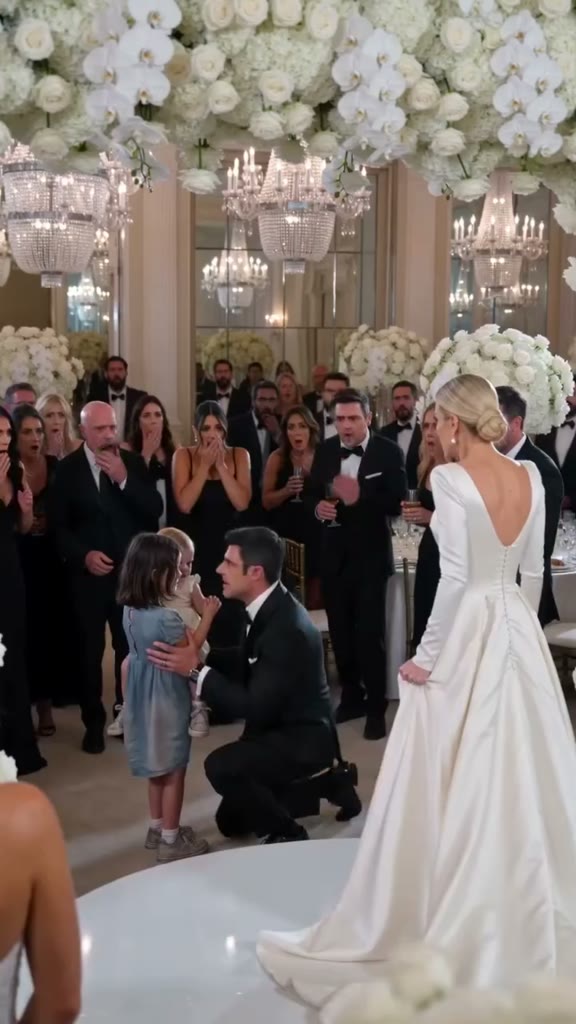
The scent of thousands of imported white roses hung heavy in the cathedral, sweet enough to make your stomach turn. Crystal chandeliers caught the afternoon sun, casting sharp prisms across polished marble floors where hundreds of high-society guests sat in absolute, breathless silence. Up at the altar stood Julian, my father, in a sharp black tuxedo that cost more than our entire rent for a year. Beside him stood Victoria, her blonde hair piled into an immaculate updo, her white strapless gown cascading in a dramatic train that swept the pristine white aisle runner. They looked like something off a billboard in Times Square. Perfect. Untouchable.
And then my little sister let out a ragged, breathless wail.
She was only one, wearing a cream-colored romper stained with yesterday’s formula, and her cries echoed off the vaulted ceilings like a siren. I held her tighter against my chest, my arms trembling beneath her weight. My own dress, a dusty blue hand-me-down, was smudged with dirt from the subway stairs. My dark hair was tangled, and my face was wet with tears I had tried all morning to wipe away. But I couldn’t stop them. Not when we had walked three miles through downtown Manhattan just to find the man on the glossy magazine covers who had promised us he was coming right back.
Victoria snapped first, her head whipping around like a striking snake. Her face twisted into an ugly, furious mask that the glossy wedding photographers failed to capture.
“Get that girl out of here!” she shouted, her voice cutting through the organ pipes like broken glass.
Nobody moved. The rows of tailored suits and silk dresses froze. I stood right in the center of the white aisle, my scuffed sneakers sinking softly into the heavy runner, my fingers locked around my sister’s small back. I looked past Victoria’s shaking, bejeweled hand, straight into the face of the man who had kissed my forehead three weeks ago before packing his bags and walking out of our cramped kitchen in Queens.
The side room behind the altar smelled of stale upholstery and expensive jasmine perfume. It was meant to be a quiet bride’s retreat, but the air inside was thick with panic. Victoria paced the length of the Persian rug, her white train hissing against the wool with every sharp turn. Her chest heaved beneath the strapless bodice, and her manicured fingernails dug into her palms.
“Do you have any idea who was out there, Julian?” she hissed, her voice vibrating with a cold, controlled fury. “The board members from the foundation. The real estate developers. My parents!”
Julian didn’t answer her. He sat on the edge of a velvet settee, his head bowed, his hands clasped tightly between his knees as if he were trying to crush the bones in his fingers. He hadn’t looked at the door since we were led in here by a panicked usher.
I sat in the corner on a stiff wooden chair, rocking my sister against my chest. She had finally quieted down, exhausted from the screaming, her damp cheek pressed against my collarbone. Every few seconds, her little shoulders hitched with a lingering sob. I kept my eyes fixed on the floorboards, tracing the grain of the wood to keep my own breathing steady. I was six years old, but I knew enough about the world to know that fancy rooms didn’t mean you were safe. Back in Queens, at least the walls didn’t judge you for being hungry.
“Well?” Victoria stopped pacing, towering over Julian with her hands on her narrow hips. “Are you going to say something, or are you just going to sit there looking like a ghost? Who are they? Tell me this is some kind of sick joke.”
Julian slowly raised his head. The sharp jawline looked hollow now, the skin around his eyes gray and drawn. He looked across the room at me, a silent, heavy weight passing between us.
“They aren’t a joke, Victoria,” he said, his voice raspy, completely stripped of its usual boardroom polish. “They’re my daughters.”
The neon sign outside Joe’s All-Night Diner flickered with a tired, electric hum, casting a red glow across the cracked linoleum floor. The booth in the very back smelled of stale coffee, grease, and floor wax—a comforting, honest smell compared to the suffocating jasmine of the cathedral.
The waitress, an older woman with tired eyes and a stained pink apron named Martha, set down a mug of steaming hot water with lemon and a small ceramic bowl of sugar cubes. She didn’t ask questions about why two kids were sitting alone in a booth at five o’clock in the afternoon with no parents in sight. She had seen enough of New York to know when minding her own business was the kindest thing she could offer.
“There you go, sweetheart,” Martha said, her voice gravelly and warm. “Take your time. Nobody’s gonna bother you here for a while.”
I dipped a plastic spoon into the hot water, dissolving the sugar until it turned clear, then cooled it down by blowing on it gently before holding the spoon to my sister’s lips. She drank greedily, her little eyelashes wet against her cheeks.
I pulled the thick envelope out of my pocket and laid it on the worn green vinyl table. Inside were neat stacks of crisp fifty-dollar bills, bound by a paper band stamped with the logo of a downtown bank. It was enough money to rent a small room for a month, maybe buy groceries that didn’t come from a pantry box. But looking at it didn’t make me feel safe. It felt like hush money. It felt like the price of making two little girls disappear so a man could keep his name on the plaques of glass office buildings.
“They canceled the reception,” Julian said quietly, sliding into the opposite side of the vinyl booth without waiting for an invitation. The springs groaned beneath his weight. He rested his elbows on the laminate table, staring down at his hands. “Victoria’s father pulled all the investments from my firm before we even made it back to the dressing room. By morning, my partners are going to vote me out.”
I didn’t say anything. I kept stirring the warm water in the ceramic mug, watching the small whirlpool form and collapse against the sides.
“I didn’t mean for you to be there, Lily,” he continued, his voice dropping to a rough whisper. “I tried to keep that world away from you. I thought if I climbed high enough, if I built a enough walls, nobody would ever look at where I came from.”
“You left us in Queens with three boxes of macaroni and no heat,” I said. My voice didn’t shake. It was flat, carrying the cold weight of every night I had spent checking the locks while our baby sister cried from hunger.
Julian flinched as if I had struck him across the face. He closed his eyes tightly, his jaw clenching until the muscle ticked beneath his skin. “I know. And I can’t undo that. But I rented a place. Just outside the city, in New Jersey. It’s small, but it has heat, and the locks work. No reporters. No society boards.”
“And Victoria?” I asked, meeting his gaze for the first time.
“She’s filing for an annulment before midnight,” he replied, a bitter, humorless smile touching the corner of his mouth. “She wants my name wiped from every document she ever signed. As far as the public is concerned, today never happened.”
The New Jersey safe house Julian promised turned out to be a mid-century modern architectural box perched on a jagged cliff overlooking the Hudson River. Floor-to-ceiling glass walls exposed every room to the gray morning light, making it feel less like a sanctuary and more like a transparent cage. Julian carried our meager belongings inside—a single plastic grocery bag containing our spare clothes and my sister’s favorite worn-out plush rabbit—while I settled the baby onto the plush cream sofa. The air inside smelled of expensive cedar and stale ozone, untouched by human warmth.
Within two hours of our arrival, the heavy iron security gate at the base of the private drive hissed open. A black town car crunched up the gravel driveway, and out stepped Marcus Vance, Victoria’s high-priced corporate attorney. Marcus didn’t bother knocking; he let himself in using a heavy brass key ring, his sharp gray eyes scanning the pristine living room before landing directly on me. He wore a charcoal bespoke suit that looked entirely out of place against the minimalist furniture and our dusty shoes.
“Julian is down in the city dealing with the emergency board meeting,” Marcus said, his voice smooth and devoid of any warmth. He pulled a thick manila folder from under his arm and dropped it onto the glass coffee table with a heavy thud. “My firm represents Victoria Sterling. We are here to ensure there are no lingering complications from yesterday’s unfortunate exhibition at the cathedral.”
I didn’t stand up. I kept my hand resting gently on my sleeping sister’s back, feeling the steady rise and fall of her chest. “I’m not looking for complications. We just want a place to sleep where the doors lock.”
“That can be arranged,” Marcus replied, sliding a stapled set of papers across the glass. “In exchange for absolute silence regarding Julian’s prior domestic arrangements, this agreement provides a modest trust fund managed by our firm. You will reside here quietly until the annulment is finalized, after which you will relocate permanently to the West Coast.”
I picked up the papers, my eyes scanning the dense legal jargon. It wasn’t an offer of help; it was a buyout. A neat, quiet transaction designed to sweep us back under the rug before the morning papers hit the stands. I folded the documents cleanly down the middle and set them back on the table.
The sun dipped below the Manhattan skyline across the river, casting long, bruised shadows across the glass walls of the house. Julian returned late, his tie loosened and dark circles carved deep beneath his eyes. He dropped his car keys onto the kitchen island and poured himself two fingers of amber bourbon from a crystal decanter, drinking it in a single, desperate swallow.
“Did Vance come by?” Julian asked, his voice rough as sandpaper.
“He left his paperwork,” I said, nodding toward the coffee table. “He wants us shipped off to the West Coast by the end of the week. Neat, tidy, and completely out of sight.”
Julian rubbed his face with both hands, groaning softly. “I tried to block him. My hands are tied with the board right now. Victoria’s father controls thirty percent of the voting shares; if I push back too hard on the legal terms, they’ll strip my name off the building before midnight.”
“Is that all you care about? Your name on a building?” I snapped, the quiet anger I had held onto since Queens finally breaking through the surface. “You left us in a freezing apartment while you practiced your society smiles in upscale restaurants. You built a glass fortress so you wouldn’t have to look at the people you crawled over to get here.”
Julian flinched, slamming his glass down onto the marble counter hard enough to crack the rim. “You think this is easy? You think I wanted this?” He stopped, his chest heaving as he stared down the dim hallway toward the study. “Look in the drawer of the oak desk in the study. The bottom drawer. It’s unlocked.”
Confused by his sudden shift in tone, I left my sister sleeping safely on the couch and walked down the shadowed corridor. The study smelled of old paper and expensive leather. I pulled open the heavy wooden drawer. Inside sat a thick stack of bank statements, tax filings, and legal deeds dating back ten years.
I flipped open the top folder. My breath caught in my throat. It wasn’t just old debt or forgotten bills. It was a certified ledger detailing the systematic transfer of funds from my mother’s small community account into a shell corporation registered under Julian’s name, executed just weeks before he vanished from our lives. He hadn’t just walked away; he had funded his entire initial corporate stake using the insurance payout left behind after our mother passed away.
Julian didn’t turn around. He stood motionless against the glass, his reflection ghosting over the twinkling lights of the highway across the river. The silence stretched between us, heavy and suffocating, broken only by the faint, rhythmic breathing of my sleeping sister on the sofa.
“The insurance money wasn’t enough to buy a firm,” Julian said finally, his voice barely audible over the hum of the refrigerator. “Not in Manhattan. But it was enough to secure the initial bridge loan. I thought… I genuinely believed that once I made it, once I reached the top, I could bring you both up with me. I was going to buy a brownstone in Brooklyn. I was going to put your name on a trust.”
“And then you met Victoria,” I said, stepping closer to the glass table and resting my hand flat against the stolen ledger. “You met a woman who owned skyscrapers, and suddenly a little girl with messy hair and a dusty dress didn’t fit the brand.”
Julian turned slowly, his eyes bloodshot and haunted. “Victoria didn’t know about you. She doesn’t know about any of this. Her father’s firm handles all the compliance audits. If these documents go public, the entire holding company collapses. Not just me—hundreds of innocent employees, pension funds, community projects.”
“Don’t hide behind other people now,” I replied, my voice steady despite the adrenaline hammering against my ribs. “You used our survival to buy your ticket into high society. And yesterday, when I walked down that aisle, I wasn’t just crashing a wedding. I was calling your bluff.”
I pulled Marcus Vance’s buyout papers toward me, picked up a heavy silver fountain pen from the desk, and flipped to the signature page. Julian watched me, confusion flickering across his sharp jawline.
“What are you doing?” he asked, taking a half-step forward.
“Signing away my right to your hush money,” I said, scratching my signature across the dotted line with sharp, deliberate strokes. But instead of accepting their terms, I crossed out their confidentiality clause and wrote in my own handwriting across the margin: Terms rejected. Public audit requested.
Julian’s eyes widened in sheer panic as he read what I had written. “Lily, you can’t do that. Vance will bury you in injunctions. He’ll freeze every asset I have left, and you’ll have nothing.”
The photograph hit the financial blogs by midnight: The Billionaire’s Hidden Past: Mystery Child Spotted at Glass Cliff House. By noon the next day, the secure perimeter of the New Jersey safe house was swarming with satellite trucks and freelance reporters flashing camera strobes against the glass walls. We were trapped inside our own transparency.
Marcus Vance didn’t call this time; he sent a car with direct instructions. A black Mercedes pulled up to the service entrance, and a courier handed over two heavy envelopes containing forged invitations to the annual Sterling Foundation Charity Gala at the Museum of Modern Art in Manhattan. It wasn’t an invitation out of goodwill; it was a trap. Victoria and her father wanted us inside a controlled, high-society environment where they could publicly discredit us as opportunistic frauds before the SEC could launch an official audit of the stolen ledger.
“We’re not going,” I told Julian, pacing the minimalist kitchen while my sister played quietly with her plush rabbit on the rug. “It’s a firing squad.”
“If we don’t go, Vance will release an injunction claiming you’re a disturbed minor being used by my corporate rivals to extort the firm,” Julian argued, buttoning a fresh black tuxedo shirt with trembling fingers. He looked older, the sharp glamour of the wedding day entirely stripped away, leaving only a desperate man clinging to the wreckage. “If you walk in beside me, under my protection, the narrative changes. We control the room.”
“And if we walk in, your father-in-law destroys us in front of five hundred people,” I countered. But I looked down at my sister, knowing the temporary safe house was already compromised. The press would camp here for weeks.
We arrived at the museum just after eight o’clock. The red carpet rolled out over the stone steps under blinding white flashbulbs and a wall of shouting journalists. When the heavy glass doors swung open, revealing the grand atrium decorated with thousands of white roses—a cruel echo of the cathedral altar—the murmur of the crowd died instantly.
The ambient noise of the gala evaporated, leaving only the sharp echo of Victoria’s voice bouncing off the concrete and glass architecture. Hundreds of wealthy donors, foundation board members, and journalists stood frozen around the fountain, their champagne flutes suspended halfway to their lips.
I didn’t flinch. I kept my hand firmly on my little sister’s shoulder, feeling her small fingers grip the hem of my jacket. I reached into my coat pocket and pulled out the original, unredacted insurance ledger Marcus Vance had left out in the New Jersey safe house.
“He didn’t pay us anything, Victoria,” I said, my voice carrying a quiet, steady resonance that cut through the cavernous room. “In fact, he forgot to pay back the people who actually bought his first office building.”
Victoria’s sharp smile flickered for a fraction of a second before hardening back into glass. “Security. Remove these trespassers immediately.”
Before the guards could step forward, Julian moved. He didn’t try to hide behind his tuxedo or smooth over the tension with corporate diplomacy. He stepped squarely between Victoria and us, facing the entire room of high-society elites with his head held high.
“Let them stay, Victoria,” Julian said, his voice ringing off the marble pillars. He turned to face the crowd, looking directly into the lenses of the financial reporters clustered near the entrance. “Every document, every transfer, and every dollar that built this foundation is detailed in the ledger my sister is holding. I built this firm on money stolen from my own family when I walked away from a freezing apartment in Queens ten years ago.”
A collective gasp rippled through the ballroom. Flashbulbs erupted in a blinding frenzy, capturing every line of exhaustion and truth on Julian’s face.
Victoria’s father, a silver-haired titan of industry standing near the Board of Directors table, slammed his cane down onto the marble floor. “Julian, you are insane. You’re destroying everything you’ve built in five seconds.”
“I destroyed it the day I left them behind,” Julian replied quietly, not breaking eye contact with the crowd. He turned back and knelt down on the cold marble floor right in front of me, ignoring the expensive fabric of his trousers dragging against the stone—the exact same posture he had taken at the altar, but this time without any cameras or scripts to hide behind.
The morning after the gala, the sunlight cutting through the heavy drapes of our New Jersey safe house felt remarkably different. There were no flashing cameras, no glittering chandeliers, and no murmuring crowds of socialites. Instead, there was only the quiet hum of the refrigerator and the gentle breathing of my baby sister, who was finally sleeping through the night without waking up in a cold sweat. Julian sat across from me at the scarred wooden kitchen table, a steaming mug of black coffee untouched between his palms. The headlines from the gala were plastered across every major news network on the laptop screen: Sterling Foundation Scandal: Julian Sterling Confesses to Embezzlement. His entire corporate empire was unraveling at breakneck speed, but for the first time since he walked out of our freezing Queens apartment a decade ago, his shoulders didn’t look weighted down by a lie.
A sharp knock at the heavy oak front door broke the silence. Julian and I exchanged a quick, knowing look. I pulled my little sister closer as Julian stood up and walked over to the entryway, peering through the small brass peephole before turning the deadbolt. Two federal marshals stood on the porch, their dark suits contrasting sharply with the bright morning light. They didn’t shout or draw weapons; they simply handed Julian a thick manila envelope bearing the federal court seal. It was a formal subpoena requiring both of us to appear before the federal grand jury in downtown Manhattan within forty-eight hours to hand over the original ledgers and testify regarding the stolen startup funds.
“Is this it?” I asked softly, my voice steady despite the flutter in my chest.
The media horde outside the Daniel Patrick Moynihan United States Courthouse was larger than the crowd at the wedding altar. Microphones bristled like a wall of steel against the courthouse steps, and camera shutters clicked in a relentless, blinding rhythm that made the September air feel hot and suffocating. When the black town car pulled up to the curb, my heart hammered against my ribs like a trapped bird. I looked down at my little sister, who clutched a small stuffed rabbit Julian had bought her the day before. She looked up at me with large, trusting eyes, completely unbothered by the flashing lights and shouting reporters demanding statements from Victoria’s legal team.
Julian stepped out first, extending a steady hand to help me onto the stone pavement. He wore a simple navy suit without a tie—a deliberate rejection of the black tuxedo he wore the day his high-society life collapsed. As we walked up the sweeping granite steps, Victoria’s lead attorney tried to block our path, thrusting a stack of papers forward and shouting about defamation suits and immediate injunctions. Julian didn’t even slow down. He simply raised his left hand, holding the original leather-bound ledger where everyone could see it.
We bypassed the main courtroom doors and stepped into the press briefing room rented out by Julian’s new defense counsel. The room fell instantly silent as we took our seats at the long mahogany table. Dozens of journalists stared at us, their eyes darting from my scuffed sneakers to Julian’s weathered expression. I cleared my throat, adjusted the microphone, and spoke into the quiet room before Julian could say a word.
The fallout within the financial district was immediate and absolute. Within forty-eight hours of our courthouse appearance, the Sterling Foundation’s board of directors held an emergency vote that stripped Julian of every executive title, voting right, and equity share he had accumulated over the past decade. Victoria’s father, realizing that the scandal was about to drag his own shipping conglomerate down into the bankruptcy courts, severed all financial ties with his daughter’s marriage, initiating a rapid-fire legal annulment that hit the tabloids before the weekend even arrived.
I watched the news unfold from the small television set in our temporary New Jersey living room while my little sister napped peacefully on the worn sofa. Stock analysts on financial news networks debated the collapse of Sterling Holdings with clinical detachment, calling it one of the most spectacular corporate downfalls in modern Wall Street history. But to me, it didn’t feel like a tragedy. It felt like clearing away dead wood after a forest fire, leaving fertile soil underneath where something real could finally grow.
Julian spent the afternoon packing up the remaining boxes from his Manhattan penthouse, discarding the expensive art pieces, designer suits, and gold-plated trinkets that had defined his double life. When he returned to the safe house just before dusk, he didn’t look like a disgraced CEO. He looked lighter, as though a fifty-pound vest of lead had finally been lifted from his chest. He dropped a single cardboard box onto the kitchen table—not filled with stock portfolios or corporate bylaws, but with old family photo albums, our mother’s recipe box, and a few faded polaroids from the apartment in Queens we thought we’d left behind forever.
Autumn arrived in New Jersey with a sharp, crisp breeze that turned the maple leaves along the highway brilliant shades of amber and red. On a quiet Sunday morning, exactly one month after the courthouse press conference, Julian, my baby sister, and I drove out to a small, unassuming wooden church tucked away on the outskirts of a quiet working-class town. There were no television cameras, no flashing lights, and no velvet ropes guarding the entrance. Just a simple white-painted steeple cutting into the clear blue sky and a handful of parishioners chatting softly on the gravel pathway before morning service.
We parked the sedan near the back lot and walked up the wooden steps together. My little sister wore a simple yellow cotton dress, holding tightly to Julian’s index finger with one hand and her stuffed rabbit with the other. When we stepped inside the dimly lit sanctuary, the scent of aged pine and beeswax filled the air. The stained glass windows cast soft, colorful patterns of light across the wooden pews, creating a peaceful sanctuary far removed from the cold marble and high-stakes drama of Manhattan.
We chose an empty pew near the back, away from the prying eyes of the world. As the organ began to play its slow, grounding hymn, Julian bowed his head, his hands clasped tightly in his lap. I looked over at him, noticing the subtle lines of stress fading from around his eyes, replaced by a quiet, hard-won humility. He wasn’t running anymore. He had faced his past, confessed his sins to the world, and chosen the difficult, unglamorous path of true accountability.
During the silent prayer, my thoughts drifted back to that chaotic day under the crystal chandeliers—the dusty blue dress, the tear-stained face, the crying baby in my arms, and the moment Julian turned around to face the truth he had tried so desperately to bury. That day had felt like the end of our world, but looking around this quiet country church now, I realized it was the exact moment our real lives finally began. We had survived the fire, and we were standing together on solid ground at last.
Six months after the storm broke, the federal investigation officially concluded with a restructuring plan that prioritized full restitution to all affected parties, leaving Julian without his fortune but with his freedom and his integrity intact. We moved into a modest, sunlit brick house on a quiet, tree-lined street in upstate New York—a place with a big backyard, a wooden porch swing, and a small flower garden that my little sister immediately claimed as her personal kingdom. There were no gated entries, no private security details, and no high-society galas to attend. There was only the steady rhythm of everyday life: school drop-offs, Saturday morning pancake breakfasts, and quiet evenings spent around the kitchen table doing homework.
Julian took a job as a senior operations manager at a regional logistics firm, trading his bespoke Italian suits for flannel shirts and work boots. He worked hard every single day, earning his position through merit rather than deception, and every evening he walked through our front door with a genuine smile that reached his eyes. We spent our weekends fixing up the back porch, planting tomatoes, and teaching my little sister how to ride her first bicycle without training wheels.
One Saturday afternoon in late spring, as the golden sunlight filtered through the heavy maple branches in our front yard, I sat on the porch swing watching Julian help my sister build a towering castle out of wooden blocks in the grass. He laughed as the entire structure wobbled and collapsed into a pile of wood, sweeping her up into his arms and spinning her around while she giggled uncontrollably.
I reached down and touched the hem of my skirt, feeling the soft, durable cotton of ordinary clothes that didn’t need to impress anyone. The echoes of the grand wedding hall, the white roses, and the flashing camera lights felt like a distant, faded memory from another lifetime. We had lost the wealth, the status, and the illusion of perfection, but in exchange, we had found something infinitely more valuable: an honest home, an unbreakable bond, and a future built entirely on truth.
