
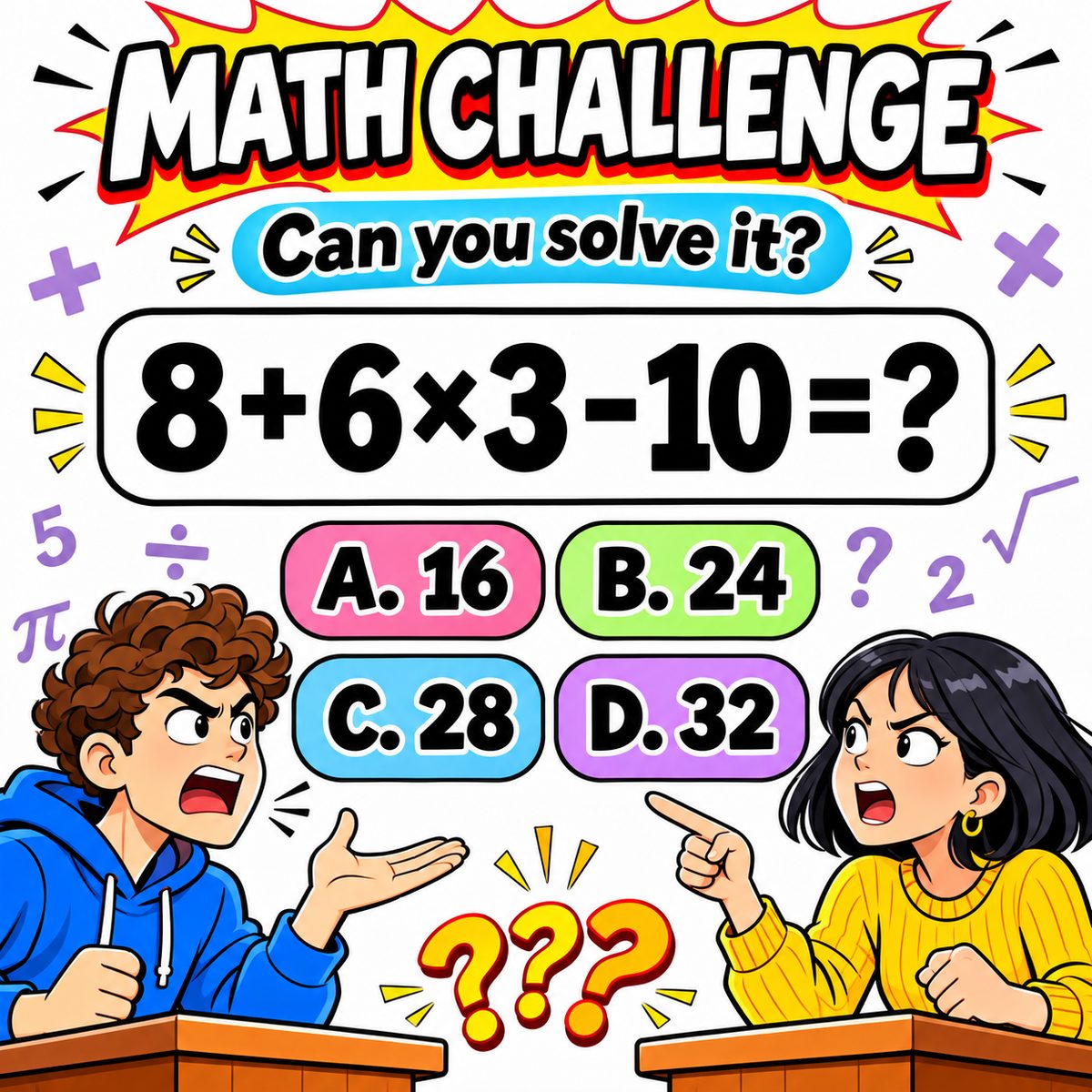
The problem appeared simple enough. Eight plus six times three minus ten. Four answer choices. Millions of people, many of them confident, many of them wrong. What began as a straightforward arithmetic puzzle became something far more revealing about how the human brain processes mathematical rules learned in school and quietly forgotten over time.
The equation is this: 8 + 6 × 3 − 10 = ?
Before reading further, consider the answer. Hold it. Because there is a very good chance it is incorrect.
The four options presented were A. 16, B. 24, C. 28, and D. 32. Each of those numbers is reachable through a different path. Only one of those paths follows the internationally accepted rules of mathematics. The others follow instinct, and instinct, in this case, is the wrong guide.
The rule at the center of this debate has two names, depending on where a person went to school. In the United States and much of the Western Hemisphere, it is taught as PEMDAS — Parentheses, Exponents, Multiplication, Division, Addition, Subtraction.
In the United Kingdom, Australia, and many Commonwealth nations, the same rule travels under the name BODMAS — Brackets, Orders, Division, Multiplication, Addition, Subtraction. The underlying logic is identical. The name is geography. The math is universal.
Both frameworks establish one foundational principle: multiplication and division must be resolved before addition and subtraction, regardless of where those operations appear in the written sequence. Left to right only serves as a tiebreaker when two operations of equal rank appear together. Multiplication outranks addition. That hierarchy does not bend for appearances.
This is where most people go wrong with 8 + 6 × 3 − 10.
The natural reading of any written sequence is left to right. It is how sentences work. It is how instructions are followed. It is how the brain defaults when no competing rule is active.
Applied to this equation, a left-to-right reading produces this calculation: 8 plus 6 equals 14, times 3 equals 42, minus 10 equals 32. That is answer D. It feels orderly. It feels correct. It is wrong.
A second common error produces answer B, 24. This occurs when a solver correctly identifies the multiplication but handles the subtraction too early, grouping 6 × 3 to get 18, then subtracting 10 to get 8, then adding the opening 8 to reach 16 — wait, that is actually correct. The path to B.
24 typically involves a mental regrouping error where the solver adds 8 and 6 to get 14, correctly multiplies 3, but then mishandles the final subtraction step, arriving at 24 through a combination of instinct and arithmetic error.
The specific path varies, but the result of choosing B reflects the kind of partial application of the rule that traps many solvers in the middle ground between guessing and calculating.
Answer C, 28, is typically produced when a solver treats the multiplication correctly but adds rather than subtracts the final term, or introduces a counting error in the final step. It represents the closest miss and, perhaps for that reason, is selected by people who are almost applying the rule but not quite completing it.
The correct path is strict and clean.
Step one: identify the highest-priority operation. In this equation, the only multiplication present is 6 × 3. No parentheses, no exponents. Multiplication is the ceiling. Resolve it first. 6 × 3 = 18.
Step two: rewrite the equation with that result substituted in. The equation becomes 8 + 18 − 10.
Step three: proceed left to right through the remaining addition and subtraction, which are equal in rank. 8 + 18 = 26. Then 26 − 10 = 16.
The answer is A. 16.
What makes this puzzle persistently viral — versions of it have circulated on social media platforms for over a decade — is not that it is mathematically complex. It contains no logarithms, no fractions, no variables.
Every number is a single digit or a round number. A ten-year-old with a solid arithmetic education should be able to solve it in under thirty seconds. The challenge is not cognitive load. The challenge is interference from pattern and habit.
Psychologists and mathematics educators have studied this category of error extensively. The phenomenon is sometimes described as a failure of “inhibitory control” in mathematical reasoning — the brain’s tendency to suppress a well-practiced automatic response in favor of a less automatic rule.
Reading left to right is so deeply ingrained that the order-of-operations rule, which overrides it, requires deliberate activation. Under time pressure, in casual scrolling conditions, or simply when confidence overrides verification, that deliberate step gets skipped.
The result is that educated adults — people who passed mathematics courses, who use numbers professionally, who would not describe themselves as poor at math — select the wrong answer and feel certain they are correct. This certainty is part of what sustains the debate in comment sections.
When someone selects D. 32 and encounters A. 16 as the stated answer, the first instinct is not to recheck the work. The first instinct is to assume the puzzle is wrong, or the answer key has an error, or the question is a trick designed to mislead.
It is not a trick. The question is entirely sincere.
The order of operations was not invented arbitrarily. It emerged as mathematical notation became standardized in the 16th and 17th centuries, as algebraic writing needed consistent rules so that equations written by one mathematician could be read unambiguously by another.
Without a shared hierarchy, an expression like 8 + 6 × 3 − 10 could mean fundamentally different things to different readers. The convention that multiplication precedes addition resolves that ambiguity. It is not a rule imposed by one culture or one curriculum. It is a convention adopted globally precisely because it works.
Some critics of these viral puzzles argue that the problem lies not with the solvers but with the notation. They point out that professional mathematicians and scientists rarely write equations in this format without additional parentheses to make the intended grouping explicit.
In formal mathematical writing, an expression intended to represent the PEMDAS-correct reading might be written as 8 + (6 × 3) − 10, eliminating any ambiguity at the source. This is a valid professional practice. It does not change the fact that the equation, as written, has one correct answer under universally accepted convention.
Others argue that the puzzle is designed to generate argument rather than to teach. That may also be true. Social media engagement is reliably produced by content that makes people feel they know something others do not, or that reveals a gap in knowledge they did not know they had.
A math puzzle that rewards the careful and embarrasses the hasty is ideally constructed for that dynamic. It spreads because people share it to prove they got it right, and because people who got it wrong want to argue that they did not.
Both motivations fill comment sections. Both drive reach. But the mathematics does not change based on the comment count.
What the puzzle does genuinely illustrate is the distance between knowing a rule and applying it. Most people who answer this equation incorrectly were taught PEMDAS or BODMAS at some point in their education. The rule is not obscure.
It is part of standard elementary and middle school curricula in virtually every country with a formalized mathematics program. The forgetting is not about the rule’s complexity. It is about the difference between procedural knowledge — knowing how to do something step by step — and automatic knowledge — doing it without thinking.
Procedural knowledge requires activation. When the brain sees an equation, especially one that looks simple, the temptation is to skip the procedural checklist and rely on automatic pattern-matching. For equations that happen to be left-to-right friendly, this produces the right answer by accident. For equations where operation hierarchy overrides sequence, it fails.
The lesson, such as there is one, is not that most people are bad at mathematics. It is that most people are human, and humans conserve cognitive effort. The workaround is mechanical and brief: before solving any equation, ask which operation is highest ranked. Answer that question first. Then proceed.
For 8 + 6 × 3 − 10, that question takes one second. The multiplication is there. It is first. 6 × 3 = 18. The rest follows without ambiguity, and the answer is 16.
Whether the people debating it in comment sections will accept that answer is, of course, a separate matter entirely.
