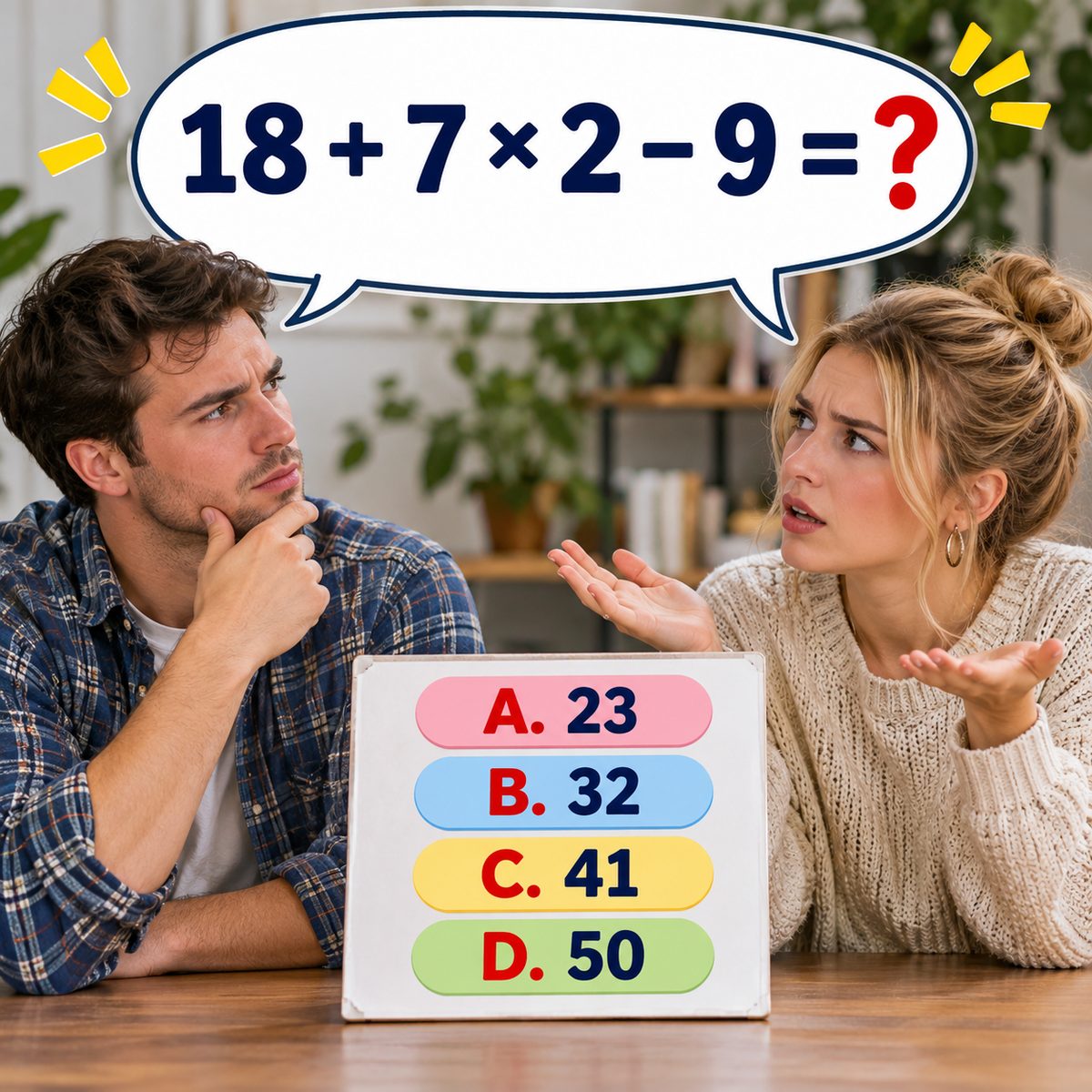
A single line of arithmetic. Four possible answers. No calculator required. Yet this problem — posted across social media platforms and shared in classrooms worldwide — has exposed a gap in mathematical understanding that most adults did not realize they had.
The equation is straightforward in appearance: 18 + 7 × 2 − 9. The answer choices are 23, 32, 41, and 50. What makes it deceptive is not the numbers themselves but the invisible rule that governs the order in which they must be calculated.
That rule has a name. It has been taught in every standard mathematics curriculum for over a century. And yet, when presented with this problem without warning, a significant portion of adults reach for the wrong answer.
The reason comes down to one principle most people learned in school and quietly forgot somewhere along the way.
The principle is called the order of operations. In the United States, it is commonly taught through the acronym PEMDAS — Parentheses, Exponents, Multiplication, Division, Addition, Subtraction. In the United Kingdom and many Commonwealth countries, the same rule is taught as BODMAS or BIDMAS. The labels differ. The underlying mathematics is identical.
The rule exists because arithmetic expressions are not simply read left to right like a sentence. Certain operations carry more weight than others and must be resolved first, regardless of where they appear in a sequence.
Multiplication and division outrank addition and subtraction. That hierarchy is not a convention someone invented arbitrarily — it emerged over centuries of mathematical development to ensure that expressions communicate a single, unambiguous value.
Without that hierarchy, the same string of numbers and symbols could yield multiple different results depending on who was reading it. Mathematical language would lose its precision. The order of operations is, in that sense, what keeps arithmetic from becoming a matter of interpretation.
Most students encounter PEMDAS somewhere between fourth and sixth grade. At that stage, the rule tends to feel mechanical — a procedure to follow on a worksheet rather than a concept with deeper significance.
It is memorized, applied to a test, and then, for many people, quietly shelved as life moves on to more pressing concerns than multi-operation equations.
The forgetting is gradual. It is also understandable. Adults who do not work in fields requiring regular mathematical reasoning may go years — sometimes decades — without encountering a situation that demands they consciously recall the order of operations. The rule fades not because it was never learned but because it was never reinforced.
Then a problem like 18 + 7 × 2 − 9 appears on a phone screen, and the gap becomes visible.
The most common wrong answer to this problem is 23. It arrives through a process that feels entirely logical to the person performing it. Working left to right, the way English text is read, the calculation proceeds as follows: 18 plus 7 equals 25.
Then 25 multiplied by 2 equals 50. Then 50 minus 9 equals 41. Some variants of this left-to-right approach produce 23 by handling the subtraction differently. Others land on 50. The specific wrong answer depends on which step the reader treats as primary.
What all incorrect approaches share is the same error: treating each operation as equally weighted and resolving them in the order they appear. It is a reasonable instinct.
Reading and language processing move left to right. The assumption that arithmetic follows the same pattern is not irrational — it simply conflicts with how mathematical notation actually works.
The correct method begins with identifying which operation in the expression holds the highest rank. In 18 + 7 × 2 − 9, that operation is multiplication. The term 7 × 2 must be resolved before anything else is touched.
Seven multiplied by two equals fourteen. The expression then simplifies to 18 + 14 − 9. From that point, addition and subtraction carry equal rank and are resolved left to right. Eighteen plus fourteen equals thirty-two. Thirty-two minus nine equals twenty-three.
The correct answer is 23, which corresponds to option A.
The irony is that 23 is also the number many people arrive at through incorrect left-to-right reasoning — but through a different sequence of steps.
Some who get 23 right are working the problem correctly. Others who get 23 right have made two errors that happened to cancel each other out. The matching answer conceals different levels of understanding.
This is part of what makes the problem an effective diagnostic tool. The answer alone does not confirm understanding. The process does.
Cognitive scientists who study mathematical reasoning have noted that errors in multi-operation problems tend to cluster around a small number of predictable mistakes. The left-to-right fallacy is the most common.
Close behind it is what researchers sometimes describe as the salience error — the tendency to perform the operation that appears largest or most prominent in a sequence before others, regardless of its actual rank.
In a problem like this one, addition appears first and involves the largest initial number. For some readers, that combination draws the eye and signals primacy.
The multiplication, tucked in the middle, is processed second when it should be processed first. The result is an answer that feels correct because the steps felt orderly, even though the order was wrong.
The salience error is not unique to mathematics. It reflects a broader pattern in human cognition — the tendency to assign importance based on position, size, or visual weight rather than on underlying rules. That pattern is useful in many everyday contexts. In arithmetic, it creates systematic errors.
Understanding where the mistake comes from does not eliminate it, but it does make it easier to guard against. When approaching any multi-operation expression, the first step is not to calculate — it is to scan.
Identify every multiplication and division sign in the expression before touching a single number. Resolve those operations first. Then return to addition and subtraction from left to right.
That sequence, applied consistently, produces the correct answer regardless of how the expression is arranged or how counterintuitive the order might feel.
For the specific problem at hand, the scan reveals one multiplication: 7 × 2. There is no division. There are no parentheses and no exponents. The resolution is therefore straightforward. Multiply first, then add and subtract from left to right. The answer is 23.
The other three options — 32, 41, and 50 — each represent a recognizable mistake. The value 23 appears through correct application of order of operations. The value 32 can be reached by performing addition first and then multiplication without completing the subtraction.
The value 41 arrives through a pure left-to-right calculation handled in one specific sequence. The value 50 appears when addition and multiplication are both handled before subtraction in a left-to-right pass.
None of the incorrect answers are random. Each one is the logical result of a consistent but flawed approach. That consistency is exactly why these problems resonate — wrong answers feel right to the people who get them because they were produced by a coherent internal process, not by careless error.
Educators who use problems like this one in classroom settings often report that the most useful moment is not the reveal of the correct answer but the discussion that follows.
Students who got it right and students who got it wrong frequently cannot articulate why their approach was correct or incorrect. The problem opens a conversation about mathematical structure that rote memorization of PEMDAS alone does not.
That conversation has value at any age. Adults who encounter this problem and find themselves uncertain — or who discover they reached the wrong answer — are not revealing a lack of intelligence.
They are revealing a gap in a specific procedural rule that may not have been revisited since middle school. The gap is common. It is also entirely closeable.
The order of operations is not a complex idea. It does not require advanced mathematical background or specialized training. It requires knowing that multiplication precedes addition, that this priority is non-negotiable, and that scanning an expression before solving it is not optional — it is the first step of the process.
Problems like 18 + 7 × 2 − 9 circulate widely because they tap into something specific: the collision between how arithmetic is formally structured and how the human mind naturally processes sequences.
That collision is not a flaw in the people who get the problem wrong. It is a feature of how cognition works, and it explains why the same types of errors appear across age groups, educational backgrounds, and national curricula.
The correct answer is 23. The more important takeaway is knowing why — and being able to apply that reasoning the next time a multi-operation problem appears without warning.