
FULL STORY
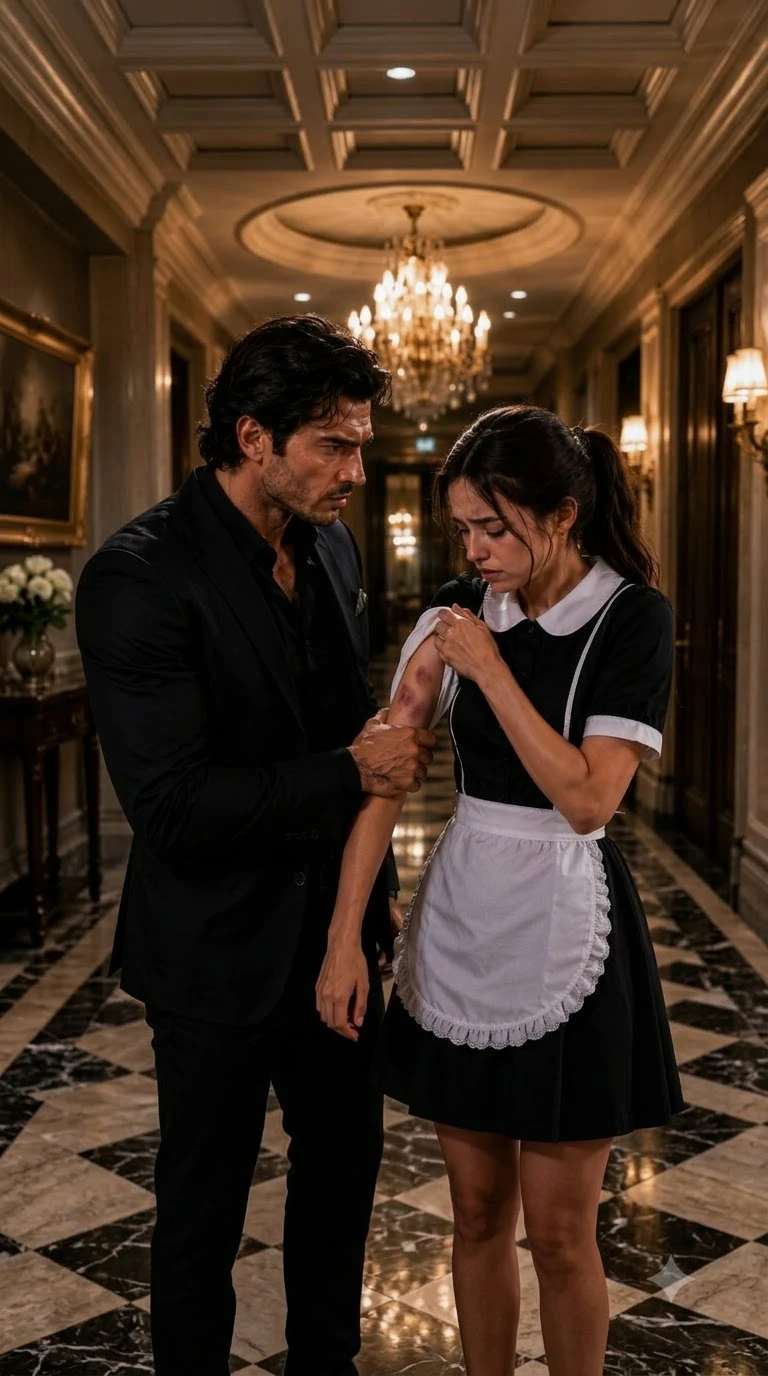
My sleeve caught against the corner of Rhett Malone’s bed at exactly 10:56 on a rainy Monday morning.
The cotton slid above my elbow.
The bruise appeared.
I yanked the sleeve down immediately, but the man standing inside the bedroom doorway had already seen the purple marks wrapped around my forearm.
He did not raise his voice.
Shouting would have been easier.
Instead, he stood inside the doorway wearing dark trousers and a gray shirt with the sleeves folded neatly to his elbows.
He watched me with a stillness that seemed to organize the room around him.
Rain had followed him in from the courtyard.
Several drops darkened one shoulder.
Behind him, the hallway smelled faintly of coffee and polished walnut.
“Who are you?”
I placed the pillow I had been straightening against the headboard.
“My name is Lena Karu.”
“I am Clara’s daughter.”
His eyes remained on my arm.
“My mother could not come to work today, so I am covering her shift.”
“Why could Clara not come?”
“She injured her wrist.”
“How?”
“She fell.”
He looked at my face then.
Not at the bruise.
At me.
“And you?”
“I fell too.”
The lie entered the room smoothly.
I had spent three years inside nursing school learning how to remain calm while blood soaked through gauze.
While families demanded answers no physician could give.
While terrified patients tried bargaining with diagnoses.
Lying to one man should have been easier.
It was not.
Rhett closed the bedroom door.
He did not lock it.
That detail mattered.
“Come here.”
“I need to finish the room.”
“The room will survive.”
His voice stayed level.
“I will not touch you.”
“Come closer so I can see your arm.”
“I said I am fine.”
“I heard you.”
He crossed toward the chair near the tall windows and sat.
Several feet of open carpet remained between us.
“Stay there, then.”
“Lift your sleeve.”
I did not move.
Rain tapped against the windows behind him.
The clock on the mantel marked each second with a dry click.
The bedding smelled of cedar and starch.
One corner of the comforter remained imperfect because I had turned too quickly when he entered.
His eyes moved toward that corner.
Then back to me.
“Lena.”
There was no threat inside the way he said my name.
That made refusing more difficult.
I pushed my sleeve upward.
The bruise began near my wrist and spread almost to my elbow.
Yellow-green discoloration marked the edges.
The center remained dark.
Four distinct oval shadows showed where fingers had pressed into my skin.
Rhett examined it silently.
“That is the shape of a hand.”
My throat tightened.
“I caught my arm inside a bus door.”
“No.”
“I have a nursing degree.”
“I know what a serious injury looks like.”
“So do I.”
Something inside his response made me pause.
He leaned back slightly.
“Your mother has worked inside this house for twelve years.”
“She arrived last Tuesday wearing a scarf in July.”
“On Thursday, she used the service elevator because the main staircase hurt her ribs.”
“Yesterday, she told my household manager that she had influenza.”
I remained silent.
“She has never lied about being ill.”
“She was not lying.”
“No.”
“She lied about the cause.”
He rested one ankle over the opposite knee.
“Who did this?”
“I already told you.”
“You told me that both you and your mother fell during the same week.”
“It has been a clumsy week.”
He did not smile.
The silence stretched until I became aware of every breath I took.
The wet hem of my jeans.
The faint tremor inside the hand holding my sleeve.
I looked away first.
That annoyed me.
“His name is Boyd Sutter.”
Rhett did not move.
“He is my mother’s husband.”
“How long have they been married?”
“Seven years.”
“How long has he been hurting her?”
“I do not know.”
That was the first honest answer I gave him.
I had returned from Pittsburgh the previous morning after completing nursing school.
The bus entered Brooklyn at 6:47 beneath a low gray sky.
I pressed my forehead against the glass while familiar streets tightened something behind my ribs.
Three years away.
Three years of clinical rotations, night shifts, textbooks, cafeteria coffee, and Sunday calls during which my mother always claimed she was fine.
I wanted to believe distance had changed the house.
It had not.
Boyd opened the front door wearing a white undershirt and the same expression he always used when my existence inconvenienced him.
“Look who remembered where she lives.”
I ignored him.
My mother stood at the end of the hallway with one hand pressed against the wall.
The left side of her face was swollen.
A bruise stretched from her cheekbone to her jaw.
She wore long sleeves despite the July heat.
“Mom.”
Her smile was practiced.
“Baby, you are home.”
I took both her hands.
She flinched.
“How serious is it?”
“I am fine.”
“How serious?”
Her eyes moved toward the kitchen.
“Two ribs, perhaps.”
“My wrist.”
“Did he do this?”
“Lena.”
“Did he?”
Boyd appeared inside the kitchen doorway.
“Your mother slipped.”
I faced him.
He smiled.
“Apparently clumsiness runs inside the family.”
I did not yet understand what he meant.
Then I noticed the envelope resting on the kitchen table.
Malone Estate—Household Access Schedule.
My mother’s handwriting covered the front.
Boyd followed my gaze.
“Private paperwork.”
“That belongs to her employer.”
“It belongs inside this house until she carries it out.”
I reached for the envelope.
He seized my wrist.
Hard.
His thumb dug into the inside of my arm.
His fingers closed around the outside.
I told him to release me.
He leaned closer.
“You have been home for ten minutes.”
“Do not make your mother’s life more difficult before breakfast.”
I drove my heel into his foot.
He released me.
The bruise formed before noon.
My mother cried.
Not because he grabbed me.
Because I had finally seen the machinery of her life without the careful words she had used to soften it.
I wanted to take her to a hospital.
She refused.
“If I miss another shift, Mr. Malone may believe I quit.”
“You have broken ribs.”
“I need that job.”
“You need an X-ray.”
“I need both.”
The answer made me angry because it was true.
So I took her shift.
Standing inside Rhett Malone’s bedroom, I told him enough of the story to make the air colder.
“He grabbed me when I attempted to take an envelope.”
“What envelope?”
“One containing your estate schedule.”
The first visible change entered his face.
Small.
Immediate.
“Why did Boyd have it?”
“I do not know.”
“Where is it now?”
“It was still on the kitchen table when I left.”
“What was inside?”
“I did not open it.”
“Did your mother prepare it?”
“Her handwriting was on the envelope.”
Rhett stood.
I stepped backward.
He stopped immediately.
“I told you I would not touch you.”
“I know.”
“Do you?”
I hated the question because the answer was no.
Not yet.
He walked toward the bedroom door.
“Do not finish anything.”
“Come downstairs.”
“What are you planning to do?”
“Call your mother.”
“Why?”
“To ask what she wants.”
The answer was so different from what I expected that I followed him.
Rhett did not take me to his study.
He chose the kitchen.
Rain-dimmed daylight entered through the windows above the long oak table.
A black coffee mug stood beside handwritten reports.
The room smelled of bread, rosemary, and coffee.
A man named Decker Shaw waited near the rear door.
He had admitted me through the gate that morning.
Compact.
Dark-haired.
Unreadable.
He carried himself like a man who had spent years entering rooms only after determining how he would leave them.
Rhett pointed toward a chair.
I remained standing.
He did not argue.
“Call Clara,” he told Decker.
“Use the house telephone.”
“Speaker only if she consents.”
Decker dialed.
Boyd answered.
“Who is this?”
“Decker Shaw.”
“I am calling on behalf of Clara Karu’s employer.”
“She is sick.”
“I need to speak with her directly.”
“She is sleeping.”
A quiet voice came through in the background.
“I am awake.”
Boyd imperfectly covered the receiver.
My mother said something.
A chair scraped.
Then she came onto the line.
“Mr. Shaw?”
“Clara, Mr. Malone is here.”
“Lena is with us.”
“Are you able to speak privately?”
A pause followed.
“No.”
Rhett looked toward me.
“Do you want us to contact emergency services?” he asked loudly enough for her to hear.
Boyd’s voice sharpened.
“This is a private family matter.”
My mother breathed into the telephone.
Rhett repeated the question.
“Clara, do you want medical help?”
“Yes.”
The word was barely audible.
It was sufficient.
Decker reached for another telephone.
Rhett leaned toward the speaker.
“Do you want to leave the house?”
Another silence.
Then my mother answered.
“Yes.”
Boyd began speaking over her.
“She is confused.”
“Her daughter returned and upset her.”
“No one is taking my wife anywhere.”
Rhett’s voice did not rise.
“Clara answered for herself.”
“You believe because you employ her—”
“No.”
“I believe because she is an adult.”
He turned toward Decker.
“Police and ambulance.”
“Neutral transport.”
“No Malone vehicle until officers arrive.”
That surprised me.
“Why neutral transportation?”
“So Boyd cannot claim she was removed by my people.”
Rhett looked back toward the telephone.
“Clara, collect your identification and medication if you can do so safely.”
“Do not confront him.”
“Officers are on the way.”
Boyd laughed.
“You are making this larger than it is.”
I had heard that sentence before.
Different apartments.
Different bruises.
The same purpose.
Rhett reached toward the receiver.
“No,” I said.
He stopped.
“If you threaten him, the situation becomes about you.”
His eyes held mine.
“What do you recommend?”
“Keep him talking.”
“Let the recorded line preserve what he says.”
Something shifted inside Decker’s expression.
Approval.
Rhett slid the telephone toward me.
I picked it up.
“Boyd.”
“You caused this.”
“No.”
“I came home.”
“You attacked me.”
“You grabbed my arm.”
“You attempted to steal private documents.”
“What documents?”
He stopped.
The silence changed.
I looked toward Rhett.
“What was inside the envelope, Boyd?”
“Ask your mother.”
“Did you copy the estate access schedule?”
“Your mother brings documents home.”
“That is not my problem.”
“Did someone pay you for them?”
The line became silent.
Rhett watched me.
I had asked the question without knowing exactly where it came from.
Perhaps the envelope.
Perhaps the way Boyd protected it more fiercely than his wife.
“Who paid you?”
Boyd ended the call.
Decker preserved the recording immediately.
“No more direct contact,” he said.
“The recording goes to counsel.”
“Whose attorney?” I asked.
“Clara’s,” Rhett said.
“My mother does not have an attorney.”
“She will be offered one who does not represent me.”
He reached toward his telephone.
“Not paid by you,” I said.
Rhett looked up.
“You object to the source of payment?”
“I object to debt disguised as rescue.”
The kitchen became still.
Decker cleared his throat.
“I know a domestic-violence legal clinic supported through the city bar association.”
“Independent intake.”
“No connection to any Malone company.”
“Call them,” Rhett said.
No irritation.
No wounded pride.
He changed direction because the objection was valid.
That was the first thing about him I did not know how to categorize.
Police transported my mother to Brooklyn General Hospital.
Rhett did not enter the emergency department.
Neither did Decker.
They remained inside the public lobby until an advocate confirmed my mother wanted me present.
Dr. Nina Patel examined her.
Two cracked ribs.
A hairline fracture inside the wrist.
Older bruising across her back.
New bruising near her jaw.
With my mother’s consent, the hospital photographed every injury and documented the estimated age of each mark as accurately as medicine allowed.
A social worker named Maya Ortiz arrived carrying a canvas bag, red reading glasses, and two protein bars.
She was fifty.
Direct.
She had spent twenty years representing people whose partners believed marriage or money created ownership.
She gave one protein bar to me.
“I am not hungry.”
“Documentation first.”
“Feelings after food.”
“I may become sick.”
“Then become sick with protein.”
My mother almost smiled.
Maya sat beside the bed.
“Clara, I represent you if you want me to.”
“Not your daughter.”
“Not Mr. Malone.”
“You.”
My mother’s fingers tightened over the hospital blanket.
“What will it cost?”
“Nothing.”
“The clinic is independently funded.”
She looked toward me.
Then back at Maya.
“I want help.”
Maya opened a legal pad.
“Good.”
“We begin with what you want.”
“Not what everyone else wants done to him.”
By evening, Maya filed for an emergency protective order.
Police collected my mother’s initial statement.
A neighbor provided doorbell footage showing Boyd pushing her against an exterior wall three nights earlier.
The recording did not capture everything.
It captured enough.
Officers recovered her identification, medication, clothing, and employment documents through a civil standby.
They photographed the envelope on the kitchen table before taking it as potential evidence connected to assault and suspected theft of business information.
Boyd was arrested the following morning.
The charges included domestic assault and violation of an earlier municipal order involving another woman.
An order my mother had never known existed.
He posted bond.
The judge prohibited him from contacting either of us.
No dramatic disappearance.
No body hidden inside an alley.
A written court order.
An ankle monitor.
A door he could no longer legally approach.
My mother did not return to the apartment.
She accepted a temporary room on the third floor of the Malone estate only after Maya negotiated every condition in writing.
No rent debt.
No requirement to continue working during recovery.
No confidentiality agreement.
No monitoring inside the room.
A lock my mother controlled.
The address could be disclosed to her lawyer, physician, and police.
Rhett signed each condition.
Maya read the agreement twice.
Then tapped the final page.
“A boundary is not cruelty, Mr. Malone.”
“I did not suggest otherwise.”
“You appeared offended by clause seven.”
“Clause seven says I cannot place guards outside Clara’s door without consent.”
“Correct.”
“This estate has security requirements.”
“Security may remain at the estate perimeter.”
“A frightened woman does not need another man deciding which doors she may open.”
Rhett signed beside the clause.
“I understand.”
Maya looked toward me.
“He may be trainable.”
“Do not encourage him.”
My mother arrived at the estate carrying one small suitcase.
I reached the car before it completely stopped.
Her face looked older than it had two days earlier.
Safer too.
The difference was subtle.
Pain remained.
But she no longer watched every doorway as though anger might enter through it.
“I am sorry,” she said while I helped her out.
“For what?”
“For bringing you home to this.”
“You did not bring me.”
“The bus company did.”
“Lena.”
“No.”
I placed one arm around her shoulders, careful of the cracked ribs.
“Not tonight.”
The third-floor room contained pale walls, a deep-blue chair, and a window overlooking the enclosed garden.
Fresh bedding covered the bed.
I had arranged it myself.
My mother touched the folded blanket.
“You made the wrong corner.”
I stared at her.
She smiled.
It was the first real smile I had seen since returning home.
Then she sat and began to cry.
Quietly.
Not because she missed Boyd.
Because there was finally enough safety for her body to stop performing endurance.
I sat beside her.
We did not discuss forgiveness.
We discussed medication schedules.
Follow-up imaging.
The protective order.
Whether she wanted the curtains open.
Practical matters.
Practical matters kept us inside the room.
Three days later, I discovered the red ledger.
I was returning clean sheets to a linen closet near the old servants’ staircase when a false wooden panel shifted beneath my hand.
Behind it was a narrow compartment.
A book wrapped inside a dish towel rested there.
Red leather.
Worn corners.
My mother’s handwriting filled the first page.
Household Service Log—Malone Estate.
The entries began twelve years earlier.
Repair workers.
Delivery drivers.
Temporary employees.
Vehicle plates.
Keys issued and returned.
Rooms entered after working hours.
My mother maintained a parallel paper record separate from the estate’s electronic system.
At first, the entries were ordinary.
Boiler service.
Florist delivery.
Kitchen maintenance.
Then six months earlier, a pattern changed.
Several entries were underlined.
Barton Safety Consulting.
The company had entered the estate seven times without appearing on the official contractor list.
Every visit occurred while Rhett was away.
The same black van arrived.
The same partial registration appeared.
Three entries included Boyd’s name inside the margin.
“Boyd asked about Tuesday study rule.”
“Boyd photographed east-gate schedule.”
“Boyd demanded spare service key.”
“Refused.”
The final entry had been written four days before my return.
“Boyd found ledger.”
“Took envelope.”
“Wants original access codes.”
“Said someone will pay enough for us to leave Brooklyn.”
Beneath it, my mother had added:
“He believes I am afraid of losing the house.”
“I am afraid of what he will do when I refuse.”
My hands became cold.
I did not carry the ledger directly to Rhett.
I photographed it where I found it.
Called Maya.
Asked Decker to witness its removal.
We sealed it inside an evidence bag and produced copies before reading further.
Rhett watched from the doorway.
“You do not trust me with the original.”
“I do not trust anyone with the only original.”
“Good.”
His response irritated me.
“You cannot approve every time I disagree with you.”
“I can when you are correct.”
“What happens when you believe I am wrong?”
“I say so.”
“Comforting.”
“It was not intended to be.”
Maya examined the ledger at the kitchen table.
“Clara created this for household administration?”
“My late husband believed electronic systems could be altered,” my mother said.
“He told me a house remembers through paper.”
Rhett looked at her.
“You never told me you kept a separate record.”
“You never asked how I knew when vendors lied.”
He accepted the correction.
Decker cross-referenced the vehicle numbers.
Barton Safety Consulting was a shell corporation.
Its registered manager was a former dock supervisor named Owen Carver.
Owen’s older brother, Vincent Carver, controlled a shipping organization that had spent eight months attempting to gain access to a port route controlled by Malone businesses.
“Boyd was selling schedules,” Decker said.
My mother shook her head.
“Not at first.”
“What did he sell initially?” Maya asked.
“Photographs.”
“Of what?”
“My work notebook.”
“Rhett’s study door.”
“The western service gate.”
“He claimed it was harmless.”
“Did you consent?”
“No.”
“When did he start hurting you?”
My mother looked toward the ledger.
“When I stopped bringing documents home.”
The second source of evidence came from a tablet registered under my mother’s name.
She and Boyd had purchased it jointly for paying bills.
Boyd used it more often, but her cloud account remained connected.
Maya obtained written consent before anyone examined the backup.
No secret intrusion.
No private security men breaking passwords.
A forensic technician copied the account through documented procedure.
Deleted photographs returned.
Estate schedules.
Rhett’s travel dates.
Security placement.
A photograph of my acceptance email to the Mount Sinai physician-assistant program.
It had been taken from my mother’s telephone while she slept.
Messages between Boyd and a contact saved as VC appeared.
“Need study access Tuesday.”
“Girl back from Pittsburgh.”
“Could be useful.”
“Mother refusing.”
“Increase pressure.”
One message arrived on the night before I replaced my mother at work.
“Get Clara’s red ledger.”
“It identifies every contractor we placed inside Malone’s house.”
Boyd replied:
“She hid it.”
VC answered:
“Then give her a reason to remember.”
The bruises acquired another meaning.
Boyd had not hurt my mother only because cruelty had become routine.
He was attempting to retrieve a record capable of exposing Carver’s people inside the estate.
Rhett read the messages once.
Then placed both hands flat against the kitchen table.
The tendons stood out along his wrists.
“What are you going to do?” I asked.
“Remove every Carver contractor from the property.”
“And Boyd?”
“He is already before the courts.”
“What about Carver?”
Rhett kept his eyes on the screen.
“That requires care.”
“What does that mean?”
“Vincent Carver will expect private retaliation.”
“If I react that way, he destroys devices, moves money, and claims the messages were fabricated.”
Maya peered over her red glasses.
“You sound almost lawful.”
“I have lawyers.”
“That is not the same thing.”
Rhett’s mouth tightened.
“No.”
He turned toward Decker.
“Outside counsel.”
“Federal port-corruption task force.”
“Give them copies with complete chain-of-custody records.”
“Do not warn our board until all evidence is secured.”
Decker nodded.
“What about the contractors?”
“Suspend their access for a neutral security review.”
“No accusations.”
I studied Rhett.
“You are not going after him?”
“I am going after the thing he values.”
“What is that?”
“Control.”
He closed the tablet.
“Control survives anger.”
“It does not survive records.”
That evening, I found him reading a pharmacology textbook.
The book lay open on the kitchen table beside untouched black coffee.
Notes crowded the margins.
Some had been written five years earlier.
Others had been added recently using darker ink.
“You read pharmacology for entertainment?”
He looked upward.
“No.”
“Punishment?”
“Possibly.”
I stepped closer.
The chapter covered receptor interactions.
Third edition.
Outdated diagrams.
“This textbook is terrible.”
“I noticed.”
“Why are you reading it?”
“I studied medicine.”
The answer stopped me.
“For how long?”
“Three years.”
“What happened?”
“My father died.”
“The organization required someone to assume control.”
“You abandoned medicine to become a mafia boss.”
“That is the version preferred by newspapers.”
“What version do you prefer?”
“I inherited criminal operations and legitimate businesses connected so tightly that abrupt separation would have cost thousands of jobs and several lives.”
“That is a polished sentence.”
“Attorneys have reviewed it.”
“Was it true?”
“Yes.”
“All of it?”
“No.”
His honesty arrived without decoration.
I pulled out the chair across from him.
“Which section is causing trouble?”
He studied me.
“You have slept four hours each night.”
“I asked about the chapter.”
“Allosteric modulation.”
“The diagram is incorrect.”
“You said that already.”
“The fifth edition corrected it.”
“Do you possess the fifth edition?”
“Digitally.”
“Show me.”
I explained the mechanism using the same lock-and-key comparison my best professor used during nursing school.
Rhett interrupted twice with questions precise enough to prove that he remembered more than he admitted.
When I finished, he looked down at the page.
“That explanation is better than the book.”
“I know.”
“Modest.”
“Accurate.”
He wrote my explanation inside the margin.
That became our first ordinary evening.
No bruises.
No police.
No corruption investigation.
Only a textbook, cold coffee, and the strange realization that Rhett Malone listened when I spoke about medicine as though the answer mattered more than the person giving it.
My acceptance letter arrived nine days later.
I opened it on the third-floor landing at 7:14 in the morning.
Mount Sinai’s physician-assistant program.
Full admission.
Classes beginning in September.
For one minute, I felt only happiness.
Then tuition appeared inside my thoughts.
Housing.
My mother’s recovery.
The four hundred twelve dollars inside my savings account.
Joy did not disappear.
It became complicated by arithmetic.
My mother found me inside the kitchen staring at the message.
“You have the face.”
“What face?”
“The one where something good happens and you immediately calculate it into a problem.”
I handed her the telephone.
She read the email.
Covered her mouth with one good hand.
Then pulled me into an embrace.
“I am so proud of you.”
I allowed her to hold me.
Twenty-three seconds.
Then practicality returned.
“I cannot afford it.”
“We will find a way.”
“It is not a small amount.”
“Today belongs to happiness.”
“Tuition may ruin tomorrow.”
Rhett entered through the rear hallway.
My mother turned toward him.
“She was accepted.”
He looked at me.
“Mount Sinai?”
“Yes.”
Warmth crossed his face.
Controlled.
Real.
“When did you apply?”
“Three weeks before returning home.”
“You told no one.”
“I did not want to explain if I failed.”
“You did not fail.”
“Tuition may correct that.”
“There are fellowships.”
“I checked.”
“Hospital sponsorships.”
“I checked those too.”
“Your mother’s employment agreement includes an education benefit for immediate family members.”
I looked at him.
“Since when?”
“Four years ago.”
My mother blinked.
“I have never used that.”
“You never required it.”
“You added the benefit when I started nursing school.”
Rhett picked up his coffee.
“Clara mentioned that you were interested in medicine.”
“You created an education provision inside a maid’s contract for a daughter you had never met.”
“Clara is not merely a maid.”
My mother narrowed her eyes.
“I am absolutely the person who cleans your house.”
“You also manage the household.”
“Staff access.”
“Vendors.”
“Inventory.”
“Every repair schedule.”
“Then change my title.”
Rhett looked toward Decker, who had entered behind him.
“Do that.”
My mother stared.
“I was joking.”
“Poorly.”
I faced him again.
“I will not accept personal money.”
“It is not personal.”
“It is a documented employment benefit.”
“It is still connected to you.”
“Then apply for the independent fellowship first.”
“Use the contractual benefit only if necessary.”
That mattered.
He did not demand gratitude.
He provided an option and left the decision with me.
I submitted the fellowship application that night.
The threat from Carver arrived the next morning.
Rhett received the call inside his study at 8:03.
Eleven minutes later, he entered the kitchen holding a mug he was not drinking from.
“What happened?”
“Vincent Carver identified you.”
My body became still.
“In what context?”
“As leverage.”
The word landed cold.
“He knows your name.”
“Nursing certification.”
“Admission.”
“Connection to this estate.”
“How?”
“Boyd’s messages.”
“Surveillance.”
“Possibly someone still inside our systems.”
“What does Carver want?”
“Access to the southern shipping route.”
“And if you refuse?”
“He suggested that people near me become unsafe.”
My mother entered behind us.
Rhett repeated the information without softening it.
That was another difference between him and Boyd.
Boyd withheld information to create helplessness.
Rhett gave us facts even when they frightened us.
“I need both of you to relocate temporarily,” he said.
“No.”
He stopped.
My mother looked toward me.
“Lena.”
“No.”
“We discuss the actual threat and available plans.”
“We do not pack simply because a man named a danger.”
“This is not Boyd.”
“I know.”
“Carver has resources.”
“So do you.”
“So does law enforcement.”
“Tell me what needs to happen.”
“Not where you want to remove us.”
Rhett studied me.
“I need Carver to understand that targeting you achieves nothing.”
“Does he believe you possess a personal interest in my safety?”
“Yes.”
“Is he mistaken?”
Silence.
Decker looked out the window.
My mother became fascinated by the teapot.
Rhett answered carefully.
“That is not the operational issue.”
“It affects the operation.”
“It does not alter your rights.”
“No.”
“It changes whether you may be tempted to decide for me.”
The statement struck him.
I saw it.
Then he nodded.
“Fair.”
“What is your plan?”
He explained everything.
A controlled meeting with Carver inside a private-club dining room under federal observation.
Rhett would reject the port demand.
Carver would be informed that copies of the ledger and tablet evidence were already held by investigators and independent attorneys.
No secret bargain.
No isolated confrontation.
A secondary evacuation plan existed if Carver moved against the estate.
Two independent security teams would protect the perimeter.
Our telephones would remain with us.
No one would track my movements outside the agreed emergency protocol.
I asked Decker to explain the secondary plan.
He answered each question.
Vehicle.
Route.
Hospital contact.
Police liaison.
A safe apartment controlled by Maya’s clinic rather than Rhett.
“How long?” I asked.
“As few days as possible,” Decker said.
“Who decides when we return?”
“You and Clara.”
“After receiving the updated threat assessment.”
Rhett had learned quickly.
Or perhaps he had always understood boundaries and had simply never been required to speak their language.
Before leaving for the meeting, he found me inside the front hall.
“I will contact you when it ends.”
“You mean Decker will contact me.”
“No.”
“I will.”
“Do not call while driving.”
“I have a driver.”
“I know.”
“That was medical advice.”
His eyes moved toward my arm.
The bruise had faded to yellow.
“Understood.”
Carver agreed to meet because he believed Rhett was frightened.
He arrived with an attorney.
Two men remained outside.
Federal agents recorded the conversation under authorization connected to the extortion case.
Rhett’s attorney attended.
Carver never openly confessed.
Men like him rarely did.
He said access to the south route would “resolve future safety concerns.”
He referred to my education as “a promising investment Rhett would not want interrupted.”
He claimed Boyd acted independently.
Then Rhett placed a copy of the red ledger on the table.
Carver’s attorney stopped writing.
“This ledger identifies seven shell contractors connected to your operation,” Rhett said.
“The original is already with law enforcement.”
Carver smiled.
“A housekeeper’s notebook.”
“Supported by electronic access logs.”
“Vehicle registrations.”
“Payments.”
“And direct messages between your contact and Boyd Sutter.”
“You are overreacting to domestic drama.”
“No.”
Rhett’s voice remained calm.
“You mistook a woman’s silence for permission.”
“Boyd made the same mistake.”
Carver leaned backward.
“What do you want?”
“No contact with Clara or Lena.”
“No surveillance.”
“No contractors approaching the estate.”
“No approach to the hospital or Mount Sinai.”
“And the port?”
“Not yours.”
Carver’s smile disappeared.
“You are risking a great deal for a maid’s daughter.”
Rhett looked at him.
“She is not a weakness inside my judgment.”
“What is she?”
“The clearest proof I still possess one.”
The meeting ended without agreement.
That had been expected.
Thirty minutes later, Carver’s attorney contacted federal prosecutors and requested formal negotiations.
Records had made the threat expensive.
Rhett returned shortly after two.
I heard his vehicle and reached the front hall before Decker opened the door.
Rhett looked toward me from across the courtyard.
“Finished.”
“What does finished mean?”
“Carver withdrew his demand through counsel.”
“His organizations received preservation orders.”
“Several accounts were frozen.”
“Will he obey?”
“Because he suddenly became honorable?”
“No.”
“Because violating the agreement strengthens the charges he is attempting to reduce.”
That answer I trusted.
Boyd retaliated publicly.
A tabloid website published an interview in which he claimed the Malone organization kidnapped his wife and seduced his stepdaughter with money.
He displayed photographs of my mother entering the estate.
He described me as Rhett’s “new personal employee.”
He claimed the bruise on my arm came from a bus accident.
He said I attacked him when he tried helping me.
Carver’s communications consultant circulated the story.
It spread for three days.
My nursing classmates saw it.
Mount Sinai’s admissions department requested a meeting.
I wanted to release every document.
Maya stopped me.
“We are not litigating a domestic-violence case inside comment sections.”
“He is calling my mother unstable.”
“The hospital records, protective order, and court file will answer where answers are necessary.”
“What about the school?”
“You attend with counsel.”
“You provide relevant evidence.”
“Nothing more.”
Mount Sinai reviewed the protective order and my clean professional history.
The admissions director asked whether security concerns might affect patients.
“I have an independent safety plan.”
“I do not expect the institution to conceal or manage my personal circumstances.”
“Are you romantically involved with Mr. Malone?”
“No.”
The answer remained true.
“Do you live at his estate?”
“Temporarily.”
“Under a written protection agreement negotiated by independent counsel.”
“Did he influence your admission?”
“No.”
I supplied the original application timestamps and committee records.
The school found no reason to withdraw the offer.
Two weeks later, the fellowship committee granted full tuition and a living stipend.
Rhett had ensured only that my delayed application received standard review.
He never contacted the selection committee.
I made Maya verify that twice.
“You earned this,” she said.
“I know.”
“Say it without sounding suspicious.”
“I earned it.”
“Better.”
Boyd’s criminal case continued.
The neighbor’s recording authenticated one assault.
Medical records documented others.
The recovered tablet messages proved that he attempted to coerce my mother into obtaining estate information.
He pleaded guilty to aggravated domestic assault, unlawful surveillance, coercion, and conspiracy connected to the Carver information scheme.
The judge sentenced him to prison.
Ordered restitution for medical expenses.
Issued a permanent protective order.
The landlord terminated the apartment lease because of criminal activity.
My mother received the documented value of her share of the household property.
She did not take the furniture.
She kept photographs.
Her sewing machine.
Clothing.
And the blue ceramic bowl that had rested beside our front door throughout my childhood.
“Why the bowl?”
“Keys should have a place.”
Carver’s case required more time.
Investigators traced payments from shell contractors to Boyd and to a compromised facilities supervisor at the Malone estate.
The supervisor admitted providing maintenance schedules and access codes.
No one vanished.
No one was found dead.
The charges included extortion conspiracy, illegal surveillance, bribery, money laundering, and attempted interference with interstate commerce.
Carver accepted a plea after every effort to discredit the messages, ledger, and financial records failed.
His businesses forfeited the port contracts obtained through bribery.
He received a federal sentence.
He was prohibited from port operations for years.
Rhett’s companies did not escape investigation.
Auditors discovered cash payments, unlicensed loans, and protection arrangements inherited from his father but continued beneath Rhett’s leadership.
He could have blamed the dead.
He did not.
He entered a cooperation agreement.
Forfeited illegal assets.
Closed two clubs.
Placed Malone Shipping under independent compliance monitoring.
Accepted three years of supervised restrictions without imprisonment because he had no violent conviction and provided substantial evidence against Carver.
Some men left him.
Decker remained.
“You are dismantling everything,” one senior lieutenant said during a meeting I overheard from the kitchen corridor.
“No,” Rhett replied.
“I am separating what survives daylight from what depends on darkness.”
“And if nothing survives?”
“Then nothing deserved to.”
The answer cost him money.
Influence.
Relationships.
It also made the estate quieter.
Four months later, my mother moved into her own apartment.
Not because Rhett asked her to leave.
Because she wanted one door belonging entirely to her.
Maya located a rent-controlled unit near Prospect Park.
My mother signed the lease in her own name.
On the first evening, we placed the blue ceramic bowl on a narrow table beside the entrance.
Two keys rested inside it.
Hers.
Mine.
No key for Boyd.
No key for Rhett.
My mother continued working at the Malone estate.
Her title became household operations manager.
Her salary and responsibilities were rewritten to reflect the work she actually performed.
She received paid medical leave.
Independent health insurance.
Authority over vendors without routing concerns through a family office.
Every Tuesday, she attended therapy.
At first, she called it “speaking to Maya’s friend.”
By winter, she called it therapy.
Our relationship changed too.
We stopped pretending Sunday telephone calls had been enough.
Sometimes I blamed her for keeping the truth from me.
Sometimes she blamed herself for allowing fear to become our family’s language.
We apologized specifically.
Not endlessly.
Specific apologies could receive answers.
General shame could not.
I began the physician-assistant program in September.
On my first day at Mount Sinai, I carried a new notebook, my nursing certificate, and the knowledge that most people inside the lecture hall had not recently testified before a grand jury about port extortion.
That helped maintain perspective.
My schedule became brutal.
Lectures.
Laboratory work.
Clinical preparation.
Hours of reading that made nursing school feel introductory.
I moved into a small studio near the hospital.
The fellowship paid for it.
I did not live at the Malone estate.
Rhett and I met at the kitchen table twice each week.
Pharmacology on Wednesdays.
Dinner with my mother on Sundays.
He began preparing a petition to return to medical education.
His original institution had dismissed him administratively after he left.
He had no criminal conviction preventing reentry.
But his associations, financial history, and long absence required a complete character review.
He disclosed everything.
The legitimate companies.
The illegal operations.
The cooperation agreement.
Why he left medical school.
Why he wanted to return.
I did not write a letter describing him as misunderstood.
I wrote only what I could verify.
He studied consistently.
Accepted correction.
Never asked me to lie.
Eighteen months later, the medical board approved a supervised reentry route.
When the letter arrived, Rhett left it unopened on the kitchen table for three days.
I found him staring at it.
“Open the letter.”
“I have considered not doing so.”
“That would be inefficient.”
“I am aware of your opinion concerning inefficiency.”
“Open it.”
He did.
He read the first paragraph.
Then placed the page down.
“Well?”
“They approved the petition.”
My mother stood at the stove.
She briefly closed her eyes.
Decker looked into the room from the doorway.
No one cheered.
A committee’s decision had not transformed Rhett into another man.
It had only permitted him to attempt difficult work.
That was enough.
“Attend the placement meeting,” I said.
He looked toward me.
“I will.”
Our relationship became romantic slowly enough to disappoint anyone who preferred dramatic stories.
The first time Rhett invited me to dinner, I refused.
I had an examination.
The second time, I accepted.
A public restaurant.
No private dining room.
No guard at the next table.
Decker remained across the street and denied it afterward.
Rhett and I maintained separate homes.
Separate finances.
Separate careers.
He disclosed any security concern involving me.
I chose which precautions to accept.
We sometimes disagreed.
Once, after a threat connected to an old creditor, Rhett placed a guard outside my building without asking.
I discovered the man at six in the morning.
I called Rhett.
“Remove him.”
“There is a credible concern.”
“Then send me the assessment.”
“I was going to.”
“After making the decision for me.”
Silence.
“The guard leaves,” I said.
“Then you send the report.”
“I choose after reading it.”
“Lena—”
“The guard leaves.”
He removed the guard.
The report supported temporary protection.
I hired a security company from Maya’s approved list for one week.
Rhett paid nothing.
He apologized without flowers.
“I used fear as authority.”
“Yes.”
“I am sorry.”
“Changed behavior first.”
“Regret afterward.”
“I believed apologies came first.”
“Not while the evidence remains outside my building.”
“It has been removed.”
“Then apology accepted.”
Love did not eliminate his instincts.
It made them visible enough to challenge.
My mother never remarried.
She began seeing a retired transit engineer named Sam.
He collected jazz records.
He asked permission before repairing shelves inside her apartment.
The first time he offered to carry her groceries, she declined.
He answered, “All right.”
Then walked away.
My mother remained on the sidewalk for several seconds.
Finally, she called him back and gave him one bag.
Recovery often looked that small.
Three years after I replaced my mother at the Malone estate, I completed my physician-assistant degree.
My mother sat inside the front row.
Maya attended wearing red glasses and ate almonds throughout the speeches.
Decker wore a suit and behaved as if graduation presented a moderate security threat.
Rhett sat beside him.
He did not finance the ceremony.
He did not arrange a private celebration with politicians or business leaders.
He brought one gift.
The fifth edition of the pharmacology textbook.
Every margin had been filled.
On the opening page, he had written:
“Lena explains things as though she believes the listener is capable of understanding.”
“That may be the rarest form of respect.”
I closed the book.
“You wrote this during the first week.”
“Yes.”
“You concealed it for three years.”
“I waited for a suitable occasion.”
“Graduation?”
“You completed the book before I did.”
“I completed several books before you did.”
“Your humility continues to inspire me.”
I began working inside emergency medicine at a community hospital in Brooklyn.
Rhett returned to clinical rotations beneath supervision.
Eventually, he chose internal medicine rather than surgery.
He said patients needed physicians capable of listening before cutting.
I accused him of stealing the sentence from Maya.
Maya accused everyone of stealing ideas from women carrying legal pads.
The Malone estate changed.
The western wing became an education center funded through assets forfeited from illegal clubs.
The program taught domestic workers about employment rights.
Digital privacy.
Routes into health-care careers.
My mother refused to allow the center to carry her name.
“The work matters.”
“My name does not.”
The red ledger entered a protected archive.
Relevant pages remained available to courts and investigators.
Everything else belonged to my mother.
Twelve years of deliveries.
Broken faucets.
Flowers.
Ordinary household life.
She kept the original after every case ended.
Not Rhett.
Not the government.
Her.
One spring evening, she brought it to my apartment.
“I do not want this inside my home anymore.”
“Do you want it destroyed?”
“No.”
She touched the worn red cover.
“I want it somewhere safe where I do not need to see it.”
We placed it inside the worker-rights center’s restricted archive.
The evidence had served its purpose.
It did not need to remain beside her bed.
Rhett and I married four years after the morning he saw the bruise on my arm.
Twenty-six people attended.
My mother stood beside me.
Decker stood beside Rhett.
Maya reviewed the marriage agreement and described it as “surprisingly civilized.”
We maintained separate property.
Separate professional accounts.
Joint household expenses required transparent records.
No medical proxy authority without independent review.
Either of us could revoke access to personal devices without explanation.
Rhett read the agreement twice.
“Romantic.”
“Accurate.”
We did not marry at the Malone estate.
The ceremony took place inside the courtyard of my mother’s apartment building.
She had planted rosemary there.
The neighbors wanted an excuse to close the street for one afternoon.
No black cars.
No visible weapons.
Decker remained nearby.
No one asked where.
I wore a cream-colored dress.
Rhett wore a navy suit.
During the reception, my mother placed both apartment keys inside the blue ceramic bowl.
“One location,” she said.
“No ownership implied.”
Maya raised her glass.
“To enforceable symbolism.”
Years later, people continued telling the story as though one powerful man had rescued a maid and her daughter.
They preferred that version.
It was simpler.
It was also false.
Rhett provided my mother access to a safe place.
Police documented the injuries.
Maya used the law.
Dr. Patel preserved medical evidence.
Decker protected the chain of custody.
My mother maintained a ledger.
I discovered it.
A forensic examiner recovered the deleted messages.
Independent investigators traced the money.
Rhett confronted his own records rather than using our pain to purchase innocence.
No single person completed the story.
That was why its ending endured.
On the seventh anniversary of my return to Brooklyn, I came home after a twelve-hour hospital shift.
Rain tapped against the kitchen window.
My mother had left soup inside the refrigerator.
Rhett sat at the table reading a cardiology article with his glasses resting low on his nose.
He had completed residency.
Three days each week, he worked at a clinic serving dockworkers and their families.
The remainder of his time belonged to compliance meetings he continued to dislike.
My telephone rested beside the blue key bowl.
Charged.
Quiet.
The bruise on my arm had disappeared years earlier.
The memory remained.
It no longer controlled which doors I opened.
Rhett looked up.
“Advice or company?”
The question had become our private shorthand.
“Company.”
He closed the article.
I heated the soup.
A cup shifted inside my tired hand and struck the counter without breaking.
Neither of us called it instability.
Neither of us rushed to seize control.
Rhett moved a towel toward me.
I accepted it.
Outside, the rain continued.
Inside, two keys rested inside the bowl.
Every door inside the apartment opened from both sides.
THE END.
