
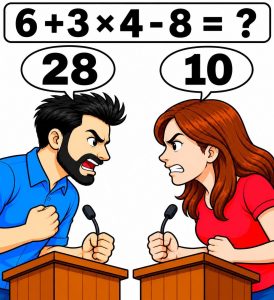
A single line of numbers has done what few things can — stopped people mid-scroll and pulled them into an argument they did not expect to have. The equation is deceptively short: 6 + 3 × 4 − 8. Two answers have emerged. Only one of them is correct.
The puzzle spread rapidly across social media platforms, accumulating thousands of comments split almost evenly between those who arrived at 28 and those who landed on 10. Both groups are confident. Both groups believe the other is simply bad at mathematics. The disagreement, it turns out, is not really about arithmetic at all.
At the center of the debate is a set of rules that every mathematics student is taught in school and that most adults quietly forget by the time they reach their thirties. Those rules go by several names depending on where in the world a person was educated.
In the United Kingdom, Australia, and much of the Commonwealth, the convention is called BODMAS. In the United States and Canada, the same framework is typically taught as PEMDAS. In some classrooms, the mnemonic appears as BIDMAS or BEDMAS.
The acronym differs by country, but the underlying rule is identical. Mathematical operations within any expression must be executed in a specific, fixed sequence. That sequence exists precisely to prevent the kind of disagreement now filling comment sections. When everyone follows the same order, every person working the same problem should arrive at the same answer.
BODMAS stands for Brackets, Orders, Division, Multiplication, Addition, and Subtraction. Each letter represents a tier of priority. Operations higher in the hierarchy must be completed before those lower down, regardless of where they appear in the written expression. The position of a number on the left or right side of the equation does not change its priority level.
Applying that framework to 6 + 3 × 4 − 8 begins with a scan for brackets. There are none. The next tier is Orders, which covers exponents and square roots.
There are none of those either. The expression then moves to multiplication and division, which share the same tier and are worked left to right. The only multiplication present is 3 × 4, which equals 12.
After substituting that result, the expression becomes 6 + 12 − 8. Addition and subtraction also share a tier and are resolved left to right. Six plus twelve produces 18. Eighteen minus eight produces 10. Under the standard mathematical order of operations, the answer to 6 + 3 × 4 − 8 is 10.
The answer of 28 comes from a different reading of the problem. A significant portion of people who arrive at 28 have worked through the equation strictly from left to right, treating each operation as it appears without applying any hierarchy.
Under that approach, 6 plus 3 equals 9, then 9 multiplied by 4 equals 36, then 36 minus 8 equals 28. The arithmetic itself is executed correctly. The error is in the method, not in the calculation.
This distinction matters. The people answering 28 are not making a computational mistake. They are applying a different interpretive framework — one that feels intuitive because reading left to right is the default mode for processing written language in English. Numbers on a page look like text. The natural instinct is to read and resolve them in the same direction.
The order of operations was not invented arbitrarily. It emerged over centuries as mathematicians formalized notation and needed a universal convention that would produce consistent results across different countries, languages, and contexts.
Without a shared hierarchy, an equation written in one country could yield a different result when evaluated by a mathematician in another. In applied fields — engineering, physics, finance, computer programming — that inconsistency would cause serious practical problems.
The modern convention became widely standardized during the nineteenth and early twentieth centuries as mathematical notation itself was being codified. The specific choice to elevate multiplication above addition is not based on any metaphysical reason that multiplication is more important. It is a convention, agreed upon and maintained because consistency produces reliability.
Computer programming languages reflect this same hierarchy. When a developer writes an expression equivalent to 6 + 3 × 4 − 8 in Python, JavaScript, C++, or virtually any other widely used language, the interpreter applies operator precedence automatically and returns 10. The machine does not read left to right. It reads by priority tier.
The same is true of scientific calculators. A basic four-function calculator — the kind often built into phones or found in desk drawers — will typically process operations as entered, left to right, and may return 28.
A scientific calculator applies order of operations and returns 10. This hardware difference is itself a frequent source of confusion, because people testing the same equation on different devices will get different outputs and conclude that the calculators disagree about mathematics.
They do not. One calculator is applying the convention. The other is not designed to. The difference is in the tool, not in the underlying arithmetic rule.
Puzzles like this one circulate widely online precisely because they expose this gap between the mathematical convention and the intuitive approach. The gap is real.
Research in mathematics education has repeatedly documented the difficulty students have internalizing operator precedence, particularly the relationship between addition and multiplication. Many students learn the mnemonic acronym without fully understanding why the hierarchy exists or how to apply it consistently in longer expressions.
The confusion deepens further when expressions include operations of equal priority. Multiplication and division occupy the same tier in BODMAS, as do addition and subtraction. When two operations share a tier, the rule is to work left to right.
This nuance is frequently lost. Some people learn BODMAS and assume it encodes a strict six-step sequence where all multiplication is finished before any division is touched. That misreading can produce errors in expressions where division appears before multiplication.
In 6 + 3 × 4 − 8, that particular nuance does not come into play because there is only one multiplication and no division. But in a slightly different expression — say, 6 ÷ 3 × 4 − 8 — the left-to-right rule within the same tier becomes essential.
Working left to right, 6 ÷ 3 equals 2, then 2 × 4 equals 8, then 8 − 8 equals 0. Reversing the order and doing the multiplication first would produce a different and incorrect result.
The viral spread of math puzzles is not a new phenomenon, but social media has amplified the scale at which these arguments play out publicly.
Platforms reward engagement, and few things generate engagement as reliably as a question that feels answerable, produces visible disagreement, and allows commenters to feel superior to those who got it wrong. The math puzzle is structurally ideal for this dynamic.
What makes the 28-versus-10 dispute particularly effective as a viral prompt is that the wrong answer requires a reasonable-sounding process to reach. Someone who answers 28 is not guessing. They performed a calculation.
That makes them harder to dismiss and harder to convince, because they have evidence of their own work. The correction requires not just pointing to the right answer but explaining why a different process should have been used from the beginning.
Educators who specialize in mathematics communication have noted that these puzzles can serve a genuine instructional function when accompanied by clear explanation. The mistake people make on 6 + 3 × 4 − 8 is not specific to this expression.
It reflects a broader interpretive habit that affects how people read and evaluate any multi-operation problem. Catching the error here and understanding why it occurred can recalibrate the approach a person brings to future problems.
The argument in comment sections rarely reaches that resolution. Most threads devolve into mutual assertions, with each side restating their answer more emphatically rather than examining the method. The puzzle succeeds at generating debate more reliably than it succeeds at teaching. The two outcomes are not the same.
For those who answered 10, the convention is on their side. BODMAS, PEMDAS, and every equivalent framework in use worldwide will confirm that result. For those who answered 28, the error is recoverable with a clear understanding of why multiplication takes priority over addition regardless of the order in which the operations appear on the page.
The underlying mathematics is not ambiguous. The order of operations is a settled convention, not an ongoing dispute. Where confusion persists, it is typically a gap in how the rule was taught or retained, not a legitimate alternative interpretation of the equation.
What the puzzle genuinely reveals is that mathematical literacy involves more than the ability to add, subtract, multiply, and divide. It requires knowing the protocol that governs how those operations interact with each other.
That protocol is learnable, teachable, and unambiguous — which means the next time a puzzle like this one appears in a feed, the answer does not need to depend on which direction the comments are leaning.
The correct answer to 6 + 3 × 4 − 8 is 10. The process that produced it has been consistent across every country, every calculator, and every programming language that recognizes operator precedence. The debate was never really about the numbers.
